Ki-87
OLD‑WIKI.WARTHUNDER.COM (DEFUNCT)
Description
The Ki-87 was a high-altitude fighter-interceptor designed to counter the American B-29 Superfortress raids on Japan. It was powered by a Nakajima Ha-44-12 radial engine with an exhaust-driven turbo-supercharger, which gave it a high performance at altitudes above 10,000 meters. The Ki-87 had a pressurized cockpit, a four-bladed propeller, and a rearward folding undercarriage. It was armed with two 30 mm and two 20 mm cannons, and could carry a 250 kg bomb under the fuselage. The Ki-87 was developed from 1942, but faced delays due to technical problems and material shortages. Only one prototype was completed and flown in April 1945, but no production aircraft were built before the end of the war.
It was introduced in Update 1.63 "Desert Hunters" as a pack vehicle. The Ki-87 is a Japanese super prop with a powerful armament and a turbo-supercharger. It performs poorly in sharp turns, rolls slowly, and overheats on WEP. Manual engine control is needed to optimize its performance. The Ki-87 excels at high altitude combat, where it can outperform many planes and dive at high speeds. The cannons are very effective and can destroy bombers easily. The Ki-87 has a fair climb-rate and is able to maintain energy after a dive to regain altitude. The recommended settings are minimum fuel, 500 m gun convergence, vertical targeting, tracer belts for 30 mm and universal belts for 20 mm.
The Ki-87 was discontinued from the store after the 2018 Independence Day Sale, but was brought back for War Thunder's 7th Anniversary as a premium purchasable in-game for 6,090 Golden Eagles  .
.
General info
Flight performance
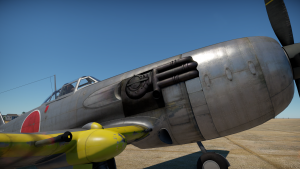
The flight performance feels slow and sluggish, yet powerful. The turning and energy retention is not good either. This plane also has overheating issues. to solve performance issues, it's always best to go for a side climb, especially when in uptiers! The plane dives insanely well. The turbo supercharger will keep the plane's performance up while at altitudes above 5,000 metres.
| Characteristics | Max Speed (km/h at 10,000 m) |
Max altitude (metres) |
Turn time (seconds) |
Rate of climb (metres/second) |
Take-off run (metres) | |||
|---|---|---|---|---|---|---|---|---|
| AB | RB | AB | RB | AB | RB | |||
| Stock | 684 | 664 | 23.1 | 23.9 | 11.6 | 11.6 | 370 | |
| Upgraded | 739 | 707 | 21.6 | 22.0 | 23.0 | 15.0 | ||
Details
| Features | ||||
|---|---|---|---|---|
| Combat flaps | Take-off flaps | Landing flaps | Air brakes | Arrestor gear |
| ✓ | ✓ | ✓ | X | X |
| Limits | ||||||
|---|---|---|---|---|---|---|
| Wings (km/h) | Gear (km/h) | Flaps (km/h) | Max Static G | |||
| Combat | Take-off | Landing | + | - | ||
| 457 | 428 | 280 | ~13 | ~6 | ||
| Optimal velocities (km/h) | |||
|---|---|---|---|
| Ailerons | Rudder | Elevators | Radiator |
| < 450 | < 450 | < 460 | > 324 |
Survivability and armour
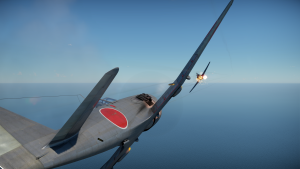
- 70 mm (63°) Bulletproof glass in cockpit front.
- 16 mm (12°) Steel plate behind the pilot.
Modifications and economy
Armaments
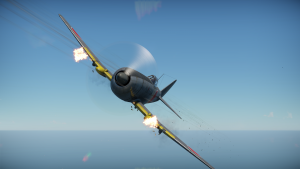
Offensive armament
The Ki-87 is armed with:
- 2 x 30 mm Ho-155 cannons, wing-mounted (150 rpg = 300 total)
- 2 x 20 mm Ho-5 cannons, wing-mounted (150 rpg = 300 total)
Japanese rank IV aircraft are typically armed with a respectable array of guns, and the Ki-87 is no exception. Although the 20 mm Ho-5s are nothing to write home about, the 30 mm cannons are some of the most feared, respected and deadly weapons in the entire game. When armed with the Tracer belt, the Japanese 30 mm cannons have a muzzle velocity that surpasses even the M2 and M3 Browning .50 cal HMGs at a staggering 920 m/s, and when combined with the high explosive filler and large calibre, these beasts will make short work of any aircraft that's unfortunate enough to end up in their crosshairs.
The usual issue with 30 mm cannons on WW2-era propeller planes - that being their lack of sufficient ammunition capacity - is notably absent on the Ki-87, which mounts 150 round per gun instead of the usual 60 seen on other aircraft like the Ki-84 hei and J7W1. Although this increased ammunition capacity is indeed wonderful, the pilot should still take care not to be too trigger happy, as the exceptional ballistics of the cannons will prevent the need to waste copious amounts of bullets on a single target, increasing the endurance of the aircraft in the hands of a patient pilot.
Suspended armament
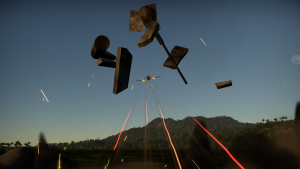
The Ki-87 can be outfitted with the following ordnance:
- Without load
- 1 x 50 kg Army Type 94 GPHE bomb (50 kg total)
- 1 x 250 kg Army Type 92 GPHE bomb (250 kg total)
Usage in battles
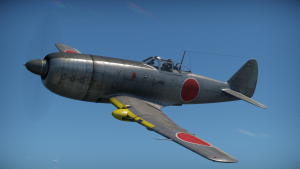
Unlike the usual Japanese low-altitude and highly manoeuvrable fighter aircraft, the Ki-87 is a high-altitude bomber interceptor with mediocre speed and climb rate but less impressive agility. Featuring something relatively new for a Japanese fighter, the Ki-87 has a notably visible turbo-supercharger to boost its high-altitude performance at the cost of aircraft weight and size. As such, it cannot be played like most other aircraft from the Japanese tree, but rather as a reserved Boom-&-Zoom that can abuse its brutal acceleration in a dive to pick off unwary victims.
For engaging the enemy, The Ki-87 is best at boom-and-zoom tactics. Sideclimb to around 6,000 m and fly over enemy formations, once in position roll the plane to target, maintain coordinated control and correct the rudder as at that altitude it is very easy to stall. Descend fast but not so much that the controls get sluggish. Once lined up and in range fire a short burst, the very heavy armament will rip the enemy plane apart; even evasive countermeasures will be insufficient for a properly executed Boom & Zoom.
If no bombers are present, then highly cautiously engage with enemy fighters. The Ki-87 can only do a 21 m/s climb at 17°, which makes it vulnerable to being outclimbed by nearly everything. As such, side climb and then engage from the side. Do not try to turn with anything.
Against heavily armed aircraft such as the B-17, B-24, and B-29, and other heavy bombers, climb at least 600 m above them using the slashing boom and zoom tactic firing short bursts, once the bullets hit the target, fire longer bursts then jump back up. Ideally, aim for large critical parts such as the wings and tailplane. The cannons on the Ki-87 will make short work of essential components and being substantial offer the best chance of hitting. Never attack behind and at nearly the same speed as the aircraft becomes a perfect target for multiple weapons. The Ki-87's fuel tanks are somewhat easy to ignite, and the plane won't last long if they do.
Tactics to Win With
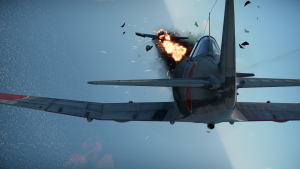
- Maintain altitude: The pilot must prioritize speed and altitude, avoiding engaging ground targets at all costs as the Ki-87 becomes an easy target for enemy fighters when flying low and slow. The primary role of the Ki-87 is to hunt bombers, necessitating a climb to high altitudes. The plane's suboptimal climbing ability requires side-climbing to reach an optimal altitude without risking interception at a lower level. Even in the absence of bombers, climbing to high altitudes is crucial, as it serves as the Ki-87's primary advantage against other high-altitude fighters and interceptors. Maintaining high speed and altitude is essential while remaining vigilant about the surroundings and enemy positions.
- B&Z: Due to the lack of air spawn, the pilot must spend 7-9 minutes side climbing until they're higher than all enemy fighters. Avoid being spotted during this climbing phase; if targeted, it will waste precious time evading enemies, particularly those flying planes adapted for high altitudes. Upon reaching an advantageous position above the target, adjust MEC settings (Radiator 10%, Prop Pitch 75%) and execute a dive attack. Avoid overcommitting and ensure the target is eliminated before the dive speed reaches 700 km/h IAS to prevent elevator compression. Maintain an altitude of at least 3000m to retain performance advantages over lower altitudes. Only pursue targets to lower altitudes when certain no other enemies are at the current altitude, as the Ki-87's energy retention diminishes with increasing air density.
- "Opportunity-Fighter": Operate at high altitudes (5500 m and above) and search for isolated targets. Steer clear of enemy groups, even pairs, and capitalize on mistakes made by opposing players over time. The Ki-87's capability as a fighter is very limited, so seize every opportunity cautiously. Opt for a 20-30 minute fuel load and refrain from using WEP upon reaching desired altitudes, as its usage is limited. Safeguard the altitude to prevent enemies from climbing freely towards the Ki-87, especially vulnerable planes like Spitfires during climbs. Preserve energy as much as possible, as there is no favourable matchmaking for the Ki-87; even 4.7 fighters outclass it.
- Force head-ons: The Ki-87 can't energy fight or turn-fight with any props (save Ta 152 C-3 and P-47M-1-RE). It will be outclassed. The only time it should ever turn-fight is if the enemy aircraft is crippled or in a low-energy state. To deal with fighters that are at a higher altitude, the most forward tactic is to step up and force a head-on. Most likely, The enemy pilot will take the head-on. The guns' good velocity should be enough to destroy them in a good burst. Remember to pull off early after releasing a burst, as even a retaliatory burst can critically damage the Ki-87. If the enemy is higher and appears to engage, dive down. The enemy will most likely level out to maintain altitude. Keep speed high, as this will allow the Ki-87's pilot to pull up and engage in vertical head-ons. This is the pilot's last chance to score the kill, as the enemy will now be at a major advantage.
- Tactical Adaptation: Exercise caution and restraint, acknowledging your bravery in selecting the Ki-87 for battle without feeling ashamed; retreat when necessary and adopt a passive approach as required. Best of luck and fight with honour. (Remember, if overwhelmed by enemy numbers with no viable path to victory, return to the main airfield, repair, and J-out to avoid penalties)
Manual Engine Control
| MEC elements | ||||||
|---|---|---|---|---|---|---|
| Mixer | Pitch | Radiator | Supercharger | Turbocharger | ||
| Oil | Water | Type | ||||
| Controllable | Controllable Not auto controlled |
Controllable Not auto controlled |
Controllable Not auto controlled |
Separate | Not controllable 1 gear |
Auto controlled |
While climbing at steeper angles, progressively adjust the prop pitch between 80-85-90 %, increasing with altitude. However, avoid prolonged use of any radiator setting other than 100 %, as it significantly impacts energy retention and speed, leading to engine overheating.
When travelling above 700 km/h, reduce propeller pitch to 75 % to maintain optimal performance.
Upon reaching the desired altitude and preparing to dive or level out (at angles between 15 - 10°), switch propeller pitch to 75 % and radiator to 10 % to conserve energy effectively.
In vertical or stall fights, revert prop pitch to 100%, but only after the airspeed drops below 350 km/h.
For optimal performance in level flight, gradually increase prop pitch (between 5 - 10°) with increasing altitude. This ensures maximum efficiency and performance throughout the flight.
Pros and cons
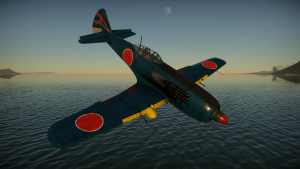
Pros:
- Excels in high-altitude bomber intercepting.
- Decent gun velocity, you can engage bombers from 1 km away.
- Powerful armament consisting of 2 x 30 mm cannons and 2 x 20 mm cannons.
- No wing-mounted fuel tanks.
- 30 mm cannons have a huge amount of ammo.
- High red-line speed of 840 km/h.
- Fast at diving.
- Can equip bombs, although it will affect the aircraft's speed and turning time.
- Sturdier than your typical Japanese fighter (yet still fragile compared to other nations).
- Competitive horsepower output at 8000m thanks to turbocharger (Can runaway from planes that were not adapted to fight at high altitudes, while maintaining shallow climb angle).
Cons:
- Manual Engine Controls are required to play plane competitively. Auto settings greatly hinder plane (already limited) performance.
- Not as manoeuvrable as other aircraft, it's very sluggish.
- Really bad energy retention without MEC, especially when coming out of a dive.
- The fuselage fuel tank is susceptible to fire.
- Mediocre climb rate (19m/s).
- No interceptor spawn, has to spend 8 minutes on side climbing.
- 30 mm HEF-T has only a maximum penetration of 2 mm.
- 30 mm HEF round fuze will not trigger unless it hits some aircraft component (wing spar, fuel tank, crew member).
- Begins to lock up at around 700 km/h (435 mph).
- Can engage fighters only when it is in a higher energy state than its enemy. Any other 1v1 engagement will lead to death.
History
Improved metallurgy and engineering in the 1930s saw a massive leap in aircraft performance, especially the once bulky, boxy, lumbering bombers reborn as sleek and sexy machines that left old-fashioned wooden fighters in their vapour trail. It was not long before those flying rag fighters were also updated with gleaming aluminium and once again surpassed the bombers' top speed. Yet bombers still had a trick up their sleeves, altitude.
Flying above 9,000 m (29,500 ft) in super cold thin air and rarefied oxygen was both a technical and physiological challenge. The long wings and large interiors of bombers offered space needed for extremely high altitude flight, for example, the Ju 86P/R bomber which flew above 12,000 m (40,000 ft) with impunity over England, beyond the RAFs reach for months. The B-17 and B-24 could also operate at altitudes the Bf 109 and Fw 190 had difficulty reaching.
Predicting the same for Japan, the military wisely ordered research into high-altitude single-engine fighters as early as 1942 and by 1943 work was underway on the future Nakajima Ki-87 and the alternate Tachikawa Ki-94. At 12,000 m the air density is about 1/4 that of sea level necessitating a huge supercharged engine, but its internal "blower" needed an additional boost so a "turbo-supercharger" was added, powered by high velocity exhaust gas. This combination is exactly like the P-47 Thunderbolt has, except this time the turbo was mounted on the right side of the nose on the prototypes and not in the rear fuselage. High aspect-ratio wings were chosen for the thin air (compare Fw 190 with Ta 152), but with limited space to mount the dual pair of 30 mm and 20 mm cannons in an unusual step Nakajima chose a landing gear retraction like on P-40 Kittyhawk. High-altitude flight is also extremely uncomfortable for the pilot so the cockpit was partially pressurized and extra tanks of oxygen installed. Pilot armour, thick bulletproof glass, self-sealing fuel tanks, and hard points for bombs were also added. Finally enough fuel for at least 2 hours flight resulted in a massive aircraft for the Japanese, well over twice the weight of the A6M2 Zero.
It was an enormous technical challenge for Japanese industry taking a long time to overcome teething issues. Japanese aircraft rarely utilized turbo-superchargers in their planes, so experience in operation was limited, and although the 90° retracting gear was a favourite design, it took Nakajima months to get it to operate correctly.
The prototype flew for the first time in April 1945 at a time when the anticipated B-29 bomber was pounding Japan, but by then it was too late. Disruption by bombing and dwindling resources prevented the second prototype from flying and attrition of what little fighter defence Japan had. Ironically, with such weak home defence, the B-29s flew much lower so they could bomb more accurately, negating the purpose of the high altitude Ki-87.
Media
- Skins
- Images
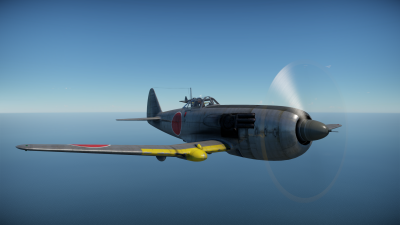
Ki-87 over the Pacific
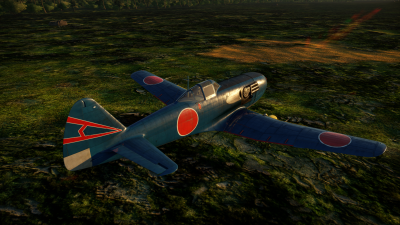
A Ki-87 sporting a blue camouflage
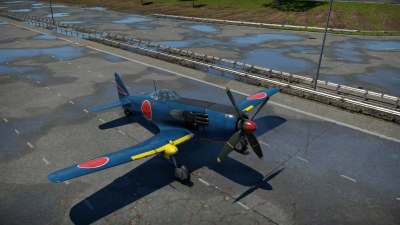
Ki-87 at cargo port
Ki-87 from viewed from a truck at Cargo Port
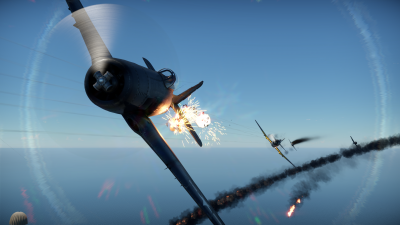
Ki-87's guns do work on an enemy Bearcat
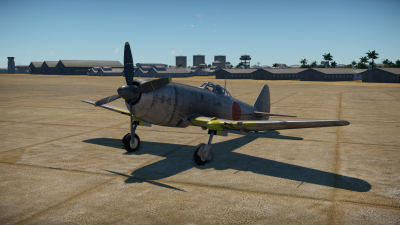
The Ki-87 on an airfield at Midway
- Videos
See also
- Aircraft of comparable role, configuration and era
- Japanese:
- Other:
External links
| Nakajima Aircraft Company (中島飛行機株式会社 ) | |
|---|---|
| Fighters | Ki-27 otsu · Ki-27 otsu Tachiarai |
| Ki-43-I · Ki-43-II · Ki-43-III otsu | |
| Ki-44-I · Ki-44-I 34 · Ki-44-II otsu · Ki-44-II hei | |
| Ki-84 ko · Ki-84 otsu · Ki-84 hei | |
| Ki-87 | |
| Hydroplanes | A6M2-N* |
| Interceptors | J1N1 · J5N1 |
| Bombers | B5N2 |
| B6N1 Model 11 · B6N2 Model 12 · B6N2a Model 12Ko | |
| G5N1 · G8N1 | |
| Ki-49-I · Ki-49-IIa · Ki-49-IIb · Ki-49-IIb/L | |
| Recon | E8N2 |
| Jet Fighters | Kikka |
| Captured | ␗Ki-27 otsu · ▃Ki-43-II · ␗Ki-43-III ko · ␗Ki-44-II hei · ␗Ki-84 ko |
| *Refit of the Mitsubishi A6M2 mod. 11 | |
| See also | Fuji Heavy Industries (1957-2017) |
| Japan fighters | |
|---|---|
| Navy | |
| Carrier-based fighter | |
| A5M | A5M4 · Hagiri's A5M4 |
| A6M | A6M2 mod. 11 · A6M2 · A6M3 · A6M3 mod. 22 · A6M3 mod. 22Ko · A6M5 · A6M5 Ko · A6M5 otsu · A6M5 Hei · A6M6c |
| A7He | A7He1* |
| A7M | A7M1 (NK9H) · A7M2 |
| Land-based Fighter | |
| J2M | J2M2 · J2M3 · J2M4 Kai · J2M5 · J2M5 (30 mm) |
| J6K | J6K1 |
| J7W | J7W1 |
| N1K-J | N1K1-Ja · N1K2-J · N1K2-Ja |
| Fighter seaplane | |
| N1K | N1K1 |
| A6M-N | A6M2-N |
| Army | |
| Ki-10 | Ki-10-I · Ki-10-I C · Ki-10-II · Ki-10-II C |
| Ki-27 | Ki-27 otsu · Ki-27 otsu Tachiarai |
| Ki-43 | Ki-43-I · Ki-43-II · Ki-43-III otsu |
| Ki-44 | Ki-44-I · Ki-44-I 34 · Ki-44-II otsu · Ki-44-II hei |
| Ki-61 | Ki-61-I ko · Ki-61-I otsu · Ki-61-I hei · Tada's Ki-61-I hei · Ki-61-I tei · Ki-61-II Otsu Kai |
| Ki-84 | Ki-84 ko · Ki-84 otsu · Ki-84 hei |
| Ki-87 | Ki-87 |
| Ki-94 | Ki-94-II |
| Ki-100 | Ki-100 · Ki-100-II |
| Other countries | ▅F4U-1A · ▅P-51C-11-NT · ▅Bf 109 E-7 · ▅Fw 190 A-5 |
| *Imported designation of the He 112 (A6M was in development - A7M would take A7 designation after the cancelation of the A7He) | |
| Japan premium aircraft | |
|---|---|
| Fighters | Hagiri's A5M4 · A7He1 · Ki-27 otsu Tachiarai |
| Ki-44-II otsu · ▅Bf 109 E-7 · ▅F4U-1A · Ki-100-II · Ki-44-I 34 | |
| ▅Fw 190 A-5 · A7M1 (NK9H) · Tada's Ki-61-I hei · ▅P-51C-11-NT | |
| J2M4 Kai · A6M5 Ko · A6M6c · J2M5 · Ki-87 · J6K1 | |
| Twin-engine fighters | Ki-96 |
| Jet fighters | F-86F-40 JASDF▅ · T-2 Early · F-4EJ ADTW |
| Strike aircraft | ▄AV-8S |
| Bombers | Ki-21-I hei · Ki-48-II otsu · H8K3 · B7A2 (Homare 23) · ▅B-17E |