Ta 152 C-3
OLD‑WIKI.WARTHUNDER.COM (DEFUNCT)
| This page is about the German fighter Ta 152 C-3. For the other version, see Ta 152 H-1. |
Description
The Ta 152 C-3 is a rank German fighter with a battle rating of (AB), (RB), and (SB). It was introduced in Update 1.57 "Battle March".
The Ta 152 C-3 should be considered the pinnacle of the Fw 190 Dora, evolving their concept to an extreme. This plane was designed for mid altitude combat, with a redesigned short wing similar to that of the late 190 series, such as the Fw 190 D-13. With its Daimler-Benz DB 603 engine, gaining speed and altitude is the first priority in this aircraft. Second is heavy usage of Boom and Zoom tactics, especially on heavily armed strategic bombers like the B-17 Flying Fortress. With its armament of four MG-151 20 mm cannons (two in the wing roots, two in the cowling), and a MK-103 cannon firing through the propeller hub, trigger discipline is a must to take down as many aircraft as you can with the ammunition on board. However, it can be pushed to turn tight in a pinch with a rather small amount of energy lost by using the flaps. The flaps are extremely strong and they deploy quickly, even at higher speeds (though it is not advisable to do this unless the situation is just right).
General info
Flight performance
| Characteristics | Max Speed (km/h at 10,400 m) |
Max altitude (metres) |
Turn time (seconds) |
Rate of climb (metres/second) |
Take-off run (metres) | |||
|---|---|---|---|---|---|---|---|---|
| AB | RB | AB | RB | AB | RB | |||
| Stock | 703 | 681 | 28.2 | 29.2 | 9.7 | 9.7 | 500 | |
| Upgraded | 759 | 730 | 25.8 | 27.0 | 17.1 | 13.1 | ||
Details
| Features | ||||
|---|---|---|---|---|
| Combat flaps | Take-off flaps | Landing flaps | Air brakes | Arrestor gear |
| ✓ | ✓ | ✓ | X | X |
| Limits | ||||||
|---|---|---|---|---|---|---|
| Wings (km/h) | Gear (km/h) | Flaps (km/h) | Max Static G | |||
| Combat | Take-off | Landing | + | - | ||
| 912 | 667 | 591 | 398 | ~11 | ~5 | |
| Optimal velocities (km/h) | |||
|---|---|---|---|
| Ailerons | Rudder | Elevators | Radiator |
| < 420 | < 240 | < 500 | > 290 |
Survivability and armour
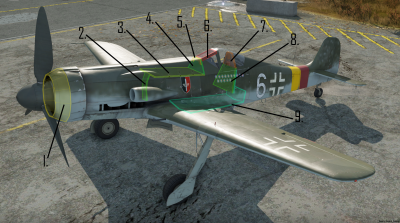
- 15 mm Steel - Engine cowling and radiator shield
- 8 mm Steel - Oil cooling system shield
- 10 mm Steel - Angled ammunition and pilot armour
- 6 mm Steel - Instrument panel and pilot armour
- 15 mm Steel - Pilot Armour
- 70 mm Angled bulletproof glass - Armoured windscreen
- 20 mm Steel - Pilot's headrest
- 8 mm Steel + 5 mm Steel - Rear pilot shield
- 5 mm Steel - Fuel tank shield
Modifications and economy
Armaments
Offensive armament
The Ta 152 C-3 is armed with:
- 1 x 30 mm MK 103 cannon, nose-mounted (90 rpg)
- 2 x 20 mm MG 151 cannons, nose-mounted (150 rpg = 300 total)
- 2 x 20 mm MG 151 cannons, wing-mounted (175 rpg = 350 total)
The high-velocity MK 103 cannon is easy to aim and a huge improvement over the MK 108 found on the H-1 model. The powerful Minengeschoß rounds usually knock out enemy planes with few rounds.
Usage in battles
Currently the Ta 152 C-3 does not carry any under-wing ordnance, but it can perform rather lethal ground-pounding with its 30 mm MK 103 cannon, if it is loaded with armoured target rounds (HVAP). Although, one must aim carefully and have good trigger discipline to knock out tanks, lest too many shells be wasted on a single vehicle. But for its intended role of air superiority, the combination of 20 mm MG 151 cannons plus the MK 103 is lethal against any aircraft in the game. However, the stock belts can be a bit of a pain to use, as half of the load are not the infamous German Minengeschoß (HEI).
The Ta 152 C-3 is somewhat of a combination of the Fw 190 D series and the Ta 152 H-1, it is easy to play, but difficult to master and is easily countered by the enemy, but that will not stop you from doing well with this aircraft as long as you fight engagements on your terms.
Ta 152 C-3 is designed to be a low and medium attitude interceptor. But due to incorrect intelligence, Germany considered B-29 will reach 12,000 m. Ta 152 H is designed as a high attitude fighter which can attack B-29 bomber over 10,000 m. This means Ta 152 C-3 as a low and medium attitude interceptor is only compare to Ta 152 H. Actually Ta 152 C-3 has very good high attitude performance compare to other propeller fighter.
- Prioritize the most agile enemies first, like Spitfires and Mustangs
- Only engage enemy fighters when they are distracted at something else or if you have the advantage or when there are no other targets in your vicinity
- Despite being heavily armoured, you are not invincible, head-on engagements eventually will take the toll on your plane, so fight smart by firing first when you are around 1.2 km away and immediately roll or bank to dodge their bullets
- Although it is tempting, engaging ground units should be the least of your priorities unless there are no other targets nearby
- HVAP shells can destroy AI light tanks and medium tanks in one hit from any direction, heavy tanks can only be killed from the side or behind.
- 30 mm Minengeschoß rounds deal a lot of damage, use it sparingly with the 20 mm
- The 20 mm and the 30 mm have different ballistics, binding different controls for each calibre is recommended
- When you have a determined enemy on your tail, there is little you can do except to wait for allies to come and help, do not let it happen
- Use your incredible roll rate to escape from sticky situations
Manual Engine Control
| MEC elements | ||||||
|---|---|---|---|---|---|---|
| Mixer | Pitch | Radiator | Supercharger | Turbocharger | ||
| Oil | Water | Type | ||||
| Not controllable | Controllable Auto control available |
Not controllable Not auto controlled |
Controllable Not auto controlled |
Combined | Not controllable 1 gear |
Not controllable |
Pros and cons
Pros:
- Powerful armament of five cannons
- Nose-mounted armament allows very tight spread of shells when firing
- Small recoil allows the plane to not slow down much when firing all its guns
- Durable and well armoured, both pilot and engine are protected
- Armour is enough to deflect machine gun rounds from bombers' gunners
- Very effective bomber hunter
- Incredibly strong at head-on engagements and will often survive unharmed or with minor damage
- Effective flaps offset the poor turn rate, landing flaps allow this plane to keep up with some nimbler fighters
- Decent energy retention, although not as good as the H-1 model
- Great roll rate, better than the H-1 model
- Gets an airspawn
- Incredible dive performance, better than the H-1 model due to stronger, shorter wings which only rip at 915 km/h (570 mph)
- Can perform a tank-buster role despite not having bombs or rockets due to the high velocity 30 mm AP belt
- Can immediately research the 20 mm and 30 mm belts
- Good high altitude performance
Cons:
- Below average rate of climb, slightly worse than the H-1 model
- Slow, coupled with average climb rate makes it an easy target after conducting a boom-and-zoom attack
- Poor turn rate, even worse than the Fw 190 series
- Easy to counter and has few options of escape when chased
- Stock performance is awful
- Feels heavier and more sluggish to fly than the H-1 model
- Engine often overheats above 3,500 m
History
Throughout much of World War II in Europe, the German Luftwaffe was only concerned with their aircraft flying in the mid to low altitudes (20,000 ft/6,100 m and below), therefore a majority of their fighter fleet only utilized a single-stage supercharger which was sufficient for their role. However, with the introduction of the B-29, the threat of this type of bomber would have been out of reach for most of the German air fleet.[1] To counter high-altitude allied fighters and bombers, the Fw 190D-9 was modified with a two-stage supercharged Junkers Jumo 213E engine which allowed it to achieve the higher altitudes, however, the shorter stubby wings well know for low altitude manoeuvrability actually hindered performance at altitude, though usable, not really a suitable fix.[2]
Answering the call of the German Air Ministry (RLM – Reichsluftfahrtministerium), Focke-Wulf modified their Fw 190 design and branched out in three directions. The three prototypes, in turn, had one to become the new existing Fw 190D (Ta 152A) series (after the D-9), the second prototype would become a dedicated high-altitude bomber (Ta 152B) while the third would become a ground-attack aircraft (Ta 152H).[2] Though adjustments and modifications were made including usage of a different engine, the ultimate results determined these aircraft did not provide enough improvement to continue moving forward and both the Ta 152A and B projects were cancelled. One bright spot from this was that the airframe built for the Ta 152B (the V21 airframe) showed promise and efforts were focused here to create the Ta 152C prototype.[2]
In 1944 the RLM made a ruling that new fighter aircraft were to include the chief designer's name in the aircraft's designation. What was earlier knows as a Focke-Wulf aircraft was now listed with the prefix Ta which was short for Kurt Tank, though Tank was still working for Focke-Wulf at the time.
Adjustments to the Fw 190D-9 fuselage resulted in its extension and addition of hydraulics to control the flaps and landing gear. These adjustments threw off the normal centre of gravity and made the aircraft off balance, resulting in the lengthening of the nose of the aircraft to normalize the CoG. The length of the wings was slightly lengthened and due to shortages in aluminium, steel spars were utilised aiding to the strength of the wings, but also at a price of extra weight.[2]
- Ta 152C variant
The Ta 152C-3 ended up with wings .5 m (1.25 ft) longer than the standard Fw 190D-9 to aid in supporting the new steel spars and hydraulic hardware in the landing gear and flaps. The 'C' variant did not incorporate a pressurized cockpit. While designed to work at lower altitudes (though above 25,000 ft or 6,100 m), the fighter was outfitted with a single 30 mm MK 103 Motorkanone which was mounted through the center propeller hub with four MG 151/20 mm cannons, two of which were mounted in the upper fuselage and two more with one in each wing.[1] This cannon setup is enough to devastate any aircraft which is on the receiving end of the 20 and 30 mm rounds. The Ta 152C-3 entered the war too late and in too little numbers to make an effective difference. Shortages in replacement parts became extremely difficult if not impossible to find reducing the ability of the Ta 152C-3 to be used to the fullest of its abilities.[2]
Media
- Skins
- Videos
See also
- Related development
- Focke-Wulf Fw 190
- Aircraft of comparable role, configuration and era
External links
- Official data sheet - more details about the performance
- [Wikipedia] Focke-Wulf Ta 152
- [Smithsonian] Focke-Wulf Ta 152 H-0/R11
References
- ↑ 1.0 1.1 Jack, C. (2019, January 21). Focke-Wulf Ta 152 Single-Seat, Single-Engine High-Altitude Fighter-Interceptor Aircraft - Nazi Germany. Retrieved from https://www.militaryfactory.com/aircraft/detail.asp?aircraft_id=455.
- ↑ 2.0 2.1 2.2 2.3 2.4 Focke-Wulf Ta 152C. (n.d.). Retrieved from http://www.historyofwar.org/articles/weapons_focke-wulf_Ta_152C.html.
| Focke-Wulf Aircraft Corporation (Focke-Wulf Flugzeugbau Aktiengesellschaft) | |
|---|---|
| Fighters | Fw 190 A-1 · Fw 190 A-4 · Fw 190 A-5 · Fw 190 A-5/U2 · Fw 190 A-5/U12 · Fw 190 A-5/U14 · Fw 190 A-8 |
| Fw 190 C | |
| Fw 190 D-9 · Fw 190 D-12 · Fw 190 D-13 | |
| Fw 190 F-8 | |
| Ta 152 C-3* · Ta 152 H-1* · Ta 154 A-1* | |
| Bombers | Fw 189 A-1 · Fw 200 C-1 |
| Export | ▅Fw 190 A-5 |
| Captured | ▃Fw 190 A-8 · ▂Fw 190 D-9 |
| * In 1944, the Germany Air Ministry changed new fighter aircraft designation to that of the chief designer. Kurt Tank was the chief designer at Focke-Wulf and later aircraft he designed were given the prefix of Ta. | |
| Germany fighters | |
|---|---|
| Heinkel | |
| He 51 | He 51 A-1 · He 51 B-1 · He 51 B-2/H · He 51 C-1 · He 51 C-1/L |
| He 100 | He 100 D-1 |
| He 112 | He 112 A-0 · He 112 B-0 · He 112 B-1/U2 · He 112 B-2/U2 · He 112 V-5 |
| Messerschmitt | |
| Bf 109 (Jumo) | Flegel's Bf 109 A · Bf 109 B-1 · Bf 109 C-1 · Bf 109 C-1 |
| Bf 109 (DB-601) | Bf 109 E-1 · Bf 109 E-3 · Bf 109 E-4 · Bf 109 E-7/U2 · Bf 109 F-1 · Bf 109 F-2 · Bf 109 F-4 · Bf 109 F-4/trop |
| Bf 109 (DB-605) | Bf 109 G-2/trop · Bf 109 G-2 · Bf 109 G-6 · Bf 109 G-10 · Bf 109 G-14 · Bf 109 K-4 |
| Focke-Wulf | |
| Fw 190 (early) | Fw 190 A-1 · Fw 190 A-4 · Fw 190 A-5 · Fw 190 A-5 · Fw 190 A-5/U2 · Fw 190 A-5/U14 · Fw 190 A-8 · Fw 190 C |
| Fw 190 (late) | Fw 190 D-9 · Fw 190 D-12 · Fw 190 D-13 |
| Ta 152 | Ta 152 C-3 · Ta 152 H-1 |
| Blohm & Voss | |
| BV 155 | BV 155 B-1 |
| Captured: | |
| USA | ▀P-47D-16-RE · ▀P-47D |
| USSR | ▀La-5FN · ▀Yak-1B |
| Britain | ▀Tempest Mk V |
| Italy | |
| CR.42 | ▀CR.42 · ▀Marcolin's C.R.42 CN |
| G.50 | ▀G.50 serie 2 · ▀G.50 AS serie 7 |
| C.200 | ▀C. 200 serie 3 · ▀C. 200 serie 7 |
| C.202 | ▀C. 202 |
| Finland | ▀Hawk H-75A-2 |