B6N1 Model 11
OLD‑WIKI.WARTHUNDER.COM (DEFUNCT)
| This page is about the Japanese bomber B6N1 Model 11. For other versions, see B6N (Family). |
Description
The B6N1 mod. 11, designated as Tenzan 11 (天山一一型), was a carrier-based torpedo bomber developed by the Imperial Japanese Navy during World War II. It was intended to replace the B5N, but faced several delays due to engine problems and stability issues. The first prototype flew in March 1941, but the production did not enter service until August 1943. The B6N1 was powered by the Nakajima Mamoru 11 engine and could carry up to 800 kg of bombs or 1,800 kg of torpedoes. It had a top speed of 481 km/h and a range of over 3,000 km. It was armed with two 7.7 mm machine guns, one in the dorsal turret and one in the ventral position. It was used in various operations, such as the Battle of the Philippine Sea and the Battle of Leyte Gulf, but it could not fully demonstrate its potential due to the lack of experienced pilots and the air superiority of the US Navy.
It was introduced in Update "Starfighters". As the successor of the B5N2, it offers a longer range and better speed, but it still performs the same role with the same total tonnage of ordnance, carrying a single 800 kg bomb or torpedo, two 250 kg bombs or a rack holding six 60 kg bombs. It had an additional rear machine gun in a ventral position compared to the B5N, making it less vulnerable to attacks coming from below, but with the machine guns only being Type 92 (7.7 mm) LMGs, they do not cause any significant damage and are effectively only a deterrent with the off-chance of damaging enemy chasers' engines or hitting their cockpit. One unusual feature about the early production Tenzan as a torpedo bomber was the mounting of a single 7.7 mm offensive machine gun in the left wing, intended as an attempt to suppress naval targets' AA batteries. It can be used to fire enough bullets into a plane to shoot it down by utilizing the excellent manoeuvrability.
- Nicknames
- Official Designation: 天山 (Tenzan, "Heavenly Mountain")
- Allied reporting name: Jill
General info
Flight performance
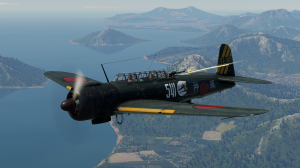
Great rudder responsiveness, good roll rate, and surprisingly good energy retention! The B6N1 Model 11 is capable of turnfighting with its humble frontal machine gun, and if they get on your 6, your turrets will offer some protection.
| Characteristics | Max Speed (km/h at 4,800 m) |
Max altitude (metres) |
Turn time (seconds) |
Rate of climb (metres/second) |
Take-off run (metres) | |||
|---|---|---|---|---|---|---|---|---|
| AB | RB | AB | RB | AB | RB | |||
| Stock | 445 | 428 | 21.4 | 22.3 | 7.7 | 7.7 | 270 | |
| Upgraded | 484 | 464 | 20.8 | 21.0 | 15.3 | 11.1 | ||
Details
| Features | ||||
|---|---|---|---|---|
| Combat flaps | Take-off flaps | Landing flaps | Air brakes | Arrestor gear |
| ✓ | ✓ | ✓ | X | ✓ |
| Limits | ||||||
|---|---|---|---|---|---|---|
| Wings (km/h) | Gear (km/h) | Flaps (km/h) | Max Static G | |||
| Combat | Take-off | Landing | + | - | ||
| 650 | 368 | 354 | 280 | ~11 | ~3 | |
| Optimal velocities (km/h) | |||
|---|---|---|---|
| Ailerons | Rudder | Elevators | Radiator |
| < 300 | < 300 | < 310 | > 300 |

Survivability and armour
- No armour
- Non-self sealing fuel tanks (3 in each wing)
Modifications and economy
Armaments
Offensive armament
The B6N1 Model 11 is armed with:
- 1 x 7.7 mm Type 97 navy machine gun, wing-mounted (400 rpg)
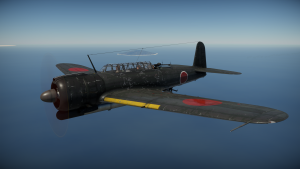
Choose your rounds wisely. The Stealth belt is a great pick because it has two incendiary bullets, and lots of armour-piercing rounds. Universal is a great pick if you need a tracer or two to guide your shots. Don't use the Tracers belt, it won't do much. Default isn't really good, the ball bullets hinder performance.
Suspended armament
The B6N1 Model 11 can be outfitted with the following ordnance:
- 6 x 60 kg Navy Type 97 Number 6 bombs (360 kg total)
- 2 x 250 kg Navy Type Number 25 Model 2 bombs (500 kg total)
- 1 x 800 kg Navy Type Number 80 Model 1 bomb (800 kg total)
- 1 x 835 kg Type 91 Model 2 torpedo
- 1 x 850 kg Type 91 Model 3 torpedo
The 800 kg bomb will destroy 1 base, it's a good pick for maps with few ground targets! The 250 kg bombs are great for destroying pillboxes and tanks, but you can only have two of them. Make sure to use a slight dive when bombing and use the bombsight for increased accuracy! The 6 x 60 kg bombs are a great option for this plane. Since they weigh so little, you can be super accurate with these bombs, just aim the crosshair where you want the bomb to drop, and pull up. No need for a bomb sight!!! Use these bombs for light targets such as AAA, Vehicles, Armoured Cars, Artillery, Howitzers, Machine Guns, and Bridges. The torpedoes are not really useful for this plane in air battles, as ships only spawn in pacific maps, and this plane is at too low of a BR to be put in a Pacific Theater battle.

Defensive armament
The B6N1 Model 11 is defended by:
- 1 x 7.7 mm Type 92 machine gun, dorsal turret (679 rpg)
- 1 x 7.7 mm Type 92 machine gun, ventral turret (679 rpg)
The Type 92 turrets are absolutely horrible at dealing with higher BR planes, but it works wonders on biplanes. You will often face certain biplanes at this BR, and since they are slow, you can often get good shots on them. Use the Default belt and shoot into the engine to start an inextinguishable engine fire. This works quite often with the Default belt. The AP-T round is a good pick if you aren't a good gunner, because the extra tracers will scare the enemy off. Most biplanes don't want to get too close when they see a wave of tracers appear from your turrets.
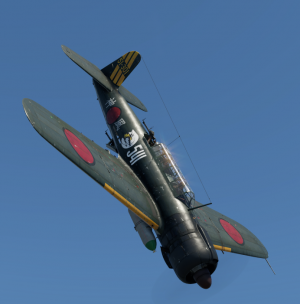
Usage in battles
This plane is great for bombing medium tanks, light pillboxes, howitzers, and vehicles. Since it is so fast, it can make multiple trips to the airfield if a resupply of bombs is needed.
For naval maps and naval gamemode it's best advised to bring the torpedo and hit ships in a quick, close, hit and run style torpedo run, the engine allows for high speeds and Japanese torpedoes are among the highest speed resistant torpedoes in-game at the cost of range of only 2 km. It is also a possibility of squading up with friends / other torpedo carrying planes to dispose of the enemy carriers / battleships in a multiple hit torpedo strike.
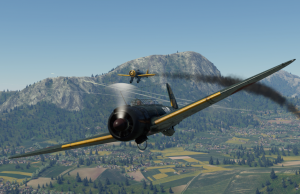
Your frontal machine gun is your biggest asset. Unlike the B5N2 or other B6Ns, the B6N1 carries a frontal machine gun that can destroy light AAA trucks or Armoured cars. Or even enemy planes in uptiers, as the B6N has an amazing turn rate for a monoplane, but will have issues trying to out-turn biplanes.
Manual Engine Control
| MEC elements | ||||||
|---|---|---|---|---|---|---|
| Mixer | Pitch | Radiator | Supercharger | Turbocharger | ||
| Oil | Water | Type | ||||
| Controllable | Controllable Not auto controlled |
Controllable Not auto controlled |
Controllable Not auto controlled |
Separate | Controllable 2 gears |
Not controllable |
Pros and cons

Pros:
- B6N for Carrier-based torpedo bomber
- Bomber spawn
- 1x Type 91 Aerial Torpedo
- Torpedo has the highest drop speed in the game at 580 km/h and is one of the most feared torpedoes in Naval Battles
- 6x Type 97 No.6 Land Bomb (60kg)
- Gets a bomb rack of 6 x 60 kg bombs which can be used to hit multiple targets
- 1x No.80 Land Bomb (800kg)
- Heaviest bomb Japanese Navy can offer
- Common Navy plane construction:
- Excellent manoeuvrability
- B6N Specific:
- Great engine power, produces 1660 hp
- High top speed for a torpedo bomber (464 km/h)
- Ventral gunner
- Model 11 Specific:
- Has offensive capabilities
Cons:
- B6N for Carrier-based torpedo bomber
- No airbrakes
- Relatively Large target
- Common Navy plane construction:
- Poor offensive armament: 7.7 mm Type 97 MG
- Poor defensive armament: 7.7 mm Type 92 MG
- Fragile, little armour, and no self-sealing fuel tanks
- Exposed tail gunner
- B6N Specific:
- Dead zones directly behind the aircraft, you are better off turn fighting and using your turrets while they struggle to complete the turn
- B6N1 Model 11 Specific:
- Single 7.7 mm in the left wing
History
An excellent replacement for the Nakajima B5N in the role of on-board torpedo aircraft, the B6N Tenzan entered service very late, after more than two years of testing. Named JILL in the Allied code, this large single-engine plane appeared as a prototype in spring 1941. The first tests revealed serious steering stability problems. Subsequently, there were difficulties in developing the engine and the need to reinforce the landing gear. After 133 units of the first version of the B6N1 were built, the second production model began to be delivered towards the end of 1943. A total of 1,268 units were built.
The B6N1 was the first stage of the B6N series, and was fitted with a Nakajima NK7A Mamoru engine in favor by Nakajima instead of the more readily and proved Mitsubishi Kasei engine the Navy suggested.
After 2 prototypes of the B6N1, 133 B6N1s were manufactured and immediately issued to the last remaining aircraft carrier groups such as on the Japanese carrier Zuikaku.
Due the slow and costy production of the NK7A engine, the B6N1 was halted in production in favor of the B6N2 with Mitsubishi MK4T Kasei 25 engine.
Media
- Skins
See also
- Related Development
- B5N - (predecessor)
- B6N1 mod. 11 - (base model)
- B6N2 mod. 12 - (main production model)
- B6N2a mod. 12A - (revised tail armament)
- Similar aircraft of comparable role, configuration and era
External links
- [Forum] Nakajima B6N Tenzan: Improved Torpedo Bomber
- Official data sheet - more details about the performance
| Nakajima Aircraft Company (中島飛行機株式会社 ) | |
|---|---|
| Fighters | Ki-27 otsu · Ki-27 otsu Tachiarai |
| Ki-43-I · Ki-43-II · Ki-43-III otsu | |
| Ki-44-I · Ki-44-I 34 · Ki-44-II otsu · Ki-44-II hei | |
| Ki-84 ko · Ki-84 otsu · Ki-84 hei | |
| Ki-87 | |
| Hydroplanes | A6M2-N* |
| Interceptors | J1N1 · J5N1 |
| Bombers | B5N2 |
| B6N1 Model 11 · B6N2 Model 12 · B6N2a Model 12Ko | |
| G5N1 · G8N1 | |
| Ki-49-I · Ki-49-IIa · Ki-49-IIb · Ki-49-IIb/L | |
| Recon | E8N2 |
| Jet Fighters | Kikka |
| Captured | ␗Ki-27 otsu · ▃Ki-43-II · ␗Ki-43-III ko · ␗Ki-44-II hei · ␗Ki-84 ko |
| *Refit of the Mitsubishi A6M2 mod. 11 | |
| See also | Fuji Heavy Industries (1957-2017) |
| Japan bombers | |
|---|---|
| Navy | |
| Carrier-based attack bomber | |
| B5N | B5N2 |
| B6N | B6N1 · B6N2 · B6N2a |
| B7A | B7A2 · B7A2 (Homare 23) |
| Carrier-based dive bomber | |
| D3A | D3A1 |
| D4Y | D4Y1 · D4Y2 · D4Y3 Ko |
| Shipboard Observation seaplane | |
| F1M | F1M2 |
| Land-based Attack bomber | |
| G4M | G4M1 |
| G5N | G5N1 |
| G8N | G8N1 |
| Flying boat | |
| H6K | H6K4 |
| H8K | H8K2 · H8K3 |
| Land-based Bomber | |
| P1Y | P1Y1 |
| Army | |
| Light | Ki-32 |
| Ki-48-II otsu | |
| Heavy | Ki-21-Ia · Ki-21-I hei |
| Ki-49-I · Ki-49-IIa · Ki-49-IIb · Ki-49-IIb/L | |
| Ki-67-I Ko · Ki-67-I otsu | |
| Other countries | ▅B-17E |