Ki-43-II
OLD‑WIKI.WARTHUNDER.COM (DEFUNCT)
| This page is about the Japanese fighter Ki-43-II. For other variants, see Ki-43 (Family). |
Description
The Ki-43-II Hayabusa is a rank Japanese fighter with a battle rating of (AB), (RB), and (SB). It has been in the game since the start of the Open Beta Test prior to Update 1.27.
General info
Flight performance
| Characteristics | Max Speed (km/h at 6,000 m) |
Max altitude (metres) |
Turn time (seconds) |
Rate of climb (metres/second) |
Take-off run (metres) | |||
|---|---|---|---|---|---|---|---|---|
| AB | RB | AB | RB | AB | RB | |||
| Stock | 539 | 524 | 15.7 | 16.3 | 11.9 | 11.9 | 190 | |
| Upgraded | 580 | 558 | 14.7 | 15.0 | 19.6 | 15.3 | ||
Details
| Features | ||||
|---|---|---|---|---|
| Combat flaps | Take-off flaps | Landing flaps | Air brakes | Arrestor gear |
| ✓ | ✓ | ✓ | X | X |
| Limits | ||||||
|---|---|---|---|---|---|---|
| Wings (km/h) | Gear (km/h) | Flaps (km/h) | Max Static G | |||
| Combat | Take-off | Landing | + | - | ||
| 661 | 416 | 373 | 250 | ~10 | ~8 | |
| Optimal velocities (km/h) | |||
|---|---|---|---|
| Ailerons | Rudder | Elevators | Radiator |
| < 370 | < 350 | < 450 | > 296 |
Survivability and armour
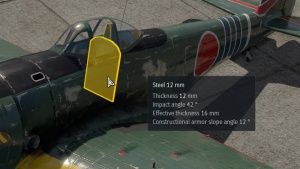
Unlike most of the Japanese airplanes around this BR, the Ki-43-II features an armour plate. It's 12 mm steel at 12° angle, protecting an entire body, legs and part of the head from rear firing angles. It's far from perfect protection, but significantly increases survival chances of the pilot. This is further improved by a large, 14-cylinder radial engine at the front, soaking up most of the incoming damage.
That said though, one of the biggest issues with the survivability of the fighter are its lack of self-sealing fuel tanks, which once ignited will happily burn the entire fighter to the ground, like most of the Japanese fighters in the game.
Modifications and economy
Armaments
Offensive armament
The Ki-43-II is armed with:
- 2 x 12.7 mm Ho-103 machine guns, nose-mounted (250 rpg = 500 total)
The Ki-43-II is armed with two nose-mounted Ho-103 army (12.7 mm) machine guns (900 rpm, 250 rpg). Typically for Japanese airplanes Air Targets and Stealth belts are the preferred options, depending on the skill of the player and the game mode. 12.7 mm machine guns have an acceptable effectiveness, which is helped by their excellent location on the nose, making it easier to aim and land shots without worrying about convergence.
Suspended armament
Unlike its predecessor, Ki-43-II can be outfitted with bombs, featuring the following ordnance:
- Without load
- 2 x 50 kg Army Type 94 GPHE bombs (100 kg total)
- 2 x 100 kg Army Type 94 GPHE bombs (200 kg total)
- 2 x 250 kg Army Type 92 GPHE bombs (500 kg total)
Generally the choice of bombs should depend on the skill of the player, with smaller bombs getting increasingly difficult to destroy enemy targets, while at the same time giving far better flight characteristics. In terms of destroying armoured targets there's a notable gap in performance, with bombs having a destructive radius of 5, 3, 2 m for 250, 100, 50 kg bombs respectively, making 250 kg bombs a very potent weapon, even if it gives a huge decrease in performance (+1.9 s to turn time, comparing to +0.5 s with the 100 kg bombs).
Usage in battles
In all modes, the Ki-43 can perform both BnZ fighting and turnfighting with the correct opponent. It can easily accelerate to 500 km/h in a dive while still having responsive controls. However its speed retention is quite poor and will lose lots of speed as soon as you level out. For turnfighting, you can out-turn most monoplanes and almost all heavy fighters/attackers even without combat flaps deployed, but never turn with Spitfires and Zeros. Note that this aircraft will experience severe rudder lockup when faster than around 450 km/h, resulting in awkward aiming adjustments if the target manoeuvres, so you need to cut throttle appropriately to control your speed.
While having sufficient flight characteristics, the Ki-43 is extremely fragile and can get critically damaged by almost all guns. From the hard-hitting M2 Browning to the fast-firing MG 15, any gun can badly hurt the Ki-43 especially on the engine, fuel tanks, and pilot which can always lead to a later crash. Before attacking try to get an altitude advantage and perform deflection shots. To maximise the damage aim for their wings and engines, as the fuselage usually soaks up lots of bullets. Only fire when the target passes in front of your guns. This short window might seem inadequate to do anything... and it usually is, unfortunately. The slow velocity, light projectiles and low one-second burst mass usually guarantee no critical damage. However sometimes it only takes one bullet to set the target aflame, if you are lucky.
- In Simulator, the Ki-43 is overall a decent plane. It has very forgiving characteristics such as good over-the-nose visibility, a clear bubble canopy without much framing and good backwards visibility. This increases your chance of spotting, tracking, and/or dodging since you can see targets from almost every direction with ease (except the underside, of course). It is recommended to set keybind for moving your head vertically to make full use of the great forward vision in a dogfight. However, its wings are located directly below the cockpit meaning that you cannot see what is below your sides which can lead to you losing track of the enemy. You should get used to searching towards your 2, 4, 5, 7, 8, 10 o'clock, avoiding the wings.
- Note that when taking off the Ki-43 will shift severely to the left due to the propeller torque, so it is recommended to set keybinds for left and right brakes to effectively control your direction on the runway. Using rudder alone will not work at low speed and you will either circle around or lose control and crash into nearby structures like tents/hangars.
- Landing is very beginner-friendly too. It is able to decelerate quickly while also having low stall speed, allowing you to quickly slow down and descend onto the runway. Takeoff and landing flaps do not lift up the nose a lot so you can easily remain overall parallel to the ground. It also performs great when braking as its nose will not usually dip into the ground, so you can keep braking until it fully stops (given that you deflect elevators fully upwards) which is vital for preparing the next fight quickly.
- It has very good handling at most speeds. It does not wobble a lot which is an advantage over the biplanes and early monoplane fighters, making it easier to smooth the aim. You should familiarise the shape of those that you should not turn with: the Spitfires have long, straight nose with an inline engine, rather large and elliptical wings. The Zeros have an overall cylindrical fuselage that merges into a pointy tail after the stabilisers, a radial engine and are usually painted white (early models). If you see them on your tail try outrunning them by diving at around -40 degrees. The Ki-43 still remains responsive handling at 500 km/h, but its speed retention is poor, meaning it will start to lose speed quickly and the enemy might catch up. If you are near a friendly airfield, great. If not, then hope for the best and run towards the friendly side. Don't forget to pitch up and down a little to mess up their aim, the early Spitfires and A6M only have a 60-round drum per cannon which will run out fairly fast. The leftover 7.7 mm machine guns will not be as destructive but still might destroy you.
- It will be very challenging when facing against the Chinese/American Ki-43, as both of you have the same characteristics. You cannot outrun each other and cannot out-turn each other, so the fight will be a combination of various manoeuvres and techniques, and of course, the pilot's skills. Note that the Ki-43 has similar appearance as the Ki-44 and can be misjudged as a Ki-44 or a Zero which are also in the Chinese/American tree. Comparing to the Ki-43, the Ki-44 has a slightly bigger engine and the canopy is shifted backwards. The Chinese Zero is painted dark brown with a silver spinner, while the American one is in greyish-blue. They all turn well and have accelerate well in a dive.
- When it comes to intercepting ground pounders or bombers, the Ki-43 generally performs poorly since the targets are all quite robust against your weak guns. Some examples are the IL-2 which is commonly seen in Sim. It can get mistakenly seen as other aircraft from a distance due to its common appearance. But up close you will see two bomb-like structures underneath its wings and triangular stabilisers with rounded tips. The early IL-2s have no defensive guns so it is safe to sit behind and carefully aim. They are heavily armoured in the cockpit and engine so avoid aiming at these areas. Instead target the tail to hope for disabling their tail control. The late IL-2s, however, have a rear-facing Berezin UB which is something you definitely want to avoid. Perform deflection shots or just disengage.
Enemies worth noting:
- Typhoon Mk Ia: this is a very capable opponent, it is quite fast, climbs good, manoeuvres alright and has 12 x 7.7 mm MGs that can fatally damage the Ki-43. If you are attacking, get an altitude advantage first and BnZ it. If you are being attacked by it, evade its first pass and immediately start a turnfight. You need to deploy combat / takeoff flaps, or even landing flaps if needed to push your turn rate to the limit. Several circles are needed, don't panic to see the Typhoon keeping up with your turns at first. With appropriate flaps, the Ki-43 will slowly out turn it, allowing you to get onto its tail. The Typhoon overall resembles a Hurricane, except its symbolic giant intake below the engine.
Manual Engine Control
| MEC elements | ||||||
|---|---|---|---|---|---|---|
| Mixer | Pitch | Radiator | Supercharger | Turbocharger | ||
| Oil | Water | Type | ||||
| Controllable | Controllable Not auto controlled |
Controllable Not auto controlled |
Controllable Not auto controlled |
Separate | Controllable 2 gears |
Not controllable |
Pros and cons
Pros:
- Extremely good roll rate
- Excellent stock performance
- Wins turn battles and can easily outrun opponents it typically faces
- Can equip bombs up to 500 kg to help aid weight and energy retention
- Useful flaps in a turnfight
- Good all-round cockpit visibility in simulator
- Forgiving landing characteristics
Cons:
- Very light, retains no energy
- Weak armour
- Very limited ammo pool
- Very vulnerable to fires, as structure is weak and flammable
- Rudder locks up at around 450 km/h, meaning that you will miss quite some passes due to the aim not being able to adjust horizontally
History
In early 1937 the Army recognized the need for a new single seat fighter. Instead of going through the normal process of requesting manufacturers to submit designs, the Army contracted with Nakajima directly to produce a replacement for their Ki-27 (Army Type 97) fighter. The requirements laid out to Nakajima for this new fighter was for it to have a top speed of 311 mph, to be able to reach 16,405 ft within five minutes, to have a minimum range of 500 miles, it was to be armed with two 7.7 mm machine guns, and to not lose any of the manoeuvrability of the Ki-27. The first prototype of what was to become the Ki-43 was completed in December 1938 with 2 more following soon after in 1939, however upon testing it was found that these airplanes did not live up the Army's expectations. The complaints from test pilots included that the plane was not manoeuvrable enough, hard to control, and had visibility issues.
Following the evaluation of the initial 3 prototypes, Nakajima would develop 10 testing aircraft with various modifications in order to address the armies concerns. The changes tested included giving the fighter the HA-105 engine, replacing the 7.7 mm machine guns with 12.7 mm machine guns, upgrading the outer skin to a treated duralumin, narrower fuselage, redesigned tail surfaces, modifications to the wing design, and the introduction of butterfly flaps. The last improvement in particular helped the plane to overcome its lack of manoeuvrability that the Army had issue with. After these designed prototypes were tested the Army settled on what they saw was the optimum configuration and requested that it be equipped with the Nakajima Ha-25 engine. The plane entered production as the Ki-43-Ia (Army Type 1 Fighter Model 1A) with the first example completing production in April 1941. This model was soon replaced with the Ki-43-Ib (Army Type 1 Fighter Model 1B) which replaced one of the 7.7 mm machine guns with a 12.7 mm machine gun which was also soon replaced by the Ki-43-Ic (Army Type 1 Fighter Model 1C) which was equipped with two 12.7 mm machine gun.
After some time in the field, the Ki-43 was to receive a major upgrade based on feedback from pilots, which included replacing the Ha-25 engine with the more powerful Ha-115 engine, a two stage supercharger, pilot armour, self-sealing fuel tanks and many more minor improvements. The first prototype of what was to become the Ki-43-II (Army Type 1 Fighter Model 2) was completed in February 1942. The Ki-43 would become the most numerous of all the Japanese Army's fighters. While operating in Malaysia and Burma the plane received the codename "Jim" and in the Pacific Theatre it received the allied codename "Oscar". The codename "Oscar" was eventually selected as the official code name for the airplane by the Allies.
| Archive of the in-game description | |
|---|---|
|
The single-seater Japanese Nakajima Ki-43 Hayabusa (Peregrine Falcon) fighter was designed to replace the Ki-27 in the Japanese Imperial Army's Air Force. The Ki-27 design was so successful that, without resorting to the competition that usually occurred among aircraft manufacturers, the Air Force authorized Nakajima to create an improved model. The main requirement for the new fighter was a high top speed of at least 500 km/h but with the same manoeuvrability as the Ki-27. The first three prototypes were prepared and tested in 1939, but their manoeuvrability was inadequate. Therefore 10 pre-production aircraft with different configurations were considered. Two of them used the new "butterfly" combat flaps, which largely decided the issue. With the flaps, the plane became much more manoeuvrable. In autumn of 1942, the Ki-42-IIA entered production. The main differences between the Ki-42-IIA and previous models were its more powerful Ha-115 motor, its 1130 hp output, and its three-bladed propeller (the previous model had a two-bladed propeller). The wings were reinforced to hold 250-kg bombs, and the lighter machine guns were replaced with large-calibre ones. In addition, the wing fuel tanks were self-sealing, and pilot protection was enhanced with 13 mm of armour (previous models, to lighten the aircraft, did not include protection for the pilot or fuel tanks). All in all, 5919 Ki-43 fighters were produced, most of which were of the Ki-43-IIA design. | |
Media
- Skins
- Videos
See also
Links to the articles on the War Thunder Wiki that you think will be useful for the reader, for example:
- reference to the series of the aircraft;
- links to approximate analogues of other nations and research trees.
External links
| Nakajima Aircraft Company (中島飛行機株式会社 ) | |
|---|---|
| Fighters | Ki-27 otsu · Ki-27 otsu Tachiarai |
| Ki-43-I · Ki-43-II · Ki-43-III otsu | |
| Ki-44-I · Ki-44-I 34 · Ki-44-II otsu · Ki-44-II hei | |
| Ki-84 ko · Ki-84 otsu · Ki-84 hei | |
| Ki-87 | |
| Hydroplanes | A6M2-N* |
| Interceptors | J1N1 · J5N1 |
| Bombers | B5N2 |
| B6N1 Model 11 · B6N2 Model 12 · B6N2a Model 12Ko | |
| G5N1 · G8N1 | |
| Ki-49-I · Ki-49-IIa · Ki-49-IIb · Ki-49-IIb/L | |
| Recon | E8N2 |
| Jet Fighters | Kikka |
| Captured | ␗Ki-27 otsu · ▃Ki-43-II · ␗Ki-43-III ko · ␗Ki-44-II hei · ␗Ki-84 ko |
| *Refit of the Mitsubishi A6M2 mod. 11 | |
| See also | Fuji Heavy Industries (1957-2017) |
| Japan fighters | |
|---|---|
| Navy | |
| Carrier-based fighter | |
| A5M | A5M4 · Hagiri's A5M4 |
| A6M | A6M2 mod. 11 · A6M2 · A6M3 · A6M3 mod. 22 · A6M3 mod. 22Ko · A6M5 · A6M5 Ko · A6M5 otsu · A6M5 Hei · A6M6c |
| A7He | A7He1* |
| A7M | A7M1 (NK9H) · A7M2 |
| Land-based Fighter | |
| J2M | J2M2 · J2M3 · J2M4 Kai · J2M5 · J2M5 (30 mm) |
| J6K | J6K1 |
| J7W | J7W1 |
| N1K-J | N1K1-Ja · N1K2-J · N1K2-Ja |
| Fighter seaplane | |
| N1K | N1K1 |
| A6M-N | A6M2-N |
| Army | |
| Ki-10 | Ki-10-I · Ki-10-I C · Ki-10-II · Ki-10-II C |
| Ki-27 | Ki-27 otsu · Ki-27 otsu Tachiarai |
| Ki-43 | Ki-43-I · Ki-43-II · Ki-43-III otsu |
| Ki-44 | Ki-44-I · Ki-44-I 34 · Ki-44-II otsu · Ki-44-II hei |
| Ki-61 | Ki-61-I ko · Ki-61-I otsu · Ki-61-I hei · Tada's Ki-61-I hei · Ki-61-I tei · Ki-61-II Otsu Kai |
| Ki-84 | Ki-84 ko · Ki-84 otsu · Ki-84 hei |
| Ki-87 | Ki-87 |
| Ki-94 | Ki-94-II |
| Ki-100 | Ki-100 · Ki-100-II |
| Other countries | ▅F4U-1A · ▅P-51C-11-NT · ▅Bf 109 E-7 · ▅Fw 190 A-5 |
| *Imported designation of the He 112 (A6M was in development - A7M would take A7 designation after the cancelation of the A7He) | |