Bf 109 E-7 (Japan)
OLD‑WIKI.WARTHUNDER.COM (DEFUNCT)
| This page is about the premium Japanese fighter Bf 109 E-7 (Japan). For other versions, see Bf 109 (Family). |
Description
The ▅Bf 109 E-7 was a variant of the German fighter aircraft Messerschmitt Bf 109, one of the first modern fighters of the World War II era. The Bf 109 E-7 had a liquid-cooled, inverted-V12 DB 601 engine, and a 20 mm MG FF cannon in each wing. Japan acquired five Bf 109 E-7s from Germany in 1941 for testing purposes. The acquired planes had the standard hinomarus and yellow wing leading edges, as well as white numbers and a red stripe on the rudder. The Japanese Army compared the Bf 109 E-7s with their latest Ki-44 and found that the Bf 109 E-7 was inferior in every aspect. They assumed that the Japanese plane development was on par with the newest Western fighters, unaware that the newer Bf 109 F was already available for German frontline troops. The planes were distributed across multiple air bases to train new pilots and compare to other Japanese planes. The main benefit the Japanese got out of the Bf 109 E-7 was the DB 601 engine license which enabled the Japanese to use a high-power inline engine in their own designs.
It has been in the game since the start of the Open Beta Test prior to Update 1.27 as the ▅Bf 109 E-3; it was renamed to the ▅Bf 109 E-7 in Update 1.65 "Way of the Samurai". The E-7 is a variant of the Bf 109 E-3 with improved armament and performance. It replaces the MG FF cannons with MG FF/Ms that fire explosive Minengeschoß rounds. The E-7 can deliver a devastating burst of fire with its two wing-mounted MG FF/Ms, each with 60 rounds. The E-7 is an excellent energy fighter that can outclimb and outspeed most of its historical opponents. However, it may face more advanced planes such as the P-47D-25, which require careful tactics and energy management. The E-7 should avoid engaging these planes unless it has a clear energy advantage or can lure them into a low-speed, low-altitude dogfight. The E-7 is not a bad turner, especially with combat flaps, but it is still inferior to the Spitfire in this regard. The E-7 also has a heavier frame than the E-3, which reduces its agility. Turning should be used as a last resort or to finish off a damaged enemy.
General info
Flight performance
| Characteristics | Max Speed (km/h at 5,000 m) |
Max altitude (metres) |
Turn time (seconds) |
Rate of climb (metres/second) |
Take-off run (metres) | |||
|---|---|---|---|---|---|---|---|---|
| AB | RB | AB | RB | AB | RB | |||
| Stock | 544 | 532 | 21.3 | 21.8 | 14.0 | 14.0 | 376 | |
| Upgraded | 594 | 570 | 18.7 | 20.0 | 26.5 | 17.8 | ||
Details
| Features | ||||
|---|---|---|---|---|
| Combat flaps | Take-off flaps | Landing flaps | Air brakes | Arrestor gear |
| ✓ | ✓ | ✓ | X | X |
| Limits | ||||||
|---|---|---|---|---|---|---|
| Wings (km/h) | Gear (km/h) | Flaps (km/h) | Max Static G | |||
| Combat | Take-off | Landing | + | - | ||
| 487 | 471 | 280 | ~12 | ~5 | ||
| Optimal velocities (km/h) | |||
|---|---|---|---|
| Ailerons | Rudder | Elevators | Radiator |
| < 370 | < 370 | < 420 | > 250 |
| Compressor (RB/SB) | ||
|---|---|---|
| Setting 1 | ||
| Optimal altitude | 100% Engine power | WEP Engine power |
| 4,800 m | 905 hp | 1,086 hp |
Survivability and armour
- 10 mm Steel plates behind the pilot.
Modifications and economy
Armaments
Offensive armament
The Bf 109 E-7 (Japan) is armed with:
- 2 x 20 mm MG FF/M cannons, wing-mounted (60 rpg = 120 total)
- 2 x 7.92 mm MG 17 machine guns, nose-mounted (1,000 rpg = 2,000 total)
Usage in battles
Unlike its Emil variant predecessors, the Bf 109 E-7 has improved its flying characteristics, while packing the MG FF/M at its wings for maximum damage output. Respectable rate of climb and energy retention due its power-to-weight ratio allow the Bf 109 E-7 to perform BnZ tactics, however due to the limited ammo of the MG FF/M cannons, this role may be better left to more suitable aircraft, such as the Fw 190s. Instead, Bf 109 E-7 excels at energy fighting, capable of bleeding opponents of energy and quickly striking them down. Bf 109 E-7 has good manoeuvrability, and combined with strong flaps can deal with anyone trying to dogfight you. The Air targets belt for your MG FF/M is undoubtedly effective for most aircraft, while universal ammo for your MG 17 provides AI and AP-I rounds which are capable of setting aflame vital part of your opponents.
Remember, altitude is everything, so make sure you are above your opponents. Thankfully the engine provides excellent speed and energy retention which makes climbing even higher without losing much speed easy. Once you are at altitude and found your opponents, analyze the situation and pick the right target to deal with. However if someone is above or has same altitude with you, don't attempt to head-on as your MG 17 cannot do much damage while the MG FF/M is less accurate at longer ranges. Instead, evade any shots from them by doing a barrel roll. If they try to turn vertically, you can turn in aggressively and attempt to shoot them down. After any engagement, regain your altitude ASAP. You don't want the opponent above your plane and destroy you without letting you to counter-attack. Be careful not to dive towards your opponents too steeply (600+ km/h), or you will crash without getting kill at all.
The 2,000 rounds in the pair of MG 17 are sufficient for sustaining battles, but the amount of MG FF/M rounds is a different story. Its cannon still utilizes the 60-round drum magazine, and its accuracy is mediocre at best. Once again, picking the right target can prevent you from burning through the cannon ammo in no time. Adjust your gun convergence to 250-400 m to maximize the effectiveness of MG FF/Ms. Refrain from attempting to catch bombers as the armament is not strong enough to reliably down them quickly, and also could get you killed from its defensive gunners. If your cannon has run out, the pair of MG 17 is still capable doing its job despite its low damage output. Most important of all: don't destroy ground targets as you don't have any kind of ordnance and save your ammo for your actual role: killing fighters.
Overall, Bf 109 E-7 is fun to play, combining a stable platform, power-to-weight ratio, improved overall performance, and devastating armament. However, trigger discipline is mandatory as cannon ammo amount is limited. As long as you have enough energy in your Bf 109 E-7, this plane can overcome anything without worrying about being overtiered as this plane provide stable performance characteristics.
Specified enemies worth noting:
- Spitfires: The bane of your existence. Not only boasting an extremely tight turn radius, but its armament (8 x 7.7 mm or 2 x 20 mm + 4 x 7.7 mm) is capable of shredding you if you are unaware of its presence. Its performance in low alt is excellent, and the opposite. If you find one on your six, do a barrel roll to make them overshoot at you. Climb slightly, and attempt to scissor as the Spitfire's roll rate is mediocre at best. Once they have bled most of their energy, rolling over and shooting them down should be easy as their wings are fragile even towards your 7.92 mm MG 17. If you are both at altitude, you can also lure them higher, as the Spitfire's engine begins to choke above 3,000 m. While so, if they force you into a sustained dogfight, pop your flaps to takeoff mode, and you may be able to outturn them. Also, remember the Spitfire engine is prone to overheating, and will soon have to break off from the fight. If they attempt to do straight flat evasion, use your speed and armament to take him down with ease. However, as a general of thumb, never attempt to dogfight Spitfire under any circumstances without proper support.
- LaGG-3: LaGG-3s has devastating armament placed in its nose. Avoid head-ons as your MG 17 are inadequate to do this task. LaGG-3 has mediocre manoeuvrability, lousy energy retention, and inadequate rate of climb. Dogfighting LaGG-3 is a good option to exploit its weaknesses. Or, if your teammate has engaged with LaGG-3, don't miss the opportunity to destroy LaGG-3. You should outclimb him, and force him into dogfight where its engine performance is significantly worse once hit and the aircraft becomes a flying brick.
- F4U-1 Corsair: Known for its gull-like wing, F4U Corsair has powerful M2 Browning which capable to shred your Bf 109 with single burst at well-placed aim. If its not enough, the Corsair could outrun and outdive you, so special awareness must be taken. However its strength has significant drawbacks: low rate of climb, poor manoeuvring energy retention, and poor performance at lower speed, making the Corsair nothing but an easy sitting duck in your sights. It should be noted despite the inverted gull wing being strong during steep dives, is actually not durable against enemy fire, especially 20 mm. If they are above you, make sure to lure them to your current altitude and provoke them into dogfight. Usually, most Corsair player will extend away if they couldn't hit you, however if they turnfight against you, pop your flaps into takeoff mode. Once they lose energy and prefer to run away, use your MG 17 to damage, or if lucky, set him on fire. If below you, watch your speed and decrease the throttle to prevent control stiffening during engagement. At this point, you have not only secured your altitude, but have greater energy to make another kill if you miss it. Low-altitude Corsair is dead Corsair, so don't miss this opportunity to secure your kill.
- MiG-3: This Soviet fighter has same armament as LaGG-3s. You'll mostly find it above your current altitude, so evade its guns and attempt the same as against LaGG-3. Fortunately, its manoeuvring capability is much worse than F4U and LaGG-3, so countering with a dogfight is the best option and you can secure the kill much easier even if they attempt to run away.
- ITP (M-1): Another worst nightmare beside Spitfire, this Soviet fighter not only has faster speed than most Soviet fighters, but also sports 2 x 20 mm ShVAK and a 37 mm NS-37 which can provide devastating damage to your fuselage in a very short burst. Worse still, the player with ITP will outclimb you by a large margin, and once that happens, he will perform BnZ at you without giving you room to evade if you are caught. Maintaining your energy is the only key to fight against ITP, and never attempt to head-on at any cost as it will end badly. Although ITP is manoeuvrable at high speed, it will not lose energy easily unless it attempts hard manoeuvring. If you find an ITP ground-pounding, analyze the situation before ambushing. Decrease your throttle if your speed is more than 450 km/h. If he notices you and pulls manoeuvres, pursue them and pepper them with your armament.
Manual Engine Control
| MEC elements | ||||||
|---|---|---|---|---|---|---|
| Mixer | Pitch | Radiator | Supercharger | Turbocharger | ||
| Oil | Water | Type | ||||
| Not controllable | Controllable Auto control available |
Controllable Not auto controlled |
Controllable Not auto controlled |
Separate | Not controllable 1 gear |
Not controllable |
Pros and cons
Pros:
- Good energy retention
- Lots of light machine gun ammo
- Minengeschoss rounds are very hard-hitting against all aircraft
- Can endure negative Gs without the engine dying (RB and SB)
- The Bf109 has excellent cockpit visibility
Cons:
- Heavy on energy fighting and gaining altitude. The turning capabilities are not reliable
- Hard to control over 500 km/h
- MG FF/M cannons have low ammo capacity (60 rpg), and low muzzle velocity
- Relatively poor durability
- No suspended armament, limiting its ground attack capabilities
History
From January to June 1941, a military ataché was sent to Germany and Italy as part of the Axis industrial cooperation. During this time, General Tomoyuki Yamashita of the Imperial Army got interested in the Bf 109 during a demonstration flight at the Messerschmitt factory in Regensburg and decided to buy and import five Bf 109 E-7s for trials and testing.
In June of that same year, the first three Bf 109 E-7s arrived at Kobe Port in the Hyogo Prefecture and promptly transferred to the Kakamigahara Airfield in the Gifu Prefecture. With the arrival of the Bf 109s, the Army Aviation Examination Department, dedicated to examining aerial technology and training on tech-demonstrator aircraft, started thorough research. In conclusion, the Department was quite interested in the DB 601 engine it came with, which the Army got a license for after acquiring the Bf 109 E.
After examining the aircraft, the Department switched to testing and performance evaluation against domestic Japanese planes. For testing, Messerschmitt sent a German test pilot by the name of Wilhelm "Willi" Stör, a WWI ace pilot, and Lieutenant Fritz Losigkeit, a frontline pilot who saw aerial combat in the Spanish Civil War, the Battle of France, and the Battle of Britain where he became an ace pilot (he would later be promoted to Major, earn the Knight's Cross of the Iron Cross and achieve a total of 68 aerial victories). They would advise the Japanese to fly with Luftwaffe tactics of the Bf 109s, flying in mock battles against Japanese experienced and ace army pilots with the most recent Japanese fighter, the Ki-44.
After all the mock battles, performance tests, and comparisons, the Army reported that the Ki-44-I outperformed the Bf 109 E-7 in all aspects of flight performance: speed, acceleration, climb performance, and offensive power. The Ki-44 was concluded as a practical aircraft that could compete with the newest Western fighters. But this would not ring true as the Bf 109 F was about to be deployed in frontline units.
After its initial testing phase, the Bf 109 E-7s were spread over multiple air bases to train new pilots and were further compared to the Ki-43, Ki-60 and Ki-61. The DB 601 license that came with the Bf 109s was put into service as the Kawasaki Ha-40 engine and primarily used on the Ki-61, which would become on par with its German relatives.
| Archive of the in-game description | |
|---|---|
|
Messerschmitt Bf 109E "Emil" single-engine front-line fighter In 1941, a Bf 109E prototype fighter was sold to Japan as a part of the German-Japanese military technical cooperation. The aircraft was delivered to the Land of the Rising Sun without armament for flight tests. Japanese Hinomaru markings and a tail number of "1" were applied to the fighter, and then the machine underwent a complete cycle of flight tests at the Kawasaki Company's factory airfield. Comparative tests of the Bf 109E were also performed, with Japanese army fighters involved, such as the Nakajima Ki-43 Type 1 Hayabusa, the Nakajima Ki-44 Type 2 Shoki, and the Kawasaki Ki-61 Type 3 Hien prototype. The aircraft was piloted not only by the Japanese but also by a German test pilot named Willy Stor. The Japanese were most of all interested in the Messerschmitt's DB 601 engine, whose licensed production was being mastered by the Japanese industry at the same time and which was to be mounted on the Ki-61 Hien, the newest fighter being developed in Japan. That is why the Bf 109E itself, as well as any prospects of its licensed manufacture, aroused minimal interest among Japanese specialists. | |
Media
- Skins
- Images
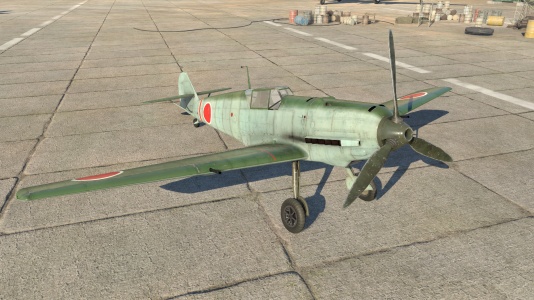
Old camouflage scheme of the Bf 109 E-3 which was later changed in-game to the ▅Bf 109 E-7.

- Videos
See also
- Aircraft of comparable role, configuration and era
External links
| Japan fighters | |
|---|---|
| Navy | |
| Carrier-based fighter | |
| A5M | A5M4 · Hagiri's A5M4 |
| A6M | A6M2 mod. 11 · A6M2 · A6M3 · A6M3 mod. 22 · A6M3 mod. 22Ko · A6M5 · A6M5 Ko · A6M5 otsu · A6M5 Hei · A6M6c |
| A7He | A7He1* |
| A7M | A7M1 (NK9H) · A7M2 |
| Land-based Fighter | |
| J2M | J2M2 · J2M3 · J2M4 Kai · J2M5 · J2M5 (30 mm) |
| J6K | J6K1 |
| J7W | J7W1 |
| N1K-J | N1K1-Ja · N1K2-J · N1K2-Ja |
| Fighter seaplane | |
| N1K | N1K1 |
| A6M-N | A6M2-N |
| Army | |
| Ki-10 | Ki-10-I · Ki-10-I C · Ki-10-II · Ki-10-II C |
| Ki-27 | Ki-27 otsu · Ki-27 otsu Tachiarai |
| Ki-43 | Ki-43-I · Ki-43-II · Ki-43-III otsu |
| Ki-44 | Ki-44-I · Ki-44-I 34 · Ki-44-II otsu · Ki-44-II hei |
| Ki-61 | Ki-61-I ko · Ki-61-I otsu · Ki-61-I hei · Tada's Ki-61-I hei · Ki-61-I tei · Ki-61-II Otsu Kai |
| Ki-84 | Ki-84 ko · Ki-84 otsu · Ki-84 hei |
| Ki-87 | Ki-87 |
| Ki-94 | Ki-94-II |
| Ki-100 | Ki-100 · Ki-100-II |
| Other countries | ▅F4U-1A · ▅P-51C-11-NT · ▅Bf 109 E-7 · ▅Fw 190 A-5 |
| *Imported designation of the He 112 (A6M was in development - A7M would take A7 designation after the cancelation of the A7He) | |
| Japan premium aircraft | |
|---|---|
| Fighters | Hagiri's A5M4 · A7He1 · Ki-27 otsu Tachiarai |
| Ki-44-II otsu · ▅Bf 109 E-7 · ▅F4U-1A · Ki-100-II · Ki-44-I 34 | |
| ▅Fw 190 A-5 · A7M1 (NK9H) · Tada's Ki-61-I hei · ▅P-51C-11-NT | |
| J2M4 Kai · A6M5 Ko · A6M6c · J2M5 · Ki-87 · J6K1 | |
| Twin-engine fighters | Ki-96 |
| Jet fighters | F-86F-40 JASDF▅ · T-2 Early · F-4EJ ADTW |
| Strike aircraft | ▄AV-8S |
| Bombers | Ki-21-I hei · Ki-48-II otsu · H8K3 · B7A2 (Homare 23) · ▅B-17E |