Bf 109 Z-1
OLD‑WIKI.WARTHUNDER.COM (DEFUNCT)
| This page is about the German twin-engined fighter Bf 109 Z-1. For other versions, see Bf 109 (Family). |
Description
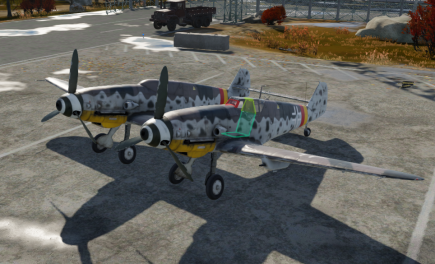
With the Allied bombing campaign gaining more and more strength, the demand for a counter was at an all-time high. Other aircraft, like the Me 210, were considered for the role but ultimately a very unique aircraft would be produced: the Bf 109 Z-1 "Zwilling" (German for "twin"). Based on the previous idea of merging two Heinkel He-111 bombers, Messerschmitt engineers fused two Bf 109 airframes together to create one aircraft. Although it had two airframes, one of them would house the pilot, and the other was blocked off, making it a single-seat fighter. The first prototype was called the "Bf 109 Z-0" but was shortly bombed after it was finished. That didn't stop the project, and a year later, the Z-1 was produced and almost ready for tests until it was abruptly cancelled. The Z-1 fused two 109 G-6 airframes and featured high-powered cannons. It was also nicknamed "Sledgehammer" due to its impressive cannon armament.
The Bf 109 Z-1 was introduced as a premium aircraft in Update 1.79 "Project X". The Z-1 is an incredibly fast aircraft with a top speed of over 700 km/h (435 mph) and is almost untouchable at high altitudes. Being a twin-engine fighter, dogfighting should not be performed, and players should opt to stick to boom and zoom tactics against enemy fighters. The four 30 mm MK 108 cannons have a high damage output, but they also lack velocity and range. It will be quite hard for players to engage at long range or aim in general due to the abysmal velocity. Players will have to lead a significant amount of rounds to hit on target.
The Bf 109 Z-1 was removed from the store after the War Thunder's 6th Anniversary sale. It was briefly made available during the 2018 Winter sale and the 2022 "Maiden flight of the Bf 109" event. It was also available after taking the new special quiz during the 2023 Christmas and New Year celebrations.
General info
Flight performance
The Zwilling shares similar characteristics to the American F-82 Twin Mustang, which also so happens to be two of the same plane super-sized and put together. However, two of the main differences is the lack of two cockpits and two pilots and a significantly more powerful armament.
While being significantly heavier, it is still a Messerschmitt and boasts an above-average manoeuvrability for a heavy fighter and high speed due to its twin DB 605's. However, it is significantly less manoeuvrable against single-engined props that it will face, so it is not recommended to turn fight unless they are considerably less manoeuvrable than you.
| Characteristics | Max Speed (km/h at 6,500 m) |
Max altitude (metres) |
Turn time (seconds) |
Rate of climb (metres/second) |
Take-off run (metres) | |||
|---|---|---|---|---|---|---|---|---|
| AB | RB | AB | RB | AB | RB | |||
| Stock | 688 | 669 | 24.1 | 24.9 | 16.7 | 16.7 | 500 | |
| Upgraded | 739 | 712 | 22.5 | 23.0 | 25.3 | 20.5 | ||
Details
| Features | ||||
|---|---|---|---|---|
| Combat flaps | Take-off flaps | Landing flaps | Air brakes | Arrestor gear |
| ✓ | ✓ | ✓ | X | X |
| Limits | ||||||
|---|---|---|---|---|---|---|
| Wings (km/h) | Gear (km/h) | Flaps (km/h) | Max Static G | |||
| Combat | Take-off | Landing | + | - | ||
| 437 | 408 | 260 | ~10 | ~6 | ||
| Optimal velocities (km/h) | |||
|---|---|---|---|
| Ailerons | Rudder | Elevators | Radiator |
| < 450 | < 390 | < 450 | > 715 |
Survivability and armour
- 8 mm steel - pilot's seat
- 10 mm steel behind and above pilot's head
- 60 mm bulletproof glass in front of pilot
- Self-sealing fuel tanks (1 behind pilot, 1 in right fuselage, 2 in "middle wing", 1 in each wing)
Modifications and economy
Armaments
Offensive armament
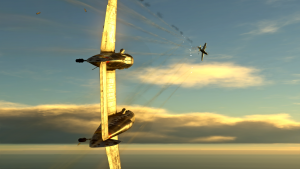
The Bf 109 Z-1 is armed with:
- 4 x 30 mm MK 108 cannons; 2x Inline with Nose Props, 2x Exterior Wings (65 rpg = 260 total)
The MK 108 is a very bad anti-fighter weapon particularly in fighter to fighter combat. Bullet drop and slow velocity result in a severe difficulty leading shots at ranges above 300 m (350 yds). In dogfights where both aircraft are constantly turning and changing direction, this trait gets even worse. The high speeds of the late props push the necessary lead for hitting the target high and very far in front of the enemy. Training with this weapon system in a custom battle against random enemies is heavily advised.
Suspended armament
The Bf 109 Z-1 can be outfitted with the following ordnance:
- Without load
- 1 x 250 kg SC250JA bomb (250 kg total)
- 1 x Flam C 250 incendiary bomb
The SC250JA bomb is the only regular type of bomb the Bf 109 Z can carry. It is a weaker bomb compared to the 500 lb (242.6 kg) AN-M64A1, but it still has an acceptable 7-metre armoured vehicle destruction radius. Heavy tanks will be a struggle to destroy with this bomb. However, light and medium tanks will be easy targets to destroy, especially since the bomb is mounted centreline with the aircraft which will make aiming simple.
The 109 Z also has access to the Flam C 250 which is an incendiary type bomb. Incendiary bombs are extremely ineffective against any armoured opponent but can be used against open-top vehicles. Against bases, these bombs will do a significant amount of damage due to the incendiary effect but not much tonnage will be awarded. This bomb is also mounted in the center much like the SC250JA.
Usage in battles
The Zwilling sits at a rather uncomfortable spot as a heavy fighter, it's fast in a straight line and it climbs well, however the plane doesn't have much else going for it. You will only win a dogfight to an F-82, you will not stand a chance against single engined fighters and you have to reserve the plane to a very passive playstyle in order to capitalize on the pros of the plane.
However, where the Zwilling really shines is as a bomber interceptor. The large bodies of bombers make it so that the MK 108's drop isn't as problematic, and the off-centre pilot makes it harder for their gunners to land a shot on your pilot. At the start of a match, climb to bomber altitude (4k-6k metres) and start hunting for prey. If all of the bombers have been destroyed, or there weren't any to begin with, you are safe to use it as a Boom-&-Zoomer or an air superiority fighter.
Manual Engine Control
| MEC elements | ||||||
|---|---|---|---|---|---|---|
| Mixer | Pitch | Radiator | Supercharger | Turbocharger | ||
| Oil | Water | Type | ||||
| Not controllable | Controllable Auto control available |
Controllable Auto control available |
Controllable Auto control available |
Separate | Not controllable 1 gear |
Not controllable |
Pros and cons
Pros:
- Extremely destructive armament mounting the dreaded Minengeschoss
- Quite speedy
- Powerful DB 605s allow it to reach high speeds
- Decent high altitude performance
- Exceptional interceptor
- Solid dive speed
Cons:
- MK 108s have an extremely slow travel time and drastic bullet drop
- Increased weight make it harder to manoeuvre with
- Easy prey for more nimble and heavily armed single-engined fighters
- Sluggish handling at lower speeds and altitudes
- Rudder locks up making aiming virtually impossible at high speeds
- Sluggish roll rate means that trying to hit anyone who is actively manoeuvring is a challenge
- Has a tendency to catch fire when hit due to the fuel tank that is positioned where the other pilot should be
- Gun arrangement makes hitting small targets hard, two guns are mounted in both noses and on the outer wings. This means that the 109Z has one of the biggest spreads on any plane in the game (Could be seen as a pro for attacking bombers)
History
With the start of allied bombing campaigns against German strategic targets in 1942, the Luftwaffe was forced to go onto the defensive for the first time in the war. This sudden turn of events sparked an urgent demand for new heavy fighter and interceptor designs that would counter the ever increasing onslaught of allied bombers and their respective escorts. Although the Messerschmitt company was already working on such a new aircraft that would replace the dated Bf 110 - the Me 210 - several problems during development delayed the project's completion. As a result, new versions of the Bf 110 had to be developed to counter the new threat. However, the RLM (German Air Ministry) wasn't content with the creation of even more modifications of the aircraft as they planned to decrease the amount of different variants for all aircraft in service at the time in hopes of addressing logistical problems that strained production. Inspired by the previous He-111 "Zwilling" project, Messerschmitt engineers began work on a similar alternative heavy fighter based on the Bf 109, that could easily be mass produced and offer better performance (in reference speed) than the Bf 110 already in service, whilst at the same time being cheaper to manufacture than newly designed machines.
By taking two standard Bf 109Fs from the assembly line and "welding" them together, Messerschmitt engineers created what would become known as the Bf 109Z-0 - the first prototype of the "zwilling" Bf 109. In 1943 however, a bombing raid of one of the Messerschmitt plants near Augsburg led to the destruction of the prototype, cancelling the planned tests. Despite this setback, the engineers kept working on the concept and less than a year later, in spring 1944, a new Z-1 prototype, based off the Bf 109G-6, was created. The second prototype differed from the first one, apart from being based on a later variant of the 109, in the abandoning of rifle-calibre guns in favor of interchangeable large-calibre autocannons, a common trend for late-war German machines. In the end, the project was ultimately cancelled as resource shortages began afflicting the German industry in the final stages of the war and the concept of a twin Bf 109 fighter was abandoned for good.
- From Devblog
Media
- Skins
- Videos
See also
- Aircraft of comparable role, configuration and era
External links
- [Devblog] Messerschmitt Bf 109Z: The Teutonic Twin-Boom Terror
- Official data sheet - more details about the performance
- [Wikipedia] Messerschmitt Bf 109 variants
| Germany twin-engine fighters | |
|---|---|
| Messerschmitt | Bf 109 Z-1 |
| Me 410 A-1/U2 · Me 410 B-1/U2 | |
| Dornier | Do 17 Z-7 · Do 217 J-1 · Do 217 J-2 · Do 217 N-1 · Do 217 N-2 |
| Focke-Wulf | Ta 154 A-1 |
| Junkers | Ju 88 C-6 · Ju 388 J |
| Germany premium aircraft | |
|---|---|
| Fighters | He 51 B-2/H · BV 155 B-1 |
| He 112 | He 112 B-1/U2 · He 112 B-2/U2 |
| Bf 109 | Flegel's Bf 109 A · Bf 109 E-7/U2 · Bf 109 G-2 |
| Fw 190 | Fw 190 A-5/U14 · Fw 190 C · Fw 190 D-13 |
| Captured | ▀Marcolin's C.R.42 CN · ▀Hawk H-75A-2 · ▀Yak-1B · ▀La-5FN · ▀P-47D-16-RE · ▀P-47D · ▀Tempest Mk V |
| Twin-engine fighters | Bf 109 Z-1 · Ju 388 J · Ta 154 A-1 |
| Jet fighters | ◄Sea Hawk Mk.100 · ◄G.91 R/4 · FFA P-16 · ◄MiG-21 SPS-K · ◊MiG-21 "Lazur-M" |
| Strike aircraft | Hs 129 B-2 (Romania) · ▀IL-2 (1942) · Bf 110 C-6 · Do 335 B-2 · He 219 A-7 · ◄Tornado IDS WTD61 · ◄Su-22M4 WTD61 |
| Bombers | Ar 196 A-3 · BV 238 · Fw 189 A-1 · He 177 A-3 · Ju 87 R-2 Libya · Ju 288 C · ▀Wellington Mk Ic |