Do 17 Z-7
OLD‑WIKI.WARTHUNDER.COM (DEFUNCT)
| This page is about the German twin-engine fighter Do 17 Z-7. For other versions, see Do 17 (Family). |
Description
The Do 17 Z-7 is a rank German twin-engine fighter with a battle rating of (AB), (RB), and (SB). It was introduced in Update 1.53 "Firestorm".
General info
Flight performance
Speed and acceleration are both decent. However, its manoeuvrability is a big weak spot. When turning, you can expect a relatively slow turn time, and the wings tend to rip off in hard banking manoeuvres. The climb rate is suboptimal at best when fully upgraded, and when stock, don't expect anything.
| Characteristics | Max Speed (km/h at 5,000 m) |
Max altitude (metres) |
Turn time (seconds) |
Rate of climb (metres/second) |
Take-off run (metres) | |||
|---|---|---|---|---|---|---|---|---|
| AB | RB | AB | RB | AB | RB | |||
| Stock | 423 | 410 | 35.6 | 37.2 | 6.4 | 6.4 | 350 | |
| Upgraded | 475 | 448 | 32.5 | 34.0 | 15.7 | 10.0 | ||
Details
| Features | ||||
|---|---|---|---|---|
| Combat flaps | Take-off flaps | Landing flaps | Air brakes | Arrestor gear |
| ✓ | ✓ | ✓ | X | X |
| Limits | ||||||
|---|---|---|---|---|---|---|
| Wings (km/h) | Gear (km/h) | Flaps (km/h) | Max Static G | |||
| Combat | Take-off | Landing | + | - | ||
| 480 | 454 | 300 | ~5 | ~2 | ||
| Optimal velocities (km/h) | |||
|---|---|---|---|
| Ailerons | Rudder | Elevators | Radiator |
| < 290 | < 300 | < 300 | > 308 |
| Compressor (RB/SB) | ||
|---|---|---|
| Setting 1 | ||
| Optimal altitude | 100% Engine power | WEP Engine power |
| 1,600 m | 815 hp | 1,118 hp |
| Setting 2 | ||
| Optimal altitude | 100% Engine power | WEP Engine power |
| 4,300 m | 780 hp | 1,070 hp |
Survivability and armour
- 8.5 mm Steel - Fore-cockpit plate
- 8.5 mm Steel - Pilot's seat
- 58 mm bulletproof glass in front of pilot
- 6 mm Steel - Belly gunner's plate
- 8.5 mm Steel - Rear cockpit plate
- 6 mm Steel - Rear gunner's upper plate
- 6 mm Steel - Rear gunner's window frame
Modifications and economy
Armaments
Offensive armament
The Do 17 Z-7 is armed with:
- 1 x 20 mm MG 151 cannon, nose-mounted (400 rpg)
- 3 x 7.92 mm MG 17 machine guns, nose-mounted (1,000 rpg = 3,000 total)
Suspended armament
The Do 17 Z-7 can be outfitted with the following ordnance:
- Without load
- 10 x 50 kg SC50JA bombs (500 kg total)
- 1 x 250 kg SC250JA bomb (250 kg total)
- 1 x Flam C 250 incendiary bomb
Defensive armament
The Do 17 Z-7 is defended by:
- 1 x 7.92 mm MG 15 machine gun, dorsal turret (750 rpg)
- 1 x 7.92 mm MG 15 machine gun, ventral turret (375 rpg)
Usage in battles
The Do 17 Z-7 is the first twin-engine heavy fighter that is unlocked in a long line of German "Zerstörer" (lit. "Destroyer", used to refer to heavy fighters) aircraft. Like all of its successors, the Do 17 Z-7 is a full-bred Boom & Zoom fighter, through and through. This means the Do 17 should, under any circumstances always strive to maintain an altitude advantage over enemy aircraft. Utilise the potential energy to dive on them and make a high speed pass while firing, then quickly make an escape. There is however, a couple of caveats for the Do 17 Z-7 that is worth considering when flying it.
For starters, its energy retention and climb rate are mediocre at best. Immediately making a second pass will generally be a bad idea, as it will attract a lot planes with ample opportunity to return fire. Instead, utilise the high air speed from the dive to gain as much horizontal distance from enemy planes as possible before starting to climb. Also, remember to never commit to chasing after a specific plane since the plane will lose too much speed and energy in doing so. Pick out a target from high altitude, roll over and dive down in a vertical position as soon as possible, in order to maximize the altitude-speed trade off. When at first possible moment get a gun solution on the target, and once the solution is lost, level the plane out and speed away at high speed, potentially destroying other players that may cross the path along the way with the same principle.
The Do 17 Z-7's primary source of damage comes from its single 20 mm MG 151 cannon. While not spitting as much lead downrange as the Bf 110's dual MG FF/Ms do, it makes up for it by having access to the MG 151's Air targets belt, which contains a lot more Minengeschoß. They are highly effective against unarmoured planes, which the Do 17 Z-7 will regularly face. While the MG 17s also can do some damage to biplanes, any aware fighter pilot will be able to move away from the gun sight and end up on the Do 17 Z-7's tail, if solely using the machine guns. The MG 151 and 17s are clustered in the nose, however, and combined can ravage lightly armoured ground formations. They must never be underestimated as an alternative to the Do 17 Z-7's bombs.
The Do 17 Z-7 is risky to use when making stealth approaches, particularly in the day, since the twin engines spew modest, but quite visible, white smoke at the higher altitudes. This makes hiding your presence hard enough, let alone your flight path. As a precaution, do what you can to gun it and make sure you are ahead of any interceptors so that your gunners can effectively defend the plane.
Counter-tactics
The best way to deal with this plane is to fly fast and aim for the engines. Don't tail the plane because then the gunners will have an easy target. If tailing the plane, dip down a little bit, as the dorsal gunner won't be able to hit the plane this way and the ventral gunner will be pointed down too much to do anything about it. At this battle rating, there are a lot of newer players, who most likely haven't put Crew XP into the gunners vitality. If the gunners are taken out, then the plane is a flying duck.
Avoid a head-on at all cost - it has nose armour and a 20 mm cannon which will shred any plane to bits. This plane cannot turn very well, if it is pursuing you, simply turn sharply to one direction. It is best to aim for the engines and not the cockpit. The cockpit glass has 58 mm sloped armour; it would be difficult for bullets to go through and hit the crew. It is highly recommended to also attack the wings when flying a plane with cannons: the wings are large, easy targets and the Do 17 Z-7, already not the most nimble plane, will not get very far with much control surface damage.
Manual Engine Control
| MEC elements | ||||||
|---|---|---|---|---|---|---|
| Mixer | Pitch | Radiator | Supercharger | Turbocharger | ||
| Oil | Water | Type | ||||
| Not controllable | Controllable Auto control available |
Not controllable Not auto controlled |
Not controllable Not auto controlled |
Separate | Controllable 2 gears |
Not controllable |
Pros and cons
Pros:
- Exclusively nose-mounted armament, resulting in very little need for convergence
- Can take a lot of machine gun fire before going down
- Armed with an 20 mm MG 151, capable of using the air targets belt, giving the plane absolutely devastating firepower
- 2 x rear gunners for covering both above and below the aircraft
- Defensive armament is quite effective, high fire rate combined with deadly AP-T belts
- Easy to put out a fire by diving
- Can be mistaken at a distance for its bomber counterpart, allowing enemies to think they can engage you head-on
Cons:
- Mediocre climb rate at best when upgraded
- Slow even when upgraded (Hurricanes will be able to outrun it in level flight)
- Mediocre roll rate
- Overall poor handling characteristics
- Lousy energy retention
- Best performs as a Boom & Zoom aircraft, although its poor flight characteristics makes it inefficient at it
- Defensive armament has poor coverage to fend of attacking enemies
- Engine overheats, important to watch the engines temp and adjust when needed
History
The Do 17 Z-7 was a model of the Do 17Z, the main variant of the Dornier Do 17. The Dornier 17, dubbed the "flying pencil", was designed in the early 1930s and was mainly used against Poland, England, France and the Netherlands. In total there were 2,139 built. Other countries that used the Do 17 were Yugoslavia, Finland, and Spain. Only a few Do 17s remain today, none of which are of the Z-7 model.
The primary model, the Z-2, was designed as a "Schnellbomber" ("fast bomber"), intended as a light bomber able to outrun enemy fighters. Its offensive armament was sparse, consisting of only two MG 15 machine guns mounted in a glass nose. The Z-7, however, was built as a night fighter, and as such was up-armed with MG 17s. The glass nose that characterized earlier models of the Do 17 was replaced with metal armour. The clustered three-machine gun, single-cannon configuration the Z-7 boasted was known as "Kauz I" ("screech owl"). It was with this weaponry that the Luftwaffe intended to take down enemy bombers, and the Z-7 was in use as a night fighter all the way up to 1945, due to its greater success as a fighter than as a bomber.
Do 17 production ended in 1940, supplanted by the Ju 88 and succeeded by the similar, but more powerful, Do 217.
Media
- Images
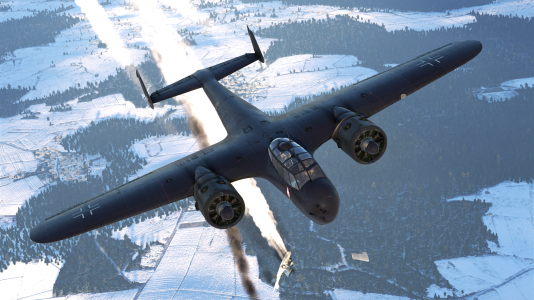
Do 17 Z-7 shot down a PBY-5A Catalina
- Skins
- Videos
See also
Links to the articles on the War Thunder Wiki that you think will be useful for the reader, for example:
- reference to the series of the aircraft;
- links to approximate analogues of other nations and research trees.
External links
| Dornier Aircraft Corporation (Dornier Flugzeugwerke) | |
|---|---|
| Fighters | Do 17 Z-7 |
| Do 217 J-1 · Do 217 J-2 · Do 217 N-1 · Do 217 N-2 | |
| Do 335 A-0 · Do 335 A-1 · Do 335 B-2 | |
| Bombers | Do 17 E-1 · Do 17 Z-2 |
| Do 217 E-2 · Do 217 E-4 · Do 217 K-1 · Do 217 M-1 | |
| Jet Aircraft | Alpha Jet A** |
| Helicopters | ◄UH-1D* |
| *Licensed | |
| **Jointly manufactured with Dassault Aviation | |
| Germany twin-engine fighters | |
|---|---|
| Messerschmitt | Bf 109 Z-1 |
| Me 410 A-1/U2 · Me 410 B-1/U2 | |
| Dornier | Do 17 Z-7 · Do 217 J-1 · Do 217 J-2 · Do 217 N-1 · Do 217 N-2 |
| Focke-Wulf | Ta 154 A-1 |
| Junkers | Ju 88 C-6 · Ju 388 J |