A6M5 otsu
OLD‑WIKI.WARTHUNDER.COM (DEFUNCT)
| This page is about the Japanese naval fighter A6M5 otsu. For other variants, see A6M (Family). |
Description
The A6M5 mod. 52 Otsu, designated as the Type 0 Carrier-based Fighter Model 52B (零式艦上戦闘機五二型乙), is the second minor modification of the A6M5. The Model 52B (Otsu) retains the belt-fed 20 mm Type 99 mod.2 mark 4 from the Model 52A (Kō) with 125 rounds per gun rather than 100, but comes with an additional 13.2 mm Type 3 machine gun in exchange for a single 7.7 mm machine gun. Other additions to the Model 52B include 45 mm thick armoured glass to the windscreen, a larger propeller spinner, and a revised gas outlet near the windscreen.
It was introduced in Update 1.37. With all the modifications done to the A6M5 over the other A6Ms, performance has improved but it faces stronger enemy aircraft which proportionally perform even better. While still unrivalled in manoeuvre dogfights capable of dodging, weaving, and out-turning the pursuer into getting on their six, staying on the six of an aircraft will be harder to maintain due to the higher top speeds all other aircraft will have over the A6M5. The A6M5 otsu's 13.2 mm HMG gives the plane an additional tool to fight with, gaining additional damage output when using all guns, and still posing a threat if the 20 mm cannons run out. As last the main-production A6Ms, the A6M5s in War Thunder also come with a late-war modification which allows them to be converted into "bakusen", mounting a 250 kg bomb in place of the centreline drop tank.
- Nicknames
- IJN Pilot nickname: Reisen (零戦) / Zerosen (ゼロ戦) (Abbreviation of 0 - 戦).
- Allied reporting name: Zeke / Zero.
General info
Flight performance
With the additional armour, this version is inherently heavier, making the aircraft more sluggish in turns and manoeuvres over the previous A6M5s.
| Characteristics | Max Speed (km/h at 6,000 m) |
Max altitude (metres) |
Turn time (seconds) |
Rate of climb (metres/second) |
Take-off run (metres) | |||
|---|---|---|---|---|---|---|---|---|
| AB | RB | AB | RB | AB | RB | |||
| Stock | 520 | 503 | 16.7 | 17.2 | 13.4 | 13.4 | 190 | |
| Upgraded | 565 | 540 | 15.8 | 16.0 | 15.2 | 16.9 | ||
Details
| Features | ||||
|---|---|---|---|---|
| Combat flaps | Take-off flaps | Landing flaps | Air brakes | Arrestor gear |
| ✓ | ✓ | ✓ | X | ✓ |
| Limits | ||||||
|---|---|---|---|---|---|---|
| Wings (km/h) | Gear (km/h) | Flaps (km/h) | Max Static G | |||
| Combat | Take-off | Landing | + | - | ||
| 740 | 397 | 368 | 220 | ~14 | ~6 | |
| Optimal velocities (km/h) | |||
|---|---|---|---|
| Ailerons | Rudder | Elevators | Radiator |
| < 280 | < 420 | < 410 | > 335 |
Engine performance
| Engine | |||||
|---|---|---|---|---|---|
| Engine Name | Number present | ||||
| Nakajima Sakae 21 14-cylinder | 1 | ||||
| Engine characteristics | |||||
| Weight (each) | Type | Cooling | |||
| 533 kg | Radial | Air | |||
| Engine power (Stock) | |||||
| Mode | Max | Take-off | |||
| Arcade | 908 hp | 1,038 hp | |||
| Realistic/Simulator | 897 hp | 1,028 hp | |||
| Engine power (Upgraded) | |||||
| Mode | Max | Take-off | |||
| Arcade | 1,106 hp | 1,237 hp | |||
| Realistic/Simulator | 995 hp | 1,126 hp | |||
| WEP Duration | |||
|---|---|---|---|
| Arcade | Realistic/Simulator | ||
| 25 seconds | Infinite | ||
Survivability and armour
This is the first version with armour in both the pilot's seat and the windscreen.
- 45 mm Bulletproof glass in front
- 13 mm Steel plate behind the pilot
Modifications and economy
The A6M5 otsu's biggest downfall is its speed. Start by unlocking performance upgrades as the stock armament options are easily workable and viable. Unlocking performance modules such as Engine and Engine Injection will also shorten turn time. Once all the performance modules have been unlocked obtaining the rest of the modules is fairly easy.
Armaments
Offensive armament
The A6M5 otsu is armed with:
- 2 x 20 mm Type 99 Model 2 cannons, wing-mounted (125 rpg = 250 total)
- 1 x 13.2 mm Type 3 machine gun, nose-mounted (230 rpg)
- 1 x 7.7 mm Type 97 navy machine gun, nose-mounted (700 rpg)
Gun convergence is best set at 400 m or less, as most engagements are in very close quarters.
The stock belts for the A6M5 otsu's weapons are insufficiently powerful, especially for the 13 mm gun. However, the 13 mm gun's belts has access to full assortment of incendiary-type bullets that can light the enemy on fire. Use stealth for the 13 mm for best performance of incendiary with no indicator for the enemy that the A6M5 otsu is firing.
The 20 mm cannon has more explosive potential, as well as some incendiary bullets. Stealth belts are actually again a great choice for the 20 mm cannon. They will shred the enemy to bits, sometimes light on fire. Another good belt choice is tracers as it is solely explosive, and are also a good asset to take into battle with the downside that firing it will alert the enemy of the A6M5 otsu's location.
The 7.7 mm machine gun's belts have little impact in comparison to the other armaments on the A6M5 otsu, but if a choice must be made, the stealth belts are a good choice as they can still pierce some armour with incendiary rounds.
Overall, the best way to make use of the A6M5 otsu's firepower is to learn how to lead and shoot properly with stealth belts. It allows an awesome advantage of surprise and explosiveness.
Suspended armament
The A6M5 otsu can be outfitted with the following ordnance:
- Without load
- 2 x 60 kg Navy Type 97 Number 6 bombs (120 kg total)
- 1 x 250 kg Navy Type Number 25 Model 2 bomb (250 kg total)
Usage in battles
Similar to past "Zeroes" the A6M5 otsu is a proficient dogfighter. With a turn time rivalling biplanes this aircraft is more than capable of winning any standard turning fight. It encounters problems at both high speeds and high altitudes, where its foes excel at. Generally speaking, the A6M5 otsu is best utilized as a low-altitude low-speed dogfighter. It can be a great addition to a team especially if paired with higher speed Japanese aircraft such as the Ki-61 or J2M3. When flying the A6M5 otsu, remember to keep your speed low and to never engage in head-on attacks. Although the aircraft has a 45 mm armoured glass plate in the windscreen, its main armament is not centrally located in the nose and thus will be at a significant disadvantage. "Bait" enemies by making them think they have a successful shot on you and then dart away to a lower altitude. This will most often result in either kind of scissors or a standard turn fight, where the A6M5 otsu excels. Once able to be destroyed, get as close as possible to the enemy aircraft and fire in short bursts. This way, ammunition will be conserved and the enemy surely destroyed. Be careful not to go too fast, as the A6M5 otsu's control surfaces lock up making it incredibly difficult to manoeuvre.
- In Simulator, the A6M Zero is overall a great plane to fly. Its advantages include the extremely smooth handling, impressive turn rate, low stall speed, the ability to not enter spins in extreme manoeuvres, decent rear visibility, and increased cannon ammo capacity. It is able to pull really tight turns or barrel rolls without losing control or going into a spin, allowing the player to use this stability to their advantage. Its disadvantages, however, are the fragile protection, wing-mounted guns, and the cockpit scattered with frames. Although not thick, these frames can still be obstructions in a fight. Also the gunsight is small and mounted very low, resulting in inadequate visibility over the nose. This can limit the player's ability to see the target in a turn fight since to lead the target, the player must cut inside its turn, meaning the nose will now block the target. The A6M can perform dogfighting, some ground pounding and some intercepting.
- You can bring the minimum amount of fuel (29 minutes) as even this Zero has the new 20 mm guns with 125 rounds each and you won't need to restock ammo as often, it is not a huge increase and returning to the airfield to resupply will still be a common occurrence. Set the convergence to 150-300 m. When taking off, the A6M will shift severely to the left so it is best to set separate keybind for left and right brakes to counter the torque.
- For dogfighting, it is better to engage with an altitude advantage so climb to around 2,500 m. Track the opponent using lead or pure pursuit, as with lag pursuit you will eventually end up at the 6'o clock of the target aircraft whose fuselage will soak up most of your MG bullets, and your wing mounted cannons will become really awkward to aim. With the amazing stableness the aim should be easy. Target their wings or nose and avoid the back half of the fuselage as there is usually nothing in there. You can turn with most planes with your combat/takeoff flaps deployed. Note that it is best to fire in 10-round/one-second bursts to avoid wasting cannon rounds. Once the cannons are out, the leftover 7.7 mm MGs can only effectively damage single engine fighters.
- For ground pounding with bombs, look for tanks and pillboxes. First you need some separation between you and the target so you have enough time to line-up the drop. Dive at the target at a rather shallow angle, and release the 60 kg bombs when you are very close, with the target below the gunsight and filling up around half of it. For the 250 kg, drop it with the gunsight slightly more above the target. If you only use the MGs, your targets are trucks, AAA and howitzers. Dive at it and stabilise the plane so the gunsight stays overall still at the target. Then, once the target fills out around 1/6 of the gunsight, open fire. If your aim is accurate you can destroy one target in a single pass. However, it is very recommended to set keybind for firing MG only as you can definitely not waste the valuable cannon rounds. Save them for any unexpected dogfights.
- Landing is easy thanks to the low stall speed and lovely handling. Line up and approach the airstrip at treetop, decrease speed to at most 210 km/h and deploy combat, takeoff and landing flaps in order. Further decelerate so the touchdown speed is no more than 180 km/h to avoid bouncing up. Keep braking until the plane reaches a full stop, you don't have to worry about the nose dipping down and causing a propeller strike.
Specific enemies worth noting
Although the A6M5 otsu is a fantastic fighter as far as manoeuvrability goes, its speed is not on par with the enemy aircraft it faces. Both the P-51 and the F4U can outrun the A6M5 otsu. In a situation where one is being Boom & Zoomed (enemy aircraft is using superior speed and dive attacks) call upon teammates for assistance. There is little an A6M5 otsu pilot can do against an enemy with superior speed. The A6M5 otsu is best used as a support aircraft as it is generally unable to destroy some of the aircraft it faces. Staying with other teammates is a sure tactic and will net the best results. A "Zero" pilot must always recognize the need for teamwork and communication. One can also play the A6M5 series as a light boom and zoom aircraft, using the climb rate to get above the competition, and the improved dive capabilities over the M2/3s to swoop down onto enemies from above, but be mindful of the aircraft's speed.
Playing the A6M5 otsu in realistic battles will allow players to easily exploit the aircraft's turn time against its opponents.
- Spitfires: their turn time will come close to the A6M5 otsu. They are fast, and can boom and zoom. To avoid them, don't panic when they are spotted trying to boom and zoom. Counter by pretending that they have not been noticed, lulling them into a false sense of security. Then, just as they fire the first shots, dodge them, and head upwards and loop around to take the shot on them.
- F4U, F6F, P-47, etc: these planes are a huge threat to the late Zeros as they have superior firepower, speed, dive acceleration and robust airframes. Their 12.7 mm MGs can easily tear you apart or simply pilot-snipe you even when they are far away, as the M2 Brownings have great velocity and trajectory. They can also set you aflame easily. Start a turnfight whenever you see these stubby planes. The F4U has a long cylindrical nose and the iconic inverted gull wing. The P-47 has a huge, jug-like fuselage, bubble canopy and elliptical trailing edge that usually have invasion stripes painted on them. The F6F, on the other hand, might get confused with other planes as it looks rather average.
- P-51: their machine guns can do severe damage to the A6M5 otsu. However, a common tendency of novice P-51 pilots is to get into a manoeuvring fight with the A6M5 otsu. Simply dodge their attacks, do a loop to get on their tail, and take shots at the opportune moments. Even better, when beating them in a turn fight, their aircraft's top profile are fully exposed, allowing for a larger surface area to be shot up and even the cockpit to hit the pilot inside.
- Yak 3/9: their 20 mm cannons are devastating if they hit. Do not try to head on them, just dodge the attacks by looping around the bullets, get on their tail, and shoot them before they get away!
- Bombers: Do not tail a bomber. Only boom and zoom them as their defensive armaments can shoot up a A6M5 otsu easily.
- P-61: this plane is one tough nut to crack. It is quite fast, packs a fatal punch, has a searching radar, and a deadly turret on top. The turret consists of 4 x 12.7 mm M2 Browning machine guns that cover the upper half of the plane, and most P-61 players tend to fly low or get you into their upper half to target you with the turret. Avoid being above them at all costs, utilise the Zero's manoeuvrability and sneak under their belly. Its appearance resembles a P-38: a center fuselage with two engine nacelles extending backwards and forming the twin tail like a frame, you will know it is a Black Widow and not a Lightning when red tracer bullets start shooting out from it.
- I-16: the late I-16s are equipped with ShVAK cannons that can be pretty dangerous to your fragile airframe. They can turn equally well as the Zero, have superior roll rate but the stability is so terrible that as soon as they pull a little more on the stick, they will enter spins. Therefore it is quite easy to counter them: engage a turnfight with them and turn tighter and tighter, or do a few barrel rolls. They will quickly lose control and start spinning and it is quite hard to recover. Then simply get some separation, turn around and put some solid shots into them. They have an I-15's short and fat fuselage, a flat radial engine and triangular stabilisers located right after the low-mounted mono wings, all covered in olive green paint.
Manual Engine Control
| MEC elements | ||||||
|---|---|---|---|---|---|---|
| Mixer | Pitch | Radiator | Supercharger | Turbocharger | ||
| Oil | Water | Type | ||||
| Controllable | Controllable Not auto controlled |
Controllable Not auto controlled |
Controllable Not auto controlled |
Separate | Controllable 2 gears |
Not controllable |
Pros and cons
Pros:
- Extremely manoeuvrable, with great turn and roll rate
- Very short takeoff distance
- Small radiator drag
- One of the nose-mounted 7.7 mm upgraded to 13.2 mm Type 3
- Can mount a bomb rack for a single 250 kg bomb, still strongly ill-advised for air-battles
Cons:
- Below-average burst mass for the BR
- Limited ammo
- Still one of the 7.7 mm Type 97 MG
- Default belts have a very poor choice of bullets
History
The A6M5 Otsu was a modification of the earlier A6M5 series. It utilized the A6M5 Ko's Type 99 Model 2 cannon modification as well as thicker wing skinning, allowing for higher dive speeds. The A6M5 Otsu was the first variant of the A6M series to utilize armour protection. It was produced from April 1944 through October 1944.
Media
- Skins
 Market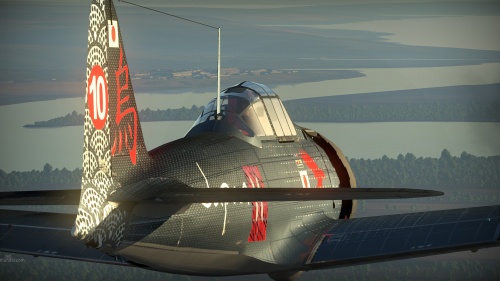
See also
- Mitsubishi A6M5 (base model)
- Mitsubishi A6M5 Ko (previous variant)
- Aircraft of comparable role, configuration and era
- Grumman F4F Wildcat
- Nakajima Ki-43 Hayabusa (▃ Oscar)
- Supermarine Seafire
- Hawker Sea Hurricane
External links
| Mitsubishi Company (三菱商会) | |
|---|---|
| Fighters | A5M4 · Hagiri's A5M4 |
| A6M2 mod. 11 · A6M2 · A6M3 · A6M3 mod. 22 · A6M3 mod. 22Ko · A6M5 · A6M5 Ko · A6M5 otsu · A6M5 Hei · A6M6c | |
| A7M1 (NK9H) · A7M2 | |
| J2M2 · J2M3 · J2M4 Kai · J2M5 · J2M5 (30 mm) | |
| Hydroplanes | F1M2 |
| Interceptors | Ki-83 · Ki-109 |
| Bombers | G4M1 |
| Ki-21-Ia · Ki-21-I hei · Ki-67-I Ko · Ki-67-I otsu | |
| Jet Fighters | Ki-200 |
| Captured | ▃A6M2 · ␗A6M2 |
| See also | Mitsubishi Heavy Industries, Ltd. (Post-War) |
| Japan fighters | |
|---|---|
| Navy | |
| Carrier-based fighter | |
| A5M | A5M4 · Hagiri's A5M4 |
| A6M | A6M2 mod. 11 · A6M2 · A6M3 · A6M3 mod. 22 · A6M3 mod. 22Ko · A6M5 · A6M5 Ko · A6M5 otsu · A6M5 Hei · A6M6c |
| A7He | A7He1* |
| A7M | A7M1 (NK9H) · A7M2 |
| Land-based Fighter | |
| J2M | J2M2 · J2M3 · J2M4 Kai · J2M5 · J2M5 (30 mm) |
| J6K | J6K1 |
| J7W | J7W1 |
| N1K-J | N1K1-Ja · N1K2-J · N1K2-Ja |
| Fighter seaplane | |
| N1K | N1K1 |
| A6M-N | A6M2-N |
| Army | |
| Ki-10 | Ki-10-I · Ki-10-I C · Ki-10-II · Ki-10-II C |
| Ki-27 | Ki-27 otsu · Ki-27 otsu Tachiarai |
| Ki-43 | Ki-43-I · Ki-43-II · Ki-43-III otsu |
| Ki-44 | Ki-44-I · Ki-44-I 34 · Ki-44-II otsu · Ki-44-II hei |
| Ki-61 | Ki-61-I ko · Ki-61-I otsu · Ki-61-I hei · Tada's Ki-61-I hei · Ki-61-I tei · Ki-61-II Otsu Kai |
| Ki-84 | Ki-84 ko · Ki-84 otsu · Ki-84 hei |
| Ki-87 | Ki-87 |
| Ki-94 | Ki-94-II |
| Ki-100 | Ki-100 · Ki-100-II |
| Other countries | ▅F4U-1A · ▅P-51C-11-NT · ▅Bf 109 E-7 · ▅Fw 190 A-5 |
| *Imported designation of the He 112 (A6M was in development - A7M would take A7 designation after the cancelation of the A7He) | |