Ki-44-II otsu
OLD‑WIKI.WARTHUNDER.COM (DEFUNCT)
| This page is about the Japanese fighter Ki-44-II otsu. For other versions, see Ki-44 (Family). |
Description
The Ki-44-II otsu Shoki, designated as the Type 2 Single-Seat Fighter, Model IIb (二式単座戦闘機一型乙), was a Model II variant of the Ki-44, featuring an improved engine and nose-mounted 12.7 mm guns. While it was equipped with only its nose armament, it could also be optionally fitted with 40 mm cannons in the wings, although these were sometimes swapped out for 12.7 mm guns due to the 40 mm’s unsatisfactory performance. The 40 mm cannons were specifically intended for countering American bombers, but despite their lethality, the Ki-44 remained an underwhelming aircraft for high-altitude interceptions against the B-29, as the cannons were effective only at very short ranges with limited ammunition—essentially at a ramming distance. This tactic was later formalised by several Army Sentai under the "Shinten Seiku-Tai" (震天制空隊) units, which used standard army planes or those stripped of armour and armament to reduce weight, enabling them to ram bombers out of the sky more efficiently. This approach was akin to the German Sonderkommando "Elbe" 's mission in 1945 and the Russian "Taran" tactics of 1941. Although survival rates were low and the attacks were effectively kamikaze missions, some pilots managed to survive multiple sorties, ramming a bomber and then ejecting to continue fighting another day.
It was introduced in Update 1.55 "Royal Armour". The Ki-44-IIb features one of the slowest-velocity cannons ever mounted on an aircraft, but the 40 mm shells pack a significant punch if they manage to hit—though this is admittedly difficult to achieve. The Ki-44-II is equipped with a powerful engine, enabling the aircraft to reach interceptor altitudes quickly and effortlessly, making it ideal for strafing bombers at high altitudes and destroying them in a single pass. Pilots should reserve their 40 mm ammunition for bombers, focusing on getting close at high speeds, as targeting smaller aircraft with these cannons presents a considerable challenge. Once the 40 mm rounds are depleted, the Ki-44-IIb can still be a formidable boom-and-zoom fighter against other aircraft, with its nose-mounted 12.7 mm machine guns providing decent lethality thanks to their high-explosive rounds.
- Nicknames
- Nickname: Shōki (鍾馗, Demon Queller)
- Allied reporting name: Tojo
General info
Flight performance
| Characteristics | Max Speed (km/h at 5,200 m) |
Max altitude (metres) |
Turn time (seconds) |
Rate of climb (metres/second) |
Take-off run (metres) | |||
|---|---|---|---|---|---|---|---|---|
| AB | RB | AB | RB | AB | RB | |||
| Stock | 583 | 565 | 21.8 | 22.4 | 13.7 | 13.7 | 320 | |
| Upgraded | 634 | 605 | 20.7 | 21.0 | 24.2 | 18.3 | ||
Details
| Features | ||||
|---|---|---|---|---|
| Combat flaps | Take-off flaps | Landing flaps | Air brakes | Arrestor gear |
| ✓ | ✓ | ✓ | X | X |
| Limits | ||||||
|---|---|---|---|---|---|---|
| Wings (km/h) | Gear (km/h) | Flaps (km/h) | Max Static G | |||
| Combat | Take-off | Landing | + | - | ||
| 400 | 400 | 250 | ~12 | ~8 | ||
| Optimal velocities (km/h) | |||
|---|---|---|---|
| Ailerons | Rudder | Elevators | Radiator |
| < 400 | < 400 | < 450 | > 335 |
| Compressor | Optimal altitude | 100% Engine power | WEP Engine power |
|---|---|---|---|
| Setting 1 | 1,386 m | 1,420 hp | 1,613 hp |
| Setting 2 | 4,443 m | 1,300 hp | 1,477 hp |
Survivability and armour
Examine the survivability of the aircraft. Note how vulnerable the structure is and how secure the pilot is, whether the fuel tanks are armoured, etc. Describe the armour, if there is any, and also mention the vulnerability of other critical aircraft systems.
Modifications and economy
Armaments
Offensive armament
The Ki-44-II otsu is armed with:
- 2 x 40 mm Ho-301 cannons, wing-mounted (10 rpg = 20 total)
- 2 x 12.7 mm Ho-103 machine guns, nose-mounted (250 rpg = 500 total)
The twin Ho-103 machine guns are identical in performance to most other Japanese aircraft carrying this type. The air targets belt is recommended in most situations as it carries a great balance of armour piercing and incendiary components along with tracer rounds, not to mention high-explosive rounds, which is very unusual for machine guns. The twin Ho-301 autocannons are devastating to anything which it hits, making short work of most aircraft. The unfortunate drawback with these cannons is that they utilise very low-velocity rounds and will need a large lead on anything being attacked, with a larger lead time the further out the target is.
Suspended armament
The Ki-44-II otsu can be outfitted with the following ordnance:
- Without load
- 2 x 50 kg Army Type 94 GPHE bombs (100 kg total)
- 2 x 100 kg Army Type 94 GPHE bombs (200 kg total)
Usage in battles
Describe the tactics of playing in the aircraft, the features of using aircraft in a team and advice on tactics. Refrain from creating a "guide" - do not impose a single point of view, but instead, give the reader food for thought. Examine the most dangerous enemies and give recommendations on fighting them. If necessary, note the specifics of the game in different modes (AB, RB, SB).
- In simulator, the Ki-44 is a decent fighter that can do traditional dogfights, some bomber-hunting and some ground pounding. It has great all-round visibility, especially to the sides and the rear thanks to its clear teardrop canopy. However there are lots of thick frames at the front which can get very annoying and obstruct the target in a chase, delaying the pilot's reaction. The glass on the canopy's sides also tend to create dizzying reflections when the sun is near, reducing the visibility a lot. The over-the-nose visibility is average. The wing position (in front of the canopy) means that you cannot see anything at your low 11, 12, 1, 2 'o clock so you have to fly past the target area and look towards 3, 4, 5, 7, 8, 9 'o clock where there is nothing to obstruct your view.
- The handling is good in general. During a take off the Ki-44 feels nose-heavy without any flaps deployed therefore after retracting the gears and flaps you need to pitch up a bit until the plane picks up some speed. Only elevator trim is available, so when the stick is at its deadzone, the Ki-44 will roll and yaw to the left side. Therefore you always need to pull the stick to the right which can get a bit annoying. It has excellent climb rate of around 14m/s at 400 km/h, with 100% throttle and no MEC. This means that it can get to an ideal altitude of around 3000m very quickly. In a dive it easily accelerates to around 550 km/h while still having responsive controls, however it does not retain the speed well after leveling out. Note that its engine will overheat unbelievably fast. With WEP it heats up to >243° within 15 seconds. Thus you must utilise the WEP only when you have to, for example in a zoom climb or a high yoyo. The good news is, the engine can cool down quick enough for another 15-second WEP.
- While being more of a BnZ fighter, the Ki-44 also performs excellent at turn fighting - with the appropriate opponent, of course. Except a few dedicated turn fighters, the Ki-44 can out-turn and get on most opponents' tail with combat flaps deployed. Note: do not turn with Spitfires or Zeros, you will never out-turn them. If you see a plane with a streamlined inline engine and large, elliptical wings (Spitfire) or something with rounded wingtips and stabiliser tips, a radial engine and a pointy tail (A6M), try some defensive manoeuvres like barrel rolls or disengage by diving towards a nearby friendly airfield.
- The Ki-44 has a lovely low stall-speed of around 160 km/h and is also very controllable when getting out of a stall. However the handling gets very sluggish when slower than 200 km/h so make sure that there is no one behind you.
- When intercepting planes, it is crucial to know what the target is. If it is a bomber/attacker with decent defensive firepower, great turret coverage, or robust protection, then you might want to disengage after some attempts if you don't want to die. From the hard-hitting M2 Browning to the fast-firing MG 15, any gun can critically damage the Ki-44 especially on the engine, fuel tanks, and pilot which can always lead to a later crash. Before attacking try to get an altitude advantage and perform deflection shots. To maximise the damage aim for their wings and engines, as the fuselage usually soaks up lots of bullets. Only fire when the bomber passes in front of your guns. This short window might seem inadequate to do anything... and it usually is, unfortunately. The slow velocity, light projectiles and low one-second burst mass usually guarantee no critical damage. However sometimes it only takes one bullet to set the target aflame, if you are lucky.
- B-25, Ju 88, IL-2, etc: These aircraft have either powerful defensive guns, for example the B-25, or wide gun coverage such as the Ju 88. The most threatening one, the B-25, is fairly easy to distinguish. It has a short and wide fuselage, twin radial engine hanging under the wings and a H-tail. Focus your fire on the engines and constantly swing sideways to avoid getting hit. A few hits from the M2 Browning is a guaranteed death. The Ju 88, on the other hand, has great underside gun coverage so attacking from below isn't a very good option. Try engaging from the sides and concentrate the fire on the front half of it, as that is where all the vital components are located. Again, never engage any of these if you have no altitude advantage. Pin them on the map and leave them to teammates with more powerful firepower.
- A6M, Spitfire, etc: If you see them on your tail try outrunning them by diving at around -40 degrees. The Ki-44 still remains responsive handling at 600 km/h, but its speed retention is poor, meaning it will start to lose speed quickly and the enemy might catch up. If you are near a friendly airfield, great. If not, then hope for the best and run towards the friendly side. Don't forget to pitch up and down a little to mess up their aim, the early Spitfires and A6M only have a 60-round drum per cannon which will run out fairly fast. The leftover 7.7 mm machine guns will not be as destructive.
- F4U, F6F, P-47, etc: these planes are a huge threat to the Ki-44 as they have superior firepower, speed, dive acceleration and robust airframes. Their 12.7 mm MGs can easily tear you apart or simply pilot-snipe you even when they are far away, as the M2 Brownings have great velocity and trajectory. They can also set you aflame easily. The F4U has a long cylindrical nose and the iconic inverted gull wing. The P-47 has a huge, jug-like fuselage, bubble canopy and elliptical trailing edge that usually have invasion stripes painted on them. The F6F, on the other hand, might get confused with other planes as it looks rather average. Anyways, start a turnfight whenever you see these stubby planes.
Manual Engine Control
| MEC elements | ||||||
|---|---|---|---|---|---|---|
| Mixer | Pitch | Radiator | Supercharger | Turbocharger | ||
| Oil | Water | Type | ||||
| Controllable | Controllable Not auto controlled |
Controllable Not auto controlled |
Controllable Not auto controlled |
Separate | Controllable 2 gears |
Not controllable |
Pros and cons
Pros:
- Powerful armament for tough aircraft
- Extremely good acceleration
- Good climb rate allows it to get altitude advantage over most enemies
- 40 mm cannons can be used as impromptu brakes when landing (because of the huge recoil)
Cons:
- Very fragile with next to no protection. Will get shredded/set on fire easily, especially by any plane with M2 Brownings (e.g. F6F-5)
- Engine easily damaged
- 40 mm cannons are very hard to use: extremely low velocity, big recoil and absurdly low ammo of only 10 RPG. This requires strict trigger control
History
Describe the history of the creation and combat usage of the aircraft in more detail than in the introduction. If the historical reference turns out to be too long, take it to a separate article, taking a link to the article about the vehicle and adding a block "/History" (example: https://wiki.warthunder.com/(Vehicle-name)/History) and add a link to it here using the main template. Be sure to reference text and sources by using <ref></ref>, as well as adding them at the end of the article with <references />. This section may also include the vehicle's dev blog entry (if applicable) and the in-game encyclopedia description (under === In-game description ===, also if applicable).
Media
- Skins
 Market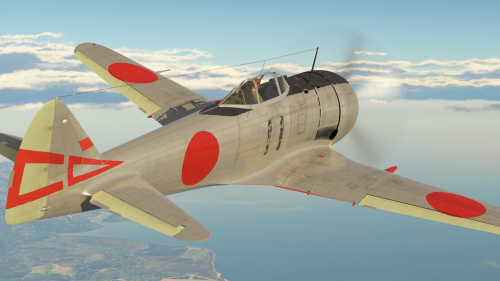
See also
- Related development
- Other vehicles of similar gun configuration


- Other vehicles of similar configuration and role
-
 Re.2000 / Re.2001 / Re.2000
 -
 P-43A-1
 -
 M.B.157
 -
 J22-A/-B
 -
 VL Myrsky II
 -
 Fw 190 (Family) - early models
 -
 J2M (Family)
External links
Paste links to sources and external resources, such as:
- topic on the official game forum;
- other literature.
| Nakajima Aircraft Company (中島飛行機株式会社 ) | |
|---|---|
| Fighters | Ki-27 otsu · Ki-27 otsu Tachiarai |
| Ki-43-I · Ki-43-II · Ki-43-III otsu | |
| Ki-44-I · Ki-44-I 34 · Ki-44-II otsu · Ki-44-II hei | |
| Ki-84 ko · Ki-84 otsu · Ki-84 hei | |
| Ki-87 | |
| Hydroplanes | A6M2-N* |
| Interceptors | J1N1 · J5N1 |
| Bombers | B5N2 |
| B6N1 Model 11 · B6N2 Model 12 · B6N2a Model 12Ko | |
| G5N1 · G8N1 | |
| Ki-49-I · Ki-49-IIa · Ki-49-IIb · Ki-49-IIb/L | |
| Recon | E8N2 |
| Jet Fighters | Kikka |
| Captured | ␗Ki-27 otsu · ▃Ki-43-II · ␗Ki-43-III ko · ␗Ki-44-II hei · ␗Ki-84 ko |
| *Refit of the Mitsubishi A6M2 mod. 11 | |
| See also | Fuji Heavy Industries (1957-2017) |
| Japan fighters | |
|---|---|
| Navy | |
| Carrier-based fighter | |
| A5M | A5M4 · Hagiri's A5M4 |
| A6M | A6M2 mod. 11 · A6M2 · A6M3 · A6M3 mod. 22 · A6M3 mod. 22Ko · A6M5 · A6M5 Ko · A6M5 otsu · A6M5 Hei · A6M6c |
| A7He | A7He1* |
| A7M | A7M1 (NK9H) · A7M2 |
| Land-based Fighter | |
| J2M | J2M2 · J2M3 · J2M4 Kai · J2M5 · J2M5 (30 mm) |
| J6K | J6K1 |
| J7W | J7W1 |
| N1K-J | N1K1-Ja · N1K2-J · N1K2-Ja |
| Fighter seaplane | |
| N1K | N1K1 |
| A6M-N | A6M2-N |
| Army | |
| Ki-10 | Ki-10-I · Ki-10-I C · Ki-10-II · Ki-10-II C |
| Ki-27 | Ki-27 otsu · Ki-27 otsu Tachiarai |
| Ki-43 | Ki-43-I · Ki-43-II · Ki-43-III otsu |
| Ki-44 | Ki-44-I · Ki-44-I 34 · Ki-44-II otsu · Ki-44-II hei |
| Ki-61 | Ki-61-I ko · Ki-61-I otsu · Ki-61-I hei · Tada's Ki-61-I hei · Ki-61-I tei · Ki-61-II Otsu Kai |
| Ki-84 | Ki-84 ko · Ki-84 otsu · Ki-84 hei |
| Ki-87 | Ki-87 |
| Ki-94 | Ki-94-II |
| Ki-100 | Ki-100 · Ki-100-II |
| Other countries | ▅F4U-1A · ▅P-51C-11-NT · ▅Bf 109 E-7 · ▅Fw 190 A-5 |
| *Imported designation of the He 112 (A6M was in development - A7M would take A7 designation after the cancelation of the A7He) | |
| Japan premium aircraft | |
|---|---|
| Fighters | Hagiri's A5M4 · A7He1 · Ki-27 otsu Tachiarai |
| Ki-44-II otsu · ▅Bf 109 E-7 · ▅F4U-1A · Ki-100-II · Ki-44-I 34 | |
| ▅Fw 190 A-5 · A7M1 (NK9H) · Tada's Ki-61-I hei · ▅P-51C-11-NT | |
| J2M4 Kai · A6M5 Ko · A6M6c · J2M5 · Ki-87 · J6K1 | |
| Twin-engine fighters | Ki-96 |
| Jet fighters | F-86F-40 JASDF▅ · T-2 Early · F-4EJ ADTW |
| Strike aircraft | ▄AV-8S |
| Bombers | Ki-21-I hei · Ki-48-II otsu · H8K3 · B7A2 (Homare 23) · ▅B-17E |