B5N2
OLD‑WIKI.WARTHUNDER.COM (DEFUNCT)
Description
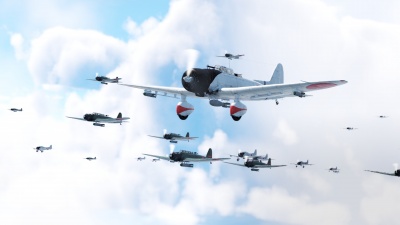
The B5N2, designated as the Type 97 Carrier Attack Bomber (九七式艦上攻撃機), was the standard Japanese carrier-based torpedo/high-level bomber during World War II. With its first flight in 1937, it served the Japanese Navy very favourably with its highly capable ordnance and was considerably faster than any Allied counterparts. Due to delays in the production of the B6N (Family), the B5N saw service from 1937 all the way until 1945, supplementing the B6Ns in secondary roles. While it saw initial service in the Second Sino-Japanese war, it played a major role in the opening phase of the Pacific war, contributing to the successes at Pearl Harbor, Coral Sea, Midway, and Santa Cruz Islands.
The B5N2 has been in the game since the start of the Open Beta Test prior to Update 1.27. While a considerably large target for the size of its wings, the B5N is a very manoeuvrable and relatively fast plane, able to outmanoeuvre and outspeed enemy interceptors. The B5N also carries a favourable array of ordnance for both high and low-altitude bombing on top of ship attacks.
- Nicknames
- IJN Pilot nickname: Kanko (艦攻, Abbriviation of 艦上攻撃機 (Kanjō Kōgekiki)).
- Allied reporting name: Kate.
General info
Flight performance
| Characteristics | Max Speed (km/h at 3,600 m) |
Max altitude (metres) |
Turn time (seconds) |
Rate of climb (metres/second) |
Take-off run (metres) | |||
|---|---|---|---|---|---|---|---|---|
| AB | RB | AB | RB | AB | RB | |||
| Stock | 362 | 347 | 19.7 | 20.4 | 3.7 | 3.7 | 270 | |
| Upgraded | 400 | 378 | 18.6 | 19.4 | 12.1 | 6.5 | ||
Details
| Features | ||||
|---|---|---|---|---|
| Combat flaps | Take-off flaps | Landing flaps | Air brakes | Arrestor gear |
| ✓ | ✓ | ✓ | X | ✓ |
| Limits | ||||||
|---|---|---|---|---|---|---|
| Wings (km/h) | Gear (km/h) | Flaps (km/h) | Max Static G | |||
| Combat | Take-off | Landing | + | - | ||
| 404 | 384 | 280 | ~11 | ~4 | ||
| Optimal velocities (km/h) | |||
|---|---|---|---|
| Ailerons | Rudder | Elevators | Radiator |
| < 300 | < 300 | < 310 | > 300 |
| Compressor (RB/SB) | ||
|---|---|---|
| Setting 1 | ||
| Optimal altitude | 100% Engine power | WEP Engine power |
| 2,500 m | 950 hp | 1,081 hp |
Survivability and armour
- No armour
- Non-self-sealing fuel tanks (2 in each wing)
Modifications and economy
- When upgrading this plane focus on getting the payload especially the torpedo modification. This is due to the high chance Japan has to get naval maps.
- After you've unlocked all the possible torpedoes, it is recommended that you research the flight performance modules first, as the aircraft has very little defensive and offensive capabilities.
Armaments
Suspended armament
With the amount of presets the B5N2 offers, it leaves a lot of space and multipurpose over to the pilot of any skill level with only 2 presets being a bad choice: the 800 kg AP bomb, and Type 91 Model 2 torpedo. The other presets should be chosen for these reasons:
- 1 x Type 91 Model 3 Torpedo = Naval targets
- 1 x 800 kg = ...
- High altitude naval bombing
- Low-skill / collateral tank bombing
- Base bombing
- 2 x 250 kg = Intermediate-skill tank bombing
- 6 x 60 kg = High-skill precise tank bombing
The B5N2 can be outfitted with the following ordnance:
- 6 x 60 kg Navy Type 97 Number 6 bombs (360 kg total)
- 2 x 250 kg Navy Type Number 25 Model 2 bombs (500 kg total)
- 2 x 250 kg Navy Type 98 Number 25 bombs (500 kg total)
- 1 x 800 kg Navy Type Number 80 Model 1 bomb (800 kg total)
- 1 x 800 kg Navy Type 99 Number 80 AP bomb (800 kg total)
- 1 x 835 kg Type 91 Model 2 torpedo
- 1 x 850 kg Type 91 Model 3 torpedo
Defensive armament
The B5N2 is defended by:
- 1 x 7.7 mm Type 92 machine gun, dorsal turret (1,000 rpg)
Usage in battles
The B5N2 is a Japanese torpedo-bomber that is lacking in offensive armaments and is defended by a single 7.7 mm Type 92 machine gun at the back, which makes it lacking in defence against enemy pursuers. Its greatest weapon is not the speed to outrun enemy fighters but its manoeuvrability and ability to do tight turns against most enemy aircraft till help arrives from the team.
The B5N2 might lack in offensive weaponry such as machine guns and cannons but it has a great variety of payload from 60 kg bombs to 800 kg bombs and even torpedoes in its arsenal to take out ground and naval targets with. Coming with 2 different 800 kg bombs, its important to pick the one most suitable for the mission, preferably the Navy Type Number 80 Model 1 over the Navy Type 99 Number 80 AP, with the benefit that the Type Number 80 Model 1 has a better blast radius and more explosive power than the Type 99 Number 80 AP bomb which is good at taking out a single heavily armoured target. It also come with two different sets of 250 kg bombs that can be dropped one by one and are preferable when striking at two different targets than a singular 800 kg.
Against naval targets, it's most preferred to use the Type 91 Mod.2 and Type 91 Mod.3 to deal with the sailors, keep in mind to dive and get fast speed to quickly get in and out of engagement with a warship or patrolboat to minimize the risk of being shot down. But when doing a dive attack to get the speed its important to not go over the speed limit where the B5N2 can drop the torpedoes without having them explode in the water on contact which would make the attack futile.
Every enemy should be seen as a serious threat to the B5N2, as it does not have an offensive armament. The only thing the plane has when it comes to armament is 1 7.7 mm machine gun, which is not a reliable way to fend off enemies with it lacks damage and doesn't offer the best coverage, but at 1.7 it might be enough to scare off ill-armoured biplanes.
Manual Engine Control
| MEC elements | ||||||
|---|---|---|---|---|---|---|
| Mixer | Pitch | Radiator | Supercharger | Turbocharger | ||
| Oil | Water | Type | ||||
| Controllable | Controllable Not auto controlled |
Controllable Not auto controlled |
Controllable Not auto controlled |
Separate | Not controllable 1 gear |
Not controllable |
Pros and cons
Pros:
- B5N for Carrier-based torpedo bomber
- Bomber spawn
- 1x Type 91 Aerial Torpedo
- Torpedo has the highest drop speed in the game at 580 km/h and is one of the most feared torpedoes in Naval Battles
- 6x Type 97 No.6 Land Bomb (60 kg)
- Gets a bomb rack of 6 x 60 kg bombs which can be used to hit multiple targets
- 1x No.80 Land Bomb (800 kg)
- Heaviest bomb Japanese Navy can offer
- Common Navy plane construction:
- Excellent manoeuvrability
Cons:
- B5N for Carrier-based torpedo bomber
- No offensive armament
- No airbrakes
- Relatively Large target
- Common Navy plane construction:
- Poor defensive armament: 7.7 mm Type 92 MG
- Fragile, little armour, and no self-sealing fuel tanks
- Exposed tail gunner
History
The Nakajima B5N2 (Allied code name: Kate) was a plane first flown in January 1937 for the Imperial Japanese Navy. About ~1149 Nakajima B5N Torpedo bombers were made for the Japanese Navy. It would see service in World war 2 and was the Japanese Navy's primary torpedo bomber for the early part of World war 2. The Nakajima B5N Torpedo bomber was credited with the sinking of three US Carriers the USS Lexington CV-2, USS Yorktown CV-6 and USS Hornet CV-8. One of the most notable pilot of the B5N is Mitsuo Fuchida, who led the first wave of aircraft during the Japanese attack on Pearl Harbor.
Although a total of 5,928 B5Ns were built, none survived the war. Two B5N's are know to exist, both made from wreckage's. One can be seen at the Pearl Harbor Memorial, it is missing its tail, left wing, engine, canopy, and a few other parts.
| Archive of the in-game description | |
|---|---|
|
Before the advent of the B5N, Japan used the B2M and B4Y as torpedo biplanes. However, the significant limitations of biplanes were obvious, so in 1935, inspired by the monoplane A5M fighter, the Imperial Japanese Navy developed the 10-Shi torpedo bomber specification. Nakajima and Mitsubishi participated in the competition. Nakajima decided to incorporate many new ideas in their B5N design. The prototype had a hydraulic wing-folding system so that the plane could be stored on an aircraft carrier, and Fowler flaps were used to improve stability while landing. In addition, the B5N had a hydraulic retractable landing gear system. Although Mitsubishi also received an order for production of its own B5M torpedo bomber, the Nakajima model won the contest and in 1937 was accepted as a production model carrier-based torpedo bomber. To create a production model, however, some changes had to be made in the prototype's design. The wing-folding system was changed to a manual one, and the flaps were replaced with conventional ones. In 1939, the B5N2 was developed. It differed from its predecessor in its more powerful and reliable Sakae engine, which produced 1000 hp instead of the Hikari 3's 770. At the beginning of World War II, the B5N torpedo series had no worthy competitors among Allied aircraft and made a great showing in the attack on Pearl Harbor, as well as in subsequent operations, where B5N forces sank four U.S. aircraft carriers within one year. A total of 5,928 B5Ns were built. | |
Media
- Skins
- Images
- Videos
See also
Links to the articles on the War Thunder Wiki that you think will be useful for the reader, for example:
- reference to the series of the aircraft;
- links to approximate analogues of other nations and research trees.
External links
| Nakajima Aircraft Company (中島飛行機株式会社 ) | |
|---|---|
| Fighters | Ki-27 otsu · Ki-27 otsu Tachiarai |
| Ki-43-I · Ki-43-II · Ki-43-III otsu | |
| Ki-44-I · Ki-44-I 34 · Ki-44-II otsu · Ki-44-II hei | |
| Ki-84 ko · Ki-84 otsu · Ki-84 hei | |
| Ki-87 | |
| Hydroplanes | A6M2-N* |
| Interceptors | J1N1 · J5N1 |
| Bombers | B5N2 |
| B6N1 Model 11 · B6N2 Model 12 · B6N2a Model 12Ko | |
| G5N1 · G8N1 | |
| Ki-49-I · Ki-49-IIa · Ki-49-IIb · Ki-49-IIb/L | |
| Recon | E8N2 |
| Jet Fighters | Kikka |
| Captured | ␗Ki-27 otsu · ▃Ki-43-II · ␗Ki-43-III ko · ␗Ki-44-II hei · ␗Ki-84 ko |
| *Refit of the Mitsubishi A6M2 mod. 11 | |
| See also | Fuji Heavy Industries (1957-2017) |
| Japan bombers | |
|---|---|
| Navy | |
| Carrier-based attack bomber | |
| B5N | B5N2 |
| B6N | B6N1 · B6N2 · B6N2a |
| B7A | B7A2 · B7A2 (Homare 23) |
| Carrier-based dive bomber | |
| D3A | D3A1 |
| D4Y | D4Y1 · D4Y2 · D4Y3 Ko |
| Shipboard Observation seaplane | |
| F1M | F1M2 |
| Land-based Attack bomber | |
| G4M | G4M1 |
| G5N | G5N1 |
| G8N | G8N1 |
| Flying boat | |
| H6K | H6K4 |
| H8K | H8K2 · H8K3 |
| Land-based Bomber | |
| P1Y | P1Y1 |
| Army | |
| Light | Ki-32 |
| Ki-48-II otsu | |
| Heavy | Ki-21-Ia · Ki-21-I hei |
| Ki-49-I · Ki-49-IIa · Ki-49-IIb · Ki-49-IIb/L | |
| Ki-67-I Ko · Ki-67-I otsu | |
| Other countries | ▅B-17E |