D4Y1
OLD‑WIKI.WARTHUNDER.COM (DEFUNCT)
| This page is about the Japanese dive bomber D4Y1. For other versions, see D4Y (Family). |
Description
The D4Y1 mod. 11, designated as the Suisei 11 (彗星一一型), was a dive bomber developed to replace the D3A1 with the primary design criteria being able to out-speed pursuers and out-range American carriers. With Japanese engine development lacking behind, the chosen high-output engine for the Suisei was the Aichi Atsuta 21 engine, a license-produced DB 601 found on the Bf 109 (Family) and many other German planes. While the engine outperformed its Japanese counterparts, the lack of industrial power, rare resources for parts and overall maintenance complexity strained its reliability and production numbers.
It was introduced in Update 1.75 "La Résistance". The pursuit for a long-range high-speed dive-bomber hampers the other capabilities of D4Y1, with relatively weak survivability, limited to only one bomb of maximum 500 kg which leaves the Suisei as a hit-and-run dive-bomber.
- Nicknames
- Official Designation: 彗星 (Suisei, "Comet")
- Allied reporting name: Judy
General info
Flight performance
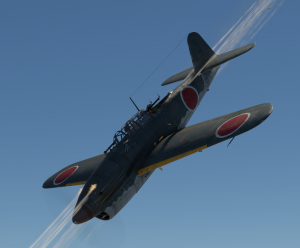
The D4Y1 is a highly agile and speedy aircraft, it can turn fight anything it wishes, even Spitfires. It gets a bomber airspawn, which allows the D4Y1 to outclimb all the fighters, but be sure to select the right airspawn, because it gets a carrier spawn by default on pacific maps. The only issue with the performance of this aircraft arises at high altitudes, where it is left without a supercharger.
| Characteristics | Max Speed (km/h at 4,750 m) |
Max altitude (metres) |
Turn time (seconds) |
Rate of climb (metres/second) |
Take-off run (metres) | |||
|---|---|---|---|---|---|---|---|---|
| AB | RB | AB | RB | AB | RB | |||
| Stock | 520 | 509 | 23.9 | 24.5 | 5.6 | 5.6 | 300 | |
| Upgraded | 589 | 552 | 22.2 | 23.0 | 14.4 | 9.3 | ||
Details
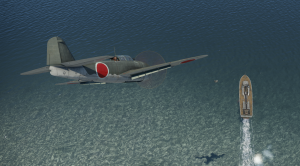
| Features | ||||
|---|---|---|---|---|
| Combat flaps | Take-off flaps | Landing flaps | Air brakes | Arrestor gear |
| ✓ | ✓ | ✓ | ✓ | ✓ |
| Limits | ||||||
|---|---|---|---|---|---|---|
| Wings (km/h) | Gear (km/h) | Flaps (km/h) | Max Static G | |||
| Combat | Take-off | Landing | + | - | ||
| 457 | 428 | 280 | ~15 | ~11 | ||
| Optimal velocities (km/h) | |||
|---|---|---|---|
| Ailerons | Rudder | Elevators | Radiator |
| < 350 | < 400 | < 400 | > 200 |
| Compressor (RB/SB) | ||
|---|---|---|
| Setting 1 | ||
| Optimal altitude | 100% Engine power | WEP Engine power |
| 4,500 m | 970 hp | 1,218 hp |
Survivability and armour
The D4Y1 has no armour. Additionally, the fuel tanks are not self-sealing. There are 2 in each wing. The gunner is not covered, making him vulnerable to attacks from the rear.
Modifications and economy
The payload option should be a top priority, so getting to tier three modifications is of utmost importance. Rush the new belts and MGs, or the radiator or compressor if you choose to have better performance. Then get the bomb modification. After that, research all engine modifications and then the survivability modifications. Save the turret upgrades for last.
Armaments
Offensive armament
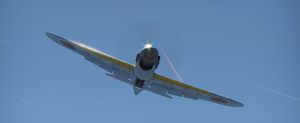
The D4Y1 is armed with:
- 2 x 7.7 mm Type 97 navy machine guns, nose-mounted (600 rpg = 1,200 total)
Suspended armament
The D4Y1 can be outfitted with the following ordnance:
- Without load
- 1 x 250 kg Navy Type Number 25 Model 2 bomb (250 kg total)
- 1 x 500 kg Number Type 2 50 Model 1 GP(SAP) bomb (500 kg total)
Defensive armament
The D4Y1 is defended by:
- 1 x 7.7 mm Type 92 machine gun, dorsal turret (582 rpg)
Usage in battles

The D4Y1 is an excellent example of a multirole aircraft, as it is an excellent ground attack aircraft, fighter, and bomber. Since you get a bomber airspawn, you can drop your bomb on a base and then start to engage the many fighters below you. You should have no problems engaging them, as long is you keep your speed up and your energy high. One key thing to note is that you don't need to use your defensive turret to shoo away enemy interceptors. You can easily out turn any interceptor at that BR. Besides the fighter role, ground attack is the D4Y1's natural method of play. The 500 kg bomb will be excellent for destroying Pillboxes, and you can use your rifle-calibre machine guns to destroy any soft target you please.Spec
Specific enemies worth noting
- CW-21 - The CW-21 poses a significant threat to the D4Y1, as it can out-turn, out-climb, and outclass the D4Y1 in every conceivable way. Its armament will shred through the D4Y1, and your plane would be a sitting duck. Now, your gunner can be of some use. Since the CW-21 is a very fragile aircraft, your gunner can set it afire, thus giving you the upper hand. But never under any circumstance attempt to go near this plane, as your gunner is only a last resort.
- He 100 D-1 - Much like the CW-21, this aircraft will outclass you in every way. Your turret will once again come in handy, as it will surely damage its cooling system.
Manual Engine Control
| MEC elements | ||||||
|---|---|---|---|---|---|---|
| Mixer | Pitch | Radiator | Supercharger | Turbocharger | ||
| Oil | Water | Type | ||||
| Controllable | Controllable Not auto controlled |
Controllable Not auto controlled |
Controllable Not auto controlled |
Separate | Not controllable 1 gear |
Not controllable |
Pros and cons

Pros:
- D4Y for Carrier-based dive bomber:
- Choice between a 250 kg and a 500 kg bomb
- Bomber airspawn, outclimbs anything and can intercept
- Airbrakes
- Common Navy plane construction:
- Nose-mounted armament
- Small radiator drag
- Excellent manoeuvrability, can outrun early Corsairs, Wildcats, and Spitfires
- D4Y Specific:
- D4Y1 Specific:

Cons:
- D4Y for Carrier-based dive bomber:
- Has bomb cradle, significant delay in fuselage bomb drop
- Bomb load is not good enough for bombing bases
- Common Navy plane construction:
- Poor offensive armament: 7.7 mm Type 97 MG
- Poor defensive armament: 7.7 mm Type 92 MG
- Fragile, little armour, and no self-sealing fuel tanks
- Exposed tail gunner
- D4Y (early) Specific:
- Engine overheats easily, it isn't a traditional Japanese radial engine
History

Nicknamed the "Judy" by allied pilots, the D4Y1 at the beginning of the war was one the fastest planes in all of the Pacific.
The D4Y1 was a carrier based dive bomber, powered by a 1,200 hp "Aichi AE1A Atsuta V12" engine. The D4Y1 was modeled after the German He 118 with the engine being modeled after the DB 601 which was used in the Bf 110. Due to the Japanese Navy requiring an extreme range for the aircraft, it was designed without any armour or self-sealing fuel tanks to lighten the plane so it would use less fuel. The lack of armour and protection decreased the weight, making them extremely quick and nimble but fragile if taking enemy fire. Combined with the unreliable engine, the D4Y1 would see many upgrades in the following models adjusting many of the flaws.
In 1943 with the introduction of the F6F Hellcat, the D4Y's became a sitting duck. Whereas with the F4F Wildcat, the D4Y's could just outrun them, the F6F would catch them with ease. During the "Great Marianas Turkey Shoot" a single F6F pilot Alexander Vraciu would shoot down 6 D4Y's within minutes. 400 Japanese planes would be shot down that day, but a D4Y did land a direct hit on the battleship USS South Dakota.
The D4Y's would become one of the most iconic planes the Japanese Military would use during World War 2.
Only a single complete D4Y1 survives today, located at the "Yasukuni Jinja Yūshūkan shrine" in Tokyo it can be seen completely restored.
Media
- Skins
- Videos
See also
- D4Y2 - Improved engine (Atsuta 31) and rocket payload
- D4Y3 Ko - Radial engine (Kinsei 62) and better tail-gun
External links
| Yokosuka Naval Air Technical Arsenal (海軍航空技術廠) | |
|---|---|
| Bombers | D4Y1 · D4Y2 · D4Y3 Ko |
| P1Y1 mod. 11 | |
| Jet fighters | R2Y2 Kai V1 · R2Y2 Kai V2 · R2Y2 Kai V3 |
| Captured | ␗P1Y1 mod. 11 |
| While the arsenal was simply known as the Naval Air Technical Arsenal and usually referred to as Kūgi-shō (Kaigun Kōkū Gijutsu-shō). | |
| The name Yokosuka prevailed however, even though it referred to the Arsenal's location. | |
| See also | Yokosuka Naval Arsenal (Shipyard) |
| Japan bombers | |
|---|---|
| Navy | |
| Carrier-based attack bomber | |
| B5N | B5N2 |
| B6N | B6N1 · B6N2 · B6N2a |
| B7A | B7A2 · B7A2 (Homare 23) |
| Carrier-based dive bomber | |
| D3A | D3A1 |
| D4Y | D4Y1 · D4Y2 · D4Y3 Ko |
| Shipboard Observation seaplane | |
| F1M | F1M2 |
| Land-based Attack bomber | |
| G4M | G4M1 |
| G5N | G5N1 |
| G8N | G8N1 |
| Flying boat | |
| H6K | H6K4 |
| H8K | H8K2 · H8K3 |
| Land-based Bomber | |
| P1Y | P1Y1 |
| Army | |
| Light | Ki-32 |
| Ki-48-II otsu | |
| Heavy | Ki-21-Ia · Ki-21-I hei |
| Ki-49-I · Ki-49-IIa · Ki-49-IIb · Ki-49-IIb/L | |
| Ki-67-I Ko · Ki-67-I otsu | |
| Other countries | ▅B-17E |