J6K1
OLD‑WIKI.WARTHUNDER.COM (DEFUNCT)
Description
The J6K1, designated as Jinpū (陣風), was a land-based interceptor that evolved from the J3K, a cancelled fighter project that depended on the delayed Mitsubishi Ha-43 / MK9 engine. Kawanishi, the manufacturer of both models, switched to the Nakajima Ha-45 / NK9 Homare engine for the J6K1 as soon as it was available. The Imperial Japanese Navy inspected the first wooden mockup in 1944 and considered three possible armaments with different combinations of 13.2 mm machine guns, 20 mm cannons, and 30 mm cannons. However, the J6K1 was soon dropped in favour of the N1K2-J Shiden Kai. The J6K might have been reconsidered as a heavier high-altitude interceptor in the final months of the war, but it was again rejected in favour of the proposed A7M3-J Reppū Kai.
The J6K1 was introduced during Update 1.95 "Northern Wind" as the main air reward for the 2019 Winter event Operation F.R.O.S.T. It is an extremely capable fighter thanks to its excellent handling at medium speeds and dangerous set of weaponry. The Jinpū comes armed with six 20 mm cannons in the wings and two additional 13.2 mm machine guns near the nose. With the tracer belt (full HE composition), the 20 mm cannons can easily destroy enemy aircraft and bombers. If needed, players can also equip armoured target belts to attack ground targets along with the two different bomb loadouts. Furthermore, the 20 mm cannons have plenty of ammunition which means players can be generous with firing from strange angles or far distances. As for performance, the Jinpū is a relatively big fighter but the manoeuvrability is still very competitive against other fighters. However, players should be careful with deploying the flaps as that’s one of the saving graces for the Jinpū when it comes to dogfighting.
- Nicknames
- Official Designation: 陣風 (Jinpū, "Squall")
General info
Flight performance
The J6K is a decent fighter. Designed to intercept and destroy B-29 formations (like most late war Japanese fighters), it has a 2-stage 3-speed supercharger and heavy armament. The aircraft is somewhat heavy and while the manoeuvrability is still pretty good, the climb rate and speed are generally sub par to its counterparts (P-51H, Bearcats, F4U/F2G etc.). The J6K1's speed is pretty good for a Japanese aircraft, which are characteristically slower than most.
| Characteristics | Max Speed (km/h at 10,000 m) |
Max altitude (metres) |
Turn time (seconds) |
Rate of climb (metres/second) |
Take-off run (metres) | |||
|---|---|---|---|---|---|---|---|---|
| AB | RB | AB | RB | AB | RB | |||
| Stock | 664 | 645 | 18.2 | 19.2 | 12.4 | 12.4 | 400 | |
| Upgraded | 710 | 686 | 17.8 | 18.0 | 20.0 | 16.0 | ||
Details
| Features | ||||
|---|---|---|---|---|
| Combat flaps | Take-off flaps | Landing flaps | Air brakes | Arrestor gear |
| ✓ | ✓ | ✓ | X | X |
| Limits | ||||||
|---|---|---|---|---|---|---|
| Wings (km/h) | Gear (km/h) | Flaps (km/h) | Max Static G | |||
| Combat | Take-off | Landing | + | - | ||
| 780 | 460 | 382 | 280 | ~12 | ~9 | |
| Optimal velocities (km/h) | |||
|---|---|---|---|
| Ailerons | Rudder | Elevators | Radiator |
| < 390 | < 390 | < 470 | > 324 |
Survivability and armour
- 8 mm steel plate behind the pilot
- Self-sealing fuel tanks (1 underneath pilot, 1 behind previously mentioned fuel tank, 1 in each wing)
Befitting of a Japanese aircraft, it is quite susceptible to damage. Despite the wings being strong enough to hold up in high G manoeuvres, they are quite weak when taking battle damage, especially so when doing said manoeuvres. Fires are also quite deadly, which happen quite often due to the large amount of fuel tanks scattered about the aircraft.
Modifications and economy
Armaments
Offensive armament
The J6K1 is armed with:
- 6 x 20 mm Type 99 Model 2 cannons, wing-mounted (200 rpg = 1,200 total)
- 2 x 13.2 mm Type 3 machine guns, wing-mounted (200 rpg = 400 total)
The J6K1 Jinpu is an ostensibly well-armed aircraft, boasting the most cannons of any Japanese aircraft. Although the Type 99 Model 2's lack the stopping power of the 30 mm Type 5/Ho-155 cannon which can be found on multiple Japanese aircraft of the ranks IV and V, they can do the job well when aimed accurately. The Type 3 HMGs are also reasonable spotting weapons that have similar muzzle velocity to the 20 mm and are quite accurate, allowing for easy follow-up shots. One should not rely on the HMGs as they deal negligible damage. Due to the considerable space between the cannons, it is recommended to set a convergence around 500 m, depending on how experienced you are with shooting these guns at higher ranges. Otherwise, you will only be hitting the target with your practically nonexistent 13 mm HMGs.
Your belt setup should be either stealth or universal for all guns. However, universal for the cannons and stealth for the HMGs allow you to focus on tracking with the cannons, which helps with players who either are learning to or have trouble with aiming them.
Suspended armament
The J6K1 can be outfitted with the following ordnance:
- Without load
- 4 x 60 kg Navy Type 97 Number 6 bombs (240 kg total)
- 2 x 250 kg Navy Type 98 Number 25 bombs (500 kg total)
Usage in battles
The J6K1 can be thought of as a slightly heavier N1K2. This means your climb rate and turn rate have been nerfed somewhat. In the beginning of each battle you will need to sideclimb as the J6K's added weight makes the climb rate rather subpar against many of your opponents. It is reasonably manoeuvrable and beats every American aircraft spare the P-59A in RB, though it is not enough to out-turn highly manoeuvrable planes like the Re.2005 serie 0 or Spitfire LF Mk IX (though it will outturn the later and heavier Spitfires with clipped wings)
However, it holds specific advantages over all of these aircraft, which changes depending on which one it's engaging. Versus Merlin Spitfires it out-speeds them and destroys them at high altitude, versus Griffon Spitfires it can outmanoeuvre them and it's considerably faster than the Re.2005 and can deal quite a bit of damage with its large armament setup. The only exception to these are the Bf 109s, as your approach style will have to change depending on the variant of the Messerschmitt in question and if they are mounting gunpods or not. You can outmanoeuvre them when they mount the gunpods but you can't outspeed them. Ideally, you should Boom-&-Zoom 109s if you have an altitude advantage or try to head-on them but the latter poses a significant risk due to the lack of bulletproof glass on the J6K.
Speed and altitude are your best friends when piloting the Jinpu. The Nakajima Homare 42 engine that powers the aircraft is tuned for high altitude combat, and is quite poor at altitudes below 2,000 m, so altitudes around or above 4,000 m are your ideal combat areas. Once you reach that altitude, start hunting for bombers and high flying attackers, then tear them to shreds with your impressive armament layout. If there are no bombers or they have all been destroyed, you are free to fly a more reserved high altitude energy fighter role versus other fighters. Be aware of the low absolute rip speed of 780 km/h (484 mph) while diving on enemies!
Specific enemies worth noting:
- P-51H-5-NA. The last of the Mustangs is a fearsome opponent that can walk all over the J6K if given the chance. It's significantly quicker, is better at altitude, and climbs better. To top it off, it mounts a sextet of the unnaturally powerful Browning M2 .50 cals that can literally light an aircraft ablaze in a short burst. Fortunately, it's quite poor in an extended turning engagement as a result of its design focusing on high speed combat and has a very weak airframe. Attempt to force it to turn fight you and bleed all of its energy, but be sure to make effective use of combat flaps and rudder.
- F8F-1B. Bearcat. This one word strikes fear into the hearts of all opponents who hear it, and the Jinpu is no exception. The last single-engined fighter of the famed Grumman Cat series can both literally and figuratively destroy the J6K with its amazing speed, excellent armament, Near Focke-wulf roll rate, and brutal acceleration. It is the only aircraft the J6K can simply not deal with, so it should be avoided at all costs unless it is distracted. If one tries to force an engagement with you, immediately seek assistance from teammates. If there is no way you can escape, head-on the Bearcat and pull off at around 1.1 km. Try to start a turnfight with the enemy. Your superior turn time and slightly better manoeuvring energy retention will allow you to eventually bleed the Bearcat's speed and light him up. However, under no circumstance should you go vertical with the Bearcat unless you have superior energy.
- I-225. The white Russian menace is the king of high-altitude combat. It outspeeds you, outclimbs you and can easily light you on fire with its fast-firing quad setup of ShVAKs. However, it is very poor in a turning engagement and has an extremely weak airframe. Turn-fight then light it up.
Manual Engine Control
| MEC elements | ||||||
|---|---|---|---|---|---|---|
| Mixer | Pitch | Radiator | Supercharger | Turbocharger | ||
| Oil | Water | Type | ||||
| Controllable | Controllable Not auto controlled |
Controllable Not auto controlled |
Controllable Not auto controlled |
Separate | Controllable 3 gears |
Not controllable |
Pros and cons
Pros:
- Strong armament (use universal belt for 20 mm, HEF round has more explosive filler than HEF-I and HEF-T)
- Decent turn
- Reasonably fast for a Japanese fighter, still sub-par to the majority of opponents (unless at very high altitude >6,000-7,000 m where you can outspeed low-alt tuned aircraft like the F8F and Spitfire LF)
- Effective combat flaps and rudder
- Reasonable cockpit visibility despite a few bars
Cons:
- Fragile, only a small armour plate behind the pilots body
- Very bad climb rate, you cannot outclimb basically any of your opponents
- Bad acceleration
- Low speed, especially since it usually faces high performance or even superprops (P-51H, Griffon Spitfires, Yak-3U, A2D, F8F) and jets
History
The Kawanishi J6K Jinpu was a land-based interceptor fighter design finalized by the Kawanishi Aircraft Company in 1944. It was an improved version of the earlier discontinued Kawanishi J3K using a more powerful engine, the Nakajima Homare 42 radial engine, rather than the Mitsubishi MK9B.
- J3K
In early 1942, Kawanishi and its engineers were developing their first ever land-based fighter out of their own volition (which would later be known as the N1K-J Shiden (Kai)). At the same time, the Navy approached Kawanishi with the 17-Shi Fighter Plane plan. Instead of using their own N1K design for the contract, they decided to design a new land-based fighter from scratch instead.
While developing the plane, Kawanishi insisted on using the Nakajima Homare engine instead of the Mitsubishi Ha-43-21 (MK9) that the Navy demanded for (this wasn't the first time they would defy the Navy's orders as the same happend during the development of the N1K1). Kawanashi's reasoning was mainly production-related however as their own Homare engine was still in development and building an airframe without a complete engine would be stagnant.
Because of this and the already in development N1K-J Shiden (Kai), Kawanishi opted to cancel the J3K project and with that the 17-shi in early 1943.
- J6K
After the J3K, the Nakajima NK9A Homare 42 was fully developed and Kawanishi restarted the designing of the J3K, now under the designation of J6K Jinpu.
(Other J-designations went to: J3K, J4M Senden, J5N Tenrai).
In June of 1944 a design was fully drawn up and ready to be put up to the test and a first airframe was to be built. There were 3 possible armaments for the plane which would be:
- 2 x 13.2 mm machine guns (nose), 4 x 20 mm cannons (wings)
- 2 x 13.2 mm machine guns (nose), 2 x 30 mm cannons (wings)
- 6 x 20 mm cannons (wings)
While a mock-up was being built, their homebrew of the N1K-J Shiden within the Navy was successfully causing havoc among the Americans, reducing the need for the new aircraft.
During a private-venture meeting in May 1945, just before the end of the war, there would be plans to reconsider the plane for a high-altitude role, but these plans would be the last nail to the coffin, as there were plans to improve the A7M for this role instead.
Media
- Skins
- Images
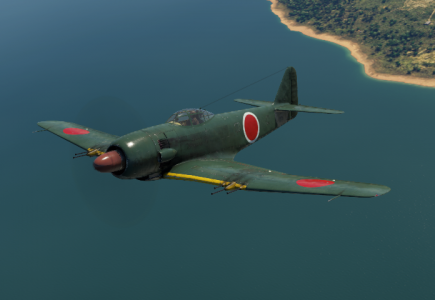
Standard camouflage
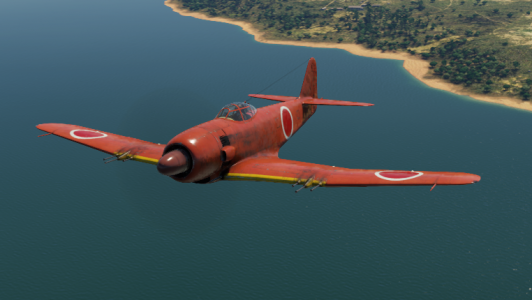
Experimental orange camouflage earned in 2019 "Operation F.R.O.S.T."

See also
Links to the articles on the War Thunder Wiki that you think will be useful for the reader, for example:
- reference to the series of the aircraft;
- links to approximate analogues of other nations and research trees.
External links
| Kawanishi Aircraft Company (川西航空機) | |
|---|---|
| Fighters | J6K1 |
| N1K | N1K1-Ja · N1K2-J · N1K2-Ja |
| Bombers | H6K4 · H8K2 · H8K3 |
| Hydroplane | N1K1 · E7K2 |
| Japan fighters | |
|---|---|
| Navy | |
| Carrier-based fighter | |
| A5M | A5M4 · Hagiri's A5M4 |
| A6M | A6M2 mod. 11 · A6M2 · A6M3 · A6M3 mod. 22 · A6M3 mod. 22Ko · A6M5 · A6M5 Ko · A6M5 otsu · A6M5 Hei · A6M6c |
| A7He | A7He1* |
| A7M | A7M1 (NK9H) · A7M2 |
| Land-based Fighter | |
| J2M | J2M2 · J2M3 · J2M4 Kai · J2M5 · J2M5 (30 mm) |
| J6K | J6K1 |
| J7W | J7W1 |
| N1K-J | N1K1-Ja · N1K2-J · N1K2-Ja |
| Fighter seaplane | |
| N1K | N1K1 |
| A6M-N | A6M2-N |
| Army | |
| Ki-10 | Ki-10-I · Ki-10-I C · Ki-10-II · Ki-10-II C |
| Ki-27 | Ki-27 otsu · Ki-27 otsu Tachiarai |
| Ki-43 | Ki-43-I · Ki-43-II · Ki-43-III otsu |
| Ki-44 | Ki-44-I · Ki-44-I 34 · Ki-44-II otsu · Ki-44-II hei |
| Ki-61 | Ki-61-I ko · Ki-61-I otsu · Ki-61-I hei · Tada's Ki-61-I hei · Ki-61-I tei · Ki-61-II Otsu Kai |
| Ki-84 | Ki-84 ko · Ki-84 otsu · Ki-84 hei |
| Ki-87 | Ki-87 |
| Ki-94 | Ki-94-II |
| Ki-100 | Ki-100 · Ki-100-II |
| Other countries | ▅F4U-1A · ▅P-51C-11-NT · ▅Bf 109 E-7 · ▅Fw 190 A-5 |
| *Imported designation of the He 112 (A6M was in development - A7M would take A7 designation after the cancelation of the A7He) | |
| Japan premium aircraft | |
|---|---|
| Fighters | Hagiri's A5M4 · A7He1 · Ki-27 otsu Tachiarai |
| Ki-44-II otsu · ▅Bf 109 E-7 · ▅F4U-1A · Ki-100-II · Ki-44-I 34 | |
| ▅Fw 190 A-5 · A7M1 (NK9H) · Tada's Ki-61-I hei · ▅P-51C-11-NT | |
| J2M4 Kai · A6M5 Ko · A6M6c · J2M5 · Ki-87 · J6K1 | |
| Twin-engine fighters | Ki-96 |
| Jet fighters | F-86F-40 JASDF▅ · T-2 Early · F-4EJ ADTW |
| Strike aircraft | ▄AV-8S |
| Bombers | Ki-21-I hei · Ki-48-II otsu · H8K3 · B7A2 (Homare 23) · ▅B-17E |