P-59A
OLD‑WIKI.WARTHUNDER.COM (DEFUNCT)
Description
At the early stages of World War II in 1941, Major General Henry H. "Hap" Arnold was invited to attend a demonstration of the United Kingdom's Gloster E.28/39, the first British jet aircraft. Impressed with what he saw, he requested a copy of the blueprints to the Power Jets W.1 turbojet engine and received them along with a Whittle W.1X turbojet and drawings for the more powerful W.2B/23 engine. All of this was handed over to General Electric for them to produce a U.S. version of the engine. Next, Bell Aircraft Corporation was approached to build a fighter which would utilize this new jet. Accepting the challenge, Bell started by modifying a version of its P-63 Kingcobra propeller-powered fighter.
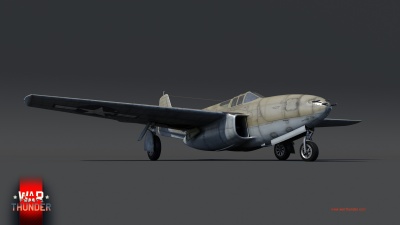
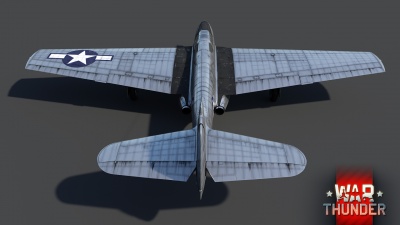
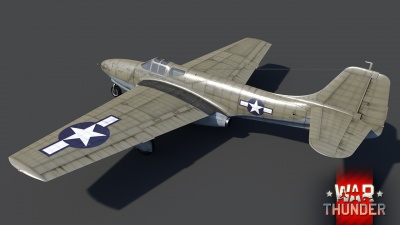
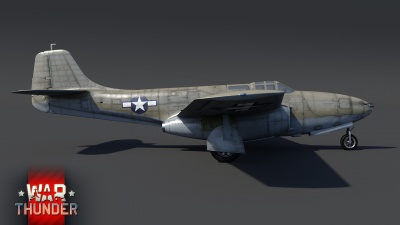
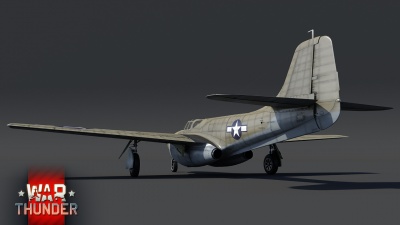
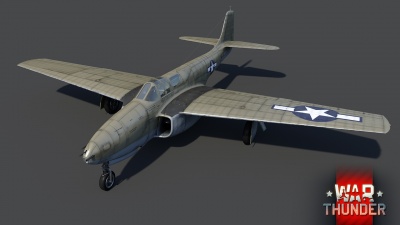
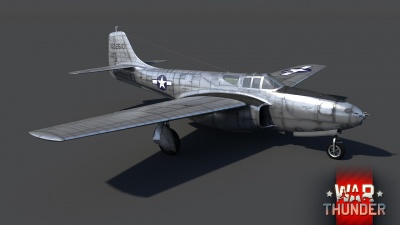
To accommodate the new type of engines, the P-59A underwent some significant modifications such as a higher placed wing (mid-fuselage compared to the P-63's low-wing setup), extended tail and fuselage and widened body to accept the turbojet engines. The new P-59A was plagued with many problems (many of which were attributed to early turbojets themselves), though, in the fighter was tested by pilot Chuck Yeager who was thoroughly dissatisfied with the speed of the aircraft, however, he noted that the flight characteristics of the aircraft were amazingly smooth.
Introduced during Update 1.89 "Imperial Navy" as a reward for the 2019 Operation H.E.A.T event, the P-59A finds itself in a unique position as a jet fighter sitting at rank IV, though just having turbojets compared to opponents at its battle rating sporting propellers will not give it the sole advantage. Several turbo-props will be able to keep up; however, the manoeuvrability of this aircraft is where it shines and when the pilot utilizes rudder control and combat flaps, the P-59A can surprisingly outmanoeuvre many aircraft including British Spitfires. The 37 mm autocannon and the three 12.7 mm machine guns are sufficient enough to punch large holes through enemy aircraft or dismantle them piece-by-piece. Without any suspended ordnance, the P-59A will strictly be a fighter/bomber interceptor unless there is a corner of the map where the Airacomet can ground attack without the threat of ambush by enemy fighters as it will need to maintain its speed to be useful.
General info
Flight performance
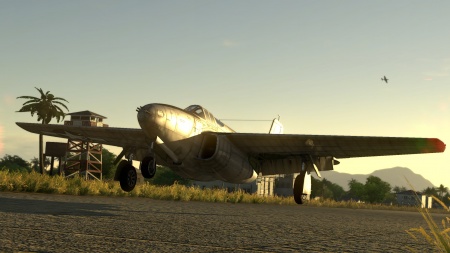
The P-59A Airacomet is quite an unusual jet with a number of unique and quirky characteristics. Firstly, it has a very low battle rating considering it is a jet. The reason for this is due to how poor its performance is compared to every other jet and most super-props (P-51H, F8F-1B, Bf 109 K-4, G.56, I-225). Secondly, the aircraft is unbelievably manoeuvrable and able to out-turn Spitfires at the BR with the correct usage of the combat flaps and rudder. These oddities make the Airacomet a very interesting plane to fly and the complete opposite of 90% of jets the player might've flown before. The P-59 has excellent manoeuvrability and decent roll rate. The very terrible acceleration is something to keep an eye on, but in a straight line, you will be able to catch other opponents. It will take a long time to get up to speed, but sooner or later, you'll catch your opponent if they continue to fly in a straight line.
| Characteristics | Max Speed (km/h at 9,144 m) |
Max altitude (metres) |
Turn time (seconds) |
Rate of climb (metres/second) |
Take-off run (metres) | |||
|---|---|---|---|---|---|---|---|---|
| AB | RB | AB | RB | AB | RB | |||
| Stock | 659 | 638 | 20.9 | 21.4 | 16.1 | 15.3 | 457 | |
| Upgraded | 723 | 690 | 19.2 | 20.0 | 23.4 | 19.5 | ||
Details
| Features | |||||
|---|---|---|---|---|---|
| Combat flaps | Take-off flaps | Landing flaps | Air brakes | Arrestor gear | Drogue chute |
| ✓ | ✓ | ✓ | X | X | X |
| Limits | ||||||
|---|---|---|---|---|---|---|
| Wings (km/h) | Gear (km/h) | Flaps (km/h) | Max Static G | |||
| Combat | Take-off | Landing | + | - | ||
| 495 | 460 | 290 | ~10 | ~6 | ||
| Optimal velocities (km/h) | |||
|---|---|---|---|
| Ailerons | Rudder | Elevators | Radiator |
| < 450 | < 420 | < 350 | N/A |
Engine performance
| Engine | Aircraft mass | |||||
|---|---|---|---|---|---|---|
| Engine name | Number | Empty mass | Wing loading (full fuel) | |||
| General Electric J31-GE-3 | 2 | 3,710 kg | 128 kg/m2 | |||
| Engine characteristics | Mass with fuel (no weapons load) | Max Takeoff Weight | ||||
| Weight (each) | Type | 8m fuel | 20m fuel | 29m fuel | ||
| 387 kg | Centrifugal-flow turbojet | 3,974 kg | 4,328 kg | 4,593 kg | 5,820 kg | |
| Maximum engine thrust @ 0 m (RB / SB) | Thrust to weight ratio @ 0 m (105%) | |||||
| Condition | 100% | 105% | 8m fuel | 20m fuel | 29m fuel | MTOW |
| Stationary | 750 kgf | 780 kgf | 0.39 | 0.36 | 0.34 | 0.27 |
| Optimal | 750 kgf (0 km/h) |
780 kgf (0 km/h) |
0.39 | 0.36 | 0.34 | 0.27 |
Survivability and armour
- 6.35 mm steel plate mounted behind the armaments
- 6.35 mm steel plate in front of the pilot
- 38 mm bulletproof glass (63°) mounted in the windshield
- 2 x 6.35 steel plates behind the pilot seat
- 9.5 mm steel plate mounted behind the pilot's head
As an early jet fighter, common carryovers from the propeller-driven aircraft were found in the P-59A which were eliminated in later aircraft in favour of more fuel or heavier suspended armaments. It was standard to envelop the pilot with armoured plates especially in a fighter such as the Airacomet to protect from defensive fire or anti-aircraft shrapnel. To protect the pilot from attacks from the front, a 6.35 mm steel plate was placed both behind the offensive weapons and in front of the instrument panel in the cockpit. A 38 mm bulletproof glass was installed in the front windshield. Three different armoured plates were placed behind the pilot's seat and headrest and were of varying thicknesses of 6.35 mm and 9.5 mm.
As the P-59A struggles for speed, it may have been a better option to sacrifice all of the armour but the bulletproof windshield in order to allow for the extra speed due to the weight savings. Unfortunately, this would not be realized until later jet fighters made this transition to forgo most if not all protective armour to squeeze out more power or more ordnance.
Modifications and economy
Armaments
Offensive armament
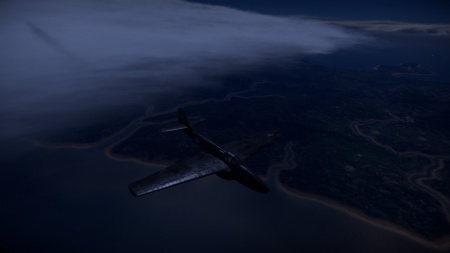
The P-59A is armed with:
- 1 x 37 mm M10 cannon, nose-mounted (45 rpg)
- 3 x 12.7 mm M2 Browning machine guns, nose-mounted (200 rpg = 600 total)
As found on earlier Bell fighters (P-39 and P-63), 37 mm autocannons tended to be heavy hitters with well-placed hits leaving only remnants of enemy fighters or bisecting bomber wings or fuselage. Though a heavy hitter, it is not without faults as it tends to work best in close range (>300 m) and when aircraft are showing the most surface area. Tail-shots have a bad propensity to spark or hit, but leave minimal or no damage (ricochet shot). Best chances for taking out an aircraft with this cannon is to wait until the enemy begins to manoeuvre and expose much of its wing or fuselage surface area, giving the 37 mm round the best chance to hit as close to perpendicular as possible thus avoiding sparking or a ricochet shot.
The 12.7 mm machine guns, though not as powerful as an autocannon round, can find their way to putting nice sized holes in engines, control surfaces, fuel tanks and pilots. Since the P-59A has all of its armament located in the nose of the aircraft, the pilot does not have to worry about calculating for convergence and the three machine guns effectively work as a shotgun and sends out a spread pattern of 12.7 mm bullets towards the enemy aircraft. Again, close in, these machine guns can be devastating, though definitely remain an option for longer range shots, however, their punch does start to drop off after a while. It is best to fire the 37 mm autocannon and the 12.7 mm machine guns separately due to the differences in velocity and bullet drop as the heavier 37 mm round will lose velocity quicker and drop sooner than the 12.7 mm rounds and with only 45 rounds to work with, the pilot will not want to squander the precious ammunition which will not land in the same location where the 12.7 mm rounds will hit.
Usage in battles
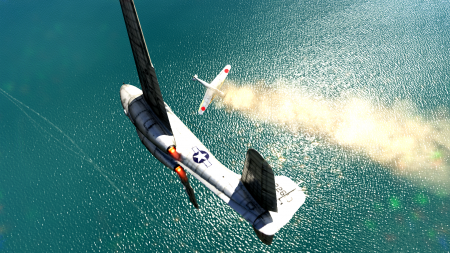
There are multiple ways the player can use the P-59A; energy fighter, highly manoeuvrable dogfighter, interceptor, or boom and zoomer.
Energy Fighter
- The P-59A is a decent energy fighter that can be used versus enemies with worse energy retention, such as most twin-engine fighters and the Fw 190's. This tactic should not be flown versus aircraft like Spitfires, 109's and Ki-84's, however. Many of these aircraft have superior energy retention, climb rates, and acceleration compared to the P-59A. You should only try to out-stall an opponent when they are coming to you with an energy disadvantage, as the Airacomet has a relatively high stall speed and mediocre climb rate. It is to be noted, however, that the aircraft can very easily recover from a full stall but is a little unstable after having to pull the nose down.
Dogfighter
- The role that P-59A excels the most at is as a medium-altitude dogfighter. This role will allow you to use its unbelievable manoeuvrability to the fullest. The only aircraft that can keep up to you in turns are the Zero's, the Reppu's and the occasional Ki-61. You can out-speed all of them very easily due to their very low top-end speeds, however. It is important to know that you can only out-turn Spitfires and Yak-3's with appropriate use of combat flaps and efficient application of the aircraft's solid rudder. A smart pilot will also use the aircraft's great roll rate to help manoeuvre around opponents. The close-range nature of dogfighting is also a boon to the P-59A because of the 37 mm cannon's mediocre muzzle velocity of 610 m/s compared to the Browning's 900 m/s, and at close range, you do not have to worry about that difference.
Interceptor
- The P-59A is a very solid interceptor that can easily climb up to bomber altitude and shred their airframes with the potent armament layout at its disposal. Be sure to steer clear of the gunners, as even though your airframe can take a beating, its never a good idea to tail a bomber with at least decent defensive armaments. One should come in at an oblique angle and aim at the wings and engines of the enemy.
Boom and Zoom
- Boom and Zoom tactics can be utilized by the P-59A against opponents that may present a challenge in a turning fight. Due to the P-59A lack of prop drag it has decent straight line energy retention. Although this tactic does not leverage the primary strengths of the P-59A it is a very useful fall back when fighting enemies such as the A6M5 Zero or the A7M2/A7M1 Reppu.
Specific enemies worth noting:
- A6M5. The dreaded Zero is an aeroplane to be feared while playing the P-59A, due to the fact that it is one of very few aircraft that can turn with you. Under no circumstances are you to engage a Zero in a manoeuvring fight, as it'll turn circles around you. The Zero is plagued by several downfalls though, namely an extremely weak airframe and slow top-end speeds, and you can take advantage of both of these.
- A7M2/A7M1. Being a cousin of the legendary Zero, you can expect a similar flight style between the two. The Reppu keeps the manoeuvrability of its cousin while improving speed, acceleration and armaments. Approach a Reppu the same way you would approach the Zero.
Pros and cons
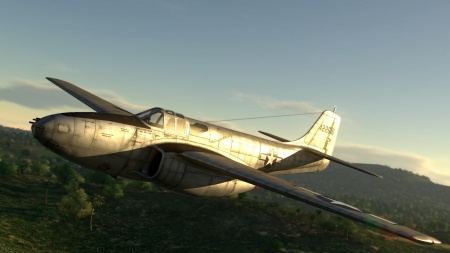
Pros:
- Unbelievable manoeuvrability for a jet
- Solid armament layout centred entirely in the nose
- Great roll rate
- Sturdy airframe which can take a beating
- Tricycle landing gear to help with high-speed landings
- Access to premium rewards
- Very low repair cost
Cons:
- Slow for a jet, unable to keep up with most super-props
- Mediocre acceleration due to being an early jet aircraft
- 37 mm cannon rounds can be less effective and easily deflected due to the angle of attack
- Large target when coming in from above or below
- Wings are littered with fuel tanks
- No suspended ordnance for dedicated ground-attack
History
The P-59A Airacomet was a prototype jet-powered fighter intended to serve in the USAF. The P-59A was the first jet fighter aircraft to fly in the USA, though it would never enter service. Because of the P-59's disappointing flight performance, the USAF cut the order from 100 aircraft to 50 and relegated the remaining aircraft to training duties. Despite this, the P-59A was instrumental in providing the air force with knowledge regarding jet operations, which would pave the way for future jet aircraft such as the F-80 and F-86.
In 1941, Major General Henry "Hap" Arnold of the USAF learned of the British jet-engine development program after witnessing taxi tests of the Gloster E.28/39, the first British jet-engined aircraft to take flight. Arnold arranged for the acquisition of the blueprints of the engine, the Power Jets W.1, and had a complete engine shipped over to the United States for evaluation. General Electric received a contract to build the engine as the General Electric I.A, while Bell Aircraft received a contract to build a fighter around the engine: as a result, the P-59A was born.
While it received the same 'P-59' designation as a prior unrelated piston-engined fighter design (mainly as a disinformation tactic), the P-59A was the first American jet-engined fighter to fly. In terms of design, the aircraft was distinguished by its engines: two General Electric J-31s, a derivative of the General Electric I.A. Aside from the engines, the P-59A wasn't too unique in any way; it had a mid-mounted straight wing and Bell's trademark tricycle landing gear. The aircraft were fitted with a single 37 mm cannon and three 12.7 mm Browning machine guns as armament.
After being built secretly at a disused car factory, the first P-59A prototype flew in early October of 1942. Over the coming months, the P-59A proved to be quite disappointing, as the aircraft suffered issues with its engines and with its lateral stability, making it impossible to aim the cannons at high speeds. The P-59A was also loaned to the British in exchange for a newly-produced Gloster Meteor, who found that the P-59A underperformed compared to their Meteors. As a result, the original order for 100 P-59As was cut in half, with the remaining aircraft used as training aircraft to familiarize pilots with jet combat. While unsuccessful as a fighter, the P-59A paved the way for the development of future jet aircraft, including the Lockheed P-80, America's first operational jet fighter.
Devblog
The P-59A Airacomet is the very first US jet-powered fighter, whose development began back in 1941, when the USA received the schematics for the Whittle turbojet engine from Great Britain. It was the Bell Aircraft Corporation that signed the contract to assemble the New World's first jet-powered fighter. Despite the unicity of the task at hand and lack of experience in the development of jet-powered aircraft, the company was planning on launching a serial production of the fighter as opposed to just building a test unit. The first aircraft was assembled as early as 1942 and underwent testing until 1944 – the engineers were struggling to solve a multitude of technical issues caused by the new engines. Once the majority of the engine-tuning problems were fixed, it turned out that the flight characteristics of the new vehicle couldn't surpass even those of serially produced piston-engine models. Nonetheless, a small series of P-59s was manufactured – a total of 66 aircraft branded "Airacomets". The US jet-powered firstling failed to impress the military, and soon all combat aircraft were replaced with P-80 Shooting Stars.
Media
- Skins
- Images
- Videos
See also
- Related development
- Aircraft of comparable role, configuration and era
External links
- [Development] P-59A Airacomet: One of Its Kind
- Official data sheet - more details about the performance
| Bell Aircraft Corporation | |
|---|---|
| Aircraft | |
| Fighters | P-39N-0 · P-39Q-5 |
| P-400 | |
| P-63A-10 · P-63A-5 · P-63C-5 · ␠Kingcobra | |
| Jet Fighters | P-59A |
| Export | ▂P-39K-1 · ▂Pokryshkin's P-39N-0 · ▂P-39Q-15 · ▄P-39Q-25 |
| ▂P-63A-5 · ▂P-63A-10 · ▂P-63C-5 · ▄P-63C-5 | |
| Helicopters | |
| Attack | AH-1F · AH-1G · AH-1Z · AH-1W |
| OH-58D | |
| Utility | UH-1B · UH-1C · UH-1C XM-30 |
| Export/Licensed | ▅UH-1B · ◄UH-1D |
| Tzefa A · Tzefa B · Tzefa D/E · ▅AH-1S early · ▅AH-1S · ▅AH-1S Kisarazu · ␗AH-1W | |
| ␗OH-58D | |
| See Also | Fuji Heavy Industries · Agusta |
| USA jet aircraft | |
|---|---|
| Fighters | |
| F9F | F9F-2 · F9F-5 · F9F-8 |
| F-80 | F-80A-5 · F-80C-10 |
| F-84 | F-84B-26 · F-84F · F-84G-21-RE |
| F-86 | F-86A-5 · F-86F-25 · F-86F-2 · F-86F-35 |
| F-89 | F-89B · F-89D |
| F-100 | F-100D |
| F-104 | F-104A · F-104C |
| F-4 | F-4C Phantom II · F-4E Phantom II · F-4J Phantom II · F-4S Phantom II |
| F-5 | F-5A · F-5C · F-5E · F-20A |
| F-8 | F8U-2 · F-8E |
| F-14 | F-14A Early · ▄F-14A IRIAF · F-14B |
| F-15 | F-15A · F-15C MSIP II · F-15E |
| F-16 | F-16A · F-16A ADF · F-16C |
| Other | P-59A · F2H-2 · F3D-1 · F3H-2 · F4D-1 · F11F-1 |
| Strike Aircraft | |
| FJ-4 | FJ-4B · FJ-4B VMF-232 |
| A-4 | A-4B · A-4E Early |
| A-7 | A-7D · A-7E · A-7K |
| AV-8 | AV-8A · AV-8C · AV-8B Plus · AV-8B (NA) |
| A-10 | A-10A · A-10A Late · A-10C |
| F-111 | F-111A · F-111F |
| Other | A-6E TRAM · F-105D · F-117 |
| Bombers | |
| B-57 | B-57A · B-57B |
| USA premium aircraft | |
|---|---|
| Fighters | Thach's F2A-1 · Galer's F3F-2 · F2G-1 · F4U-4B VMF-214 · P-26A-34 · Rasmussen's P-36A · P-40C · P-43A-1 |
| P-47M-1-RE · ⋠P-47M-1-RE · P-51A · P-51D-10 · P-51D-20-NA · ␠Kingcobra · XP-55 | |
| ▃A6M2 · ▃Ki-43-II · ▃Ki-61-Ib · ▃Bf 109 F-4 · ▃Fw 190 A-8 · ▃Spitfire LF Mk IXc | |
| Twin-engine fighters | XP-38G · Bong's P-38J-15 · P-38K · YP-38 · P-61A-11 · XF5F · XP-50 · F7F-3 |
| Jet fighters | P-59A · F-86F-35 · F-89B · F-89D · F-4S Phantom II · F-5C · F-20A |
| Strike aircraft | A-1H · A2D-1 · AU-1 · XA-38 · AV-8A · AV-8B (NA) · A-6E TRAM · A-10A |
| Bombers | A-26C-45DT · B-10B · BTD-1 · PBM-3 "Mariner" · PBM-5A "Mariner" · PV-2D |