F2G-1
OLD‑WIKI.WARTHUNDER.COM (DEFUNCT)
Description
Goodyear Aircraft Company was one of two companies that were building F4U Corsairs during World War 2. GAC decided to take a chance in developing the F2G, also known as the Super Corsair. The F2G-1 was a land-based variant intended to be a low-altitude interceptor while the F2G-2 was intended for naval operations. GAC planned to modify the original Corsair airframe with improvements like a new bubble-type canopy. The most notable addition was the Pratt & Whitney R-4360 Wasp Major, a 28-cylinder radial engine that could produce an impressive 3,000 horsepower. Ten F2Gs were produced until production was canceled in 1945 due to the superior F8F Bearcat. Performance deficiencies in testing and engine issues also doomed the Super Corsair from further production.
Introduced in Update "New Power", the F2G-1 was a reward for Battle Pass: Season I, 75th Anniversary of the Great Victory. The F2G has stellar low-altitude performance but struggles at higher altitudes due to the lack of a usable supercharger gear. The Super Corsair also has excellent flaps which greatly help with dogfighting enemies. It's also armed with six .50 cal machine guns and has access to bombs and rockets. The F2G is a very dangerous aircraft in the right hands especially with its incredible dive speed and handling.
General info
Flight performance
The F2G-1 has an excellent straight-line speed at all altitudes, together with a fantastic roll rate and a brilliant flap performance. The engine allows long usage of WEP before heating up and has a stellar engine performance below 3,000 m but the engine performance declines above 3,000 m, and becomes weak above 5,000 m. The acceleration declines strongly above 4,000 m and engine radiators are hard to be kept closed in Automatic Engine Control mode, adding some drag.
The F2G-1 shows great performance in shallow high speed climbs but the plane has an overall lacklustre manoeuvrability.
The great low-altitude engine performance combined with the strong flap performance allows the F2G-1 to stall fight quite well. However, it has a slow stall recovery: it's suggested you flip your plane horizontally with your rudder prior to a stall. The flaps have relatively low rip speeds for this plane and they will not open at all when above a certain IAS velocity. The Landing gear can be used as an improvised airbrake instead. Elevator & rudder compressions become a handicap upwards of 700 km/h.
| Characteristics | Max Speed (km/h at 5,000 m) |
Max altitude (metres) |
Turn time (seconds) |
Rate of climb (metres/second) |
Take-off run (metres) | |||
|---|---|---|---|---|---|---|---|---|
| AB | RB | AB | RB | AB | RB | |||
| Stock | 675 | 654 | 22.0 | 22.7 | 14.9 | 14.9 | 180 | |
| Upgraded | 739 | 706 | 20.7 | 21.0 | 27.0 | 20.0 | ||
Details
| Features | ||||
|---|---|---|---|---|
| Combat flaps | Take-off flaps | Landing flaps | Air brakes | Arrestor gear |
| ✓ | ✓ | ✓ | X | X |
| Limits | ||||||
|---|---|---|---|---|---|---|
| Wings (km/h) | Gear (km/h) | Flaps (km/h) | Max Static G | |||
| Combat | Take-off | Landing | + | - | ||
| 382 | 293 | 248 | ~10 | ~4 | ||
| Optimal velocities (km/h) | |||
|---|---|---|---|
| Ailerons | Rudder | Elevators | Radiator |
| < 540 | < 250 | < 450 | > 460 |
Survivability and armour
- 38 mm bulletproof glass - Windscreen
- 12.7 mm steel - Pilot's headrest
- 8 mm steel - Pilot's seat
- 3 mm steel in front of the pilot
Modifications and economy
Armaments
Offensive armament
The F2G-1 is armed with:
- 6 x 12.7 mm M2 Browning machine guns, wing-mounted (375 rpg outer + 400 rpg centre + 400 rpg inner = 2,350 total)
Suspended armament
The F2G-1 can be outfitted with the following ordnance:
- Without load
- 2 x 250 lb AN-M57 bombs (500 lb total)
- 2 x 500 lb AN-M64A1 bombs (1,000 lb total)
- 2 x 1,000 lb AN-M65A1 bombs (2,000 lb total)
- 8 x HVAR rockets
- 2 x Tiny Tim rockets
Usage in battles
Generally, this aircraft is best suited to the in-game American doctrine of boom-and-zooming. In composition with stellar dive speed, engine performance, and long-range weaponry: you have great capability to dance around other propeller planes with relative impunity. Due to this, this is an amazing plane for dogfights, which you should always engage in. You should be cruising at ~3km, a perfect altitude to dive on any ground huggers or to dive away from any climbers who might swoop down upon you. Any dogfight you wish to initiate should be prioritized energy-wise; you should master the use of your flaps, they will give that needed edge. Keep fights low. In the circumstance you are below another propeller plane, you should extend the other direction and increase your IAS. Climbers like Bf 109 K-4, Ta-152 H, G.56, and so on, will not peruse you. Alternatively, you may try baiting them into a dogfight.
On the other end, a fully up-tiered F2G will be faced with early jets. Any attempts to outperform them in straight lines, be they flat runs or shallow climbs/dives, may often result in failure. Although you do have a chance to catch most jets by surprising them with steep dive. You should take advantage of the F2G's superior low speed acceleration and handling. Be quick and decisive in punishing jet players who attempt to turn with you, as a manoeuvring Super Corsair tends to quickly grab attention from other enemies. However, express caution when attempting to engage Kikka, J21R, F-80, and so on. Many early jets have comparable manoeuvrability to you, while still boasting solid top speed and horizontal energy retention. To your benefit, their acceleration is still lacking, so it is still possible to successfully counter them in a manoeuvring fight. Try to fight under 3,000 m (9,800 ft), as your engine's high altitude performance is inadequate.
If you are being boom-and-zoomed by a jet, there is not much you can do. Your guns are long-range, high-velocity, and cover a large area, so spraying down the engines of your enemy is a valid tactic, just watch your ammo. Ultimately, you must continue dodging their BnZ passes until they become impatient and make a mistake. Do not try and pitch up for too long after they zoom, the superior top speed of all jets will allow them to easily stall you out, despite your impressive engine.
Manual Engine Control
| MEC elements | ||||||
|---|---|---|---|---|---|---|
| Mixer | Pitch | Radiator | Supercharger | Turbocharger | ||
| Oil | Water | Type | ||||
| Not controllable | Controllable Auto control available |
Controllable Auto control available |
Controllable Auto control available |
Separate | Not controllable 1 gear |
Not controllable |
The F2G-1 does not have meaningful overheating problems. In the case you do, however, it is recommended to utilize 85% prop-pitch, and to optimize your oil radiators to ~100%, given they have almost no drag.
Pros and cons
Pros:
- Fantastic roll rate
- Brilliant flap performance
- Absolutely stellar engine performance below 3,000 m
- Engine allows long usage of WEP before heating up
- Excellent straight-line speed at all altitudes
- Landing gear can be used as an improvised airbrake
- Low-altitude energy and flap performance allows you to stall fight quite well
- Great performance in shallow high speed climbs
- Each .50 cal MG has 400 rounds per gun
- .50 cal MGs have great ballistics and can be deadly even past 1 km
Cons:
- Lacklustre manoeuvrability at low speeds without flaps
- Low flap rip speeds
- Flaps will not open at all when above a certain IAS velocity
- Elevator & rudder compression upwards of 700 km/h becomes a handicap
- Slow stall recovery
- Engine performance declines above 3,000 m, and becomes weak above 5,000 m
- Engine radiators are hard to be kept closed in Automatic Engine Control mode, adding some drag
- Acceleration declines strongly above 4,000 m
- The 6 x .50 cal MGs require solid sustained bursts, making high speed deflection shots unreliable
History

|
The F2G Corsair is often referred to as "Super Corsair", though that was never an official designation. |
Genesis
Pratt & Whitney fitted an F4U-1 Corsair (Bu.No. 02460) - donated to them by the Navy - with their R-4360-4 Wasp Major engine in March 1943. The P&W R-4360-4 Wasp Major engine put out approximately 50% more power than the original P&W R-2800-1 Double Wasp used in other Corsairs; the 28-cylinder R-4360-4 was able to produce 3,000 horsepower. The F4U-1 fitted with the R-4360-4 was designated as F4U-1WM, and it was proven as a success after testing. As such, development of a production Corsair fitted with the R-4360 was given to Goodyear on 22 March 1944, when the Navy ordered 418 F2G-1 Corsairs and 10 F2G-2 Corsairs (a navalized variant with carrier capability).
Development
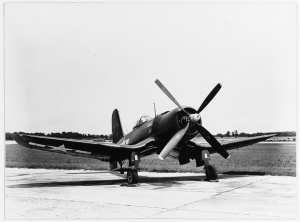
Seven prototypes were built and designated as XF2G-1, being modified production FG-1 Corsairs (a Goodyear-produced, fixed wing "de-navalized" version of the Corsair). The first XF2G-1 (Bu.No. 13471) was fitted with the R-4360 engine but retained many characteristics of the standard Corsair, including the canopy and cockpit, though the engine cowling was extended and an air scoop was added on top of the fuselage right behind the engine cowling. It began ground testing on 31 May 1944, and first flew on 26 August of the same year. The second XF2G-1 (Bu.No. 13472) was used to test new aspects including oil coolers and propellers, which would be used on later XF2G-1s.
The remaining five prototypes (Bu.Nos. 14691 through 14695) were modified much more extensively. They featured a new bubble canopy and a reduced spine, in order to provide better visibility to the pilot. Additionally, the cockpit was redesigned; it received a floor and new controls quite similar to those used on the Vought F4U-4 version of the Corsair. The XF2G-1 retained the six .50 cal (12.7 mm) machine guns of the FG-1 as well as the same ordnance carrying capability, but they were modified to allow the carrying of external, jettisonable fuel tanks for extended range.
Bu.No. 14691 used the engine taken from the first prototype, Bu.No. 13471, and it first flew on 15 October 1944. Bu.No. 14692 added wing-mounted fuel tanks and improved vertical control surfaces. Bu.No. 14693 was fitted with the R-4630-4W version of the R-4630 engine, which introduced water-ethanol injection for increased power, but the -4W version of the engine was not fitted to any other version of the F2G. The final XF2G-1, Bu.No. 14695, had its first flight on 4 December 1944. Both 14692 and 14695 were lost in separate accidents on December 12th 1945: 14692 lost hydraulics inflight which led to its undercarriage extending to a position in which a safe landing could not be made, so its pilot bailed out; while 14695 suffered a similar hydraulics failure but in its case the pilot was able to make a safe belly landing. However, on recovering the stricken aircraft, the crane used to salvage it failed and collapsed on top of the aircraft, effectively destroying it.
On 27 November 1944, the XF2G-1 was given to the U.S. Navy for testing. Some issues arose during testing, particularly that the engine torque of the engine would cause the aircraft to turn hard to the left in a carrier wave off (when increasing the throttle in the case that the landing had to be aborted). In the case of a wave off and the throttle being applied, the rudder was not able to prevent the nose swinging to the left. To prevent this effect, the rudder was heightened by twelve inches and an auxiliary rudder was installed beneath it which would automatically turn 12.5° to the right when the flaps were extended past 30°, in order to counteract the torque of the engine[1].
Production
The first production F2G-1 (Bu.No. 88454) was delivered to the Navy on 15 July 1945, but the contract for production had been cut down to only five F2G-1 and five F2G-2 two months earlier in May. Production therefore ended in August 1945 after only 5 F2G-1 (Bu.Nos. 88454 through 88458) and and 5 F2G-2 (Bu.Nos. 88459 through 88463) had been produced, for a total of eighteen F2G aircraft built of all variants, including the F4U-1WM. The Navy continued testing of the F2G series after production cancellation but dropped the F2G completely soon after.
Production of the F2G had been cancelled due in part to disappointing test results. The F2G-1 had an impressive climb rate of 4,400 feet per minute, but its top speed of 430 mph (692 km/h) was rather disappointing, and it also had some stability issues. Overall, its performance wasn't a large enough improvement over other aircraft in production, particularly the F4U-4 and F8F-1 Bearcat, which is why the production orders for the F2G were cancelled.
Post-War Use - Racing
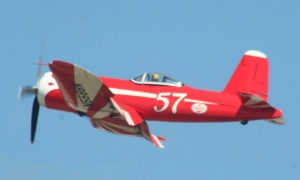
The F2G was much more successful post-war, many of the aircraft having served well as air racing aircraft, the most famous of which being the fifth production F2G-1 (Bu.No. 88458) known as "Race 57", famous for its bright red color scheme. Bu.No. 88463, the last F2G-2 produced, was also a racing aircraft known as "Race 74" and painted dark blue. Race 74 was destroyed in a crash in 2012 that also killed the pilot, Bob Odegaard. Only two F2G aircraft survive as of January 2021, which are the aforementioned Bu.No. 88458 "Race 57" and Bu.No. 88454, both F2G-1s.
List of F2G Aircraft
F4U-1WM
- Bu.No. 02460
XF2G-1
- Bu.No. 13471- engine test airframe and first flying prototype. Engine donated to 14691 after completion of trials.
- Bu.No. 13472 - scrapped April 30th 1946
- Bu.No. 14691 - scrapped June 30th 1947
- Bu.No. 14692 - destroyed in crash December 12th 1946, pilot bailed out with landing gear stuck in configuration unsafe for landing.
- Bu.No. 14693 - Sold to Cook Cleland in 1947 as NX5590N. "Race 94" at 1947, 1948 and 1949 National Air Races. Flown by Dick Becker at 1947 Thompson Trophy, 2nd place. Flown by Cook Cleland at 1948 Thompson Trophy, retired due to engine failure. Flown by Cook Cleland at 1949 Thompson Trophy, 1st place. Restored by Bob Odegaard in 2007 - destroyed in fatal accident in 2012.
- Bu.No. 14694 - Sold to Ron Puckett in 1947 as NX91092. "Race 18" in 1947 & 1949 National Air Races. Retired at 1947 Thompson Trophy due to engine failure. 2nd place at 1949 Thompson Trophy. Aircraft scrapped some time after 1949 National Air Races.
- Bu.No. 14695 - damaged in crash December 12th 1946, destroyed in subsequent recovery accident
F2G-1
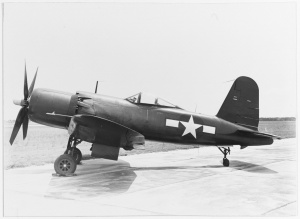
- Bu.No. 88454 - N/A - Display, Museum of Flight, Seattle, Washington
- Bu.No. 88455 - scrapped August 31st 1946
- Bu.No. 88456 - scrapped May 31st 1947
- Bu.No. 88457 - Sold to Cook Cleland in 1947 as NX5588N. "Race 84" at 1947 National Air Races. Destroyed in fatal accident at 1947 Thompson Trophy while flown by Tony Janazzo.
- Bu.No. 88458 - scrapped in January of 1948, parts sold as spares to Cook Cleland. Rebuilt using the data plate of 88457, taking up the identity of N5588N. "Race 57" at 1949 National Air Races - flown by Ben McKillen at 1949 Thompson Trophy, 3rd place Restored by Bob Odegaard in 1999 - Airworthy, Louise M. Thaden Airfield, Bentonville, Arkansas (owned by Steuart Walton)
F2G-2
- Bu.No. 88459 - scrapped January 1948
- Bu.No. 88460 - scrapped May 31st 1948
- Bu.No. 88461 - scrapped January 1948
- Bu.No. 88462 - scrapped May 31st 1947
- Bu.No. 88463 - Sold to Cook Cleland in 1947 as NX5577. "Race 74" at the 1947, 1948 and 1949 National Air Races. Flown by Cook Cleland at 1947 Thompson Trophy, 1st place. Flown by Dick Becker at 1948 Thompson Trophy, retired due to engine failure. Flown by Dick Becker at 1949 Thompson Trophy, withdrawn due to engine failure. Aircraft scraped some time after 1949 National Air Races.
- Bu.No. 88464 - aircraft not completed by Goodyear, probably scrapped while still incomplete on the production line.
- Bu.No. 88465 - aircraft not completed by Goodyear, probably scrapped while still incomplete on the production line.
- Bu.No. 88466 - bounced on landing and broke in two, NAS Alameda, February 6th 1949.
- Bu.No. 88467 - aircraft noted marked as C51. Aircraft fate unknown.
- Bu.No.88468 - aircraft not completed by Goodyear, probably scrapped while still incomplete on the production line.
Note: There was an aircraft named Super Corsair and later "Race #1" , which despite the name was not an F2G. It was an F4U-1D fitted with the R-4360 engine, clipped wings, and a modified cockpit.
Media
- Skins
- Images
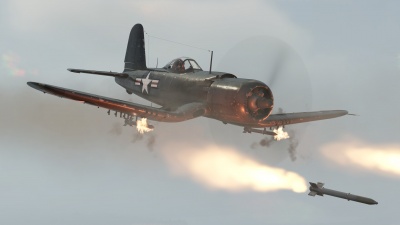
F2G-1 devblog image
- Videos
See also
Links to the articles on the War Thunder Wiki that you think will be useful for the reader, for example:
- reference to the series of the aircraft;
- links to approximate analogues of other nations and research trees.
External links
- Official data sheet - more details about the performance
- Air and Space - Corsairs with Four-Bank Radials
References
- Citations
- ↑ https://www.avialogs.com/reader.php?jid=55684 Archieved: https://web.archive.org/web/20231119004237/https://www.avialogs.com/reader.php?jid=55684 Preliminary Pilot's Handbook of Flight Operating Instructions Navy Models F2G.
- Bibliography
- Air Racers - The Planes - In Focus - F2G Super Corsairs - Part 3: Corncob Corsair Racing Roots. (n.d.). Retrieved January 09, 2021, from http://www.pylon1.org/articles/publish/article_24.shtml
- F2G Super Corsairs - Part 2: "Kamikaze Killer". (n.d.). Retrieved January 09, 2021, from http://www.pylon1.org/articles/publish/printer_23.shtml
- Goodyear F2G super Corsair. (n.d.). Retrieved January 09, 2021, from https://www.jdsf4u.be/goodyear-f2-g-super-corsair
- Goodyear XF2G-1 Corsair. (n.d.). Retrieved January 09, 2021, from https://www.jdsf4u.be/kopie-van-goodyear-f2-g-super-corsa
- http://www.airrace.com/1947%20NAR%20.html
- http://www.airrace.com/1948%20NAR.htm
- http://www.airrace.com/1949%20NAR%20.htm
| Goodyear Aircraft Company | |
|---|---|
| Fighters | F2G-1 |
| USA fighters | |
|---|---|
| P-26 Peashooter | P-26A-33 · P-26A-34 · P-26A-34 M2 · P-26B-35 |
| P-36 Hawk | P-36A · Rasmussen's P-36A · P-36C · ○P-36C · P-36G |
| P-39 Airacobra | P-400 · P-39N-0 · P-39Q-5 |
| P-40 | P-40C · P-40E-1 · P-40E-1 TD · P-40F-10 |
| P-43 Lancer | P-43A-1 |
| P-47 Thunderbolt | P-47D-22-RE · P-47D-25 · P-47D-28 · P-47M-1-RE · ⋠P-47M-1-RE · P-47N-15 |
| P-51 Mustang | P-51 · P-51A (Thunder League) · P-51C-10 · P-51D-5 · P-51D-10 · P-51D-20-NA · P-51D-30 · P-51H-5-NA |
| P-63 Kingcobra | P-63A-5 · P-63A-10 · P-63C-5 · ␠Kingcobra |
| Prototypes | XP-55 |
| F2A Buffalo | F2A-1 · Thach's F2A-1 · F2A-3 |
| BF2C | BF2C-1 |
| F3F | F3F-2 · Galer's F3F-2 |
| F4F Wildcat | F4F-3 · F4F-4 |
| F4U Corsair | F4U-1A · F4U-1A (USMC) · F4U-1D · F4U-1C · F4U-4 · F4U-4B · F4U-4B VMF-214 · F2G-1 |
| F6F Hellcat | F6F-5 · F6F-5N |
| F8F Bearcat | F8F-1 · F8F-1B |
| Other countries | ▃Ki-43-II · ▃Ki-61-Ib · ▃A6M2 · ▃Bf 109 F-4 · ▃Fw 190 A-8 · ▃Spitfire LF Mk IXc |
| USA premium aircraft | |
|---|---|
| Fighters | Thach's F2A-1 · Galer's F3F-2 · F2G-1 · F4U-4B VMF-214 · P-26A-34 · Rasmussen's P-36A · P-40C · P-43A-1 |
| P-47M-1-RE · ⋠P-47M-1-RE · P-51A · P-51D-10 · P-51D-20-NA · ␠Kingcobra · XP-55 | |
| ▃A6M2 · ▃Ki-43-II · ▃Ki-61-Ib · ▃Bf 109 F-4 · ▃Fw 190 A-8 · ▃Spitfire LF Mk IXc | |
| Twin-engine fighters | XP-38G · Bong's P-38J-15 · P-38K · YP-38 · P-61A-11 · XF5F · XP-50 · F7F-3 |
| Jet fighters | P-59A · F-86F-35 · F-89B · F-89D · F-4S Phantom II · F-5C · F-20A |
| Strike aircraft | A-1H · A2D-1 · AU-1 · XA-38 · AV-8A · AV-8B (NA) · A-6E TRAM · A-10A |
| Bombers | A-26C-45DT · B-10B · BTD-1 · PBM-3 "Mariner" · PBM-5A "Mariner" · PV-2D |