F4F-4
OLD‑WIKI.WARTHUNDER.COM (DEFUNCT)
| This page is about the American fighter F4F-4. For other variants, see F4F (Family). |
Description
The F4F-4 was a workhorse of US Naval aviation in the first years of World War II until the arrival of more powerful and advanced carrier based fighters such as F6F Hellcat and F4U Corsair. F4F was initially designed as a competitor to Brewster F2A Buffalo, but lost the contract. Although slower, the more manoeuvrable Buffalo was chosen. Grumman then redesigned his XF4F-2 prototype into what was to become a F4F-3 Wildcat. The Wildcat was inferior to A6M Zero used by Japanese in the Pacific Theatre in most aspects. Unlike the A6M, it was heavily armoured which allowed the fighter to take significant damage and still return to its carrier. Jimmy Thach developed a tactic for Wildcat pilots fighting Zeros which consisted of using altitude advantage and hit and run attacks on the Japanese fighters. Unlike the F4F-3, the F4F-4 featured Grumman patented Sto-Wing folding wing system where the wings folded behind the aircraft, saving valuable space on the carriers. Another change was installing two additional .50 cal machine guns into the wing, total of six. Unfortunately the ammunition amount stayed the same, so instead of 450 rpg, pilots had only 240 rpg at their disposal. Installing the extra guns and folding wings came at cost of performance decrease as the extra weight slowed down the plane to max speed of about 512 km/h at 5900 m.
The F4F-4 has been in the game since the start of the Open Beta Test prior to Update 1.27. The F4F-4 is nimble, heavily armoured and heavily armed fighter compared to its contemporaries. It cannot achieve speeds higher than its foes, although it is possible to utilize the sheer weight of the plane to gain speed for fast boom & zoom attacks on the foes under your aircraft. Due to abysmal climb rate, side climbing is advised.
General info
Flight performance
The Wildcat is a sort of middle child between the F2A Buffalo and the F6F Hellcat in the naval tree. While being slightly slower, climbing slower and turning worse than the previous F2A-3 Buffalo you unlocked, the Wildcat has two extra Browning M2s which ups the firepower by a decent amount. The Wildcat is also better at altitude than the Buffalo, meaning it's a better dogfighter at a high altitude. Given its traits, it is recommended to use the Wildcat as a high altitude dogfighter, although its mediocre climb rate makes it difficult to out-climb the opponents you face.
The clipped wings and light weight of the F4F-4 allows for a very solid roll rate while having little effect on its turning capabilities, as it will still be able to outturn most enemies.
| Characteristics | Max Speed (km/h at 5,600 m) |
Max altitude (metres) |
Turn time (seconds) |
Rate of climb (metres/second) |
Take-off run (metres) | |||
|---|---|---|---|---|---|---|---|---|
| AB | RB | AB | RB | AB | RB | |||
| Stock | 497 | 480 | 20.9 | 21.8 | 11.6 | 11.6 | 258 | |
| Upgraded | 538 | 517 | 18.9 | 19.9 | 16.8 | 14.0 | ||
Details
| Features | ||||
|---|---|---|---|---|
| Combat flaps | Take-off flaps | Landing flaps | Air brakes | Arrestor gear |
| ✓ | ✓ | ✓ | X | ✓ |
| Limits | ||||||
|---|---|---|---|---|---|---|
| Wings (km/h) | Gear (km/h) | Flaps (km/h) | Max Static G | |||
| Combat | Take-off | Landing | + | - | ||
| 826 | 420 | 420 | 420 | ~13 | ~4 | |
| Optimal velocities (km/h) | |||
|---|---|---|---|
| Ailerons | Rudder | Elevators | Radiator |
| < 320 | < 390 | < 300 | > 200 |
Survivability and armour
- 6.35 mm steel- behind pilot's body
- 8 mm steel - behind pilot's head
- 38 mm bulletproof glass - armoured windscreen
- Critical components located in front of aircraft (fuel, pilot, engine, controls).
The Wildcats have two large and easy to hit fuel tanks that are placed in the centre of the fuselage, and a big oil cooling system in the cowling. This means that any pilot who knows where to aim will be able to seriously cripple you and send you limping back to the airfield if they don't kill you outright.
When facing against a Wildcat pilot, a smart Wildcat pilot will assess the situation it is in and plan accordingly. If you are in a plane that turns worse, do not take its bait to make you turn to fight them, so try to Boom-N-Zoom it and vice-versa for a plane that turns better but is slower.
Modifications and economy
Armaments
Offensive armament
The F4F-4 is armed with:
- 6 x 12.7 mm M2 Browning machine guns, wing-mounted (240 rpg = 1,440 total)
If you liked the F4F-3 Wildcat but were disappointed by its poor armament, you will welcome the upgrade in firepower from the F4F-4. The 2 extra M2 Brownings increase the firepower from the Buffalo and F4F-3 by an entire kilogram, reaching a respectable one-second burst mass of 3.30 kg/s compared to the previously mentioned Buffalo and F4F-3's 2.20 kg/s.
However, a downside to this change is a much lower ammo count per machine gun load. The total ammunition load is the same at around 1,400 rounds, but compared to the F4F-3's 450 rounds per gun load, the F4F-4 only has 240 rounds per gun. As such, the time span of firing is reduced greatly for the gain in increased fire saturation.
Suspended armament
The F4F-4 can be outfitted with the following ordnance:
- Without load
- 2 x 100 lb AN-M30A1 bombs (200 lb total)
Usage in battles
As with any American fighter, you should break into a climb at the start of a match, attempting to reach an altitude of 3,000 to 4,000 m where the Pratt and Whitney R-1830-86 radial starts increasing performance. If you encounter an enemy you know you can outturn, turn fight them and make good use of the rudder.
As you climb, you will encounter enemies that outclass you in many ways such as BF 109 E-3/4s and F-1s, C. 202ECs and C. 205s, Zeroes and the dreaded J2M2. Do not engage with any of these targets. All of the previously mentioned planes will rip you to shreds and almost completely outclass you.
When encountering enemies, there are some that should be highlighted as dangerous to the F4F-4's well-being.
- BF 109s: The legendary Messerschmitts out climb you, outrun you and in some cases, outturn you. Bf 109 E-4s and F-1s are the most common versions you will come across, but you can face the F-4 which is entirely superior. You can outturn the E-4, but be wary of its twin MG FF/M carrying the volatile minengeschoß round. However, do not engage with the F-1, as it turns better and is faster than you while still mounting a single MG FF/M which only needs to land a few shots before downing you and the same goes for the F-4 which mounts the more powerful MG 151.
- A6M2s: Zeroes are an interesting opponent to fight, but are easily countered. Zeroes turn better than almost every plane in the game but are painfully slow, so abuse their low speed to Boom-N-Zoom them, but be careful about their two 20 mm cannons which can still down you as you fly away.
- J2M2s: The Raiden is the ultimate counter to the Wildcat. It is better at altitude, climbs almost twice as well, is faster, and mounts two powerful 20 mm Type 99 Mk2 cannons which can rip you to shreds, and as such, you should avoid them at all costs. However, if you are forced to fight one, use your better turn time to try to get on its tail, but it is the best course of action to fly towards teammates so they can help get rid of it.
Manual Engine Control
| MEC elements | ||||||
|---|---|---|---|---|---|---|
| Mixer | Pitch | Radiator | Supercharger | Turbocharger | ||
| Oil | Water | Type | ||||
| Controllable | Controllable Auto control available |
Controllable Not auto controlled |
Controllable Not auto controlled |
Separate | Controllable 3 gears |
Not controllable |
Pros and cons
Pros:
- Decent manoeuvrability
- Fair roll rate
- Extra pair of .50 M2 Browning machine guns, compared to the F4F-3
- Can carry some payload
- Can take some heavy punishment
- Improved pilot protection, compared from the previous model
- Good dive speed characteristics
- Can fly with a red engine (AB)
Cons:
- Commonly faces difficult foes
- Mediocre rate of climb and top speed
- Low ammo count (of only 1,440 rounds) despite the added guns
- Bad cockpit rear visibility (SB)
History
The F4F-4 Wildcat was an improved version of the F4F-3. The main improvements were the addition of a third pair of wing-mounted .50 cal machine guns - for a total of six machine guns, and the Grumman Sto-Wing system, which allowed the outer wings to fold inwards on hinges. This would theoretically allow 5 Wildcats to be stored in the space that 2 would have taken up before, but this didn't quite work out in actuality.
After entering service in 1941, the F4F-4 replaced the earlier F4F-3 Wildcat in all squadrons but VMF-221 by the Battle of Midway in 1942. As such, the F4F-4 was the main fighter aircraft in service during the early part of the war, including the Battle of Midway.
Many pilots disliked the F4F-4, because despite having two more guns the F4F-4 had the same amount of ammunition as earlier models. The 1,800 rounds of ammunition had just been distributed between the guns; the F4F-3 had 450 rounds per gun but the F4F-4 only had 240, decreasing firing time by almost 50%. The extra guns had been added per Royal Navy request. Additionally, the extra guns and folding wings increased weight and therefore decreased performance. The F4F-4 had a lower top speed and climb rate than the F4F-3. As well, the folding wings only allowed an increase of F4F Wildcats in a carrier wing by only 50% - much lower than was hoped.
| Archive of the in-game description | |
|---|---|
|
The Grumman F4F-4 Wildcat was a single-engine all-metal construction plane in the F4F series. The F4F-4 increased the number of 12.7 mm machine guns to six and was built with manually folding wings. Wingspan was decreased from 11.5 to 4.36 metres when the wings were folded, allowing 50% more aircraft to be held on a carrier. The plane's ruggedness was also much improved. To protect the pilot, bulletproof glass was installed and the area under the pilot's seat was armoured. Other armoured areas were improved, fuel tank protection was increased, and the oil radiators under the wings were better protected, as well. The engine was replaced. The F4F-3 model had a two-stage supercharger, but those engines were in high demand for the production of B-17 bombers, so engines with single-stage superchargers were used instead for the F4F-4. The F4F-4 entered service in 1942, but the pilots were disappointed with the new model. It had greater survivability when compared with the F4F-3 but had significantly lower performance characteristics. Also, its gun ammunition was reduced and could be depleted in less than 20 seconds, which also evoked a negative response from pilots. All in all, 1,169 F4F-4s were constructed. | |
Media
- Skins
- Images
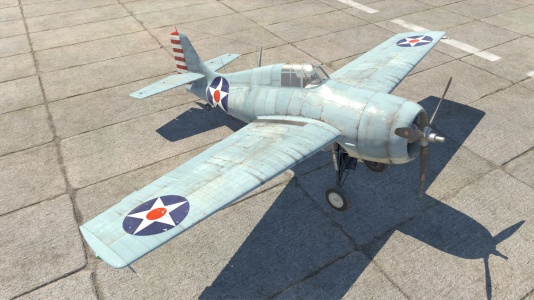
Reworked model of the F4F-4
- Videos
See also
- Related development
External links
Paste links to sources and external resources, such as:
- topic on the official game forum;
- other literature.
| Grumman Aircraft Engineering Corporation | |
|---|---|
| Aircraft | |
| Fighters | |
| F3F | F3F-2 · Galer's F3F-2 |
| F4F Wildcat | F4F-3 · F4F-4 |
| XF5F Skyrocket | XF5F · XP-50 |
| F6F Hellcat | F6F-5 · F6F-5N |
| F7F Tigercat | F7F-1 · F7F-3 |
| F8F Bearcat | F8F-1 · F8F-1B |
| Jet Fighters | |
| F9F Panther/Cougar | F9F-2 · F9F-5 · F9F-8 |
| F-11 Tiger | F11F-1 |
| F-14 Tomcat | F-14A Early · F-14B |
| Jet Strike Aircraft | |
| A-6 Intruder | A-6E TRAM |
| Bombers | TBF-1C |
| Export | ▄Martlet Mk IV · ▄F6F-5 · ▄F6F-5N · ▄F8F-1B · ▄Avenger Mk II · ▄Hellcat Mk II |
| ▄F-14A IRIAF | |
| Naval Vehicles | |
| Patrol Gunboat Hydrofoil (PGH) | USS Flagstaff |
| USA fighters | |
|---|---|
| P-26 Peashooter | P-26A-33 · P-26A-34 · P-26A-34 M2 · P-26B-35 |
| P-36 Hawk | P-36A · Rasmussen's P-36A · P-36C · ○P-36C · P-36G |
| P-39 Airacobra | P-400 · P-39N-0 · P-39Q-5 |
| P-40 | P-40C · P-40E-1 · P-40E-1 TD · P-40F-10 |
| P-43 Lancer | P-43A-1 |
| P-47 Thunderbolt | P-47D-22-RE · P-47D-25 · P-47D-28 · P-47M-1-RE · ⋠P-47M-1-RE · P-47N-15 |
| P-51 Mustang | P-51 · P-51A (Thunder League) · P-51C-10 · P-51D-5 · P-51D-10 · P-51D-20-NA · P-51D-30 · P-51H-5-NA |
| P-63 Kingcobra | P-63A-5 · P-63A-10 · P-63C-5 · ␠Kingcobra |
| Prototypes | XP-55 |
| F2A Buffalo | F2A-1 · Thach's F2A-1 · F2A-3 |
| BF2C | BF2C-1 |
| F3F | F3F-2 · Galer's F3F-2 |
| F4F Wildcat | F4F-3 · F4F-4 |
| F4U Corsair | F4U-1A · F4U-1A (USMC) · F4U-1D · F4U-1C · F4U-4 · F4U-4B · F4U-4B VMF-214 · F2G-1 |
| F6F Hellcat | F6F-5 · F6F-5N |
| F8F Bearcat | F8F-1 · F8F-1B |
| Other countries | ▃Ki-43-II · ▃Ki-61-Ib · ▃A6M2 · ▃Bf 109 F-4 · ▃Fw 190 A-8 · ▃Spitfire LF Mk IXc |