F4F-3
OLD‑WIKI.WARTHUNDER.COM (DEFUNCT)
| This page is about the American naval fighter F4F-3. For other versions, see F4F (Family). |
Description
The Grumman F4F Wildcat was the US Navy's backbone against the Japanese A6M2 and A6M3 Zero in the early stages of the Pacific War. The aircraft was praised for its survivability and reliability, but in most cases, regular pilots could not out-dogfight the skilled Japanese pilots in their Zero fighters. The F4F-3 was a single-engine all-metal plane with midwing construction, armed with four 12.7 mm M-2 Browning machine guns. Because of its lack of manoeuvrability, the F4F-3 lost to the Japanese fighter in close dogfights, so pilots prefer to avoid such situations by diving out of battle, taking advantage of their aircraft's higher speed. It was also used by Britain under the name Martlet II and Martlet III.
It has been in the game since the start of the Open Beta Test prior to Update 1.27. The Wildcat is a beast when piloted well. Its strengths lie in its firepower and diving ability, but it also has the ability to outmanoeuvre most aircraft in War Thunder. This gives you numerous options when dogfighting. The F4F-3 Wildcat is a good all-around fighter, though its top speed and rate of climb are lacking. It is good to go head-on with opponents from other nations as their aircraft won't be able to withstand the damage that the Wildcat can deal, and the good protection for your pilot added to the overall resilience of the aircraft gives it some pretty impressive defence.
General info
Flight performance
In the air, the Wildcat performs pretty well, with roll rate and turn time being adequate for most engagements. However, on the ground (not on a carrier), it does not perform as well. The acceleration, even when fully upgraded, is subpar on the ground. When taking off, you will find yourself still struggling to take off when most of your teammates are already in the air.
| Characteristics | Max Speed (km/h at 5,800 m) |
Max altitude (metres) |
Turn time (seconds) |
Rate of climb (metres/second) |
Take-off run (metres) | |||
|---|---|---|---|---|---|---|---|---|
| AB | RB | AB | RB | AB | RB | |||
| Stock | 498 | 481 | 19.9 | 20.7 | 12.7 | 12.6 | 210 | |
| Upgraded | 539 | 518 | 18.0 | 18.9 | 18.1 | 15.1 | ||
Details
| Features | ||||
|---|---|---|---|---|
| Combat flaps | Take-off flaps | Landing flaps | Air brakes | Arrestor gear |
| ✓ | ✓ | ✓ | X | ✓ |
| Limits | ||||||
|---|---|---|---|---|---|---|
| Wings (km/h) | Gear (km/h) | Flaps (km/h) | Max Static G | |||
| Combat | Take-off | Landing | + | - | ||
| 826 | 420 | 420 | 420 | ~14 | ~5 | |
| Optimal velocities (km/h) | |||
|---|---|---|---|
| Ailerons | Rudder | Elevators | Radiator |
| < 300 | < 330 | < 350 | > 335 |
Survivability and armour
- 6.35 mm steel- behind pilot's body
- 8 mm steel - behind pilot's head
- 38 mm bulletproof glass - armoured windscreen
Modifications and economy
Armaments
Offensive armament
The F4F-3 is armed with:
- 4 x 12.7 mm M2 Browning machine guns, wing-mounted (450 rpg = 1,800 total)
Suspended armament
The F4F-3 can be outfitted with the following ordnance:
- Without load
- 2 x 100 lb AN-M30A1 bombs (200 lb total)
Usage in battles
The Wildcat is an easy plane to fly. It is very manoeuvrable and well-armed for its class. You can out turn pretty much all German and Soviet aircraft, but beware that you don't get into a turnfight with any of the Japanese planes and especially the British Spitfires. The Wildcat will lose a large amount of energy during a dogfight making it sluggish, and therefore an easy target for enemy planes with good energy retention, like the Yak-1.
The Wildcat will have a hard time downing planes simply because it has only 4 machine guns, you will often get matched with the Bf 109 E-3 and F-1 which have powerful cannons and a very good turn rate. The best way to use this plane is to BnZ since most of your opponents are less armoured and are slower. You can also out turn some of the Soviet aircraft, but you cannot simply dive away, as you may rip the wings off.
Manual Engine Control
| MEC elements | ||||||
|---|---|---|---|---|---|---|
| Mixer | Pitch | Radiator | Supercharger | Turbocharger | ||
| Oil | Water | Type | ||||
| Controllable | Controllable Auto control available |
Controllable Not auto controlled |
Controllable Not auto controlled |
Separate | Controllable 3 gears |
Not controllable |
Pros and cons
Pros:
- Good turn rate, especially when using combat flaps
- Decent armament with loads of ammo, 4 wing-mounted .50 cal MGs with 450 rpg
- Decent roll rate
- Can carry bombs
- Able to endure heavy punishment
- Good pilot protection for its BR
- Good dive speed and characteristic
Cons:
- The F4F-3 is a rather sluggish climber, doing 15 degrees at most
- Terrible at head-ons, due to the exposed engine being a target and the guns being wing-mounted
- Most of the flammable components are stored in the front of the plane, near the pilot
- Bad cockpit rear visibility (SB)
- Engine and oil overheat quickly when using WEP
History
During the early years WW2, the United States' main fighter in its navy was the F4F Wildcat, one of the first monoplane navy fighters of its era. It served well in many battles, like the battle for Wake Island, and most notably in the battle of Guadalcanal. It was a very reliable aircraft, however, was constantly challenged by the infamous A6M2 and A6M3 Zero. However, most of the time skilled pilots like John Smith were able to out-dogfight more manoeuvrable fighters like the Zero and Oscar in those battles.
| Archive of the in-game description | |
|---|---|
|
The first model, the XF4F-1, was a biplane, but to meet the demands of U.S. Navy's carrier-based monoplane competition, the Grumman Company changed the design, creating the XF4F-2 prototype. Due to a number of defects in the XF4F-2, a competing firm won instead with the Brewster F2A Buffalo. However, the F4F had potential and was sent back for revision. The next model was superior to the Buffalo, and the other new versions of the Buffalo did not satisfy the requirements of the fleet, so in August of 1939, Grumman received an order for the first series of F4F-3 Wildcats. The F4F-3 was a single-engine all-metal plane with midwing construction, armed with four 12.7 mm M-2 Browning machine guns. Because of its lack of manoeuvrability, the F4F-3 lost to the Japanese fighter in close dogfights, so pilots prefer to avoid such situations by diving out of battle, taking advantage of their aircraft's higher speed. The Wildcat had only one major drawback - the landing gear extension system. In order to release or retract the landing gear, the pilot had to crank a mechanical hoist handle 29 times, which was difficult given the need to direct the aircraft and start climbing after takeoff. The Wildcat was exported to Greece, Britain and Canada. All in all, 7251 F4Fs (including all variants) were constructed, including 285 F4F-3s. | |
Media
- Skins
- Images
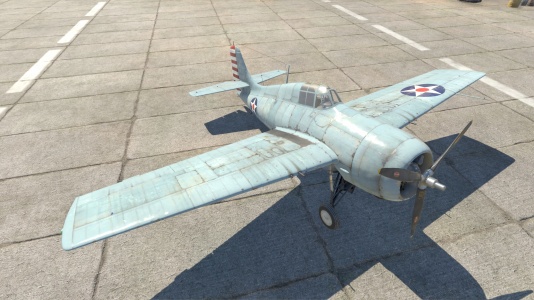
Updated model of the F4F-3
- Videos
See also
Links to the articles on the War Thunder Wiki that you think will be useful for the reader, for example:
- reference to the series of the aircraft;
- links to approximate analogues of other nations and research trees.
External links
Paste links to sources and external resources, such as:
- topic on the official game forum;
- other literature.
| Grumman Aircraft Engineering Corporation | |
|---|---|
| Aircraft | |
| Fighters | |
| F3F | F3F-2 · Galer's F3F-2 |
| F4F Wildcat | F4F-3 · F4F-4 |
| XF5F Skyrocket | XF5F · XP-50 |
| F6F Hellcat | F6F-5 · F6F-5N |
| F7F Tigercat | F7F-1 · F7F-3 |
| F8F Bearcat | F8F-1 · F8F-1B |
| Jet Fighters | |
| F9F Panther/Cougar | F9F-2 · F9F-5 · F9F-8 |
| F-11 Tiger | F11F-1 |
| F-14 Tomcat | F-14A Early · F-14B |
| Jet Strike Aircraft | |
| A-6 Intruder | A-6E TRAM |
| Bombers | TBF-1C |
| Export | ▄Martlet Mk IV · ▄F6F-5 · ▄F6F-5N · ▄F8F-1B · ▄Avenger Mk II · ▄Hellcat Mk II |
| ▄F-14A IRIAF | |
| Naval Vehicles | |
| Patrol Gunboat Hydrofoil (PGH) | USS Flagstaff |
| USA fighters | |
|---|---|
| P-26 Peashooter | P-26A-33 · P-26A-34 · P-26A-34 M2 · P-26B-35 |
| P-36 Hawk | P-36A · Rasmussen's P-36A · P-36C · ○P-36C · P-36G |
| P-39 Airacobra | P-400 · P-39N-0 · P-39Q-5 |
| P-40 | P-40C · P-40E-1 · P-40E-1 TD · P-40F-10 |
| P-43 Lancer | P-43A-1 |
| P-47 Thunderbolt | P-47D-22-RE · P-47D-25 · P-47D-28 · P-47M-1-RE · ⋠P-47M-1-RE · P-47N-15 |
| P-51 Mustang | P-51 · P-51A (Thunder League) · P-51C-10 · P-51D-5 · P-51D-10 · P-51D-20-NA · P-51D-30 · P-51H-5-NA |
| P-63 Kingcobra | P-63A-5 · P-63A-10 · P-63C-5 · ␠Kingcobra |
| Prototypes | XP-55 |
| F2A Buffalo | F2A-1 · Thach's F2A-1 · F2A-3 |
| BF2C | BF2C-1 |
| F3F | F3F-2 · Galer's F3F-2 |
| F4F Wildcat | F4F-3 · F4F-4 |
| F4U Corsair | F4U-1A · F4U-1A (USMC) · F4U-1D · F4U-1C · F4U-4 · F4U-4B · F4U-4B VMF-214 · F2G-1 |
| F6F Hellcat | F6F-5 · F6F-5N |
| F8F Bearcat | F8F-1 · F8F-1B |
| Other countries | ▃Ki-43-II · ▃Ki-61-Ib · ▃A6M2 · ▃Bf 109 F-4 · ▃Fw 190 A-8 · ▃Spitfire LF Mk IXc |