F4U-1D
OLD‑WIKI.WARTHUNDER.COM (DEFUNCT)
| This page is about the American naval fighter F4U-1D. For other versions, see F4U (Family). |
Description
When the first F4U Corsairs were accepted in naval aviation services, the low visibility offered by its design caused complications in carrier landing, thus it was relegated to land operations among units like the United States Marine Corps Squadrons. Back in the factories, the F4U continued to be improved as user's experience and technology trickled into the design. This led to the installation of a more powerful Double Wasp engine, and accommodations for more ordnance as rockets and bombs that could be carried for the ground attack role, as well as being able to use external fuel tanks for extra range. The improved Corsair, designated the F4U-1D Corsair as produced by Vought, or FG-1D as produced by Goodyear, came in right as the US Navy began to accept the F4U Corsair for carrier operations. The first US Corsair squadron based on a carrier would be the USMC VMF-214 on the USS Essex with F4U-1Ds in December 1944. The F4U-1Ds would see service for the remainder of the war, even as improved Corsairs continued coming in.
The F4U-1D, introduced since the start of the Open Beta Test prior to Update 1.27, does not have many external differences from the F4U-1A. Despite the more powerful engine, the F4U-1D actually has lower maximum speed in comparison to its predecessor due to additional drags from its modifications. However, the ability to mount rockets and bombs onto the F4U-1D makes it more versatile to a changing battlefield, able to assist allies by blasting away lightly armoured foes with its rockets or with precision bomb strikes in a dive. In the air-to-air role, like its predecessor, play to its strength as an energy fighter by climbing and then performing boom-n-zoom attacks on your opponents, use the F4U-1D's greater maximum speed to escape from opponents before they have a chance to retaliate.
General info
Flight performance
The stock performance is not that great. The engine overheats extremely easily, even just at 100% throttle, and once it has overheated it takes a century to cool down. Don't even think about using WEP except takeoff or very extreme emergencies or else your engine will die. However, once spaded it can perform very well using Boom and Zoom tactics, and can even out turn some aircraft. It will quickly lose energy in a turn, so it is primarily an energy fighter.
| Characteristics | Max speed (km/h at 7,000 m) |
Max altitude (metres) |
Turn time (seconds) |
Rate of climb (metres/second) |
Take-off run (metres) | |||
|---|---|---|---|---|---|---|---|---|
| AB | RB | AB | RB | AB | RB | |||
| Stock | 645 | 622 | 23.1 | 23.9 | 11.7 | 11.7 | 250 | |
| Upgraded | 703 | 672 | 20.9 | 22.0 | 19.6 | 15.2 | ||
Details
| Features | ||||
|---|---|---|---|---|
| Combat flaps | Take-off flaps | Landing flaps | Air brakes | Arrestor gear |
| ✓ | ✓ | ✓ | X | ✓ |
| Limits | ||||||
|---|---|---|---|---|---|---|
| Wings (km/h) | Gear (km/h) | Flaps (km/h) | Max Static G | |||
| Combat | Take-off | Landing | + | - | ||
| 388 | 330 | 252 | ~11 | ~4 | ||
| Optimal velocities (km/h) | |||
|---|---|---|---|
| Ailerons | Rudder | Elevators | Radiator |
| < 450 | < 450 | < 500 | > 450 |
Survivability and armour
- 3 mm Steel - Upper engine cowling armour plate
- 8 mm Steel - Behind pilot's seat
- 12.7 mm Steel - Pilot's headrest
- 38 mm Bulletproof glass - Windshield
Modifications and economy
Armaments
Offensive armament
The F4U-1D is armed with:
- 6 x 12.7 mm M2 Browning machine guns, wing-mounted (375 rpg outer + 400 rpg center + inner = 2,350 total)
Suspended armament
The F4U-1D can be outfitted with the following ordnance:
- Without load
- 8 x HVAR rockets
- 2 x 1,000 lb AN-M65A1 bombs (2,000 lb total)
Usage in battles
Due to its great energy retention and high dive speed, the Corsair is very good at Boom and Zooming. It is recommended to be used this way especially against any Japanese planes. Against any German planes Boom & Zoom is still recommended, but some planes you can out turn, such as the Fw 190 A-4. As with every American fighter, always climb at the start of a match. The only way to be successful with this plane is to climb high and end up higher than the enemy. Using this tactic will greatly increase your chances of getting air kills and forcing the enemy down low where you can finish them off.
When you are diving on a Japanese plane and it turns around, do not follow it in the turn to get a couple shots off. Instead pull an Immelmann turn, and you will end up right on the tail of an opponent with a lot less energy while you still have a lot. The same tactic can work against German aircraft to an extent as well.
Suitable for both dogfighting and ground attacking as the Corsair fulfils many roles.
With 8 rockets a great variety of targets can be taken care of. Four tanks of any size, if aimed well, four light pillboxes, or a single destroyer. 2,000 lbs (~1,000 kg for in-game purposes) deliver enough punch for 2/3 of a strategic base, or 1/2 Japanese Carrier.
Simulator mode procedures
Hands-off carrier take-off (Auto engine control, no secondary weapons): Ignite engine, flaps: raised, elevator trim: 20%, aileron trim: 11%, rudder trim: 6%, WEP throttle, hands off controls until you get lifted off the ground.
Specific enemies worth noting
When facing the Japanese, you always have to look out for A6Ms, Ki-61s, and Ki-43s. Against all past mentioned you should never turnfight them, boom-and-zoom each and let your superior speed, energy retention, and dive speed save you.
When facing the Germans or Italians, you have to be wary of Bf 109 F-4s and Bf 109 G-2s, each will outclimb you, outgun you, and accelerate faster than you. The best way to counter a 109 is to jump one that is on an teammate's tail, and pour your 6 x .50 cals into them. Unlike the Japanese planes, a 109 can take a lot of hits, and its fires can go out as well, so be wary. You do not have to worry much about Fw 190s, the only thing worth mentioning is to never head-on one, and if you do happen to get one on your tail, either out dive it or turnfight it.
Counter-tactics
The best countermeasure against the F4U-1D is to outclimb it. If you do then it will be a sitting duck. If you are at the same altitude as it, try to engage it in a turnfight if you have more energy than it (be mindful, a skilled pilot can make his F4U-1D outturn the agile Bf 109 F-4).
Manual Engine Control
| MEC elements | ||||||
|---|---|---|---|---|---|---|
| Mixer | Pitch | Radiator | Supercharger | Turbocharger | ||
| Oil | Water | Type | ||||
| Not controllable | Controllable Auto control available |
Controllable Not auto controlled |
Controllable Not auto controlled |
Separate | Controllable 3 gears |
Not controllable |
Pros and cons
Pros:
- High acceleration and speed in level flight and in a dive
- Heavy armament of six .50 cal heavy machine guns
- Large machine gun ammunition reserve and fast reload
- Can carry significant ground attack ordnance
- Good energy retention
Cons:
- Wing-mounted armament makes convergence an issue
- Mediocre climb rate and turning capabilities
- Relatively fragile airframe
- High-speed handling suffers due to compression at speeds above 611 km/h (380 mph)
- Poor cockpit visibility to the rear
History
The F4U-1D Corsair was designed in order to meet the Navy's requirement for capable carrier-based fighter-bombers. To meet this need, the -1D incorporate a Pratt and Whitney R-2800-8W water injection engine, increasing the engine power and the plane's speed from that of the F4U-1A. This gave it the increased performance necessary to carry a larger armament. Two pylons were added to the center wing section, that could hold 154 gallon fuel tanks, bombs up to 1,000 lbs, or napalm bombs. Because of the ability to carry more fuel externally, the 63 gallon fuel tanks in the wing tips were removed. Later in production, the ability to carry four 5 in rockets under each wing was added. In addition, the propeller diameter was reduced from 13 ft 4 in to 13 ft 1 in.
| Archive of the in-game description | |
|---|---|
|
When designing the single-engine carrier-based fighter-bomber designated as the Chance Vought F4U-1D Le Corsaire ("The Corsair"), it was decided to ignore the new weaponry from the F4U-1C and use six of the proven 12.7 mm machine guns (as had been on the F4U-1A). The plane's main innovation was its capacity to hold two 454 kg bombs and one 907 kg bomb. Thus, the F4U-1D could be used as a heavy fighter-bomber. Also, additional fuel tanks could be installed instead of bombs. In addition, a more powerful engine was added, and the last 266 F4U-1Ds and 295 FG-1Ds could carry eight 127 mm HVAR rockets. The F4U-1D, the first large-scale variant after the F4U-1A, was produced not only at Chance Vought factory, but also at the Goodyear factory. Planes from the latter became known as FG-1Ds. The Brewster plant, which had produced the F4U-1A, did not work on the production of this variant, as its contract was annulled. All in all, 1,685 F4U-1Ds were made at the Chance Vought factory and 1,997 FG-1Ds at the Goodyear factory. | |
Media
- Skins
- Images
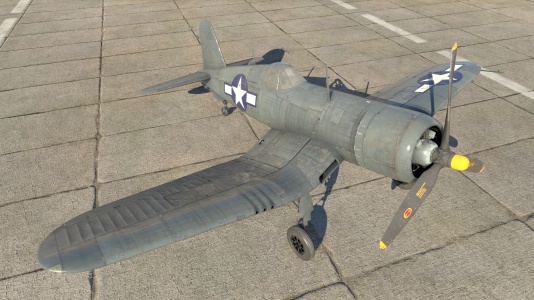
Reworked model of the F4U-1D
See also
External links
References
- Bibliography
- "F4U-1D Vought Corsair", F4U Corsair - The Bent Wing Bird plane site, Retrieved on 28 March 2020.
- "Types of Plane F4U - Variants", F4U Corsair- The Bent Wing Bird plane site, Retrieved on 28 March 2020.
| Chance Vought Aircraft | |
|---|---|
| Fighters | |
| Corsair | F4U-1A · F4U-1A (USMC) · F4U-1C · F4U-1D · F4U-4 · F4U-4B · F4U-4B VMF-214 |
| Float planes | O3U-1 · OS2U-1 · OS2U-3 |
| Attackers | AU-1 |
| Bombers | SB2U-2 · SB2U-3 |
| Jet aircraft | |
| Corsair II | A-7D · A-7E · A-7K |
| Crusader | F8U-2 · F-8E |
| Export | V-156-B1 · V-156-F · ▄Corsair F Mk II · F4U-7 · ▄F-8E(FN) |
| Captured | ▅F4U-1A |
| USA fighters | |
|---|---|
| P-26 Peashooter | P-26A-33 · P-26A-34 · P-26A-34 M2 · P-26B-35 |
| P-36 Hawk | P-36A · Rasmussen's P-36A · P-36C · ○P-36C · P-36G |
| P-39 Airacobra | P-400 · P-39N-0 · P-39Q-5 |
| P-40 | P-40C · P-40E-1 · P-40E-1 TD · P-40F-10 |
| P-43 Lancer | P-43A-1 |
| P-47 Thunderbolt | P-47D-22-RE · P-47D-25 · P-47D-28 · P-47M-1-RE · ⋠P-47M-1-RE · P-47N-15 |
| P-51 Mustang | P-51 · P-51A (Thunder League) · P-51C-10 · P-51D-5 · P-51D-10 · P-51D-20-NA · P-51D-30 · P-51H-5-NA |
| P-63 Kingcobra | P-63A-5 · P-63A-10 · P-63C-5 · ␠Kingcobra |
| Prototypes | XP-55 |
| F2A Buffalo | F2A-1 · Thach's F2A-1 · F2A-3 |
| BF2C | BF2C-1 |
| F3F | F3F-2 · Galer's F3F-2 |
| F4F Wildcat | F4F-3 · F4F-4 |
| F4U Corsair | F4U-1A · F4U-1A (USMC) · F4U-1D · F4U-1C · F4U-4 · F4U-4B · F4U-4B VMF-214 · F2G-1 |
| F6F Hellcat | F6F-5 · F6F-5N |
| F8F Bearcat | F8F-1 · F8F-1B |
| Other countries | ▃Ki-43-II · ▃Ki-61-Ib · ▃A6M2 · ▃Bf 109 F-4 · ▃Fw 190 A-8 · ▃Spitfire LF Mk IXc |