F4U-7
OLD‑WIKI.WARTHUNDER.COM (DEFUNCT)
| This page is about the French naval fighter F4U-7. For other versions, see F4U (Family). |
Description
Intended for the French Aéronavale, the F4U-7 Corsair was developed to fulfill France's urgent need for a carrier aircraft. America responded to the call with the F4U-7, an F4U-4 airframe with the ground attack capability of the AU-1, a ground attack-focused Corsair. The F4U-7s were some of the last Corsairs to be produced in its long production run of 13 years. France began receiving the new Corsairs in 1953 and retired them 11 years later in 1964. During its service, the F4U-7 saw combat in many places like Algeria and Vietnam. Much like in WW2, F4U-7s flew sortie after sortie with minimal losses.
Introduced in Update 1.79 "Project X", the F4U-7 is one of 5 Corsairs in-game armed with the dangerous 20 mm cannons. Like every other Corsair, it's extremely fast at an astounding 885 km/h (553 mph) but does weigh more than the F4U-4/4B due to its provisions to carry a variety of ordnance. It is a strong plane when it comes to both air-to-air roles and ground attack roles but it also has the highest BR for a cannon-armed Corsair.
General info
Flight performance
| Characteristics | Max speed (km/h at 9,000 m) |
Max altitude (metres) |
Turn time (seconds) |
Rate of climb (metres/second) |
Take-off run (metres) | |||
|---|---|---|---|---|---|---|---|---|
| AB | RB | AB | RB | AB | RB | |||
| Stock | 675 | 651 | 21.2 | 22.0 | 13.5 | 13.5 | 200 | |
| Upgraded | 754 | 711 | 19.1 | 20.0 | 25.7 | 18.5 | ||
Details
| Features | ||||
|---|---|---|---|---|
| Combat flaps | Take-off flaps | Landing flaps | Air brakes | Arrestor gear |
| ✓ | ✓ | ✓ | X | ✓ |
| Limits | ||||||
|---|---|---|---|---|---|---|
| Wings (km/h) | Gear (km/h) | Flaps (km/h) | Max Static G | |||
| Combat | Take-off | Landing | + | - | ||
| 885 | 388 | 299 | 252 | ~11 | ~4 | |
| Optimal velocities (km/h) | |||
|---|---|---|---|
| Ailerons | Rudder | Elevators | Radiator |
| < 450 | < 220 | < 410 | > 450 |
Survivability and armour
- 38 mm Bulletproof glass in cockpit front.
- 3 mm Steel plates in front of the cockpit, top of the fuselage.
- 8 mm Steel plate behind the pilot.
- 12.7 mm Steel plate on the headrest.
Modifications and economy
Armaments
Offensive armament
The F4U-7 is armed with:
- 4 x 20 mm M3 cannons, wing-mounted (246 rpg = 984 total)
The four cannons are arranged in bundles of two mounted in each wing. Each is armed with the same amount of ammunition, which means that all guns will fire together until empty.
Suspended armament
The F4U-7 can be outfitted with the following ordnance:
| 1 | 2 | 3 | 4 | 5 | 6 | 7 | 8 | 9 | 10 | 11 | 12 | 13 | 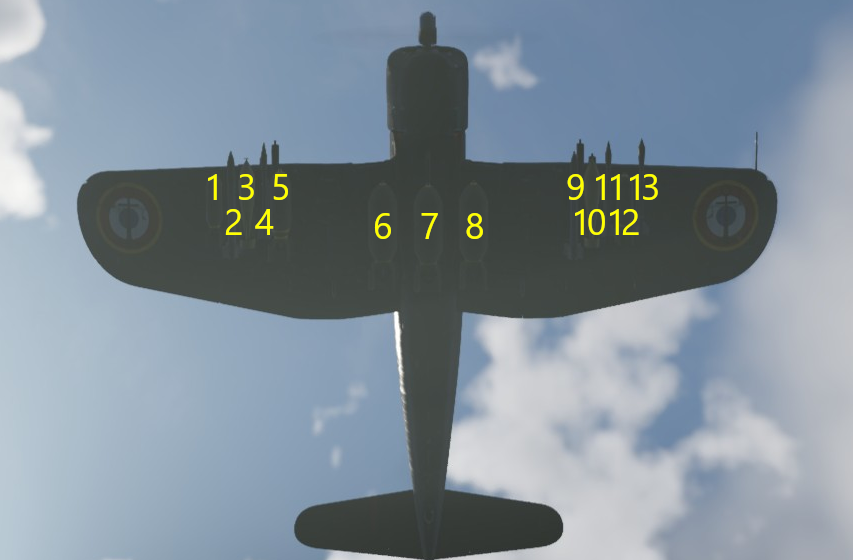 | |
|---|---|---|---|---|---|---|---|---|---|---|---|---|---|---|
| 100 kg No.1 bombs | 1 | 1*† | 1 | 1*† | 1 | 1 | 1*† | 1 | 1*† | 1 | ||||
| 250 lb AN-M57 bombs | 1 | 1*† | 1 | 1*† | 1 | 1 | 1*† | 1 | 1*† | 1 | ||||
| 500 lb AN-M64A1 bombs | 1† | 1† | 1† | 1† | ||||||||||
| 1,000 lb AN-M65A1 bombs | 1 | 1 | 1 | |||||||||||
| HVAR rockets | 1 | 1* | 1 | 1* | 1 | 1 | 1* | 1 | 1* | 1 | ||||
| SNEB type 23 rockets | 19* | 19* | 19* | 19* | 19* | 19* | ||||||||
| T10 140 rockets | 1 | 1* | 1 | 1* | 1 | 1 | 1* | 1 | 1* | 1 | ||||
| T10 151 rockets | 1 | 1* | 1 | 1* | 1 | 1 | 1* | 1 | 1* | 1 | ||||
| Maximum permissible loadout weight: 2,720 kg | ||||||||||||||
| * SNEBs on hardpoints 3, 5, 9, 11 cannot be equipped in conjunction with marked ordnance in adjacent hardpoints † Bombs on hardpoints 3, 5, 9, 11 cannot be equipped in conjunction with marked bombs in adjacent hardpoints | ||||||||||||||
| Default weapon presets | |
|---|---|
| |
Usage in battles
- Play it as a pure fighter, no payload, with the powerful 4 x 20 mm AN/M3 guns there is no need to spray the enemy aircraft with ammunition, just one hit will severely damage the enemy fighter to include a potential loss of control systems, fire or multiple leaks, if you're facing attackers or heavy bombers (especially the He 177 A-5), you must keep your distance because the F4U-7 is a fragile aircraft, engage them from far or attack them par surprise. Use this aircraft as a boom and zoomer.
- Play it as an attacker, use the famous 114 x SNEB rocket payload. This payload is the best for the Enduring Confrontation. There is enough firepower to eliminate all the enemies on the battlefield with careful aim. And a convoy is just a piece of cake. For the tanks, send six rockets, two for howitzer and two to four rockets for a pillbox. When you run out of rockets, you have two choices:
- Return to the airfield to reload
- Use it as a fighter.
- Fly the aircraft as a fighter/bomber, take the payload with the 3 x 1,000 lbs bombs and attack the bases. Once you're out of bombs, you can dogfight other planes.
Manual Engine Control
| MEC elements | ||||||
|---|---|---|---|---|---|---|
| Mixer | Pitch | Radiator | Supercharger | Turbocharger | ||
| Oil | Water | Type | ||||
| Not controllable | Controllable Auto control available |
Controllable Auto control available |
Controllable Auto control available |
Separate | Controllable 3 gears |
Not controllable |
Pros and cons
Pros:
- Excellent armament when fully upgraded, high ammo count
- 114 x SNEB rockets are devastating against both ground and air targets
- Powerful AN/M3 Canons
- Very powerful engine when at low and medium altitudes
Cons:
- Painful to play when stock
- Limited WEP (11 minutes)
- Fragile tail section
- Extremely inaccurate guns when stock
- Performs poorly with added weight from suspended armaments
History
The French Navy (Aéronavale) desperately needed a carrier-born aircraft for their newly acquired carriers from the U.S. and Britain. The U.S. decided to help France by making the F4U-7. The F4U-7 was essentially the AU-1 Corsair and F4U-4 Corsair mixed together. It combined the engine from the F4U-4 and airframe, but it also had the payload capacity of the AU-1 Corsair. This allowed it to be powerful against fighters but also effective against ground targets. The U.S. actually bought the F4U-7s first, then through MAP (Military Assistance Program), France received them.
In 1956, due to the inaccuracy of free-fall bombs and unguided rockets, France experimented with the F4U-7 in its ability to carry SS-11 guided missiles. France couldn't afford sortie after sortie with a shortage of pilots, so the only way to combat that was to make weapons more accurate. Use of the SS.11 on the F4U-7 required intense training as there would be 2 sticks, one to fly the plane and one to guide the missile to its target. This required the pilot to have "2 brains" as you would have to fly while watching the ATGM. France found it to be a success, so they decided to select a squadron to start the process on, but however, they decided to not pursue it. France couldn't take 15 Corsairs at a time to be fitted with ATGMs due to their small fleet of only around 115 F4U-7s. However, the idea did live on with the MD.311 Flamant.
Media
- Skins
- Videos
See also
Links to the articles on the War Thunder Wiki that you think will be useful for the reader, for example:
- reference to the series of the aircraft;
- links to approximate analogues of other nations and research trees.
External links
- [Devblog] F4U-7: The Corsair under a French Tricolore
- [wwiiafterwwii.wordpress.com] Guided missiles on Corsairs
| Chance Vought Aircraft | |
|---|---|
| Fighters | |
| Corsair | F4U-1A · F4U-1A (USMC) · F4U-1C · F4U-1D · F4U-4 · F4U-4B · F4U-4B VMF-214 |
| Float planes | O3U-1 · OS2U-1 · OS2U-3 |
| Attackers | AU-1 |
| Bombers | SB2U-2 · SB2U-3 |
| Jet aircraft | |
| Corsair II | A-7D · A-7E · A-7K |
| Crusader | F8U-2 · F-8E |
| Export | V-156-B1 · V-156-F · ▄Corsair F Mk II · F4U-7 · ▄F-8E(FN) |
| Captured | ▅F4U-1A |
| France fighters | |
|---|---|
| Dewoitine | D.371 · D.371 H.S.9 · D.373 · D.500 · D.501 · Pallier's D.510 · D.520 |
| Morane-Saulnier | M.S.405C1 · M.S.406C1 · M.S.410 |
| Arsenal | V.G.33C-1 |
| Bloch | M.B.152C1 · M.B.157 |
| Caudron | C.R.714 |
| Sud-Ouest | S.O.8000 Narval |
| American | H-75A-1 · H-75A-4 · ▄P-39Q-25 · ▄P-40F-5 Lafayette · ▄P-47D-22-RE · ▄P-63C-5 · F-6C-10-NA |
| ▄F6F-5 · ▄F6F-5N · F4U-7 · ▄F8F-1B | |
| Other countries | ▄Seafire LF Mk.III · ▄Yak-3 · Challe's ▄Yak-9T · NC.900 |
| Belgium | ▄Gladiator Mk I · ▄Spitfire FR Mk XIVe |
| Netherlands | ◘Sea Fury FB 51 |