M4A2 (USSR)
OLD‑WIKI.WARTHUNDER.COM (DEFUNCT)
| This page is about the premium medium tank M4A2 (USSR). For other M4 Shermans, see M4 Sherman (Family). For other uses, see M4 (Disambiguation). |
Description
The Soviet Union received 4,102 Medium Tank M4 (Sherman) as part of the lend-lease program. Of these, 2,007 had been fitted with the original 75 mm M3 tank guns (M4A2), while the remaining 2,095 were outfitted with the more capable 76 mm M1 tank guns (M4A2 (76) W). The total quantity of lend-lease Sherman tanks shipped to the USSR constituted 18.6% of all lend-lease M4 Sherman tanks. In the late summer of 1944, the first M4A2 (76) W arrived in the USSR. The Red Army believed that the M4A2 (76) W was less likely than the T-34s to catch fire from an ammunition detonation, although the M4A2 (76) W has a higher center of gravity than the T-34s, making it more susceptible to rolling over on uneven terrain. Some Red Army tank regiments were completely equipped with M4A2 (76) Ws by 1945. Among these units were the 1st Guards Mechanized Corps, the 3rd Guards Mechanized Corps, and the 9th Guards Mechanized Corps. Many Soviet tank crews evaluated and regarded the M4A2 (76) W highly, citing its dependability, ease of maintenance, and overall better firepower. However, flaws were also identified, the most serious of which was its high profile, which made it vulnerable to hostile fire. The M4A2 (76) W Sherman's narrow tracks also struggled to handle muddy terrain as compared to the T-34s' broader tracks.
Introduced in Update 1.45 "Steel Generals", the premium ▂M4A2 (76) W offers unique gameplay experiences for the Soviet Army ground forces. Being one of the few foreign tanks in service within the Soviet Army, it allows for hull-down fighting positions due to substantially superior gun depression angles than standard Soviet tanks. Due to its high profile, the M4A2 (76) W is difficult to drive about undetected, making it an easy target for adversaries. However, by utilizing its excellent mobility early in the conflict, it is feasible to get into strategic positions and adopt a hull-down position in order to get the first shot at the enemy.
General info
Survivability and armour
Armour type:
- Rolled homogeneous armour
- Cast homogeneous armour (Turret, Transmission area)
| Armour | Front (Slope angle) | Sides | Rear | Roof |
|---|---|---|---|---|
| Hull | 63.5 mm (47°) | 38.1 mm | 38.1 mm | 19.5 mm |
| Turret | 88.9 mm | 63.5 mm | 63.5 mm | 25.4 mm |
| Cupola | 63.5 mm | 63.5 mm | 63.5 mm | 25.4 mm |
Notes:
- Suspension wheels are 15 mm thick, the bogies are 10 mm thick, and the tracks are 20 mm thick.
Mobility
| Game Mode | Max Speed (km/h) | Weight (tons) | Engine power (horsepower) | Power-to-weight ratio (hp/ton) | |||
|---|---|---|---|---|---|---|---|
| Forward | Reverse | Stock | Upgraded | Stock | Upgraded | ||
| Arcade | Expression error: Unexpected * operator. | 635 | Expression error: Unexpected round operator. | __.__ | |||
| Realistic | 363 | Expression error: Unexpected round operator. | __.__ | ||||
Modifications and economy
The most important modules to research are Parts and FPE. The M62 APCBC shell is superior to the stock M79 AP shot in performance, so researching the M62 shell module is a priority. After that, the player may prioritize either mobility or firepower upgrades, depending on playstyle.
Armaments
Main armament
| 76 mm M1 | Turret rotation speed (°/s) | Reloading rate (seconds) | |||||||||||
|---|---|---|---|---|---|---|---|---|---|---|---|---|---|
| Mode | Capacity | Vertical | Horizontal | Stabilizer | Stock | Upgraded | Full | Expert | Aced | Stock | Full | Expert | Aced |
| Arcade | 71 | -10°/+25° | ±180° | Vertical | 22.85 | 31.62 | 38.40 | 42.47 | 45.18 | 7.67 | 6.78 | 6.25 | 5.90 |
| Realistic | 14.28 | 16.80 | 20.40 | 22.56 | 24.00 | ||||||||
Ammunition
| Penetration statistics | |||||||
|---|---|---|---|---|---|---|---|
| Ammunition | Type of warhead |
Penetration @ 0° Angle of Attack (mm) | |||||
| 10 m | 100 m | 500 m | 1,000 m | 1,500 m | 2,000 m | ||
| M79 shot | AP | 134 | 132 | 121 | 109 | 99 | 89 |
| M42A1 shell | HE | 16 | 16 | 14 | 13 | 11 | 10 |
| M62 shell | APCBC | 149 | 146 | 133 | 119 | 106 | 94 |
| Shell details | ||||||||||||
|---|---|---|---|---|---|---|---|---|---|---|---|---|
| Ammunition | Type of warhead |
Velocity (m/s) |
Projectile mass (kg) |
Fuse delay (m) |
Fuse sensitivity (mm) |
Explosive mass (TNT equivalent) (g) |
Ricochet | |||||
| 0% | 50% | 100% | ||||||||||
| M79 shot | AP | 792 | 6.8 | - | - | - | 47° | 60° | 65° | |||
| M42A1 shell | HE | 823 | 5.84 | 0.2 | 0.1 | 390 | 79° | 80° | 81° | |||
| M62 shell | APCBC | 792 | 7 | 1.2 | 14 | 63.7 | 48° | 63° | 71° | |||
Ammo racks
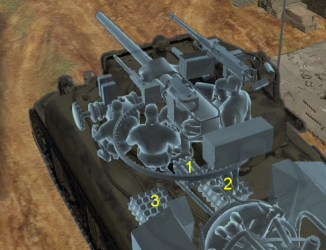
| Full ammo |
1st rack empty |
2nd rack empty |
3rd rack empty |
Visual discrepancy |
|---|---|---|---|---|
| 71 | 66 (+5) | 31 (+40) | 1 (+70) | No |
Note:
- Shells are modeled individually and disappear from the rack after having been shot or loaded.
Machine guns
| 12.7 mm M2HB | ||||
|---|---|---|---|---|
| Mount | Capacity (Belt) | Fire rate | Vertical | Horizontal |
| Pintle | 600 (200) | 577 | -10°/+30° | ±60° |
| 7.62 mm M1919A4 | ||||
|---|---|---|---|---|
| Mount | Capacity (Belt) | Fire rate | Vertical | Horizontal |
| Coaxial | 3,000 (250) | 500 | N/A | N/A |
Usage in battles
The M4A2 (76) W is a classic Sherman tank. It requires careful positioning and avoidance of enemy fire, possesses an above-average gun, and works best when played around teammates.
As such, it is well-suited to city brawls in which it can use rubble as cover and protect its flanks effectively. The city environment also suits the tank's below-average mobility. In close quarters, this shortcoming will not be too much of a hindrance. That being said, the M4A2 is also a classic medium tank, and highly adaptable. If needed, it can engage at most, if not all, ranges. It can be used to rush a point, or to defend from an assault. Certainly, the powerful cannon is capable against all but the most heavily armoured enemies.
This vehicle has mediocre armour and a highly visible profile, so it must be played carefully if the player wishes to stay alive for more than a few minutes. It is not uncommon for the M4A2 to be destroyed in a single hit, especially when facing the German cannons. Other enemies to watch out for include enemy aircraft: although the roof armour will protect crew members from strafing runs, the vehicle's above-average size makes it rather visible from the air, and makes it a target for bombing and rocket attacks.
Pros and cons
Pros:
- Higher top speed compared to the previous vehicle
- Great rate of fire for the main gun
- Angled frontal slope which may sometimes bounce larger calibres if angled correctly
- A standard 5 crew members, which equates to 3 spare crew members to take over positions of the tank if necessary
- A pintle-mounted heavy machine gun (12.7 mm), which can be used for anti-aircraft and against light armoured vehicles
- Wet ammo storage - Which reduces greatly ammo rack chances, is indicated by the "W" in its name, this also means tightly packed ammo only placed under the turret
- Fast turret traverse
Cons:
- Is quite tall
- Prone to tipping over when travelling across steep inclines
- Sides and rear are thinly armoured
- Engine compartment is poorly armoured
- Susceptible to nearby artillery explosions
- Narrow tracks mean poor ground flotation and cross country performance
- Only reaches its top speed on paved surfaces
- Lacks the add-on armour module found on the 76 mm M4A1 and M4A3
- Unlike the earlier M4A1 (76) W, Cruise Control 1 setting is slightly above the maximum speed that the stabilizer operates at
- Armour might not stand up against common guns like the Soviet 85 mm or the KwK36.
History
Lend-Lease
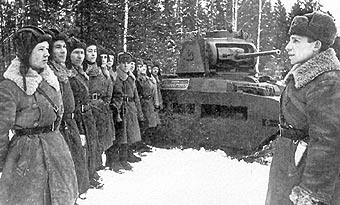
The Soviet participation in the United States' Lend-Lease program started in Autumn of 1941 when the United States and United Kingdom agreed to give military aid. Tanks were of particular interests to the Soviets in order to replenish their Summer losses against Germany during Operation Barbarossa. The first tanks sent were from Great Britain with Valentines and Matildas, which played a part in the Battle of Moscow.[1] The United States provided their M3 Stuart light tanks and M3 Medium tanks in late 1941/early 1942 (The two were designated M3L and M3S respectively to avoid name confusion).[2][3] These American tanks were not viewed with satisfaction, with the head of Soviet tank industry, Vyacheslav Malyshev, even considering stopping all American tank imports and focusing instead on American trucks.[4] Despite that, the Soviets were interested in America's newest medium tank, the M4 Sherman, and were eager to obtain some as soon as possible.
Shermans in the Soviet Union
Though the M4 and M4A1 were available, the Soviets disliked the gasoline Continental radial engine due to their experience with the M3 Light and Medium tanks. Instead, they asked for the diesel GMC engine variant M4A2 Sherman upon learning of its existence in August 1942.[5] The M4A2 had been in production since April 1942, but the time needed for the production to supply the demand meant that the first M4A2 only arrived in the Soviet Union by 21 September 1942.[6] Concern on shortfalls in M4A2 productions caused the Soviets to order and receive two M4A4 tank models for evaluation in 1943. After trials with the M4A4, the Soviet disliked the Chrysler A57 engine configuration and low fuel efficiency compared to the M4A2, and so opted not to receive anymore M4A4 tanks.[7][8]
The low numbers of M4A2 received in 1943 caused the Soviet Union to field the first M4A2 tanks in small units, with the first of these being the 563rd Independent Tank Battalion in 04 January 1943 with 9 M4A2 tanks and the 5th Guards Tank Brigade with two M4A2 in January 12th. [6][9][10] The first major campaign the M4A2 were involved in was the Battle of Kursk with the 229th Independent Tank Regiment with 39 M4A2 Shermans, which was put into combat on 11 July 1943.[11] As combat experience with the M4A2 grew, the Soviets came to appreciate the qualities and recognize the flaws of the M4A2 Sherman. A report on 23 October 1943 from the 5th Guards Tank Brigade regarding their M4A2 Shermans noted:[6]

|
Due to its high speed, M4A2 tank is very convenient for exploitation, and offers great manoeuvrability. Armament is consistent with its design and it has fragmentation and armour-piercing shells with very high penetration. The 75 mm gun and two Browning machine guns are trouble-free. Its disadvantages include a great height making it a bigger target on the battlefield. Armour, despite the greater thickness (60 mm), is substandard. There were cases when it was penetrated by an antitank rifle at a distance of 80 m. In addition, there were a number of cases where Ju 87, while bombing the tanks, penetrated the side armour and turret armour with 20 mm cannon fire, resulting in crew casualties. Compared with the T-34, the M4A2 is easier to operate, and more durable when making long marches as the motors do not require frequent adjustment. In combat, these tanks are working well. |
As the inventory of the M4A2 grew in the Soviet Union, the formation of larger tank units composed of M4A2s was possible. The first of such was the 5th Mechanized Corps (later renamed the 9th Guards Mechanized Corps) which, on 01 January 1944, had a total of 131 M4A2 among the regiments and brigades.[12] The M4A2 in service was given the nickname "emcha" by the Soviet soldiers, which was a contraction of the Russian pronounciation of M4 (M-Chetire).[6]
The Soviets continued requesting more M4A2 Shermans to fill their armies, with 2,000 more expected from July 1943 to June 1944. This was at odds with America's plans to switch M4 production over to the 76 mm gun at the end of 1943. To continue supplying the Soviets, the Fisher Body production lines at the Grand Blanc Tank Arsenal continued to produce 75 mm armed M4s until May 1944 to fulfill the Soviet's order.[13]
76 mm Shermans
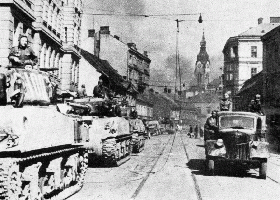
The Soviet Union's next order of 3,000 Shermans would be for M4 Shermans equipped with the new 76 mm M1 gun.[14] These M4A2 (76 mm) Shermans began arriving to the Soviet Union in September 1944.[15] The first combat unit to be equipped with these M4A2 (76) Shermans was the 1st Mechanized Corps in October. Other units that received and used the M4A2 (76) Shermans were the 8th and 9th Guards Mechanized Corps, as well as the 2nd Guards Cavalry Corps.[16]
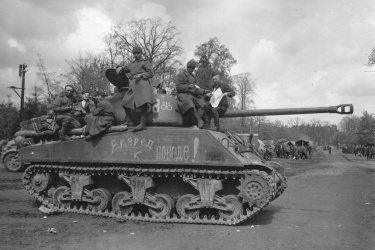
The first action the M4A2 (76) Sherman saw in Soviet service in was in December 1944, when the 6th Guards Tank Army and its associated 9th Guards Mechanized Corps conducted offensive operations in Hungary.[14][17] The M4A2 (76) Shermans would see large-scale usage in 1945 during the Soviet's offensives towards Germany, sometimes alongside the M4A2 (75) versions. Some of the most notable Soviet actions the M4A2 (76) were in the Vistula–Oder offensive in Winter 1945, the Vienna Offensive in Spring 1945, and finally the Battle of Berlin in April-May 1945, where most notably the 1st Mechanized Corps, equipped with 165 M4A2 Shermans prior to the battle, participated in the heavy fighting.[18]
The final M4A2 Sherman usage by the Soviet Union was in Operation August Storm, the Soviet invasion of Manchuria against Japan in August 1945.[19] This offensive saw M4A2 Shermans used on the Transbaikal Front, with the M4A2s in the 3rd and 9th Guards Mechanized Corps, as well as smaller units such as the 48th Independent Tank Battalion and 201st Tank Brigade present (the 201st were held in reserves).[10][17] In all, 250 M4A2 Sherman tanks were present in the Soviet forces when the invasion of Manchuria commenced.[20] [21]
Lend-Lease numbers
Of the 12,485 tanks and armoured fighting vehicles sent to the Soviet Union from 1941 to 1945 in the Lend-Lease program, 4,102 of those were of the M4A2 Sherman tanks, with 2,007 being of the M4A2 (75 mm) version, and 2,095 being the M4A2 (76 mm) version. Of the tanks sent, the Soviet records reported the receiving of 3,664 tanks; the difference mainly due to deliveries being sunk on the way and discrepancies between the United States and Soviet Union archives.[22][23] Of the 76 mm variants, 460 tanks were versions with the HVSS suspension designs, which began arriving in March-April 1945, delivered too late to see combat in Europe.[19] However, 128 of the tanks saw use with the 9th Guards Mechanized Corps (84 tanks) and the 201st Tank Brigade (44 tanks) in Manchuria.[21] These figures also indicate that the Soviet Union was one of the largest users of the M4A2 (76 mm) Shermans, of which 2,915 were manufactured in total by the United States.[24]
| Archive of the in-game description | |
|---|---|
|
Large quantities of military vehicles were delivered to the Soviet Union as part of the lend-lease program. These deliveries made a considerable impact on the Soviet Army's arsenal and played a significant role in the final victory over Germany in WWII. One of the vehicles provided as part of the lend-lease program was the American Sherman medium tank. | |
Media
- Skins
- Videos
See also
- Other M4A2 tanks in the game
External links
References
- Citations
- ↑ Zaloga 2017, Loc 63, 95 of 1264
- ↑ Zaloga 2017, Loc 245-257 of 1264
- ↑ Zaloga 2017, Loc 305 of 1264
- ↑ Zaloga 2017, Loc 420-426 of 1264
- ↑ Samsonov 2021, pg 28
- ↑ 6.0 6.1 6.2 6.3 Zaloga 2017, Loc 616-633 of 1264
- ↑ Samsonov 2021, pg 51-55
- ↑ Samsonov 2013
- ↑ Samsonov 2021, pg 61
- ↑ 10.0 10.1 Gillono and Hulbert 2011, pg 23
- ↑ Samsonov 2021, pg 70
- ↑ Samsonov 2021, pg 80-81
- ↑ Zaloga 2017, Loc 166, 649 of 1264
- ↑ 14.0 14.1 Zaloga 2017, Loc 660 of 1264
- ↑ Samsonov 2017
- ↑ Gillono and Hulbert 2011, pg 17-18
- ↑ 17.0 17.1 Loza and Gebhardt 1996
- ↑ Samsonov 2015
- ↑ 19.0 19.1 Zaloga 2017, Loc 665-672 of 1264
- ↑ Samsonov 2014
- ↑ 21.0 21.1 Samsonov 2018
- ↑ Zaloga 2017, Loc 899-1212 of 1264
- ↑ Gillono and Hulbert 2011, pg 1
- ↑ Zaloga 2003, Loc 686 of 977
- Bibliography
- Gillono, Claude; Hulbert, Leife. Comrade Emcha: Red Army Shermans of WW2 (Battleline, 2). The Oliver Publishing Group, 2011
- Loza, Dimitry; Gebhardt, James F. Commanding the Red Army's Sherman Tanks: The World War II Memoirs of Hero of the Soviet Union Dimitry Loza. University of Nebraska Press, 1996.
- Samsonov, Peter. "Common Questions: Sherman Preference." Tank Archives, Blogger, 22 Jun. 2015, Website. Accessed 24 Mar. 2021 (Archive).
- Samsonov, Peter. "Lend Lease Impressions: M4A4 Sherman." Tank Archives, Blogger, 12 Sep. 2013, Website. Accessed 24 Mar. 2021 (Archive).
- Samsonov, Peter. "M4A2(76)W: Emcha With a Long Hand." Tank Archives, Blogger, 30 Jul. 2017, Website. Accessed 23 Mar. 2021 (Archive).
- Samsonov, Peter. "New Legs for the Emcha." Tank Archives, Blogger, 15 Dec. 2018, Website. Accessed 24 Mar. 2021 (Archive).
- Samsonov, Peter. "Soviet Tanks in the Far East." Tank Archives, Blogger, 09 Apr. 2014, Website. Accessed 24 Mar. 2021 (Archive).
- Samsonov, Peter. Sherman Tanks of the Red Army: The American Vehicle in Soviet Service. Gallantry Books, 23 Jul. 2021.
- Zaloga, Steven J. M4 (76mm) Sherman Medium Tank 1943-65. Osprey Publishing Ltd., 20 Apr. 2003.
- Zaloga, Steven J. Soviet Lend-Lease Tanks of World War II. Osprey Publishing Ltd., 20 Jul. 2017.
| USSR medium tanks | |
|---|---|
| T-28 | T-28 (1938) · T-28 · T-28E |
| T-34-76 | T-34 (Prototype) · T-34 (1940) · T-34 (1941) · T-34 (1st Gv.T.Br.) · T-34 (1942) · T-34E STZ · T-34E |
| T-34-57 | T-34-57 · T-34-57 (1943) |
| T-34-85 | T-34-85 (D-5T) · T-34-85 · T-34-85E |
| T-34-100 | T-34-100 |
| T-44 | T-44 · T-44-100 · T-44-122 |
| T-54 | T-54 (1947) · T-54 (1949) · T-54 (1951) |
| T-55 | TO-55 · T-55A · T-55AM-1 · T-55AMD-1 |
| T-62 | T-62 · T-62M-1 |
| T-64 | Object 435 · T-64A (1971) · T-64B |
| T-72 | T-72A · T-72AV (TURMS-T) · T-72B · T-72B (1989) · T-72B3 · T-72M2 Moderna |
| T-80 | T-80B · T-80U · T-80UD · T-80UK · T-80UM2 · Т-80U-Е1 · T-80BVM · Object 292 |
| T-90 | Т-90А · T-90M |
| Trophies/Lend-Lease | |
| Germany | ▂T-III · ▂T-V |
| Great Britain | ▂МК-IX "Valentine" |
| USA | ▂M3 Medium · ▂M4A2 |
| USSR premium ground vehicles | |
|---|---|
| Light tanks | BA-11 · RBT-5 · BT-7A (F-32) · T-26 (1st Gv.T.Br.) · T-26E · T-126 · PT-76-57 · 2S38 |
| Medium tanks | T-34 (Prototype) · T-34 (1st Gv.T.Br.) · T-34E · T-34-57 (1943) · T-34-85E · T-34-100 · T-44-122 · TO-55 · T-55AM-1 · T-72AV (TURMS-T) · T-80UD · Т-80U-Е1 |
| ▂M3 Medium · ▂M4A2 · ▂T-III · ▂T-V · ▂МК-IX "Valentine" | |
| Heavy tanks | SMK · T-35 · ▂MK-II "Matilda" · KV-1E · KV-2 (1940) · KV-2 (ZiS-6) · KV-122 · KV-220 · IS-2 "Revenge" · Object 248 · IS-6 · T-10A |
| Tank destroyers | BM-8-24 · BM-13N · BM-31-12 |
| SU-57 · SU-76D · SU-76M (5th Gv.Kav.Corps) · SU-85A · SU-100Y · SU-122P · Object 120 | |
| SPAA | ▂Phòng không T-34 · ZUT-37 |