T-64B
ATGM vehicles
OLD‑WIKI.WARTHUNDER.COM (DEFUNCT)
| This page is about the Soviet medium tank T-64B. For other versions, see T-64 (Family). |
Description
The T-64B is the third variant of the T-64 main battle tank family. It has many improvements over its predecessor, including a redesigned armour layout, a better 1A33 fire control system, a new 9K112-1 "Kobra" ATGM system, an improved 125 mm 2A46-2 tank gun, a 2E26M two-plane fully automatic stabilisation system, and a new 6ETs40 autoloader. T-64B variants were fitted with stronger upper hull glacis armour beginning in 1985, and older T-64B variants were upgraded with a 16 mm armour plate.
Introduced in Update 1.77 "Advancing Storm", the T-64B is a formidable opponent on the battlefield. Its triple-layer composite hull armour can withstand most enemy hits; however, its lacklustre engine power can be disappointing. The tank has access to a vast arsenal of ammunition that is more than capable of dealing with any type of enemy on the battlefield. The tank's low profile allows players to avoid detection and utilize forms of cover that other tanks cannot. Additionally, players have access to a "Kontakt-1" explosive reactive armour (ERA) upgrade, which significantly alters the tank's appearance. The ERA is shaped like a "pike" or triangular prism. The appearance of the hull will also change, as it will be covered in ERA and the distinctive triangle at the front will be removed. An extra armour plate will be added to the lower plate.
General info
Survivability and armour
Armour type:
- Composite armour (Hull front, Turret front)
- Cast homogeneous armour (Turret)
- Rolled homogeneous armour (Hull, Turret roof)
- Armour radiation material (Roof)
| Armour | Front (Slope angle) | Sides | Rear | Roof |
|---|---|---|---|---|
| Hull | 60* mm (68°) Front glacis 80 mm (62°) Lower glacis |
85 mm Front 70 mm Rear <br. 20 mm (33°) Bottom |
20 mm (4-54°) Top 45 mm Center 20 mm (21-57°) Bottom |
30 + 30 mm Front 20 mm Engine deck |
| Turret | 50-330 mm (0-80°) | 65-140* mm (12-29°) | 65 + 30 mm (0-65°) | 45-140 + 30 mm |
| Cupola | 45 mm | 45 mm | 45 mm | 40 + 30 mm |
| Composite armour* | Front (Slope angle) | Sides |
|---|---|---|
| Hull | 403 mm Kinetic 476 mm Chemical |
N/A |
| Turret | Angles +0-0°: 440 mm Kinetic 500 mm Chemical Angles +30-30°: 400 mm Kinetic 450 mm Chemical |
200 mm Kinetic 220 mm Chemical |
Notes:
- Suspension wheels are 20 mm thick, torsion bars are 10 mm thick, and tracks are 30 mm thick.
- Belly armour is 20 mm thick.
- A 5 mm RHA plate separates the engine from the crew compartment
- A log providing 100 mm thickness in wood is mounted on the rear.
- The snorkel tube on the turret rear provide 4 mm of structural steel.
- Hull composite armour configuration is 60 mm RHA + 35 mm Textolite + 30 mm RHA + 35 mm Textolite + 45 mm RHA.
- Turret composite armour configuration is 130-140 mm CHA + 150 mm Ultra porcelain + 100-110 mm CHA.
- Turret side composite armour configuration is 90 mm CHA + 80 mm Ultra porcelain + 60 mm CHA.
Mobility
| Game Mode | Max Speed (km/h) | Weight (tons) | Engine power (horsepower) | Power-to-weight ratio (hp/ton) | ||||
|---|---|---|---|---|---|---|---|---|
| Forward | Reverse | Stock | AoA | Stock | Upgraded | Stock | Upgraded | |
| Arcade | 40.1 | 1.1 | 1,085 | 27.06 | __.__ | |||
| Realistic | 619 | 15.44 | __.__ | |||||
Modifications and economy
Armaments
Main armament
| 125 mm 2A46M-1 | Turret rotation speed (°/s) | Reloading rate (seconds) | ||||||||
|---|---|---|---|---|---|---|---|---|---|---|
| Mode | Capacity | Vertical | Horizontal | Stabilizer | Stock | Upgraded | Full | Expert | Aced | Autoloader |
| Arcade | 36 | -6°/+14° | ±180° | Two-plane | 22.85 | 31.62 | 38.40 | 42.47 | 45.18 | 7.10 |
| Realistic | 14.28 | 16.80 | 20.40 | 22.56 | 24.00 | |||||
Ammunition
| Penetration statistics | |||||||
|---|---|---|---|---|---|---|---|
| Ammunition | Type of warhead |
Penetration @ 0° Angle of Attack (mm) | |||||
| 10 m | 100 m | 500 m | 1,000 m | 1,500 m | 2,000 m | ||
| 3BK18M | HEATFS | 550 | 550 | 550 | 550 | 550 | 550 |
| 3OF26 | HE | 42 | 42 | 42 | 42 | 42 | 42 |
| 3BM22 | APFSDS | 425 | 420 | 415 | 405 | 393 | 380 |
| 9M112 | ATGM | 650 | 650 | 650 | 650 | 650 | 650 |
| 3BM42 | APFSDS | 457 | 454 | 445 | 431 | 419 | 406 |
| Shell details | ||||||||||||
|---|---|---|---|---|---|---|---|---|---|---|---|---|
| Ammunition | Type of warhead |
Velocity (m/s) |
Projectile mass (kg) |
Fuse delay (m) |
Fuse sensitivity (mm) |
Explosive mass (TNT equivalent) (kg) |
Ricochet | |||||
| 0% | 50% | 100% | ||||||||||
| 3BK18M | HEATFS | 905 | 19 | 0.05 | 0.1 | 2.79 | 65° | 72° | 77° | |||
| 3OF26 | HE | 850 | 23 | 0.3 | 0.1 | 5.24 | 79° | 80° | 81° | |||
| 3BM22 | APFSDS | 1,760 | 4.83 | - | - | - | 76° | 77° | 80° | |||
| 3BM42 | APFSDS | 1,700 | 4.85 | - | - | - | 78° | 80° | 81° | |||
| Missile details | ||||||||||||
|---|---|---|---|---|---|---|---|---|---|---|---|---|
| Ammunition | Type of warhead |
Velocity (m/s) |
Range (m) |
Projectile mass (kg) |
Fuse delay (m) |
Fuse sensitivity (mm) |
Explosive mass (TNT equivalent) (kg) |
Ricochet | ||||
| 0% | 50% | 100% | ||||||||||
| 9M112 | ATGM | 400 | 5,000 | 27.5 | 0.05 | 0.1 | 5.72 | 80° | 82° | 90° | ||
Ammo racks
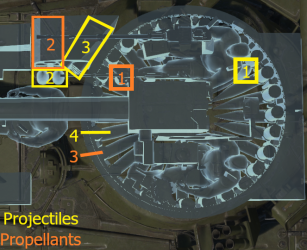
| Full ammo |
Ammo part |
1st rack empty |
2nd rack empty |
3rd rack empty* |
4th rack empty* |
Visual discrepancy |
|---|---|---|---|---|---|---|
| 36 | Projectiles Propellants |
36 (+0) 36 (+0) |
34 (+2) 29 (+7) |
29 (+7) 1 (+35) |
1 (+35) N/A |
No |
Notes:
- The T-64B main ammo rack consists of a mechanized carousel at the bottom of the turret. Such ammo stowage carries 28 propellants and projectiles.
- The 4th projectile rack is the carousel at the bottom of the turret; it serves as first-stage ammo stowage.
- The 3th propellant rack is the carousel at the bottom of the turret; it serves as first-stage ammo stowage.
Machine guns
| 12.7 mm NSVT | ||||
|---|---|---|---|---|
| Mount | Capacity (Belt) | Fire rate | Vertical | Horizontal |
| Pintle | 300 (150) | 700 | -5°/+70° | ±180° |
| 7.62 mm PKT | ||||
|---|---|---|---|---|
| Mount | Capacity (Belt) | Fire rate | Vertical | Horizontal |
| Coaxial | 1,250 (250) | 700 | N/A | N/A |
Usage in battles
The T-64B performs optimally as a sniper or support tank, utilising the low profile and long-range weapon performance. While the armour of the T-64B was good for its time, many later vehicles can fairly reliably penetrate the UFP, even through the composite armour. The gun performs well, with a good variety of ammunition, an autoloader for reliable reload times (even when a crew member is knocked, or putting out fires) and extremely high round velocity for long-range ease of use.
The T-64B can be used as a brawling tank but positioning is key - wherever possible, the LFP should not be exposed, and due to the abysmally low reverse speed, there's usually no escape from a sticky situation. Play carefully in close quarters environments, letting targets move into your gunsights rather than vice versa.
Keep in mind that the vehicle is relatively slow, so you'll often be one of the last into battle. This gives you an opportunity to exploit known intel - where your teammates have been shot/destroyed from, primarily - which can be used to position, ready for pushing enemy tanks.
T-64BV
One of the later upgrades available to the T-64B is the "additional protection" upgrade, which covers the frontal hull and turret with "Kontakt-1" ERA. This adds a huge amount of protection to the vehicle specifically against chemical rounds. While it's uncommon to see top rank MBTs use HEAT rounds, it can prove useful when facing IFVs/ATGM carriers, or in many cases, helicopters with ATGMs. The weight increase is often well worth the benefits of the BV upgrade.
Top-rank Adversaries
- M1 Abrams: The Abrams series of vehicles are significantly faster than the T-64B, and will almost always get into position before you're able to. The best way to combat them is to catch them while they're pushing. Be careful with shot placement, however, because of the nature of the Abrams vehicles it's often very hard to guarantee a single-shot vehicle knockout - if necessary, disable the vehicle's gunner/weapon first. When you have a clear shot on the back of an Abrams' turret, try to place it through the ammunition and the blast door: this often results in ammo detonation and the vehicle's destruction.
- Leopard 2K: The Leopard 2K has negligible armour and can often be destroyed with a well placed shot almost anywhere - beware the highly angled surfaces, however, which will bounce shots you may not expect it to. Watch out for the Leopard's mobility, though - it can flank quickly and the L/44 120mm can be deadly.
- Leopard 2A4: The Leopard 2A4 is similar vehicles to face and it is reasonably mobile, especially compared to the T-64. The best option is to try to get a side shot - but if this isn't possible, try for a round through the upper plate or shooting the side of turret where the commander and gunner are inside.
- Challenger Mk.2/Mk.3: These vehicles can be extremely hard to destroy when they're in a hull-down position - their turret cheeks are extremely well protected and the mantlet is small and hard to place a round through. If you're forced to engage one at long range, it's best to try your best to land a shot in the mantlet or the lower half of the turret cheeks, which are slightly weaker. When a Challenger is exposed, however, simply place a shell through the massive LFP and reap the rewards.
- Ariete (P): The Ariete is reasonably easy to destroy - it has a reasonably vulnerable hull, although the turret can be slightly harder to deal with. Still avoid being a target, because due to the compact nature of the T-64 and spread out ammunition, if an Ariete penetrates you, there's a pretty good chance you're a goner.
How to fight the T-64B
Disable its gun: the gun mantlet is very weak against top tier shells so it will be destroyed. Even if a shell can penetrate the composite armour, make sure the T-64B can not hit you back as it will penetrate most vehicles it can face. The driver port does not contain composite armour. Rounds with 200 mm of penetration can penetrate effectively, almost guaranteeing a kill. However at long ranges this is a very small target so try and hit the T-64B's gun. The lower plate is a very big weak spot as there is no composite armour there. Any top tier shell will penetrate at close to medium range. However at long ranges the lower plate is a very small target so try and disable the T-64B's gun. Vehicles such as the Type-90 or Ariete C1 are capable of punching straight through the hull composite armour.
Fighting the T-64BV (T-64B with "Kontakt-1" ERA) is a different situation. With the ERA, protection against chemical is 850 mm and above meaning it can stop the HOT missile and DM12 HEAT-FS. If you have an autocannon fire at the ERA to destroy it. Once it is gone you the value will drop to 500 mm against chemical rounds. In some cases, a if a projectile with lots of explosive hits the breech or the ERA on turret, some shrapnel will deflect downwards into the ammunition, destroying the tank even though the projectile was stopped. However, the provides minimal protection against kinetic rounds.
Pros and cons
Pros:
- Stock-friendly grind, with decent stock HEAT shell and potent HE shell
- Upgraded hull armour allows it to shrug off hits from many top-rank cannons
- Lower profile compared to other MBTs, allows the user to utilize cover and tactics that other players cannot use
- Ability to mount the Kontakt-1 Explosive Reactive Armour package which enhances first-hit protection against chemical munitions
- Very strong turret armour combined with a bad but usable -6° gun depression can allow it to hull down relatively well in some instances
- Upgraded 125 mm cannon inherited from the previous model
- The high muzzle velocity on the T-64B's APFSDS rounds make it an excellent sniper
- More diverse ammunition choices gives it a great deal of flexibility and allows it to engage at any distance and adapt to different situations and playstyle
- 9M112 "Kobra" ATGM capable of penetrating 650 mm of armour
- Replaces the "oil barrel" smoke grenades with two sets of four-barrelled smoke grenade launchers
- Good optics allow for more accurate shots at long range
Cons:
- Horrible reverse speed
- Bad gun depression compared to its adversaries
- Gun elevation/depression speed is very slow compared to other MBTs (2.4 degrees per second)
- HEAT-FS shell requires skill against its contemporaries' armour, simply pointing and firing it will not guarantee a penetration
- High risk of ammunition detonation thanks to the vertical nature of the autoloader
- The hull armour is not good enough to reliably stop APFSDS shells from the most higher-tier tanks.
- Angling the tank causes the weak side armour to be exposed and let APFSDS to tear through the ammo carousel
History
The T-64B is a third-generation main battle tank developed in the Soviet Union in the early 1960s. It was designed to replace the T-54/55 and T-62 tanks with a more modern and effective design. The development of the T-64B began in 1963, with the first prototype completed in 1965. The tank entered service in 1976.
The T-64B was a significant improvement over its predecessors. It was faster and more manoeuvrable, with a more powerful engine that gave it a top speed of 70 km/h on the road. The tank was armed with a 125 mm smoothbore gun that was capable of firing a variety of ammunition, including APFSDS, HEAT, HE, and the new 9M112 "Kobra" radio-guided ATGM.
The T-64B was also equipped with advanced fire control systems, including a laser rangefinder, an electronic ballistic computer, and an automatic target tracker. These systems allowed the tank to engage targets accurately and quickly, even while on the move. The tank also had a composite armour system that was lighter but more effective than the armour used on previous Soviet tanks.
The T-64B was produced in large numbers, with estimates ranging from 5,000 to 7,000 tanks built. The tank was eventually replaced by the T-72, T-80, and T-90 tanks in the Soviet and Russian armies, but it remains in service with several other countries, including Ukraine and Uzbekistan.
Devblog
Development work on the T-64B started in the early 1970s, with Soviet engineers conducting research on firepower improvements for the T-64. Specifically, they wanted to give the T-64 the ability to fire ATGMs through its main gun via a complex guidance system. This attempt succeeded and resulted in the construction of the Object 447A.
Beside the ability to fire "Kobra" ATGMs, the Object 447 also received a new gun stabilizer, a modernized autoloader and improved electronics. However, as the ATGM capability came at a high production cost, the decision was made to produce two separate versions of the improved T-64, one with and one without the ATGM capability. The two new tanks would be designated T-64B and T-64B1 respectively. The resulting high cost of the T-64B led to the fact that far more T-64B1s were manufactured due to their lower complexity and production cost. Throughout the years, T-64s were continuously being modernized and improved upon, incorporating many new features that would extend their capabilities and service life. It's safe to say that the later modifications of the T-64 and its prototypes laid the foundation for new Soviet tanks to make their appearance, such as the T-72 and T-80. In fact, most of the improvements featured on these younger Soviet MBTs were initially tested on the T-64 chassis.
Media
- Skins
- Images
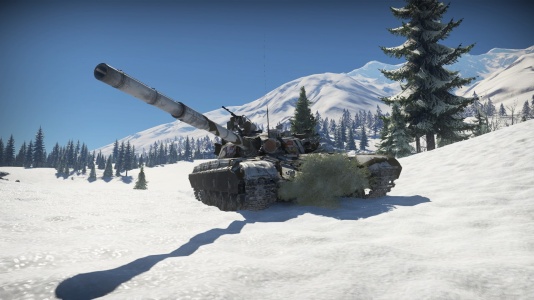
The T-64B in War Thunder with Winter Camouflage
- Videos
See also
Links to the articles on the War Thunder Wiki that you think will be useful for the reader, for example:
- reference to the series of the vehicles;
- links to approximate analogues of other nations and research trees.
External links
| Kharkov Design Bureau for Mechanical Engineering named after A. A. Morozov | |
|---|---|
| Light Tanks | |
| BT-5 | BT-5 · RBT-5 |
| BT-7 | BT-7 · BT-7M · BT-7A (F-32) |
| Medium Tanks | |
| T-34-76 | T-34 (Prototype) · T-34 (1940) · T-34 (1941) · T-34 (1st Gv.T.Br.) · T-34 (1942) · T-34E STZ · T-34E |
| T-34-57 | T-34-57 · T-34-57 (1943) |
| T-34-85 | T-34-85 (D-5T) · T-34-85 · T-34-85E |
| T-34-100 | T-34-100 |
| T-44 | T-44 · T-44-100 · T-44-122 |
| Main Battle Tanks | |
| T-54 | T-54 (1947) · T-54 (1949) · T-54 (1951) |
| T-64 | T-64A (1971) · T-64B |
| Export/Captured | |
| T-34 | ▀T 34 747 (r) · ▄T-34 · ▄T-34-85 · ␗T-34 (1943) · ␗Т-34-85 (S-53) |
| T-54 | ▄T-54 |
| See Also | Uralmashzavod · Uralvagonzavod |
| USSR medium tanks | |
|---|---|
| T-28 | T-28 (1938) · T-28 · T-28E |
| T-34-76 | T-34 (Prototype) · T-34 (1940) · T-34 (1941) · T-34 (1st Gv.T.Br.) · T-34 (1942) · T-34E STZ · T-34E |
| T-34-57 | T-34-57 · T-34-57 (1943) |
| T-34-85 | T-34-85 (D-5T) · T-34-85 · T-34-85E |
| T-34-100 | T-34-100 |
| T-44 | T-44 · T-44-100 · T-44-122 |
| T-54 | T-54 (1947) · T-54 (1949) · T-54 (1951) |
| T-55 | TO-55 · T-55A · T-55AM-1 · T-55AMD-1 |
| T-62 | T-62 · T-62M-1 |
| T-64 | Object 435 · T-64A (1971) · T-64B |
| T-72 | T-72A · T-72AV (TURMS-T) · T-72B · T-72B (1989) · T-72B3 · T-72M2 Moderna |
| T-80 | T-80B · T-80U · T-80UD · T-80UK · T-80UM2 · Т-80U-Е1 · T-80BVM · Object 292 |
| T-90 | Т-90А · T-90M |
| Trophies/Lend-Lease | |
| Germany | ▂T-III · ▂T-V |
| Great Britain | ▂МК-IX "Valentine" |
| USA | ▂M3 Medium · ▂M4A2 |