T26E5
OLD‑WIKI.WARTHUNDER.COM (DEFUNCT)
| This page is about the American heavy tank T26E5. For the other T26, see T26E1-1. |
Description
The success and popularity of the M4A3E2 "Jumbo" tanks in combat led to a similar undertaking for the M26 Pershing tank. Conversions started in January 1945 with M26 prototypes modified with heavier armour in the turret and hull into the T26E5. While the heavier weight strained the suspension, the performance was considered favorable. However, the end of World War II led to the necessity of these tanks to disappear, with only 27 T26E5 produced by the war's end for testing.
Introduced in Update "Ground Breaking", the T26E5 is an assault tank that can be most effective at close-ranges alongside the frontlines. Its excellent frontal armor can withstand hits from many armor-piercing rounds, and the fairly good 90 mm gun, inherited from the M26, often destroys enemy tanks with its explosive rounds in a single hit. However, it should be noted that the armor penetration of the main shell might be insufficient against some opponents, and the mobility of the T26E5 does not allow it to be among the first to occupy key positions.
General info
Survivability and armour
The frontal armour is quite strong, able to resist common weapons such as the 7,5 cm KwK42 and the 8,8 cm KwK43 if angled properly. A notable weak spot on the front glacis is the machine gun port but it is a small target difficult to hit with precision. The other notable weak spot is the lower front plate. With a relatively thin lower glacis, it is not able to absorb rounds from most guns, and there is no transmission to absorb a penetrating shell. However, the side armour can protect you to a certain degree when angled.
The turret armour is strong, consisting of variable thickness armour ranging from 150 to 300 mm thickness, with the mantlet ranging from about 100 to 200 mm of protection. A notable weakness in the turret is the first stage ammo, stowed on the left side of the turret, protected by about 170 mm of armour, plus 20 mm from an added track segment. Any penetrating shell hitting the turret from this side will most likely knock out all of your crew members in the turret as well as detonate the first-stage ammo rack.
The cupola with only 76 mm thickness can be penetrated by an APHE shell, taking out your gunner and commander, however the cupola is small in size, and is not an easy shot to make.
Survivability is about average for a tank of this type. You have 5 crew members, which is standard for US tanks at this time, but the turret is cramped, and a well placed shot can destroy the tank entirely if said round has an explosive filler.
Additionally, this tank only has 25 mm of protection on the roof, making it vulnerable to attacking aircraft with heavier ground focused weapons.
Armour type:
- Rolled homogeneous armour (Hull sides, rear and roof)
- Cast homogeneous armour (Front hull, turret, gun mantlet, cupola)
| Armour | Front (Slope angle) | Sides | Rear | Roof |
|---|---|---|---|---|
| Hull | 152.6 mm (46°) Upper glacis 242 mm (21-35°) Upper bulge 25.4 mm MG port 101.6 mm (54°) Lower glacis |
76.2 mm Fighting compartment 50.8 mm Engine compartment |
50.8 mm (7°) Upper plate 22.2 mm (72°) Lower glacis |
152.6 mm (44°) Front glacis 38.1 mm (0-20°) Fighting compartment 22.2 mm (0-20°) Engine compartment 5 mm (7-10°) Engine vents |
| Turret | 170-229 mm (24°) Turret front 177.5 mm (cylindrical) Gun mantlet |
160 mm (cylindrical) Front & centre 110 mm (8°) Rear |
127 mm (2°) | 25 mm (0-7°) |
| Cupola | 76.2 mm (conical) | 25 mm | ||
Notes:
- Suspension wheels, tracks and torsion bars are 20 mm thick.
- Mudguards and storage boxes are 4 mm thick.
Mobility
The T26E5 use the same engine as the M26 Pershing. It has a poor power-to-weight ratio and its top speed is 40-43 km/h. But expect the average cruising speed to be closer to 30 km/h. When off-road the speed will drop even more. Lacking neutral steering, it might be difficult for the heavy tank to turn in urban environment. As such, the player should plan the route they want to take carefully and avoid flanking manoeuvres that will take a lot of time.
| Game Mode | Max Speed (km/h) | Weight (tons) | Engine power (horsepower) | Power-to-weight ratio (hp/ton) | |||
|---|---|---|---|---|---|---|---|
| Forward | Reverse | Stock | Upgraded | Stock | Upgraded | ||
| Arcade | Expression error: Unexpected * operator. | 646 | Expression error: Unexpected round operator. | __.__ | |||
| Realistic | 442 | Expression error: Unexpected round operator. | __.__ | ||||
Modifications and economy
Armaments
Main armament
| 90 mm M3 | Turret rotation speed (°/s) | Reloading rate (seconds) | |||||||||||
|---|---|---|---|---|---|---|---|---|---|---|---|---|---|
| Mode | Capacity | Vertical | Horizontal | Stabilizer | Stock | Upgraded | Full | Expert | Aced | Stock | Full | Expert | Aced |
| Arcade | 70 | -10°/+20° | ±180° | N/A | 19.4 | 26.9 | 32.6 | 36.1 | 38.4 | 9.75 | 8.63 | 7.95 | 7.50 |
| Realistic | 14.3 | 16.8 | 20.4 | 22.6 | 24.0 | ||||||||
Ammunition
The T26E5 uses the same standard ammunition found in the other 90 mm M3 cannons. When first unlocked, the T26E5 will have an APBC(T33) shell as its default round. The APBC has decent characteristics, but since it doesn't have any explosive filler, it should be replaced by the APCBC(M82) shell as soon as possible. The APCR shot can be used to penetrate some heavily armoured vehicle such as the Tiger II (H), the Ferdinand or the Jagdtiger but the player should be aware of the poor post-penetration damage of the APCR projectile. Thus, the APCR should be used as a last resort against an already disabled tank. Additionally, the HE shell can be used to damage lightly armoured vehicles and the smoke shell can be used to provide smoke cover for teammates or to blind entrenched enemy tanks.
| Penetration statistics | |||||||
|---|---|---|---|---|---|---|---|
| Ammunition | Type of warhead |
Penetration @ 0° Angle of Attack (mm) | |||||
| 10 m | 100 m | 500 m | 1,000 m | 1,500 m | 2,000 m | ||
| T33 shot | APBC | 175 | 172 | 160 | 146 | 134 | 122 |
| M82 shot | APCBC | 185 | 182 | 169 | 155 | 142 | 130 |
| M304 shot | APCR | 287 | 281 | 259 | 234 | 211 | 191 |
| M71 shell | HE | 20 | 20 | 18 | 17 | 16 | 16 |
| Shell details | ||||||||||||
|---|---|---|---|---|---|---|---|---|---|---|---|---|
| Ammunition | Type of warhead |
Velocity (m/s) |
Projectile mass (kg) |
Fuse delay (m) |
Fuse sensitivity (mm) |
Explosive mass (TNT equivalent) (g) |
Ricochet | |||||
| 0% | 50% | 100% | ||||||||||
| T33 shot | APBC | 853 | 10.91 | - | - | - | 47° | 60° | 65° | |||
| M82 shot | APCBC | 853 | 10.91 | 1.2 | 14 | 137.2 | 48° | 63° | 71° | |||
| M304 shot | APCR | 1,021 | 7.62 | - | - | - | 66° | 70° | 72° | |||
| M71 shell | HE | 823 | 10.55 | 0.2 | 0.1 | 1,210 | 79° | 80° | 81° | |||
| Smoke shell characteristics | ||||||
|---|---|---|---|---|---|---|
| Ammunition | Velocity (m/s) |
Projectile mass (kg) |
Screen radius (m) |
Screen deploy time (s) |
Screen hold time (s) |
Explosive mass (TNT equivalent) (g) |
| M313 | 821 | 10.7 | 9 | 5 | 20 | 50 |
Ammo racks
| Full ammo |
1st rack empty |
2nd rack empty |
3rd rack empty |
4th rack empty |
5th rack empty |
6th rack empty |
7th rack empty |
8th rack empty |
9th rack empty |
Visual discrepancy |
|---|---|---|---|---|---|---|---|---|---|---|
| 70 | 65 (+5) | 56 (+14) | 48 (+22) | 40 (+30) | 32 (+38) | 24 (+46) | 17 (+53) | 11 (+59) | 1 (+69) | No |
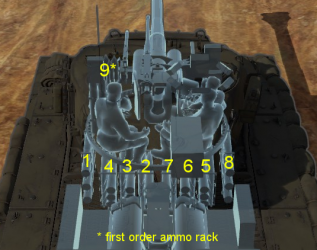
Notes:
- Shells are modeled individually and disappear after having been shot or loaded.
- 1 shell from rack 7 is fired after rack 1 is emptied. For the purpose of clarity, it is counted as belonging to rack 2 in the table above.
- Rack 9 is a first stage ammo rack. It totals 10 shells and gets filled first when loading up the tank.
- This rack is also emptied early: the rack depletion order at full capacity is: 9 - 1 - 2 - etc. until 8.
- If you pack 17 (+53) shells, it will keep most of the hull empty of ammo.
- Full reload speed will be realized as long as shells are available in the ready rack 9. If the ready rack is empty, a penalty to reload speed will occur.
- Simply not firing when the gun is loaded will move ammo from racks 1-8 into rack 9. Firing will interrupt the restocking of the ready rack.
Machine guns
The 12.7 mm M2HB Browning can shred light tanks and also engage low-flying aircraft to a certain degree. The coaxial 7.62 mm machine gun is not able to damage anything except open-topped vehicles and unarmoured trucks.
| 12.7 mm M2HB | ||||
|---|---|---|---|---|
| Mount | Capacity (Belt) | Fire rate | Vertical | Horizontal |
| Pintle | 600 (200) | 577 | -10°/+50° | ±120° |
| 7.62 mm M1919A4 | ||||
|---|---|---|---|---|
| Mount | Capacity (Belt) | Fire rate | Vertical | Horizontal |
| Coaxial | 5,000 (250) | 500 | N/A | N/A |
Usage in battles
The T26E5 is a heavy tank and should be played like one: stick with allies and move slowly. It is best used in positions that have concealment, this allows you to get the first shot off. When in positions with cover, you should wait for enemies to come to you. Generally, the better the position the better the tank will perform. Its armour can defend against some of the MBTs of the BR, but do not rely on it, and in uptiers it can struggle when against better rounds. It's best to try and cover your flank, as pretty much any round at the BR will penetrate your sides. This can be done by having teammates nearby, or a good position. In close range situations, it would be best to use the M82 round, but it must be aimed well. When it hits weak spots, the explosive filler is large enough to take out several crew members. If not, it can bounce easily against sloped armour. For medium and longer ranges, the M304 round will work better, but you will have to aim at specific components within the tank, as the APCR round does not inflict as much post-penetration damage as the M82 round.
Pros and cons
Pros:
- Adequately armoured, capable of shrugging off shells fired by lower-calibre armaments
- 90 mm M3 cannon is a noticeable upgrade from the Jumbo's 76 mm M1 cannon
- APCR shell is able to penetrate most heavily armoured targets
- Weak spots are relatively small and difficult to hit
- Serves the same purpose and role as the preceding M4A3E2 (76) W Jumbo
- M82 has insane damage potential - either destroys in a single hit or severely cripples your target
- Frontal armour can, when properly angled, even shrug off the dreaded 88 mm shells fired by the Tiger II
- Stronger lower frontal plate than on the regular M26's
- Reverse speed is decently high and fairly responsive
- Strong mantlet armour, a true force to be reckoned with in a hull-down fighting position
- Decent zoom and relatively wide FOV in the gunner's sight
- Fairly quick turret rotation
Cons:
- 90 mm M3 is inadequate in uptiers
- M82 shot does not like sloped armour - bounces frequently
- Front armour is vulnerable to heavier weapons (such as the 122 mm D-25T and 8,8 cm KwK43)
- Increased armour makes the vehicle even more sluggish than the already sluggish M26 its based on
- Very low power-to-weight ratio - sluggish acceleration and low reactive mobility
- Average survivability
- Struggles when uptiered - its armour loses its value due to facing more potent ammunition and the mobility and speed is too low to keep up with the faster, more manoeuvrable cold war MBTs it can face
- Large muzzle brake - expect your gun to be knocked out frequently
- First stage ammunition is stored upright in the turret - ammo detonations are quite frequent
History
Development
The T26E5 was intended to fill much the same niche as the M4A3E2 "Jumbo" in being an up-armoured version of the M26 to fulfil a role as a heavy assault tank, just as the M26 itself was to replace the M4. Even before early 1944 the US army recognised a need for a heavy assault tank for an upcoming offensive in the European theatre, but at this time the M26 was not set to be ready for full-scale production in time, and as such it was decided to move forward with an up-armoured version of the M4A3[1]. As the allied invasion of France progressed into 1945, the US Army took note of the success and utility of the M4A3E2 and sought to take advantage of the larger gun on the M26 platform by proceeding with the development of the T26E5. A few modifications were made to the design including wider tracks to better support the increased weight, and a more suitable gear reduction. This, however, combined with the weight of the additional frontal armour and new, thicker, turret and mantlet castings conspired to make the tank significantly slower[2].
An M4A3 was fitted with a T26 turret and additional weights as a test bed for the suspension and trials ran from February to March of 1945, resulting in various amendments to the specifications including even thicker frontal hull armour, with a slight reduction in frontal turret armour but a thicker mantlet[2]. In April 1945 these specifications were approved and production orders for 27 vehicles were sent to contractors as conversions from the T26E3, with completion of the first vehicle expected in June 1945[2].
Testing and cancellation
The first T26E5 was completed in July 1945 and while all 27 ordered vehicles were finished before September 1945 and the end of WW2, no more were ordered[2]. The T26E5 was by a good margin the most heavily armoured assault tank set to be operated by the US Army at the time, but the increased weight led to significant troubles with reliability during testing, largely due to inadequate suspension but also with transmission failures. As a result all produced vehicles were resigned to being used as range targets, with all 27 either being destroyed on the range or scrapped[2].
Media
- Skins
- Videos
See also
External links
Paste links to sources and external resources, such as:
- topic on the official game forum;
- other literature.
References
| USA heavy tanks | |
|---|---|
| M4 Jumbo | M4A3E2 · Cobra King · M4A3E2 (76) W |
| M6 | M6A1 · T1E1 · T1E1 (90) · M6A2E1 |
| T26 | T26E1-1 · T26E5 |
| T29/30/34 | T29 · T30 · T34 |
| T32 | T32 · T32E1 |
| M103 | M103 |
| Others | T14 |