BM-13N
Wheeled ground vehicles
OLD‑WIKI.WARTHUNDER.COM (DEFUNCT)
Description
The BM-13N is a premium gift rank Soviet tank destroyer with a battle rating of (AB), (RB), and (SB) also known as "Katyusha". It was introduced during Update 1.67 "Assault" as part of the 2017 Victory Day Event. It later returned as part of the Hot Tracks trophy and is currently only obtainable from different trophies or the marketplace via a coupon.
One of the most unusual vehicle in game, to say the least. Not only is its truck-based configuration not the most common, it also uses 16 x 132 mm M13 rockets as its main armament, has limited traverse, has only 2 crew members, and a gun depression of +8°. The last is somewhat compensated by its ability to lean forwards with a hydropneumatic suspension system usually found on Rank 5 vehicles and up. Its gameplay is somewhat comparable to other rocket-armed premium machines such as the T34 Calliope or Panzerwerfer 42, but remains a rather unique experience.
The Katyusha is an artillery piece, belonging more in an artillery formation than in a tank battle. One should stay at a distance from the enemy since its rockets have a blind zone of about 250 m in front of the truck when moving on a flat surface. This is best used as it was back in the days: to support allies.
General info
Survivability and armour
With next to no armour, the BM-13N is not designed for armour-vs-armour engagements. Being a simple truck, even rifle-calibre machine gun can penetrate the vehicle and knock out the two crew members. Therefore, the vehicle is extremely vulnerable to overpressure (HE shells, rockets, bombs and artillery strikes) as well as strafing aircraft. It is best to play at a distance from the frontline and with some cover nearby to retreat behind once the enemy presence increases, as your mobility isn't great either.
Armour type:
- Rolled homogeneous armour (Roof)
- Structural steel (Chassis and driver's cabin)
| Armour | Front (Slope angle) | Sides | Rear | Roof |
|---|---|---|---|---|
| Chassis | 5 mm | 5 mm | 5 mm | 5 mm |
| Cabin | 1 mm (77-86°) Hood 4 mm (38°) Driver's windows |
1 mm (1-8°) | 4 mm (86°) | 4 mm |
Notes:
- Wheels are 2 mm thick.
- No armour in front grille, simple 7.62 mm machine gun rounds can enter and damage the engine.
Mobility
| Game Mode | Max Speed (km/h) | Weight (tons) | Engine power (horsepower) | Power-to-weight ratio (hp/ton) | |||
|---|---|---|---|---|---|---|---|
| Forward | Reverse | Stock | Upgraded | Stock | Upgraded | ||
| Arcade | Expression error: Unexpected * operator. | 134 | Expression error: Unexpected round operator. | __.__ | |||
| Realistic | 83 | Expression error: Unexpected round operator. | __.__ | ||||
Being a wheeled vehicle with a rather high ground pressure, the BM-13N has issues traversing soft and uneven terrain (sand, snow, mud, hills), as expected from a truck. On hard terrain (roads, concrete, etc.), it can reach 70 km/h but the acceleration to get to those speeds is poor. The brakes are not powerful so you'll have to anticipate the braking phases to stop in time. The turn radius is also quite large: you won't be able to change directions easily.
Modifications and economy
Armaments
Main armament
| 132 mm M13 rockets | Turret rotation speed (°/s) | Reloading rate (seconds) | |||||||||||
|---|---|---|---|---|---|---|---|---|---|---|---|---|---|
| Mode | Capacity | Vertical | Horizontal | Stabilizer | Stock | Upgraded | Full | Expert | Aced | Stock | Full | Expert | Aced |
| Arcade | 16 | +8°/+45° | ±10° | N/A | 6.2 | 8.5 | 10.4 | 11.5 | 12.2 | 10.40 | 9.20 | 8.48 | 8.00 |
| Realistic | 4.2 | 4.9 | 6.0 | 6.6 | 7.0 | ||||||||
Ammunition
| Penetration statistics | |||||||
|---|---|---|---|---|---|---|---|
| Ammunition | Type of warhead |
Penetration @ 0° Angle of Attack (mm) | |||||
| 10 m | 100 m | 500 m | 1,000 m | 1,500 m | 2,000 m | ||
| M-13 | Rocket | 40 | 40 | 40 | 40 | 40 | 40 |
| Shell details | ||||||||||||
|---|---|---|---|---|---|---|---|---|---|---|---|---|
| Ammunition | Type of warhead |
Velocity (m/s) |
Projectile mass (kg) |
Fuse delay (m) |
Fuse sensitivity (mm) |
Explosive mass (TNT equivalent) (kg) |
Ricochet | |||||
| 0% | 50% | 100% | ||||||||||
| M-13 | Rocket | 355 | 42.36 | 0 | 0.1 | 4.9 | 79° | 80° | 81° | |||
Ammo racks
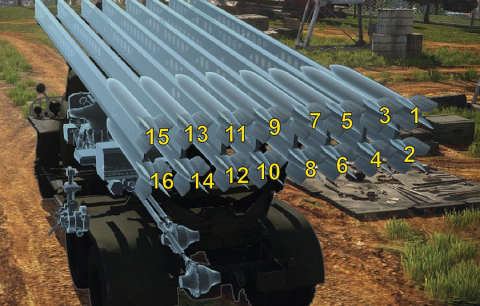
| Full ammo |
Visual discrepancy |
|---|---|
| 16 | No |
Notes:
- Rockets deplete right to left, columns first
Usage in battles
There are two main ways to use the Katyusha:
Artillery
This truck is a real killer in an open field, provided it could hit its target before it is noticed. One should estimate the correct angle, shoot a rocket, watch where it lands, adjust fire, and retry it as many time as needed. Do not take too much time with this method of rangefinding since a single retaliatory shot can end your day. Once the correct sight distance is found, unleash hell on your enemies, blinding them with dust lifting up from the ground, detonating ammo racks and blasting off tracks. This is basically an intelligent artillery barrage. Once all rockets are fired, fall back behind allied lines, find a captured objective to reload at, and repeat.
Keep in mind that firing the M-13 rockets is in no way quiet, and will alert enemies all around that there is a Katyusha somewhere. You can use the method of "shoot-n-scoot" to prevent being destroyed. This is finding a position, firing a couple rockets, and then moving to a different position to repeat. Rocket launcher vehicles are a rare and high-priority target, so watch out for enemy tanks as well as aircraft. There is little a Katyusha can do against enemy aircraft, which can kill the vehicle with as little as a half-second machine gun burst or a relatively close detonation of a bomb or rocket. Try not to get caught out in the open, and hide under trees or behind buildings. You can also have a friendly SPAA tag along, but note that once either of you start firing, your position is compromised.
Ambusher
Best used in an urban combat scenario, when your team is losing and the enemies are pushing towards your spawn. In these times, enemies often rush the base/objectives without watching corners very well. This is your chance: find yourself a pile of rubble and lift the rear of the truck on it in such a way that you can fire right in front of you just past the corner. When an enemy passes by, spray it with rockets until it dies, using your high rate of fire. This tactic is often a last resort when you're cornered and encircled. You may kill one or more enemies if you're lucky, but you will eventually be caught or run out of rockets.
When firing, try to aim for these:
- Tank's bellies: Since very few tanks have more than 40 mm of armour underneath, rocket detonations on or right under the floor of a tank can go up and into the fighting compartment, damaging essential components and crewmembers, or detonating ammo racks.
- Tracks: To immobilize your foes, you can knock out the tracks of the enemy vehicle. This can be to stop it from escaping your sights, or to give your allies a chance to finish them off. This is particularly deadly for casemate tank destroyers like the StuG III F or the Gun Carrier (3-in). Some tanks store ammo over the tracks, it can detonate them.
- Gun barrel: Blasting off your enemy's gun barrel will incapacitate it from firing back at you and your allies. Beware other weapons and coaxial and roof machine guns however, as even though the main gun may be incapacitated, the enemy could still fire back. An extreme example of this is the M6A1 which has one main cannon, one coaxial cannon, a roof machine gun, and two bow machine guns. Completely disabling the M6A1 from firing back would require, at minimum, five well-placed rockets.
- Engine deck: Can disable a tank's engine to prevent it from moving. Has a decent chance of igniting it.
- Turret front/Commander's hatch/Turret roof: Many tanks have weak roof armour. Rocket detonations on or right on top of the roof of a tank can go down and into the fighting compartment, damaging essential components and crewmembers, or detonating ammo racks.
- Hull roofs: Same as with turrets the hull top armour is usually weak, an easy way to knock out the driver and immobilize your target.
Pros and cons
Pros:
- Powerful 132 mm rockets with a high explosive mass. Able to take out most, if not all, lightly armoured vehicle and open topped vehicles in just a few shots.
- High rate of fire
- High-velocity rockets
- Adjustable suspension
- Can be used in deceptions: a similar model is used as decorations on some maps, without rockets and with the add-on armour plate lifted. This may allow the player to hide in plain sight. Works better when in groups of 2 Katyushas or more.
- Relatively rare vehicle to see on the battlefield, thus it has a certain element of surprise.
- Launcher sight helps with aiming to play as an indirect fire weapon
Cons:
- Poor survivability
- Has issues traversing rough and muddy terrains, to be expected from a wheeled vehicle
- Poor horizontal launcher traverse
- Low ammunition supply of 16 rockets
- Loud and distinguishable firing sound
- Lacks other armaments beside rockets
- Large dead zone in front of vehicle up to 250 m (launcher depression of +8°)
- Vehicle cannot move properly while suspension is adjusted
- In RB & SB, cannot reload unless on allied capture point and can only reload one rocket at a time.
History
Development
The concept of a multiple rocket launcher system came about in June 1938, when the Soviet Jet Propulsion Research Institute was authorized by the Main Artillery Directorate to develop such system for the RS-132 rocket in use on their aircraft. A prototype by I. Gvay in Chelyabinsk was tried and fired M-132 rockets on ZiS-5 trucks, though these were unstable and were revised on the proposals of V.N. Galkovskiy to mount the launching rails longitudinally. Testing for the newly made prototype began at the end of 1938, firing 233 rounds in a couple of salvos. The rockets were found to be able to hit up to 5,500 meters out, but the system was not looked fondly upon by the artillery branch. It took 50 minutes to load 24 rockets onto the launching rail, while a regular artillery cannon and howitzer can fire about a hundred in the same time at a sustained rate.
Testing continued up until 1940 and with a prototype of a truck with the launch rails on the back. The design was approved for production before Germany invaded the Soviet Union in June 1941, and mass-production began after the first month of the war, where the multiple rocket launchers proved very successful. During the war, the launchers were taken with much secrecy and operated by specialized troops such as the NKVD who do not even know its true name. Through the presence of a "K" on the vehicles from the Komintern Factory, the soldiers operating decided to nickname these launchers "Katyusha" after a popular wartime song of the same name. Up to 3,237 of all types of Katyusha launchers were produced from 1941 to the end of 1942, and more than 10,000 were made by the end of the war.
Advantages and disadvantages
Compared to the contemporary artillery systems of the time, the multiple rocket launcher system presented a different kind of artillery barrages used in the field. Advantages the multiple rocket launcher was that they were simple, extremely effective in saturation bombardment, fires lots of ordnance in a small time span, and were usually attached to mobile vehicles that can permit a quick retreat after firing to prevent counter-battery firing. Disadvantages with the system was that the rockets took a long time to reload, less accurate than regular artillery guns, and cannot sustain fire for a long period of time. However, in the battlefield, the multiple rocket launcher induces a greater psychological effect onto the targets on the receiving end due to the heavy amount of explosives able to be delivered in a short time. A battery of only four launchers could deliver their salvos of about 4.35 tons of explosives in a span of no longer than 10 seconds at a 400,000 square meter area.
Designations
Multiple variants of the multiple rocket launcher system were made in the course of the war as the design is simply the attachment of launch rails onto a variety of vehicles. Each vehicle has different names that follows a template to distinguish their types.
- "BM-x-y" indicates a ground vehicle.
- "M-x-y" indicates a towed variant.
- "y-M-x" indicates a naval variant.
and "x" stands for the missile model while "y" stands for the number of launch rails available for the launcher variant. For example, the BM-8-24 indicates a ground vehicle firing M-8 rockets with 24 rails available to mount on.
Vehicles using the Katyusha launchers range from trucks, cars, and tanks. The production started with trucks such as the ZiS-6, then moving on to STZ-5 artillery tractors, then on Allied Lend-Lease vehicles. The 82 mm M-8 rockets, which saw service in August 1941, was the most popular rocket variant and saw use on the trucks and even tanks, which would make the BM-8-24 rocket launcher tank mounted on the T-60 light tank. Another attempt with tank mounting was with a KV-1 heavy tank as the KV-1K, but as a waste of heavy armour, this was scrapped.
Combat usage
The Katyusha rocket launchers first saw service during the opening of Operation Barbarossa against Germany. On July 14, 1941, under the experimental battery commanded by Captain Ivan Flyorov, seven launchers were used in Rudnya and were able to cause massive destruction to the Germans in the town before they fled in panic. This success prompted the Red Army to build up more Katyushas in their inventory and raise more batteries and regiments for the vehicle. All these units were under NKVD control for secrecy until the Germans reveal their own multiple rocket launcher system, the Nebelwerfer. The Germans nicknamed the Katyusha launchers "Stalin's Orgel", literally "Stalin's Organ" after Joseph Stalin and how the launchers are organized in a way which looks like a church organ. This German nickname became widely known in other areas in Western Europe. By the end of 1941, eight regiments and 37 independent battalions were available with a count of 554 Katyushas total.
The rocket launchers continue to become more integrated into the rest of the army as the war continued. Heavy mortar battalions were armed with the newer M-30 rocket launchers with heavy 300 mm M-30 rockets in June 1942. In July, a battalion of rocket launchers was added to the tank corps. The organization and equipment of these mortar battalions equipped with the Katyusha continue to increase and by the end of the war in 57 regiments, about 518 batteries of Katyusha launchers were available.
Legacy
The Katyusha launchers, issued in large numbers in the Eastern Front, was largely successful in the strategic effect of the war, granting the Soviet Union the ability to lay down a very heavy and shocking bombardment very quickly. The success of the system prompted many other countries to pursuit such a system as well, such as the modified T34 Calliope based off the Sherman and the Germans Panzerwerfer 42s. Today, the multiple rocket launcher system is still widespread with the implementation of newer technology, rockets, and missiles that makes the rocket launcher system a very potent weapon to anyone on the receiving end.
Media
- Skins
- Images
- Videos
See also
- Other vehicles of similar configuration and role
External links
| USSR tank destroyers | |
|---|---|
| SU-76M | SU-76M · SU-76M (5th Gv.Kav.Corps) · SU-85A |
| SU-57B | SU-57B · SU-76D |
| T-34 Derivatives | SU-122 · SU-85 · SU-85M · SU-100 · SU-122P |
| Heavy Tank Derivatives | SU-100Y · ISU-122 · ISU-122S · SU-152 · ISU-152 · Object 268 |
| SU-100P and Derivatives | SU-100P · Object 120 |
| Wheeled | YaG-10 (29-K) |
| Airborne | ASU-57 · ASU-85 |
| Rocket | BM-8-24 · BM-13N · BM-31-12 |
| ATGM | IT-1 · Shturm-S · Object 775 · Khrizantema-S |
| Artillery | 2S1 · 2S3M |
| Other | SU-5-1 · ZiS-30 · SU-122-54 |
| USA | SU-57 |
| USSR premium ground vehicles | |
|---|---|
| Light tanks | BA-11 · RBT-5 · BT-7A (F-32) · T-26 (1st Gv.T.Br.) · T-26E · T-126 · PT-76-57 · 2S38 |
| Medium tanks | T-34 (Prototype) · T-34 (1st Gv.T.Br.) · T-34E · T-34-57 (1943) · T-34-85E · T-34-100 · T-44-122 · TO-55 · T-55AM-1 · T-72AV (TURMS-T) · T-80UD · Т-80U-Е1 |
| ▂M3 Medium · ▂M4A2 · ▂T-III · ▂T-V · ▂МК-IX "Valentine" | |
| Heavy tanks | SMK · T-35 · ▂MK-II "Matilda" · KV-1E · KV-2 (1940) · KV-2 (ZiS-6) · KV-122 · KV-220 · IS-2 "Revenge" · Object 248 · IS-6 · T-10A |
| Tank destroyers | BM-8-24 · BM-13N · BM-31-12 |
| SU-57 · SU-76D · SU-76M (5th Gv.Kav.Corps) · SU-85A · SU-100Y · SU-122P · Object 120 | |
| SPAA | ▂Phòng không T-34 · ZUT-37 |