ASU-57
OLD‑WIKI.WARTHUNDER.COM (DEFUNCT)
Description
The ASU-57 (Авиадесантная самоходная установка, АСУ-57) was a small, light Soviet assault gun designed for use primarily by Soviet airborne troops. The ASU-57 was intended to be a lightweight assault gun that could be airdropped from the An-12 transport plane, the Soviet military's main cargo plane at the time, and deployed alongside troops via rocket-assisted parachute. The ASU-57 was the first effective Soviet airborne tank, overcoming shortcomings in previous Soviet doctrine dating back to the 1930s. It was lightly armoured and armed with a 57 mm Ch-51 tank gun, a modified version of the 57 mm ZiS-2 anti-tank gun employed during World War II. Beginning in 1954, an improved 57 mm Ch-51M tank gun was mounted, with a somewhat shorter double-baffle muzzle brake. One significant disadvantage was the vehicle's welded aluminium structure, which provided insufficient protection for the crew. During its operational years, each airborne division would have received 54 such vehicles. Beginning in 1960, it was gradually phased out in favour of the ASU-85.
Introduced in Update 1.59 "Flaming Arrows", the ASU-57 is extremely vulnerable since it lacks armour and weighs only 3.3 tonnes. ASU-57 gameplay is exceedingly difficult, but it can also be extremely rewarding. Because of its small size, the ASU-57 can readily conceal itself behind low obstacles on the battlefield, making ambushes and surprise strikes its speciality. The ASU-57, on the other hand, is extremely susceptible to virtually any form of fire. Aircraft are extremely dangerous due to the exposed crew compartment. It is recommended that players only engage isolated enemies one at a time, as dealing with multiple opponents will be extremely difficult.
General info
Survivability and armour
Due to the weight restrictions necessary for air portability, the ASU-57 has nearly no armour to speak of, and the side armour can be penetrated by even rifle-calibre machine guns. It has no armoured roof, and is thus extremely vulnerable to strafing runs by aircraft.
Armour type:
- Rolled homogeneous armour
| Armour | Front (Slope angle) | Sides | Rear (Slope angle) | Roof | Belly |
|---|---|---|---|---|---|
| Body | 6 mm (21-65°) Front Plate 6 mm (38°) Lower glacis |
4 mm | 6 mm (9°) | 5 mm | 6 mm |
Notes:
- Suspension wheels are 10 mm thick, tracks are 15 mm thick
Mobility
| Game Mode | Max Speed (km/h) | Weight (tons) | Engine power (horsepower) | Power-to-weight ratio (hp/ton) | |||
|---|---|---|---|---|---|---|---|
| Forward | Reverse | Stock | Upgraded | Stock | Upgraded | ||
| Arcade | Expression error: Unexpected * operator. | 78 | Expression error: Unexpected round operator. | __.__ | |||
| Realistic | 49 | Expression error: Unexpected round operator. | __.__ | ||||
While the ASU-57 has a top speed below 50 km/h, it has an excellent power/weight ratio that allows the vehicle to accelerate very quickly to reach its top speed. It is thus very mobile and turns very quickly. However, it has a poor reverse speed of only 5 km/h, which makes it hard to back up into cover or away from a threat.
Modifications and economy
Armaments
Main armament
The ASU-57 is armed with the 57 mm Ch-51M, a derivative of the 57 mm ZiS-2 anti-tank gun encountered previously on the ZiS-30. The mounting has a very limited amount of gun depression and traverse due to the small size of the ASU-57. The gun itself has a fairly fast reload, which is a good thing since it is not uncommon for the first penetrating hit to not completely destroy the target.
| 57 mm Ch-51M | Turret rotation speed (°/s) | Reloading rate (seconds) | |||||||||||
|---|---|---|---|---|---|---|---|---|---|---|---|---|---|
| Mode | Capacity | Vertical | Horizontal | Stabilizer | Stock | Upgraded | Full | Expert | Aced | Stock | Full | Expert | Aced |
| Arcade | 30 | -5°/+12° | ±8° | N/A | 10.57 | 14.63 | 17.76 | 19.64 | 20.89 | 6.50 | 5.75 | 5.30 | 5.00 |
| Realistic | 7.14 | 8.40 | 10.20 | 11.28 | 12.00 | ||||||||
Ammunition
- BR-271SP: APBC; a solid shot with a good penetration but no explosive filler. It is your stock shell, use it until you unlock BR-271M.
- BR-271M: APCBC; an armour-piercing round with ballistic cap and explosive filler. It will punch through most targets frontally and its explosive filler will take out most targets in a single shot. This should be your main shell once you unlock it.
- BR-271N: APCR; a composite round with a slightly increased penetration but no explosive filler and will only penetrate flat vertical surfaces. The small added penetration (a few mm) does not make a viable ammo choice to deal with heavily armoured targets.
- O-271: HE; a slow round with a high explosive mass useful for taking out the crew of open-topped vehicles. As it won't consistently kill SPAAGs due to the small calibre and low explosive mass, don't try to hunt these vehicles as they will kill you much faster than you will.
| Penetration statistics | |||||||
|---|---|---|---|---|---|---|---|
| Ammunition | Type of warhead |
Penetration @ 0° Angle of Attack (mm) | |||||
| 10 m | 100 m | 500 m | 1,000 m | 1,500 m | 2,000 m | ||
| BR-271SP | APBC | 142 | 139 | 125 | 109 | 96 | 84 |
| BR-271M | APCBC | 155 | 151 | 135 | 118 | 102 | 89 |
| O-271 | HE | 12 | 12 | 10 | 8 | 6 | 5 |
| BR-271N | APCR | 159 | 155 | 140 | 123 | 108 | 94 |
| Shell details | ||||||||||||
|---|---|---|---|---|---|---|---|---|---|---|---|---|
| Ammunition | Type of warhead |
Velocity (m/s) |
Projectile mass (kg) |
Fuse delay (m) |
Fuse sensitivity (mm) |
Explosive mass (TNT equivalent) (g) |
Ricochet | |||||
| 0% | 50% | 100% | ||||||||||
| BR-271SP | APBC | 975 | 3.14 | - | - | - | 48° | 63° | 71° | |||
| BR-271M | APCBC | 1,020 | 2.8 | 1.2 | 9 | 20.02 | 48° | 63° | 71° | |||
| O-271 | HE | 695 | 3.72 | 0.4 | 0.1 | 220 | 79° | 80° | 81° | |||
| BR-271N | APCR | 1,125 | 2.4 | - | - | - | 66° | 70° | 72° | |||
Ammo racks
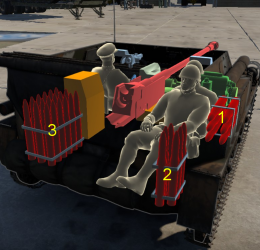
| Full ammo |
1st rack empty |
2nd rack empty |
3rd rack empty |
Visual discrepancy |
|---|---|---|---|---|
| 30 | 25 (+5) | 19 (+11) | 1 (+29) | No |
Notes:
- Racks disappear after you've fired all shells in the rack.
- Right side empty: 19 (+11) shells.
Usage in battles
One of the smallest tracked vehicles in the game, weighing only 3.3 tons, the ASU-57's complete lack of armour makes it extremely vulnerable. Its only defense is its small size, making it extremely difficult to notice, let alone hit. It accelerates quickly and is very nimble for a turretless tank destroyer.
The ASU-57 is very difficult but can be very rewarding and fun to play. It is not recommended for arcade battles, as its primary advantage, stealth, is lost. The ASU-57 is a master of stealth, famed and beloved by the community for its ability to sneak up on tanks using its extremely small size. When using the ASU-57, objects that other tanks would ignore or simply drive over are capable of completely hiding the vehicle, making ambushes and surprise attacks the specialty of the ASU-57. This size comes at a cost, however, as the ASU-57 is extremely vulnerable to almost anything that can shoot at it. Aircraft are especially dangerous due to the open crew compartment.
The ASU-57 is best used as an ambusher/flanker, executing surprise attacks from unexpected locations other vehicles would struggle or be unable to reach. The ASU-57 is incredibly short, and by driving up next to an enemy it can render the enemy tank completely helpless, as almost no vehicle has enough gun depression to reach it. For this reason, it is recommended to only go after isolated vehicles, as an enemy teammate will be able to assist their ally by destroying the ASU-57. For the maximum efficiency of this tactic, knock out the driver of the enemy vehicle, then rush up to their side before they can bring their gun to bear.
Sniping can also be a very good tactic, thanks to the amazing velocity of BR-271M (over 1,000 m/s) and consequently penetration, also thanks to your very low profile you are very hard to spot/hit at far range. Be careful though when engaging American vehicles as they can just spray their .50 cals at you, knocking your crew out even at long range.
Note that the ASU-57 is the lowest ranked vehicle in the game with access to night vision devices, a useful feature in night battles.
- Enemies worth noting
As the ASU-57 can be easily knocked out by most enemies, it does not makes sense to list all opponents. However, some foes are more dangerous than others as they may survive your shots.
- Panther D, Tiger H1: in uptiers you can see those two big cats. The Panther's UFP is immune to all your rounds, so better aim for the left side (right when facing it) of the gun mantlet, this will usually knock out gunner, commander and with some luck the gun breech. For the Tiger, aim for the front hull if it is not angled as you can punch right through. If it is angled, in this situation it is better to just retreat and relocate. The best is still to get a side shot on both of them. An important note is that with their enormous size and your rounds small explosive mass, you can and will struggle to destroy them; actually a shot to the middle of the Tiger's UFP wont take out a single crew member, only damage them.
- KV-1B/C (germany). Those can be really tricky even side shots can non-pen, treat similarly as a Tiger, the armour layout is very similar, especially on the hull.
Pros and cons
Pros:
- Tiny size, can easily hide in unexpected places, making it difficult to spot and hit
- Smallest of bushes are able to hide the tank
- Armour is too thin to trigger APHE fuses
- Excellent mobility
- Powerful 57 mm gun for its BR
- Access to NVDs
- Given the abilities of a light tank (scouting, help repair)
- Very short profile, most tanks can't kill it with their main gun up close
Cons:
- Virtually no armour: can be destroyed by overpressure, 12.7 mm will chew right through it and even 7.62 mm machine guns can penetrate the armour at close range.
- Open-topped, extremely vulnerable to aircraft
- Low ammunition capacity
- 57 mm gun rarely destroys vehicles with one shot
- Zero stabilisation and extremely bouncy suspension, making quick shoot and scoots difficult
- Poor gun depression and horizontal traverse
- Gun located at the bottom of the vehicle, meaning in order to fire the whole tank must be exposed
- NVDs are only available in 3rd person or in the Commander's view
History
Development
In mid-1940s, sometime either late in World War II or post-war, a proposal was made to develop a vehicle for the airborne troops. The vehicle was to be a lightweight assault gun able to support the paratroopers by being transportable by air. The task was given to two design bureaus, OKB-40 headed by Nikolaj Astrov in Mytischi and the other to Anatoly Karvtsev in Moscow. Astrov designed his vehicle as the ASU-76, armed with a 76 mm D-56T gun. The design ended up being too heavy and its armour way too thin for adequate protection and was cancelled. Kartsev's project was the K-73 which was amphibious and used a 57 mm Ch-51 anti-tank gun as its armament. This was even more thinly armoured than the ASU-76 and was also cancelled.
In 1949, Astrov was able to continue work on his design, but with specifications that the vehicle be made lighter and use the 57 mm Ch-51 gun instead due to its anti-tank performances. The redesigned vehicle was labeled Object 572 and passed the test phases in 1949. It was formally accepted for service as the ASU-57 in 1951 and production lasted from 1950 to 1952 with amounts produced up to a thousand.
Usage
The ASU-57, as an airborne vehicle, was made to be air-dropped from planes and land via a rocket-assisted parachute. It was then crewed by its airborne crew and support the airborne troops in their operation. Each airborne division had 54 vehicles at its disposal. It proved successful despite its weak armour and small caliber as this type of vehicle was invaluable in the hands of airborne troops, able to use a mobile artillery vehicle behind enemy lines. The ASU-57 stayed in service in the Soviet Airborne Forces for around 20 years before being replaced by the ASU-85.
The ASU-57 was also given out to the Soviet Union's allies from 1960s to 70s. Such included Egypt, East Germany, North Korea, Poland, Sahrawi Republic, Vietnam, Yugoslavia, and Ethiopia.
Media
- Skins
- Videos
See also
- Other vehicles of similar configuration and role
External links
| USSR tank destroyers | |
|---|---|
| SU-76M | SU-76M · SU-76M (5th Gv.Kav.Corps) · SU-85A |
| SU-57B | SU-57B · SU-76D |
| T-34 Derivatives | SU-122 · SU-85 · SU-85M · SU-100 · SU-122P |
| Heavy Tank Derivatives | SU-100Y · ISU-122 · ISU-122S · SU-152 · ISU-152 · Object 268 |
| SU-100P and Derivatives | SU-100P · Object 120 |
| Wheeled | YaG-10 (29-K) |
| Airborne | ASU-57 · ASU-85 |
| Rocket | BM-8-24 · BM-13N · BM-31-12 |
| ATGM | IT-1 · Shturm-S · Object 775 · Khrizantema-S |
| Artillery | 2S1 · 2S3M |
| Other | SU-5-1 · ZiS-30 · SU-122-54 |
| USA | SU-57 |