SU-100
OLD‑WIKI.WARTHUNDER.COM (DEFUNCT)
| This page is about the Soviet tank destroyer SU-100. For the other version, see SU-100 (China). For other uses, see SU-100 (Disambiguation). |
Description
The SU-100 was a Soviet self-propelled anti-tank gun that was developed in 1944 based on the T-34-85 tank chassis. It was armed with a powerful 100 mm D-10S gun that could penetrate the armour of German heavy tanks at long ranges. It was produced at the Ural Heavy Machinery Factory (UZTM) in Yekaterinburg and saw extensive service during the last year of the Second World War and afterwards with the Soviet allies. The SU-100 was designed by a team of engineers led by L. I. Gorlitskiy, who received the Stalin Prize for their work.
It was one of the first vehicles introduced in the opening of "Ground Forces" in Update 1.41. The SU-100 is a classical casemate tank destroyer and as such has a fixed forward gun for its main armament, not too unlike the SU-85(M) tank destroyers. This gives the SU-100 a preference towards a defensive playstyle rather than an offensive one. As such, it is best to play the SU-100 in a supporting role, firing at distant enemies and ambushing them rather than facing them head-on. Though the external difference is minimal, the gun performance is big enough for a whole rank.
General info
Survivability and armour
The SU-100 does not look very different from the Rank III SU-85M tank destroyer, the only big external difference is the large 100 mm D-10S gun extending from the body, significantly bigger than the 85 mm D-5S gun, which makes it difficult to hide at times.
The armour on the SU-100 is the same 75 mm sloped frontal armour. The engine and weight are also the same. With all these similarities, those familiar with the SU-85 series will feel at home with the SU-100, with the exception that a majority of the enemies in the BR bracket can effortlessly knock out the SU-100 with even a glancing shot, so it is even more difficult to survive in a direct confrontation.
Attempts to angle and deflect shots of any tank of the same or higher BR as the SU-100 will likely be in vain, but should be tried anyway for a chance of not being knocked out by a single shot, as the crew is still placed in a straight line on the left side. At the very least it works against some Soviet tanks of the same BR in AB, as it still can bounce shots from itself or T-44 on rare occasions or when their users are very poor shot.
There are also non-premium ATGM tanks in the BR range of the SU-100, which can annihilate it on direct hit. The best course of action is to either not interact with them at all or try to immediately turn left after firing at them and try to sacrifice the engine before the ATGM hits the main compartment. This will not really stop ATGM tanks with two launchers if you failed the shot, but at the very least they will be busy reloading after destroying the SU-100 in such case and, maybe, teammates will defeat it.
Armour type:
- Rolled homogeneous armour (Casemate hull)
- Cast homogeneous armour (Gun mantlet, Driver's hatch)
| Armour | Front | Sides | Rear | Roof |
|---|---|---|---|---|
| Hull | 75 mm (50°) Front glacis 45 mm (59°) Lower glacis 70 mm (50°) Driver's hatch 75 mm (3-55°) Gun mantlet |
45 mm (19°) Front 45 mm (41°) Rear 45 mm Bottom |
45 mm (48°) Top 45 mm (47-48°) Bottom |
20 mm |
| Cupola | 45 mm | 45 mm | 45 mm | 20 mm |
Notes:
- Suspension wheels and tracks are 20 mm thick.
- The commander's cupola extends out of the right side of the casemate, presenting a protrusion that could be penetrated from the front
- Driver's hatch maximum effective armour is 120 mm.
Mobility
| Game Mode | Max Speed (km/h) | Weight (tons) | Engine power (horsepower) | Power-to-weight ratio (hp/ton) | |||
|---|---|---|---|---|---|---|---|
| Forward | Reverse | Stock | Upgraded | Stock | Upgraded | ||
| Arcade | Expression error: Unexpected * operator. | 710 | Expression error: Unexpected round operator. | __.__ | |||
| Realistic | 442 | Expression error: Unexpected round operator. | __.__ | ||||
Modifications and economy
Armaments
Main armament
The SU-100 boasts high firepower and long effective range due to its 100 mm armament.
The gun is able to penetrate armour similar to the 122 mm on the ISU-122, but also mostly retains a faster reload rate of SU-85M with it being just 3 seconds longer. As such, the SU-100 can lay in wait hidden in an open field and confidently attack enemies up to 1,000 m away.
Do note that tanks with 88 or 85 mm gun will now reload faster than the SU-100, unless their loader has been knocked out, and they might be able to fire back twice. The implication is that, since the SU-100 does not receive any better armour over SU-85M, it is even more vulnerable to the same tanks that bullied it's predecessors before, unless it obliterates them immediately.
The stock 100 mm ammunition boasts penetration levels along the line of the 122 mm, but with much faster muzzle velocity. Upgraded ammunition places the SU-100 more in line with the ASU-85 in terms of firepower.
Aside from that, everything else is the same as the SU-85M. Gun elevation and depression is the same as +20°/-3°.
| 100 mm D-10S | Turret rotation speed (°/s) | Reloading rate (seconds) | |||||||||||
|---|---|---|---|---|---|---|---|---|---|---|---|---|---|
| Mode | Capacity | Vertical | Horizontal | Stabilizer | Stock | Upgraded | Full | Expert | Aced | Stock | Full | Expert | Aced |
| Arcade | 33 | -3°/+20° | ±8° | N/A | 6.2 | 8.5 | 10.4 | 11.5 | 12.2 | 13.65 | 12.08 | 11.13 | 10.50 |
| Realistic | 4.2 | 4.9 | 6.0 | 6.6 | 7.0 | ||||||||
Ammunition
| Penetration statistics | |||||||
|---|---|---|---|---|---|---|---|
| Ammunition | Type of warhead |
Penetration @ 0° Angle of Attack (mm) | |||||
| 10 m | 100 m | 500 m | 1,000 m | 1,500 m | 2,000 m | ||
| BR-412 | APHE | 218 | 212 | 189 | 164 | 142 | 124 |
| BR-412B | APHEBC | 218 | 215 | 201 | 184 | 169 | 155 |
| BR-412D | APCBC | 239 | 236 | 220 | 202 | 185 | 170 |
| OF-412 | HE | 27 | 27 | 26 | 24 | 23 | 21 |
| Shell details | ||||||||||||
|---|---|---|---|---|---|---|---|---|---|---|---|---|
| Ammunition | Type of warhead |
Velocity (m/s) |
Projectile mass (kg) |
Fuse delay (m) |
Fuse sensitivity (mm) |
Explosive mass (TNT equivalent) (g) |
Ricochet | |||||
| 0% | 50% | 100% | ||||||||||
| BR-412 | APHE | 895 | 15.88 | 1.2 | 19 | 100.1 | 47° | 60° | 65° | |||
| BR-412B | APHEBC | 895 | 15.88 | 1.2 | 19 | 100.1 | 48° | 63° | 71° | |||
| BR-412D | APCBC | 887 | 15.88 | 1.2 | 19 | 100.1 | 48° | 63° | 71° | |||
| OF-412 | HE | 900 | 15.6 | 0.2 | 0.1 | 1,460 | 79° | 80° | 81° | |||
| Smoke shell characteristics | ||||||
|---|---|---|---|---|---|---|
| Ammunition | Velocity (m/s) |
Projectile mass (kg) |
Screen radius (m) |
Screen deploy time (s) |
Screen hold time (s) |
Explosive mass (TNT equivalent) (g) |
| 3D3 | 880 | 15.6 | 16 | 5 | 25 | 50 |
Ammo racks
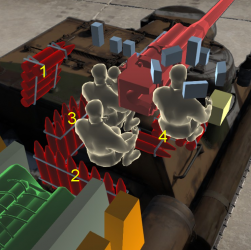
| Full ammo |
1st rack empty |
2nd rack empty |
3rd rack empty |
4th rack empty |
Visual discrepancy |
|---|---|---|---|---|---|
| 33 | 28 (+5) | 20 (+13) | 11 (+22) | 1 (+32) | No |
Note:
- Shells are modeled individually and disappear after having been shot or loaded.
Usage in battles
The SU-100 can be effortlessly defeated by a majority of the enemies faced at the BR bracket. As such, it is most important that the SU-100 makes the first, damaging shot before the enemy could get a shot first. The SU-100 is a classical casemate tank destroyer and as such has a fixed forward gun for its main armament, not too unlike the SU-85 or SU-85M tank destroyers. This gives the SU-100 a preference towards a defensive playstyle than an offensive one. As such, it is best to play the SU-100 in a supporting role, firing at distant enemies and ambushing them rather than facing them head-on. The SU-100 boasts high firepower and long effective range due to its 100 mm armament. The gun is able to penetrate armour similar to the 122 mm on the IS-2, but also a faster reload rate while retaining suitable post-penetration damage to devastating enemy tanks. As such, the SU-100 can lay in wait hidden in an open field and confidently attack enemies up to 1,000 m away.
- Panther A,G,F: Though the Panther's 75 mm gun can penetrate the SU-100's front armour with little difficulty, the 100 mm gun can penetrate the Panther's front glacis plate at quite a distance (>500 m). Thus, getting the first shot off will turn the battle situation towards the SU-100's advantage.
- Tiger (P) and (H): The front glacis of the Tiger II is impervious to the 100 mm, but the turret cheeks are still a major weak point that the gun can easily penetrate. At closer range, the lower glacis is also a weak point on the front area. If the Tiger II decides to traverse its turret slightly away from towards the SU-100, the 100 mm also has enough power to penetrate through the Tiger II turret side rather easily.
- IS-2 (1944): The IS-2 is easily disposable by a good firing on the front glacis, though the 1944 version requires careful aiming on the front glacis, thus it is better to aim at the lower glacis for an easier time at penetrating. The turret cheeks are also easy to penetrate like other heavy tanks.
- M4A3E2: when the Jumbo isn't angling, the SU-100 can penetrate its frontal hull and turret with ease. However when it's angling the hull, it is best to shoot the rather vertical turret for better chances of penetration. The explosives can knock out almost all its crew even when exploding inside the turret.
Pros and cons
Pros:
- Access to the 100 mm D-10 gun from the T-54 series
- Stock shells have high penetration and explosive filler
- Can easily penetrate and one-shot common heavily armoured tanks like the Panther, Jagdpanther and M4A3E2. Can penetrate the Tiger II's turret frontally
- Great top speed and manoeuvrability (56 km/h)
- Decent ammo count
- Access to BR-412D, which has great angle performance
Cons:
- Although the front armour is sloped and isn't overmatched, it received no upgrades and is overall too weak for its rank
- Can be easily taken out in one shot due to the cramped internals
- Bad gun depression of 3 degrees
- Reloads slower than tanks that it still has to face in down-tiers
- Long cannon make the tank hard to conceal and it is much taller than ASU-85
- No machine gun which may be useful to destroy light obstacles obscuring view, calculate approximate enemy distance, or mark nearby enemies
History
Development
This tank destroyer takes its lineage from its predecessor SU-85. The SU-85's introduction with its 85 mm D-5 cannon made it a lethal weapon against German tanks, giving it much better firepower than the current T-34 with the 76.2 mm F-34 guns. However, the SU-85 became redundant when the T-34 began to upgrade into the T-34-85, which contains the same 85 mm gun as the SU-85. No longer having the advantage in firepower, the SU-85 was discontinued, but the role of a self-propelled gun was still required to support the armoured forces.
It was decided to up-gun the SU-85 model with a much bigger cannon. Lev I. Gorlitsky, the chief designer of Soviet medium self-propelled guns, began the development of improving the SU-85. It was decided that the new cannon will be of 100 mm in calibre, and work started on developing the prototype in February 1944. In March, the prototype named "Object 138" was made for testing, mainly by trying many different 100 mm guns to see which would prove most effective. It was decided that the 100 mm D-10 gun produced by Fyodor F. Petrov's design bureau, which was an adapted S-34 naval gun, was to be used as the main armament of the self-propelled gun, now named the SU-100.
While the vehicle is essentially a SU-85 reworked to mount the larger 100 mm cannon, the SU-100 body has some major improvements compared to its predecessor. Armour on the front is increased from the regular 45 mm to 75 mm, the commander's workplace was enlarged into a small sponson on the right side of the hull with a commander's cupola, which increased his combat effectiveness. Two new ventilator units were also installed for increased ventilation of the gun's propellant gases. Production started in September 1944 and continued until some time in 1947 with a total of 2,335 units produced.
Combat usage
In its introduction in the last few months of World War II, the SU-100 proved to be a very successful tank destroyer. The 100 mm D-10 gun could penetrate 125 mm of armour at 2,000 m away, against the Panther, it could take it out from 1,500 m away easily. Most of the SU-100 in service saw action in Hungary in March 1945, most notably in the German offensive Operation Frühlingserwachen (Spring Awakening). Although never intended for infantry support, the SU-100 even saw action in the Battle of Berlin in the close-quarters combat of urban warfare as its 100 mm gun was very good against heavy fortifications, but the lack of any machine guns has the vehicle work in cohesion with infantry or aircraft.
After World War II, the Red Army retained the SU-100 for a few more years until retiring them to reserves in 1947, still existing to this day. The SU-100 was given out to Warsaw Pact allies such as Egypt, Angola, Cuba, China, and Czechoslovakia. The SU-100 saw service in many Cold-War conflicts such as the Korean War in 1950, Vietnam War in 1955, Suez Crisis in 1956, the Six-Day War in 1967 and the Yom Kippur War in 1973. Some were modified to adapt to the sandy environment of the Middle East, these were designated the SU-100M. These exported SU-100s continue to see service up to today in some countries, but most replaced it by 1970s. One of the most recent usages of the SU-100 is in Yemen during the Yemen Civil War of 2015.
| Archive of the in-game description | |
|---|---|
|
In connection with the increased armour of new enemy heavy tanks, it became necessary to create a self-propelled gun more powerful than the SU-85. Mass production of a new SPG under the designation SU-100 began at UZTM in August 1944. The engine, transmission, undercarriage and many other key parts from the T-34-85 tank were used in its design. It was armed with a 100 mm D-10S cannon with a 56 calibre barrel length. This weapon perfectly combined a high rate of fire with good ballistic characteristics. Its armour-piercing shell could penetrate 160 mm thick armour from a distance of 1,000 m. The vehicle had a standard design, with the driving compartment in the front, the fighting compartment in the middle and the engine compartment in the rear. Above the commander's place, the cabin's roof contained a fixed command cupola with five observation slots for all-round visibility. The command cupola's hatch housed an MK-4 observation instrument and rotated on a bearing. The SPG was manufactured between 1944 and 1947, and 2,495 SPGs of this type were produced during the Great Patriotic War. The SU-100 was first deployed in battle in January 1945. The SPGs showed their worth and earned a reputation as a reliable and powerful combat vehicle. The vehicle also inherited negative aspects from its base tank, such as its outdated suspension construction, its fuel tank positioning in the fighting compartment, and its unfavourable layout for an SPG. The SU-100's barrel length was even greater than that of the SU-85, making manoeuvring difficult on rough terrain and in urban areas. After the war, the vehicle was modernised numerous times and remained in service in the Soviet Army for several decades. These SPGs were supplied to the USSR's allies and took part in a range of local post-war conflicts. | |
Media
- Skins
- Videos
See also
- Other T-34 based SPGs
External links
| USSR tank destroyers | |
|---|---|
| SU-76M | SU-76M · SU-76M (5th Gv.Kav.Corps) · SU-85A |
| SU-57B | SU-57B · SU-76D |
| T-34 Derivatives | SU-122 · SU-85 · SU-85M · SU-100 · SU-122P |
| Heavy Tank Derivatives | SU-100Y · ISU-122 · ISU-122S · SU-152 · ISU-152 · Object 268 |
| SU-100P and Derivatives | SU-100P · Object 120 |
| Wheeled | YaG-10 (29-K) |
| Airborne | ASU-57 · ASU-85 |
| Rocket | BM-8-24 · BM-13N · BM-31-12 |
| ATGM | IT-1 · Shturm-S · Object 775 · Khrizantema-S |
| Artillery | 2S1 · 2S3M |
| Other | SU-5-1 · ZiS-30 · SU-122-54 |
| USA | SU-57 |