ISU-122
OLD‑WIKI.WARTHUNDER.COM (DEFUNCT)
| This page is about the Soviet tank destroyer ISU-122. For other versions, see ISU-122 (China) and ISU-122S. |
Description
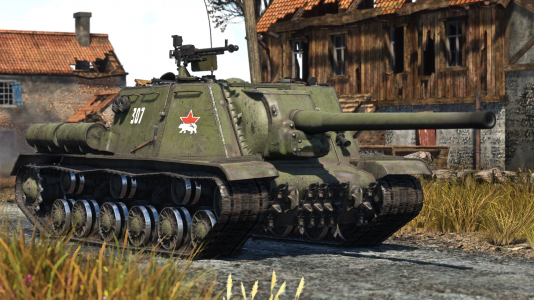
The ISU-122 was a Soviet assault gun used during World War II, mostly in the anti-tank role. The 122 mm A-19S tank gun was installed on the IS heavy tank chassis by engineers after the ISU-152 was developed, resulting in the creation of Object 242, the first ISU-122 prototype. Although testing went well, it was not put into mass production right away. Early in 1944, authorities from the state instructed unused IS heavy tank chassis to be equipped with a 122 mm A-19S tank gun, which resulted in mass production of the ISU-122.
Introduced in the Closed Beta Test for Ground Forces before Update 1.41, the ISU-122 should be used as a long-range sniper, making use of its high penetration shells, good accuracy, and good reverse speed. Choose a concealed place for sniping and engage targets at a distance to prevent the enemy from getting closer to the objectives. Always avoid the frontline to prevent being flanked or swarmed due to the tall profile and weak frontal armour.
General info
Survivability and armour
Armour type:
- Rolled homogeneous armour (hull, superstructure/casemate, roof)
- Cast homogeneous armour (Gun mantlet)
| Armour | Front | Sides | Rear | Roof |
|---|---|---|---|---|
| Hull | 60 mm (75°) Front glacis 90 mm (31°) Lower glacis |
90 mm | 60 mm (50°) Top 60 mm (39°) Bottom |
30 mm |
| Superstructure | 90 mm (30°) Front glacis 65 mm (7-69°) Gun mantlet case 100 mm Gun mantlet (0-45°) |
75 mm (14-15°) | 60 mm | 30 mm |
Notes:
- Suspension wheels are 20 mm thick while tracks are 30 mm thick.
- Being rather vertical, the casemate walls provide little chance for ricochet in a close range engagement.
- The gun is installed at mid-height in the casemate, meaning you will have to expose 2/3 of your superstructure to get your gun on a target.
- Maximize the distance between you and your opponents by profiting of the good performance of the gun to increase your survivability.
Mobility
| Game Mode | Max Speed (km/h) | Weight (tons) | Engine power (horsepower) | Power-to-weight ratio (hp/ton) | |||
|---|---|---|---|---|---|---|---|
| Forward | Reverse | Stock | Upgraded | Stock | Upgraded | ||
| Arcade | Expression error: Unexpected * operator. | 739 | Expression error: Unexpected round operator. | __.__ | |||
| Realistic | 460 | Expression error: Unexpected round operator. | __.__ | ||||
Based off the IS-2, the ISU-122 has its robust chassis, wide tracks and powerful engine. It benefits thus from the same good mobility all while being a heavy vehicle. The acceleration is good and reaching the maximum speed takes only a dozen seconds.
The very high reverse speed is a positive aspect, that will help you get out of enemy sight quickly once you've fired or once spotted. The wide tracks give it a good handling and performance on soft terrain.
A negative aspect of the ISU-122 is that it is sluggish in stock condition, especially when turning on the spot. And because of its weight, it is slow when going uphill.
If you have to turn quickly on the spot, privilege using your reverse gear because it has more torque.
Modifications and economy
Armaments

Main armament
| 122 mm A-19 | Turret rotation speed (°/s) | Reloading rate (seconds) | |||||||||||
|---|---|---|---|---|---|---|---|---|---|---|---|---|---|
| Mode | Capacity | Vertical | Horizontal | Stabilizer | Stock | Upgraded | Full | Expert | Aced | Stock | Full | Expert | Aced |
| Arcade | 30 | -3°/+22° | -3°/+7° | N/A | 6.16 | 8.53 | 10.40 | 11.50 | 12.19 | 26.00 | 23.00 | 21.20 | 20.00 |
| Realistic | 4.17 | 4.90 | 6.00 | 6.60 | 7.00 | ||||||||
The ISU-122, like the ISU-152, is a vehicle created by adapting an artillery field gun design on an armoured vehicle. The A-19 gun has the same good ballistic characteristics as the 122 mm on the IS-2 (flat trajectory, high muzzle velocity, accuracy at long range) and the same available ammunition choice.
The gun stays reliably accurate until 1,300 m distance. Beyond 1,000 m your optics will limit your accuracy as your magnification is poor (unless you fire at huge targets like Ferdinand, Jadgtiger, Tiger II, etc.). The high muzzle velocity of your shells grants you pretty flat firing trajectories and thus helps fire at moving targets from a distance. In that regard, using the "sight distance control" feature can increase your chances of successfully hitting enemy tanks.
The gun has a limited traverse on the horizontal axis. That displacement is asymmetrical due to the commander's position limiting rotation towards the left side. This can make the tracking of a target difficult as the gun quickly reaches a stop. You should take that constraint into account when positioning your hull at a firing spot.
Additionally, the rotation speed is very slow compared to other tanks at the same rank or battle rating who can aim their gun in average 2 to 3 times faster than you do. Which means your targeting process will be longer than for other tanks if you aim to be accurate. Any enemy appearing outside of the area your gun covers will require hull movement and will make you restart your targeting process from 0.
Being originally an artillery field gun, the gun uses two-piece ammunition with projectiles and propellant bags. The breech mechanism was not designed to be operated by a limited crew inside a casemate, which explains the very long reload time (between 19 and 26 seconds, which is on average 3 times longer than other vehicles' at the same BR).
Your recoil is important but not powerful enough to throw your gun off target after firing: the damping cylinders on the gun are too weak to absorb most of the recoil power and the suspension will absorb much of it. Your reload time being very long, the recoil is not as much of a handicap as it could be.
Targeting weak spots on heavily armoured tanks with the large 122 mm volumetric shell can be difficult as these are often small areas and if the shell does not precisely hit the spot, it can ricochet or fail to penetrate. The same can happen when engaging targets at long range too but you have the advantage of being at a distance, giving you time to get out of sight before they can retaliate.
Ammunition
The available choice of ammunition focuses on heavily armoured targets:
- BR-471: APHE; an armour-piercing shell with high explosive mass and high muzzle velocity that will one-shot any tank that it penetrates.
- BR-471B: APHEBC; the same as the BR-471 but with increased penetration thanks to the ballistic cap. This shell can reliably penetrate the frontal glacis of a Panther from over 700m.
- OF-471: HE; for destroying open and lightly armoured vehicles. While it is a standard shell for a Soviet vehicle, prioritize using your heavy machine gun to deal with lightly armoured targets because of the long reload time of the ISU-122.
| Penetration statistics | |||||||
|---|---|---|---|---|---|---|---|
| Ammunition | Type of warhead |
Penetration @ 0° Angle of Attack (mm) | |||||
| 10 m | 100 m | 500 m | 1,000 m | 1,500 m | 2,000 m | ||
| BR-471 | APHE | 205 | 201 | 182 | 161 | 143 | 127 |
| BR-471B | APHEBC | 205 | 203 | 192 | 178 | 166 | 155 |
| OF-471 | HE | 37 | 37 | 37 | 37 | 37 | 37 |
| Shell details | ||||||||||||
|---|---|---|---|---|---|---|---|---|---|---|---|---|
| Ammunition | Type of warhead |
Velocity (m/s) |
Projectile mass (kg) |
Fuse delay (m) |
Fuse sensitivity (mm) |
Explosive mass (TNT equivalent) (g) |
Ricochet | |||||
| 0% | 50% | 100% | ||||||||||
| BR-471 | APHE | 795 | 25 | 1.2 | 19 | 246.4 | 47° | 60° | 65° | |||
| BR-471B | APHEBC | 795 | 25 | 1.2 | 19 | 246.4 | 48° | 63° | 71° | |||
| OF-471 | HE | 795 | 25 | 0 | 0.1 | 3,600 | 79° | 80° | 81° | |||
Ammo racks
| Full ammo |
Ammo type |
1st rack empty |
2nd rack empty |
3rd rack empty |
4th rack empty |
5th rack empty |
Visual discrepancy |
|---|---|---|---|---|---|---|---|
| 30 | Projectiles Propellants |
25 (+5) 25 (+5) |
19 (+11) 19 (+11) |
13 (+17) 17 (+13) |
7 (+23) 9 (+21) |
1 (+29) 1 (+29) |
No |

Notes:
- The ISU-122 uses two-piece ammunition, composed of propellant bags (orange) and projectiles (yellow). Both have separate racks.
- To go into battle with the right flank depleted of propellant bags (racks 1 to 3), pack 17 (+13) shells.
Machine guns
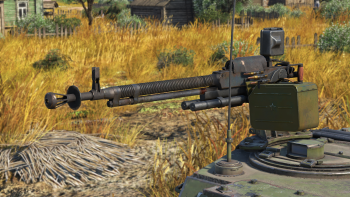
The 12.7 mm DShK heavy machine gun is located on a pintle mount and can act as both an offensive and anti-aircraft machine gun on the ISU-122, giving it protection against aircraft and lightly armoured vehicles. Best use is within 500 m against lightly armoured vehicles. The 360° movement allows you to point quickly your MG in any given direction. However, the position of the MG high on the casemate and the poor depression angle make it difficult to shoot a low-profile tank when it is close.
| 12.7 mm DShK | ||||
|---|---|---|---|---|
| Mount | Capacity (Belt) | Fire rate | Vertical | Horizontal |
| Pintle | 250 (50) | 600 | -5°/+85° | ±180° |
Usage in battles
- Offensive role
The ISU-122 should be played as a long range sniper, taking advantage of the APHEBC shell's high penetration values, high gun accuracy and good reverse speed. Find a shooting spot and engage targets from at least 1,000 m away to prevent enemy progress towards the objectives. You will also suppress enemy fire to prevent your team from being pinned down by enemy snipers attempting the same in return. Because of your high profile (casemate) and weak frontal armour, always stay away from the frontline to avoid being flanked or swarmed. While your gun is very powerful, your in-game performance will highly be dependent on the map you're playing. Open maps like Fire Arc, Kursk or Maginot Line will allow to play at the full extent or your capability whereas urban environments like Advance to the Rhine will be detrimental to your playstle. In case you are playing a mixed map, privilege open spaces.
- Defensive role
In case of an enemy breakthrough, your role is to contain the enemy advance by pinning them down. The enemy will be moving the front line, so engagements will take place at a closer range than you're comfortable with. You should identify and target in priority choke points, narrow passages and corridors of the map that the enemy will be forced to take. Your limited gun traverse only allows you to monitor an area spanning 175 m at 1,000 m distance without having to reposition your hull. Position the left side of your casemate behind an obstacle to let only your gun exposed.
- Other roles
If you try to use the ISU-122 in a different role on the battlefield, you will be confronted with the following:
- If you try to play as a front-line tank, you will be quickly disabled by any type of fire coming from enemy tanks. Your frontal armour is pretty thin for a tank at close range and a successful penetrating shot from the front will greatly handicap your crew sitting in line. Your gun traverse is very limited and your turning speed is also too poor to manoeuvre quickly enough in close combat.
- If you attempt to play support tank, your high profile will make it difficult to stay hidden behind obstacles without taking fire. Your good reverse speed can be an advantage but the enemy will flush you out with artillery strike (which can be accurate enough from middle ranges to disable you). Even with an escape route planned and cover to hide behind, your chances of survival are meagre. You will also be at risk of being flanked by light tanks or armoured cars, especially if they swarm you. Anyone who manages to get behind you has a very high chance to destroy you. In that role, an undetected flanking enemy, artillery strikes or CAS will be great threats to the ISU-122.
- Notable enemies
- Any tank will disable you with little effort in a close range encounter because of your weak and vertical casemate armour.
- For long range engagements, the cannons able to penetrate an ISU-122 from 1,000 m are:
- USA: M4 tanks equipped with a long 76 mm gun, M36 GMC
- Germany: any vehicle equipped with a 75, 88 or 128 mm gun like Panthers. Tigers I, Sturer Emil, etc.
- USSR: any vehicle equipped with a 85, 122 or 152 mm gun like the IS-2, T-34-85, ISU-152, etc.
- Great Britain: any vehicle equipped with APDS like the Comet, Challenger, Centurion & Charioteer
- Japan: Chi-Ri II & US tank imports
- China: vehicles similar to US and USSR ones
- France: ARL-44
- Sweden: Ikv 103 & Strv 74

An important note when engaging tanks, especially Tiger I's, is that, with the implementation of volumetric shells, you can no longer expect your shells to pierce through small openings or right past an obstacle. The large 122 mm calibre of your shells will result in it catching on an armour plate's edge very often, losing all of its penetration. For example, a Tiger I has some edges that can absorb your shell unexpectedly, despite having flat armour. Thus you must always make sure that where you are aiming at is absolutely free of obstruction, or it may result in a non-penetration or a ricochet. This can be seen in the diagram to the right.
- Defeating an ISU-122
- Wait for ISU-122 to shoot before engaging it: its long reloading time is a big weakness as it is defenseless for at least 15 seconds like an IS-2. It can however retreat quickly thanks to its good reverse speed. Be careful not to get baited into open field trying to follow your prey.
- The ISU-122 has a rather thin armour when compared to tanks at the same BR: iIf you have a very high penetrating power, aim for the casemate.
- In a frontal encounter, the right side of the frontal armour plate is the biggest weak spot. A successful penetration will most likely knock out 3 out of 4 crew members because they sit in line along that axis.
- In a flanking manoeuvre, the center of the casemate is the place to shoot to knock most crew members out.
- From behind, the left side of the casemate is the best spot to disable the ISU-122.
- If you are alone, flanking a ISU-122 undetected remains your best chance to destroy it. But it is difficult because the ISU-122 ideally positions itself very far from the frontline.
- Force it out of position with indirect fire (artillery strikes) if you're at relative close range.
- In case of a frontal attack (choke point/corridor), try blinding the ISU-122 with smoke and then swarm it with several tanks to saturate its defensive capacities.
- Engage the ISU-122 while it is moving: it takes a long time to brake, turn, bring the gun to a stable position and target precisely. With a reload time over 15 seconds, no player will take a shot that has little chance to hit.
- Do not take pot shots or shoot on the move, aim precisely at the weak spots (casemate walls). Your chance of ricochet is increased at long range as your penetration power decreases and the ISU-122 can angle its hull in a defensive manoeuvre.
Pros and cons
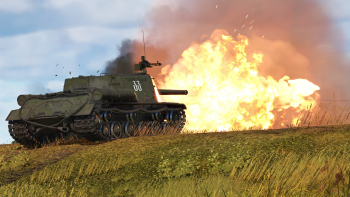
Pros:
- Powerful cannon, can penetrate the majority of enemies it faces (e.g. M4A3E2, Panther A, Churchill VII)
- Devastating post-penetration damage
- All-round protection has no weak spots, is effective against low-penetrating guns
- Good acceleration in reverse allows you to hide quickly
- Roof-mounted 12.7 mm HMG is useful against low-flying planes and lightly armoured vehicles like R3 T106
Cons:
- Very long reload time, leaving it vulnerable
- Armour cannot stop most common cannons (e.g. M4A3 76W, Chi-Ri), penetrations are often lethal
- Like most tank destroyers, it lacks a turret and so firing angles are restricted
- Breech gets damaged often
- Slow traverse means flanking attacks are lethal
History
Development
When the ISU-152 began production in 1943 with the large 152 mm ML-20S gun, production of the chassis and hull soon exceeded the supply of the ML-20S gun, which caused a decrease in the production of self-propelled guns for the Soviet military. It was determined to speed up self-propelled gun production, the ISU chassis were to be mounted with the 122 mm A-19S gun. Work on this mounting already began before the supply issue in December 1943 at the Chelyabinsk Kirov Plant (ChKZ), which had a design team simply take the ISU-152 chassis and hull and only changing out the armament with the 122 mm gun, but this prototype - Object 242 - was not immediately put into production despite successful testings. When the supply issue arose, the prototype was then adopted by the Soviet Defense Committee for increased production and also that the 122 mm gun had better accuracy against tanks than the 152 mm gun. The ISU armed with the 122 mm gun, designated the ISU-122, began production in April 1944.
Upgrade
The original ISU-122 is equipped with the 122 mm A-19S gun, which had a firing rate of 1.5 to 2.5 shots per minute due to its manual-piston breech. An attempt to fix this was a modernized A-19 gun called the D-25. The D-25 didn't see instalment onto the ISU-122 for a while due to prioritization on the IS-2 tanks, but it was available for use on self-propelled mounts after September 1944 as the D-25S. The ISU-122 prototype mounting the D-25 gun was called Object 249 which was successfully tested and an improvement over the A-19 gun with an increased firing rate of 2 to 3 shots per minute with one loader and up to 4 shots per minute with an additional loader in the crew. The D-25 also exploited the use of a muzzle brake in order to reduce the recoil forces on the gun, so the recoil buffer on the D-25 was much smaller than the A-19, which helped reduce the size of the gun and improved crew workspace in the self-propelled gun. Object 249 was then adopted as the ISU-122S, which entered production side by side with the ISU-122 u and both were produced up until the end of 1945. ChKZ produced both vehicles during the war and manufactured 1,735 ISU-122s (April 1944 - December 1945) and 675 ISU-122Ss (September 1944 - December 1945).
Combat usage
The ISU-122 were organized in units in a similar fashion as the ISU-152. The focus was made to not mix the two vehicles in the same regiments or brigades due to logistical reasons with ammunition and ballistic differences in indirect fire, but some units were equipped with both vehicles anyways. Like the ISU-152, the ISU-122 proved to be a very powerful multi-purpose vehicle as an assault gun, self-propelled artillery, and tank destroyer. The 122 mm gun on the ISU-122 allowed it to engage armour and fortifications with heavy armour-piercing round and a large high-explosive round. The primary role of the ISU-122 was as a tank destroyer due to the gun's superior ballistics compared to the ISU-152's, which large calibre size more suited its role as an assault gun. The ISU-122 did participate as an assault gun role in urban combat to support the infantry, but the lack of rotating turret and long barrel length restricted its manoeuvring and ability to engage all enemies in a large angle. Nevertheless, commanders found the ISU-122 as a very good assault gun. Usage of the ISU-122 in an indirect firing role as a howitzer is rare, but when used could fire up to 14 kilometres away. Usage as an artillery piece is more likely during a rapid offensive where towed artillery behind the lines is unable to keep up with the advancing infantry lines.
| Archive of the in-game description | |
|---|---|
|
The ISU-122 SPG was created in 1943 based on the IS-1 with the 122 mm A-19 Mod. 1937 field cannon's tipping unit installed in its cabin. The cannon was mounted with an offset to the right from the hull's central axis. The driver's compartment was placed to the left of it. The weapon had a relatively low rate of fire, amounting to around 2.2 shots per minute. The barrel's length came to 46.3 calibres. Its armour-piercing round weighed 25 kg and had an 800 m/s muzzle velocity. Its ammunition load consisted of separately loaded shots. Its direct firing range came to 5,000 m, and its maximum range was 14,300 m. The fighting compartment was also equipped with two 7.62 mm PPSh and PPS submachine guns with 1,491 rounds and 25 F-1 hand grenades. Starting from October 1944, a 12.7 mm DShK anti-aircraft machine gun was mounted on a bracket next to the commander's hatch. The machine gun had a 250 round ammunition complement. The crew consisted of four to five men. The crew housing in this vehicle was the same as in the ISU-152. Its armour protection was also the same as on the ISU-152. The cannon's gun mantlet had 100 mm thick armour. The vehicle was mass-produced from April 1944 to September 1945 at the ChKZ factory in Chelyabinsk. In total, 1,735 of them were made. The new SPGs were widely used in battles as tank destroyers and assault weapons in the final stage of the Great Patriotic War. The long barrel length of the A-19 cannon installed in the fore of the armoured cabin limited the vehicle's manoeuvrability. A small number of ISU-122s were modernised in 1958. Only their sights and radio sets underwent modernisation. At the beginning of the 1960s, the SPGs were removed from service in the Soviet Army. | |
Media
- Skins
- Images
See also
- Vehicles equipped with the same chassis
- Similar Soviet vehicles
- Other vehicles of similar configuration and role
External links
| Chelyabinsk Tractor Plant (Челябинский тракторный завод) | |
|---|---|
| IFVs | |
| BMP-1 | BMP-1 |
| Heavy Tanks | |
| KV | KV-85 · KV-122 |
| IS-1/2 | IS-1 · IS-2 · IS-2 (1944) · IS-2 "Revenge" · IS-2 No.321 |
| T-10 | T-10A · T-10M |
| Other IS Tanks | IS-3 · IS-4M |
| Tank Destroyers | |
| KV Derivatives | SU-152 |
| IS Derivatives | ISU-152 · ISU-122 · ISU-122S · Object 268 |
| Export | |
| IS-2 | ␗IS-2 · IS-2 No.402 · ␗IS-2 (1944) |
| ISU | ␗ISU-152 · ␗ISU-122 |
| IFVs | SPz BMP-1 |
| See Also | Leningrad Kirov Plant |
| USSR tank destroyers | |
|---|---|
| SU-76M | SU-76M · SU-76M (5th Gv.Kav.Corps) · SU-85A |
| SU-57B | SU-57B · SU-76D |
| T-34 Derivatives | SU-122 · SU-85 · SU-85M · SU-100 · SU-122P |
| Heavy Tank Derivatives | SU-100Y · ISU-122 · ISU-122S · SU-152 · ISU-152 · Object 268 |
| SU-100P and Derivatives | SU-100P · Object 120 |
| Wheeled | YaG-10 (29-K) |
| Airborne | ASU-57 · ASU-85 |
| Rocket | BM-8-24 · BM-13N · BM-31-12 |
| ATGM | IT-1 · Shturm-S · Object 775 · Khrizantema-S |
| Artillery | 2S1 · 2S3M |
| Other | SU-5-1 · ZiS-30 · SU-122-54 |
| USA | SU-57 |