AIM-9B FGW.2 Sidewinder
Suspended armaments
OLD‑WIKI.WARTHUNDER.COM (DEFUNCT)
| This page is about the German air-to-air missile AIM-9B FGW.2 Sidewinder. For other versions, see AIM-9 Sidewinder (Family). |
Description
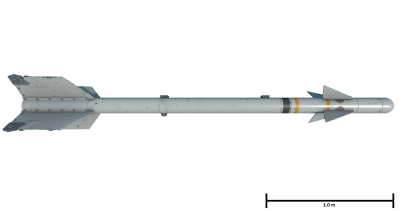
The AIM-9B FGW.2 Sidewinder is a German infrared homing air-to-air missile, it was introduced in Update "Starfighters".
Vehicles equipped with this weapon
General info
The AIM-9B FGW.2 is known also as the AIM-9F, an upgrade to the AIM-9B. The differences between the E and F variants are a different design philosophy including a slightly different sensor window, solid state electronics instead of vacuum tubes, and a new cooling system.
With similar performance to the AIM-9B, the FGW.2 should be treated the same way. The missile's performance is generally subpar in comparison to other missiles found in the same BR range, thanks to the FGW.2 base having stats of a missile designed in 1954-6. With only 10 G of overload, it performs terribly in high-G dogfights. The missile will be ready to fire in 1 second, while the target search time amounts to 20 seconds.
| Missile characteristics | |
|---|---|
| Mass | 72 kg |
| Guidance | IR |
| Aspect | Rear-aspect |
| Lock range (rear-aspect) | 5.5 km |
| Launch range | 10 km |
| Maximum speed | 1.7 M |
| Maximum overload | 10 G |
| Missile guidance time | 20 secs |
| Explosive mass | 7.62 kg TNTeq |
Effective damage
While being relatively bad compared to other missiles, the FGW.2 does not disappoint in the damage department. Like every other AAM, if this missile connects, it will knock out or at least deal critical damage to any aircraft. Obviously, it can't be used against ground targets, unless you count parked and active aircraft.
Comparison with analogues
Its performance is identical to the AIM-9B and R-3 missiles, but is massively outperformed by mid-tier missiles like the AIM-9D, E, R-60, and R550. Its lack of a movable seeker-head, higher G-pulling, range, and sensitivity make it subpar if not for having four missiles on a platform that is capable of traveling at Mach 2.
- AIM-9B FGW.2 Sidewinder - A European-licensed version of the AIM-9B with their own improvements; however the performance in-game are quite similar.
- R-3S/PL-2 - Infamous as a reverse-engineered variant of the AIM-9B, the R-3 missile shares many of its in-game performances with the AIM-9B, only falling slightly short in locking and launching range.
- Shafrir - Shares in-game performance values despite their design differences
- Rb24 - Licensed-produced version of the AIM-9B for the Swedish, and as such shares in-game performance values.
| Missile | Guidance | Lock range (rear-aspect)(km) |
Launch range (km) |
Maximum speed (Mach) |
Maximum overload (g) |
Mass (kg) |
TNT Equivalent (kg) | |||||
|---|---|---|---|---|---|---|---|---|---|---|---|---|
| Type | Aspect | Time | Uncaged seeker | Radar slaving | ||||||||

|
AIM-9B Sidewinder | IR | Rear | 20 |  |
|
4 | 10 | 1.7 | 10 | 72 | 7.62 |
|
|
AIM-9C Sidewinder | SARH | Front | 60 | |
 |
9 | 18 | 2.5 | 18 | 95 | 4.69 |
|
|
AIM-9D Sidewinder[note 1] | IR | Rear | 20 | |
|
5.5 | 18 | 2.5 | 18 | 88 | 4.69 |
|
|
AIM-9E Sidewinder[note 2] | IR | Rear | 20 | |
|
5.5 | 18 | 2.8 | 10 | 76 | 7.62 |
|
|
AIM-9G Sidewinder | IR | Rear | 60 | |
|
5.5 | 18 | 2.5 | 18 | 88 | 3.53 |
|
|
AIM-9H Sidewinder | IR | Rear | 60 | |
|
5.5 | 18 | 2.5 | 18 | 88 | 3.53 |
|
|
AIM-9J Sidewinder[note 3] | IR | Rear | 40 | |
|
5.5 | 18 | 2.5 | 20 | 76 | 7.62 |
|
|
AIM-9L Sidewinder | IR | All | 60 | |
|
11 | 18 | 2.5 | 30 | 84 | 4.58 |
|
|
AIM-9M Sidewinder | IR | All | 60 | |
|
11 | 18 | 2.5 | 30 | 84 | 4.58 |
|
|
AIM-9P Sidewinder | IR | Rear | 40 | |
|
5.5 | 18 | 2.5 | 20 | 76.93 | 7.62 |
|
|
AIM-9P4 Sidewinder | IR | All | 40 | |
|
11 | 18 | 2.5 | 20 | 76.93 | 7.62 |

|
AIM-9B FGW.2 Sidewinder | IR | Rear | 20 | |
|
5.5 | 10 | 1.7 | 10 | 72 | 7.62 |

|
Shafrir | IR | Rear | 20 | |
|
7 | 10 | 1.7 | 11 | 65 | 7.62 |

|
RB24 | IR | Rear | 20 | |
|
4 | 10 | 1.7 | 10 | 72 | 7.62 |

|
R-3S | IR | Rear | 21 | |
|
9 | 10 | 1.7 | 10 | 75 | 8.8 |

|
PL-2 | IR | Rear | 21 | |
|
9 | 10 | 1.7 | 10 | 75 | 8.8 |
Usage in battles
This missile's best usage comes in three situations, low energy, roll-rate spamming and compressed enemies:
- Enemies at low energy can't dodge this missile, as their planes won't be able to manoeuvre above 10Gs.
- Enemies that constantly roll in order to dodge your guns will find the missile to be much more accurate, as their aileron rolls put them in a situation where they can't run.
- Enemies that have high compression speeds will find your missiles hard to dodge as well. The French Vautour bombers, high speed MiG-15's and Yak-38/38M, and F11F-1's won't be able to outturn the missile's seeker at high speeds, and will be forced to either bleed enough speed to manoeuvre or get hit by the warhead. It has a top speed of around Mach 1.7, so the planes that can outrun this missile with low manoeuvrability are other F-104's.
Forcing enemies to bleed speed is more of this missile's job, but speed isn't generally a big deal for the jets it can be equipped on, so it's kind of redundant.
Pros and cons
Pros:
- Effective against low-energy targets
- Decent at longer ranges in a straight line
- Effective against aircraft with low manoeuvrability
- Effective against aircraft in their high-speed compression ranges
- Only available on a platform that benefits from its more passive role
Cons:
- Small seeker area
- Short range relative to other AAMs
- Poor manoeuvrability limits its capability in top-rank dogfights
History
Development
The missile's history starts at the Naval Ordnance Test Station (NOTS) at China Lake in 1947.[1] Under William B. McLean, the missile conception sprang from mating lead-sulfide proximity fuzes that were sensitive to infrared radiation with a guidance system to home onto the infrared source.[2] Initially his own private project, McLean eventually received approval by Admiral William S. Parsons for development.[1]These missiles were first test fired in 1951, with the first air-to-air hit was made on 11 September 1953 on a drone.[3] This experimental missile would be designated as the XAAM-N-7. The missile would also earn the name "Sidewinder" by the development team, named after the desert rattlesnake that senses its prey's heat and moves in a winding motion.[1][2]
Initially a US Navy project, the US Air Force was urged into participating by Howard Wilcox, the next project lead after McLean was promoted to upper management at NOTS in 1954.[1] This culminated in a shoot-off in June 1955 between the Navy's Sidewinder against the Air Force's GAR-2 Falcon missile. The Sidewinder's performance in this event resulted in the US Air Force putting their support in the Sidewinder.[3] By May 1956, the missile was officially adopted as the AAM-N-7 for the US Navy and the GAR-8 for the US Air Force.[3][4] These designation would remain until 27 June 1963, when the Sidewinder's designations were standardised across all armed services as the AIM-9.[5]
AIM-9B FGW.2
The AIM-9B (pre-1963 Navy designation AAM-N-7 Sidewinder IA) was the initial production version of the Sidewinder.[3] More than 80,000 units of the AIM-9B Sidewinder would be produced.[4]
The Sidewinder was also acquired by NATO forces for their air forces. The AIM-9B licensed production was distributed to West Germany, who would produce 15,000 units.[4] Like the US Navy and US Air Force, the manufacturer sought to improve the AIM-9B design. These improvements modernized the components with solid-state technology, added a carbon dioxide cooling for the seeker, developed a new nose dome and implemented better optical filtering.[6] The culminations of these improvements developed into the AIM-9B FGW.2, which is also known as the AIM-9F in US nomenclature.[3] These missiles would see service in 1969, with conversions being done on European AIM-9B with the FGW.2 upgrade.[4][3]
Media
- Images
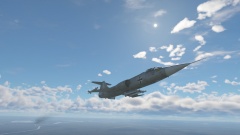
F-104G mid-flight with 3 AIM-9B FGW.2 Sidewinders (1 Fired)
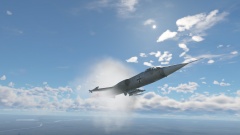
F-104G going supersonic mid-flight with 3 AIM-9B FGW.2 Sidewinders (1 Fired)
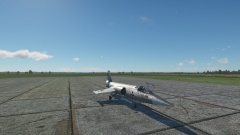
F-104G on the runway with 4 AIM-9B FGW.2 Sidewinders
See also
- Related development
External links
References
- Bibliography
- Gervasi, Tom. America's War Machine: the Pursuit of Global Dominance: Arsenal of Democracy III. Grove Press, Inc., 1984.
- Goebel, Greg. "The Falcon & Sidewinder Air-To-Air Missiles." Air Vectors, 01 Apr. 2019, Website.
- Hollway, Don. "The AIM-9 Sidewinder: Fox Two!" HistoryNet, Website.
- Kopp, Carlo. "The Sidewinder Story: The Evolution of the AIM-9 Missile." Air Power Australia, 27 Jan 2014, Website.
- Parsch, Andreas. "AIM-9." Directory of U.S. Military Rockets and Missiles, Designation-Systems.Net, 09 July 2008, Website.
- Parsch, Andreas. "Current Designations of U.S. Unmanned Military Aerospace Vehicles." U.S. Military Aviation Designation Systems, Designation-Systems.Net, 30 March 2020, Website.