Kh-66
Suspended armaments
OLD‑WIKI.WARTHUNDER.COM (DEFUNCT)
Description
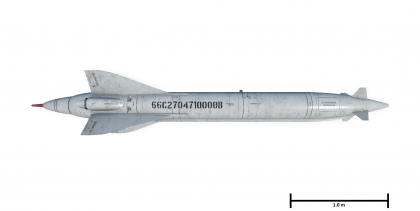
The Kh-66 is a Soviet SACLOS-guided air-to-ground missile. It was introduced during Update "Hot Tracks".
Vehicles equipped with this weapon
General info
| Missile characteristics | |
|---|---|
| Mass | 278 kg |
| Guidance | Semi-automatic (SACLOS) |
| Maximum speed | 2 M |
| Missile guidance time | 25 secs |
| Firing range | 10 km |
| Explosive mass | 65.28 kg TNTeq |
| Armour penetration | 74 mm |
Effective damage
A direct hit is almost always guaranteed to cripple if not outright destroy an enemy tank. It is also able to destroy lightly and even medium-armoured targets with proximity impact.
Comparison with analogues
- AGM-12B Bullpup - It has a shorter range than the Kh-66, a flight speed 4 times slower, and a slightly lighter warhead. Jets can carry 4 to 5 AGM-12B missiles against only 2 for the Kh-66.
- AGM-12C Bullpup - It has an extra 6 km range over the Kh-66 but a flight speed 4 times slower. It is three times heavier than the Kh-66 and its warhead is twice larger than the Kh-66's. Like the Kh-66, jets can carry only 2 x AGM-12C.
- AS-20 Nord - It has a shorter range than the Kh-66, a slightly slower flight speed, and a warhead 4 times lighter. It is manually guided (WASD keys), which is less practical than mouse-aimed missiles.
Usage in battles
The Kh-66 is used to perform Close Air Support from outside enemy AA effective range.
Pros and cons
Pros:
- Great range, greater than most AA missiles
- High explosive mass
Cons:
- Hard to aim
- Only two missiles
- Heavy weight impacts flight performance
History
The Kh-66 is an early version of the Kh-23 Grom air-to-ground missile. The missile was developed from the existing K-5 and K-8 (RS-2-US) beam-riding air-to-air missiles. Just before the war in Vietnam, the United States began fielding new guided missiles; most notably the AGM-12 Bullpup, which caused the Soviet Ministry of Aircraft Industry to request an air-to-ground version of earlier RS-2-US beam riding air-to-air missile.[1]
This new missile was designated Kh-66 (as the year it entered design/testing was 1966) and began to be used on the MiG-21PFM airframe (itself a testbed aircraft designed in conjunction with the Kh-66). Later in 1968, the missile finally entered service. The weapon was an amalgamation of the K-5 and K-8's guidance and propulsion systems and had an increased warhead for better performance against ground and sea-based targets. While the missile performed at the required specifications set by the Soviet government, the weapon was only a stopgap measure until more suitable armaments were developed. This was due to the flaws in utilizing the weapon as the pilot had to dive towards his target and maintain a lock with the gunsight. The missile was further developed into the Kh-23 by Korolyov again in early 1968 with the intention of making the weapon more effective. With this, the Kh-66 was effectively put out of production for new models by 1973.[2]
Media
Excellent additions to the article would be video guides, screenshots from the game, and photos.
See also
- Related development
- Weapons of comparable role, configuration, and era
External links
References
- ↑ Friedman, Norman (1997), The Naval Institute Guide to World Naval Weapons Systems, Naval Institute Press, p. 235, ISBN 978-1-55750-268-1
- ↑ https://web.archive.org/web/20110727014325/http://eng.ktrv.ru/docs/history_eng.doc History of JSC Tactical Missile Corporation, pp. 3–4, archived from http://eng.ktrv.ru/docs/history_eng.doc (Word 97 DOC) on 2011-07-27, retrieved 2009-02-15