AGM-114B Hellfire
Suspended armaments
OLD‑WIKI.WARTHUNDER.COM (DEFUNCT)
| This page is about the American air-to-ground missile AGM-114B Hellfire. For the other version, see AGM-114K Hellfire II. |
Description
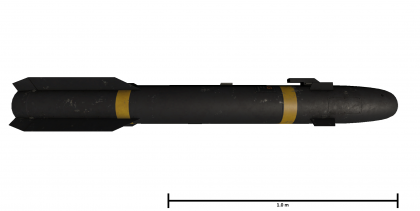
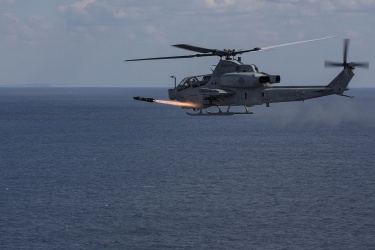
The AGM-114B Hellfire is an American laser-guided air-to-ground missile. It was introduced in Update 1.85 "Supersonic".
Vehicles equipped with this weapon
| Vehicles equipped with this weapon | |
|---|---|
| Attack helicopters | |
| A129 | A-129 International (p) · A129CBT · AH-129D |
| AH-1 | AH-1Z · AH-1W · ␗AH-1W |
| AH-64 | AH-64A · AH-64A (GR) · Peten · ▃AH-64A Peten · AH-64A Peten · AHS · YAH-64 |
| Utility helicopters | G-LYNX · Lynx AH.Mk.1 |
General info
Initially added for the AH-1Z, it was later included with other vehicles that carried it as they were introduced. The AGM-114B features an impressive range with the ability to lock on to a target after launching (LOAL), giving helicopter pilots the ability to perform careful strikes on a target by hiding behind terrain to initially launch a Hellfire, starting near a mountain or hill to begin the attack, retreating behind cover, and then return to lock onto the target before the missile impacts to provide terminal guidance. The Hellfire requires precise methods to be effective, and cannot be used with any reasonable success in close range and direct fire engagements, but at range it can be a deadly weapon against ground vehicles, who have almost no warning of the incoming missile.
The AGM-114B is the initial version of the Hellfire used by the U.S. Navy and Marine Corps, being identical to the AGM-114A aside from an added safety measure for use on ships. While it was originally designed for use on the AH-1 series of attack helicopters, it has since been tested and used on many other vehicles, including some fixed-wing aircraft and newer unmanned drones. While the AGM-114B version is no longer produced and used in combat, newer versions are widely used today across many nations and platforms.
| Missile characteristics | |
|---|---|
| Mass | 45.13 kg |
| Guidance | Laser+IOG |
| Maximum speed | 475 m/s |
| Missile guidance time | 45 secs |
| Firing range | 8 km |
| Guaranteed launch range | 8 km |
| Explosive mass | 8.02 kg TNTeq |
| Armour penetration | 1,100 mm |
The AGM-114B is laser-guided with a maximum range of 8,000 m (~5 mi) and a minimum range of 800 m (~0.5 mi). There is no method to control the missile other than through the use of the laser and it must be placed on a viable target for the weapon to lock and track. Due to this, using the AGM-114B on aircraft is difficult, as any time that the laser is not directly on target is time which the Hellfire is not able to track although the use of the TV locking function can aid in this result. The AGM-114B has a narrow but very tall targeting limit, which allows for tracking a target even when at extreme height. The Hellfire also uses a lofting trajectory to engage targets, which gives the missile some ability to evade obstacles and terrain features and strike the target from an angled position.

The Hellfire has a feature known as Lock-On After Launch (LOAL), which allows for a period of time where the laser is not turned on between when the missile is launched and when it hits the target. In War Thunder, LOAL works as follows:
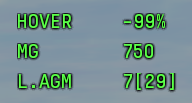
- When a Hellfire missile is launched, the laser will be turned on to designate the target. A timer will appear on the HUD next to the L.AGM count in brackets, which displays the remaining flight time of the missile.
- At this time, the laser designator can be turned off if desired and the Hellfire Inertial Navigation System (INS) will guide it towards the reference point set by the laser at launch. Doing so allows the pilot to hide behind cover, perform evasive manoeuvres against incoming enemy aircraft, missiles etc. or to scan for other targets.
- When the impact timer displays 6 seconds remaining, it will begin flashing and a warning will pop up above the centre of the screen saying ENABLE LASER NOW.
- Provided that the laser is switched back on and the target has not moved too far from the initial point of reference, the Hellfire will re-acquire the target from the laser designator and a successful hit will occur.
However, relying on the warning to enable the laser and waiting until 6 seconds will not guarantee a hit, especially if the target has moved away from the initial reference point set during launch. Therefore, it is advised to visually acquire the target sometime before the warning would appear and enable the laser with around 8-10 seconds of flight time remaining. At extended ranges, a flight time of 30+ seconds can be observed, giving the pilot around 20 seconds of time without the laser designator enabled. At closer ranges, it is advised to maintain the laser on the target, as otherwise the missile will still drift off course and miss the target.
Effective damage
The AGM-114B Hellfire has very high levels of penetration with 1100 mm (~43 in) at 0°, 953 mm (~37.5 in) at 30° and 550 mm (~21.7 in) at 60°. A successful penetration is likely to cause critical damage to both crew and internal components. If the damage is dealt to ammunition, the enemy vehicle will likely suffer an ammunition detonation, resulting in the destruction of the vehicle. The AGM-114B uses a HEAT warhead, so damage is dealt in a cone spreading from the point of impact. Hits on a turret are likely to contain the damage within the turret, disable the cannon breech and knocking out the vehicle commander/gunner/loader. A hit to the hull of a vehicle will likely knock out the driver and disable the engine/transmission and likely set a fire in the fuel tanks or the engine.
There is a small amount of splash damage dealt by the AGM-114B, however, it is minimal and will do no effective damage to any ground vehicle with a serious amount of armour. Vehicles with no armour or only structural protection may suffer some critical damage for a near miss, but it must be an impact within a few metres of the vehicle.
Comparison with analogues
- PARS 3 LR - The PARS 3 also uses a laser guidance system along with inertial navigation, and a lofting trajectory to engage targets. Its penetration and damage performance is very similar to the AGM-114B and has only a slightly shorter range (7.0 km). However, it is much slower at 290 m/s (compared to 475 m/s).
- 9K127 Vikhr - The Vikhr is another missile capable of locking onto a target, although the Vikhr does not use a laser designator and is instead optically guided. The Vikhr is much faster (600 m/s) than the Hellfire and pursues targets with a direct route rather than the lofting trajectory of the Hellfire. Penetration and damage performance is similar with a small advantage to the Hellfire.
- 9M120 Ataka / 9M120-1 Ataka - The Ataka missiles act similarly to the Vikhr and are able to lock onto a target optically and are slightly faster than the AGM-114B at 550 m/s and features the same range at 8.0 km.
- HOT-3 - The HOT-3 is an ATGM with just over half the range of the AGM-114B and therefore does not have any of the range benefits or LOAL capability, although it does feature even higher penetration at 1,250 mm.
- BGM-71 TOW-2 - The TOW-2 is another ATGM and has a much shorter range and less speed than the Hellfire. While the damage is comparable, the penetration is far less. The TOW-2 is typically along the upgrade path to the AGM-114B, so it may be used in the interim until the Hellfire is unlocked although it will be much less effective.
Usage in battles
Describe situations when you would utilise this missile in-game (vehicle, pillbox, base, etc)
Pros and cons
Pros:
- 8.0 km maximum range makes the Hellfire one of the longest range air-to-ground missiles, granting increased survivability by allowing engagements outside of SPAAG firing range
- Very high penetration of 1,100 mm defeats most armour and allows for critical or fatal damage
- LOAL capability gives the launch platform almost unmatched flexibility to carry out other tasks while the missile is in flight
- Lofting trajectory of missile allows it to clear obstacles and terrain along the flight path and impact the target from an elevated position
- Ability to fire multiple missiles at one time and have all track together to the same target (unlike some other ATGMs like TOW missiles)
Cons:
- Maximum range is still within the envelope of several SAM vehicles (2S6, ADATS, FlaRakPz 1)
- Lofting trajectory gives very long flight times at maximum range (upwards of 30 seconds) which can give targets time to move out of a clear line of sight and escape
- Terminal guidance with the laser designator must be provided or else the chance of a hit is essentially zero at any range due to the inertial navigation drift
- No true fire-and-forget capability, as inertial navigation is unreliable alone except against a stationary target
- Poor tracking against air targets
History
The AGM-114 Hellfire program dates back to a 1971 program to develop a laser guided fire-and-forget missile intended to defeat armour and be used on helicopters, appropriately named the Helicopter Launched Fire and Forget Missile. It would be 1976 when the laser designator and paired seeker were completed, and the Rockwell International company was awarded a contract to produce the AGM-114A and test firing of the Hellfire began in 1978 with the U.S. Army completing their own testing in 1981.[1] The AGM-114A was approved for production in 1982 and began to be used in 1985.
The AGM-114 Hellfire uses a solid-fuel rocket motor developed by Thiokol and flies through the air with four fins with adjustable edges.[1] The laser seeker head of the Hellfire and track a target before launching and is capable of locking onto a target after launching. The AGM-114A has a maximum range of 8,000 m (8,750 yards) and uses an impact fuze to detonate a shaped-charge warhead. The AGM-114B is the version developed by the U.S. Navy for use by them and the Marine Corps which is largely the exact same as the AGM-114A with the exception of the Safing/Arming Device which allows for safe shipboard use as well as a new Thiokol rocket motor which produces less smoke.[1]
The AGM-114A and B are deemed ineffective against reactive armours due to the single shaped-charge warhead, and production of the early models was ceased in 1992.[2] The laser Hellfires have been sold to many nations across the world and following various acquisitions and corporate changes, the Hellfire was produced by Lockheed Martin. It has since been superceded by the Hellfire II (AGM-114K) and the Hellfire Longbow (AGM-114L) and numerous other versions.[2]
Media
- Videos
See also
- Related development
- Similar-performing missiles
External links
References
- ↑ 1.0 1.1 1.2 Andreas Parsch, "Boeing/Lockheed Martin AGM-114 Hellfire," Directory of U.S. Military Rockets and Missiles, Designation-Systems.net, Last modified June 24, 2009, http://designation-systems.net/dusrm/m-114.html.
- ↑ 2.0 2.1 2013 Army Weapon Systems Handbook, (Arlington: Department of Defense, 2013), p. 135.