Yak-38M
OLD‑WIKI.WARTHUNDER.COM (DEFUNCT)
| This page is about the Soviet strike aircraft Yak-38M. For the premium version, see Yak-38. |
Description
The Yak-38 had many problems, especially with the powerplant, which was complex, heavy, and underpowered, and suffered from inexcusable overheating issues, with some reports even stating that the Yak-38 was grounded during the hot summers of the Mediterranean sea due to the engine overheating dangerously during VTOL take-offs. By comparison to its adversaries such as the Harrier family, the initial Yak-38 was abysmally underperforming. These issues quickly led to a urgent request from the Soviet navy to upgrade the Yak-38 in the late '70s and early '80s to address these issues. This directly resulted in the upgraded Yak-38M, which entered service in 1985. The main upgrade in the Yak-38M variant, was the installation of a new set of engines, the Tumansky R-28V-300 and Rybinsk RD-38 engines respectively, to correct the issues with overheating and low power of the previous model, while also upgrading the aircraft's avionics and armament suite to include new all-aspect variants of the R-60, and better guidance and autopilot systems.
The Yak-38M was introduced in Update "New Power". Like the Harrier, it is an aircraft with a VTOL capability. The Yak-38M is externally almost identical to the Yak-38 and the few differences are difficult to identify in combat, aside from the plane's default livery. These features are the tail boom (long and coloured in red for the 38M while short for the 38) and the forward Pitot tube (striped for the 38M and unicolour for the 38). The Yak-38 is very underwhelming in flight performance, but makes up for it in great armament options and ordnance, and acts as a stepping stone to the far more powerful successor in Soviet VTOL aircraft, the formidable Yak-141.
General info
Flight performance
| Characteristics | Max Speed (km/h at 0 m - sea level) |
Max altitude (metres) |
Turn time (seconds) |
Rate of climb (metres/second) |
Take-off run (metres) | |||
|---|---|---|---|---|---|---|---|---|
| AB | RB | AB | RB | AB | RB | |||
| Stock | 1,190 | 1,186 | 39.6 | 40.7 | 87.3 | 78.7 | 520 | |
| Upgraded | 1,205 | 1,197 | 36.9 | 38.1 | 124.5 | 102.4 | ||
Details
| Features | |||||
|---|---|---|---|---|---|
| Combat flaps | Take-off flaps | Landing flaps | Air brakes | Arrestor gear | Drogue chute |
| X | X | ✓ | X | X | ✓ |
| Limits | ||||||
|---|---|---|---|---|---|---|
| Wings (km/h) | Gear (km/h) | Flaps (km/h) | Max Static G | |||
| Combat | Take-off | Landing | + | - | ||
| - | - | 500 | ~11 | ~5 | ||
| Optimal velocities (km/h) | |||
|---|---|---|---|
| Ailerons | Rudder | Elevators | Radiator |
| < 650 | < 850 | < 920 | - |
Engine performance
| Engine | Aircraft mass | |||||
|---|---|---|---|---|---|---|
| Engine name | Number | Basic mass | Wing loading (full fuel) | |||
| Tumansky R-28V-300 (main) | 1 | 7,240 kg | 502 kg/m2 | |||
| Kolesov RD-38 (lift jets) | 2 | |||||
| Engine characteristics | Mass with fuel (no weapons load) | Max Takeoff Weight | ||||
| Weight (each) | Type | 6m fuel | 20m fuel | 22m fuel | ||
| 1,420 kg (main) | Vectored-thrust axial-flow turbojet | 8,065 kg | 9,716 kg | 9,990 kg | 10,300 kg | |
| 210 kg (lift jet) | Axial-flow turbojet | |||||
| Maximum main engine thrust @ 0 m (RB / SB) | Thrust to weight ratio in forward flight @ 0 m (100%) | |||||
| Condition | 100% | WEP | 6m fuel | 20m fuel | 22m fuel | MTOW |
| Stationary | 7,120 kgf | N/A | 0.88 | 0.73 | 0.71 | 0.69 |
| Optimal | 7,120 kgf (0 km/h) |
N/A | 0.88 | 0.73 | 0.71 | 0.69 |
| Maximum lift engine thrust @ 0 m (RB / SB) | Thrust to weight ratio in VTOL (all 3 engines) @ 0 m (100%) | |||||
| Stationary | 3,230 kgf | N/A | 1.68 | 1.40 | 1.36 | 1.32 |
Survivability and armour
The Yak-38 has no armour. It is a fairly large target with the entire fuselage being taken up with engines and fuel tanks.
Modifications and economy
Armaments
| Ballistic Computer | |||
|---|---|---|---|
| CCIP (Guns) | CCIP (Rockets) | CCIP (Bombs) | CCRP (Bombs) |
 |
|
 |
|
Offensive armament
The Yak-38M is armed with:
- 1 x 23 mm GSh-23L cannon, belly-mounted (160 rpg)
Suspended armament
The Yak-38M can be outfitted with the following ordnance:
| 1 | 2 | 3 | 4 | 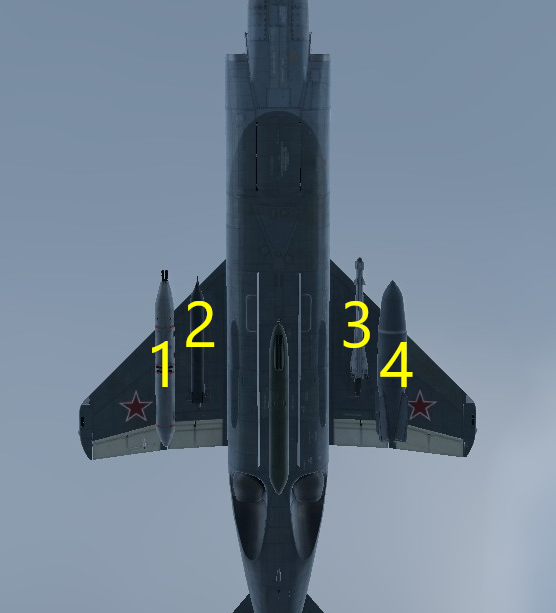 | |
|---|---|---|---|---|---|
| 23 mm GSh-23L cannons (250 rpg) | 1 | 1 | 1 | 1 | |
| 100 kg OFAB-100 bombs | 3 | 1 | 1 | 3 | |
| 250 kg OFAB-250sv bombs | 1 | 1 | 1 | 1 | |
| 500 kg FAB-500M-54 bombs | 1 | 1 | |||
| ZB-500 incendiary bombs | 1 | 1 | |||
| S-5KP rockets | 16, 32 | 16 | 16 | 16, 32 | |
| S-8KO rockets | 20 | 20 | |||
| S-24B rockets | 1 | 1 | 1 | 1 | |
| Kh-23M missiles | 1* | 1* | |||
| R-60 missiles | 1 | 1 | 1 | 1 | |
| Delta-NG targeting pod | 1* | ||||
| Maximum permissible weight imbalance: 450 kg | |||||
| * Delta-NG targeting pod must be carried when equipping Kh-23M missiles | |||||
| Default weapon presets | |
|---|---|
| |
Usage in battles
The Yak-38 is not very fast (you can reach Mach 1 in a slight dive when carrying minimum loadout) and not very nimble (bad energy retention in tight turns) so you'll lose many engagements with dedicated boom and zoom and dogfight optimised aircraft. What really makes this plane shine is the customizable loadout as well as its amazing rate of climb (101.2 m/s when spaded) and acceleration.
Due to your low speed it is wise to avoid high altitude combat as you'll be pitted against supersonic interceptors at this BR. Try to stay low and either ground pound or destroy enemy attackers. Doing this your main opponents are F-86 and Harrier variants. Both of which will out-turn you in a dogfight.
You have two options for dogfighting aircraft:
Use your climb rate to get into an advantageous position. You can out-climb almost all aircraft of your battle rating. And as long as you stay at lower altitudes you'll most likely be able to avoid those aircraft that can out-climb you.
Switch to hover mode. The Yak's hover mode can only be engaged at speeds below 450 km/h so you have to plan ahead a bit or react really fast once you slow down enough. Your goal here should be to get into the center of the enemies turning circle. When executed correctly it is impossible for the enemy to get their aim on you, while you are still perfectly able to fire at them. And if they disengage they set themselves up for you to lock on with AAMs. But be aware that engaging hover mode will make you an easy target for other aircraft that are not part of the dogfight so it's best used in 1 on 1 situations.
Air-to-air
The Yak-38M has several air-to-air options for its loadout. You can also set one additional 23 mm gun-pod as offensive weapon in your modifications menu. Keep in mind that gun pods add a substantial amount of drag and heavily impact your climb and turn rate and are not dropped after expending their ammo.
All combinations of gun-pods, R-60 and S-24B are viable but emphasize on different ways to approach enemy aircraft.
- Central gun-pod + R-60 keeps your drag quite low and still leaves you with a main gun after firing both missiles.
- Everything from two gun-pods (2 x pods or central pod + 2 x pods) up creates a high volume of fire and makes the Yak-38M deadly in head-on approaches. This can be combined with R-60 for taking out faster planes.
- 4 pods (5 with central pod) give an incredible burst mass of over 40 kg/s and will shred everything in a head-on approach. In many cases this will be overkill though. The pods can't be fired independently and trigger discipline is required to not run out of ammo too fast. Also there is no R-60 in this config.
- 2 x R-60 + 2 x S-24B (+ central pod) opens up the possibility to make snapshots on passing enemies with very deadly anti-bunker rockets. With a bit of practise and setting a detonation distance you are comfortable with the S-24B can be used to reliably take out every plane in its large burst radius. Can also be used in head-on approaches but in contrast to adding more gun-pods they won't create any drag after you have fired them.
Air-to-ground
You have access to a ballistics computer for your rockets and guns. A ballistics computer is not available for bombs.
As with the Su-7 it gives you firing solutions for your guns on ground and missiles on ground.
The loadout you should choose depends heavily on whether you are playing Air RB or Ground RB. For Air RB gun-pods and rocket-pods are most useful to take out groups of smaller ground targets like vehicles, light tanks, howitzers, etc.
The available bomb loadout is not sufficient to be threatening to enemy bases in any way, so it is recommended to not attempt to bomb enemy bases.
For Ground RB the Kh-23M gives you access to two beam riding ATGMs with an TNT equivalent of almost 100 kg. As with all beam riding missiles you will be an easy target while keeping your nose pointed at the enemy. As you will face SPAAs equipped with SAMs at this BR, taking 2 x 500 kg bombs might be more useful depending on the situation and composition of the enemy team.
Pros and cons
Pros:
- VTOL capabilities
- Very high rate of climb
- Numerous payload options
- Offensive 23 mm cannons have a very high fire rate
- Split elevator
Cons:
- Subsonic
- Boom and zoom only playstyle
- Offensive 23 mm cannon has low ammo for its fire rate, trigger discipline is required
- Offensive 23 mm belts is a Tier III modification
History
Development
As the Soviet navy received the last batches of the original Yak-38, it increasingly became evident that the aircraft suffered from a multitude of issues and constraints, which significantly impeded its operational efficacy. These issues prompted the Soviet authorities to initiate a modernization program, and a government decree on August 27, 1981, authorized the development of the Yak-38M, an improved version of the Yak-38 with enhanced performance and capabilities. The main upgrade in the Yak-38M was the installation of new engines, the Tumansky R-28V-300 and Rybinsk RD-38, which increased the thrust and reduced the overheating problems of the previous model. The new engines also allowed the Yak-38M to increase its maximum takeoff weight in VTOL mode from 10,300 kg to 11,300 kg and to 12,000 kg in short takeoff mode; however, the target figures were not finally achieved. Other changes included a new avionics and weapon suite, provision for drop tanks, and minor improvements in the navigation systems. Even so, the Yak-38M still had trouble achieving its desired performance targets. Due to its payload and performance limitations, the aircraft was still referred to as a "moral support aircraft", despite noticeable improvements in engine thrust and fewer overheating problems. By 1988, only 50 of these aircraft had been produced, and their fate was sealed by the collapse of the Soviet bloc and the ensuing budget cuts. Most of the carriers that carried them were either scrapped or sold, and the last Yak-38Ms flew from the Baku carrier until they were relegated to land-based training missions. However, these missions were short-lived, as the Yak-38s were retired for good in early 1993.
Further development
The Yak-38M was seen as a stepping stone to a better VTOL aircraft by the Yakovlev Design Bureau. A large part of the Yak-38M design would end up in the Yak-41M which, instead of having 2 nozzles, would instead pivot a much larger single engine exhaust while still retaining the 2 lift engines at the front, and unlike the Yak-38M it was supersonic capable. In the Western world it was known as the Yak-141, while inside the Soviet military it was the Yak-41M. When the Cold War ended and funding for the project was cut Yakovlev looked for other companies that would like to enter a partnership. In 1991, Yakovlev would enter a partnership with Lockheed-Martin and due to this relationship officially change the designation of the 2 flying prototypes to Yak-141. Lockheed-Martin would end up using the experience they gained from this on their X-35 plane which would end up being the F-35 family of planes, the F-35B having the same general engine layout as the Yak-141.
Devblog
Although Soviet engineers were experimenting with VTOL fixed wing aircraft design since the early 1960's, it wasn't until December 1967 before a formal order to develop a light VTOL strike aircraft as well as a corresponding trainer version was issued. As a result, engineers at the Yakovlev design bureau began work on the new aircraft in the late 1960's, basing their design on experience gained from developing the preceding Yak-36 - an early VTOL demonstration design.
The new aircraft, designated Yak-36M, was being developed for immediate frontline service, operating both from land bases as well as aircraft-carrying ships. The aircraft's primary role was that of a strike aircraft, engaging ground and surface targets while also being suited to intercept enemy aircraft and helicopters if necessary.
Not too long after work on the project began, the first prototype saw completion and conducted its maiden flight in December 1970. Subsequent prototypes and trials continued testing the aircraft's performance, particularly its novel VTOL capabilities. By 1973, the aircraft was considered ready and serial production commenced.
After some further testing and crew training, the aircraft officially entered service with the Soviet Navy in August 1977, receiving the designation Yak-38. By 1982, over 140 Yak-38's were built, all of which served aboard the then new Kiev-class aircraft carriers. In the mid 1980's, the modernized Yak-38M version came into service, most prominently featuring more powerful engines as well as other improvements. About 50 Yak-38M's were built before the type was ultimately decommissioned in 1991.
Media
- Skins
- Images
- Yak-38M Devblog Images
- Videos
See also
- Related development
- Aircraft of comparable role, configuration and era
External links
- [Development] Yak-38 & Yak-38M: Hover Jet
- Official data sheet - more details about the performance
- [Wikipedia] Yakovlev Yak-38
- [Air Vectors] Soviet Jet VTOL: Yak-36, Yak-38, & Yak-41
| A.S. Yakovlev Design Bureau (Яковлев Опытное конструкторское бюро) | |
|---|---|
| Fighters | |
| Yak-1 | Yak-1 · Yak-1B |
| Yak-3 | Yak-3 · Eremin's Yak-3(e) · Yak-3 (VK-107) · Yak-3P · Yak-3T · Yak-3U |
| Yak-7 | Yak-7B |
| Yak-9 | Yak-9 · Yak-9B · Yak-9K · Golovachev's Yak-9M · Yak-9P · Yak-9T · Yak-9U · Yak-9UT |
| Twin-engine fighters | I-29 |
| Jet fighters | |
| Yak-15 | Yak-15P · Yak-15 |
| Yak-17 | Yak-17 |
| Yak-23 | Yak-23 |
| Yak-30 | Yak-30D |
| Yak-141 | Yak-141 |
| Strike aircraft | |
| Yak-2 | Yak-2 KABB |
| Yak-38 | Yak-38 · Yak-38M |
| Bombers | Yak-4 |
| Jet bombers | Yak-28B |
| Foreign use | ▄Yak-3 · Challe's ▄Yak-9T · ◔Yak-9P |
| Captured | ▀Yak-1B |
| USSR jet aircraft | |
|---|---|
| Bereznyak-Isayev | BI |
| Yakovlev | Yak-15 · Yak-15P · Yak-17 · Yak-23 · Yak-28B · Yak-30D · Yak-38 · Yak-38M · Yak-141 |
| Mikoyan-Gurevich | MiG-9 · MiG-9 (l) · MiG-15 · MiG-15bis · MiG-15bis ISh · MiG-17 · MiG-17AS · MiG-19PT |
| MiG-21F-13 · MiG-21PFM · MiG-21S (R-13-300) · MiG-21SMT · MiG-21bis | |
| MiG-23M · MiG-23ML · MiG-23MLD · MiG-27M · MiG-27K | |
| MiG-29 · MiG-29SMT | |
| Lavochkin | La-174 · La-15 · La-200 |
| Sukhoi | Su-9 · Su-11 |
| Su-7B · Su-7BKL · Su-7BMK · Su-17M2 · Su-17M4 · Su-22M3 | |
| Su-24M | |
| Su-25 · Su-25BM · Su-25K · Su-25T · Su-25SM3 · Su-39 | |
| Su-27 · Su-27SM | |
| Su-34 | |
| Ilyushin | IL-28 · IL-28Sh |
| Tupolev | Tu-14T |