Tu-14T
OLD‑WIKI.WARTHUNDER.COM (DEFUNCT)
Description
The Tu-14T was developed as a competitor to the IL-28 bomber. The project resulted in the Tu-14T being used as a torpedo bomber with a similar design nature to that of the IL-28. However the Tu-14 proved inferior to the IL-28. It was capable of carrying more weight compared to its competitor but it was slower and less reliable. The Tu-14T was used as a maritime reconnaissance and torpedo bomber, the T in the name was added to signify its role of torpedo bomber. The low priority of maritime aircraft meant it was produced in low numbers, with 88 units built in the early '50s and it served as the Soviet Union's main torpedo bomber between 1961 and 1970.
It was introduced in Update 1.65 "Way of the Samurai". The Tu-14T is larger and slower than the IL-28 but it compensates this with more variable loadouts for ground attack and better loadouts for naval strikes against enemy ships. The Tu-14T can be considered very similar to the IL-28 but its lack of ammo and no gunpods available to increase the firepower mean that it can't be used reliably as an interceptor. So, in order to survive it must climb to high altitudes like most bombers and use its turrets when possible to attack incoming interceptors. However it has the benefit of including an airbrake, which is essential for naval targeting and the launch process of torpedoes.
General info
Flight performance
The Tu-14T can be considered a slow and heavy jet like most bombers. However, even for its BR it is quite slow when compared to bombers like the B-57 Canberra or the IL-28. But it includes an airbrake, which is not present in all bombers and this is very important to lose altitude quickly without crashing or for naval targeting.
| Characteristics | Max Speed (km/h at 5,500 m) |
Max altitude (metres) |
Turn time (seconds) |
Rate of climb (metres/second) |
Take-off run (metres) | |||
|---|---|---|---|---|---|---|---|---|
| AB | RB | AB | RB | AB | RB | |||
| Stock | 817 | 807 | 52.4 | 53.4 | 11.6 | 11.4 | 1,500 | |
| Upgraded | 901 | 856 | 49.7 | 51.0 | 18.7 | 15.0 | ||
Details
| Features | |||||
|---|---|---|---|---|---|
| Combat flaps | Take-off flaps | Landing flaps | Air brakes | Arrestor gear | Drogue chute |
| ✓ | ✓ | ✓ | ✓ | X | ✓ |
| Limits | ||||||
|---|---|---|---|---|---|---|
| Wings (km/h) | Gear (km/h) | Flaps (km/h) | Max Static G | |||
| Combat | Take-off | Landing | + | - | ||
| 892 | 580 | 554 | 420 | ~7 | ~3 | |
| Optimal velocities (km/h) | |||
|---|---|---|---|
| Ailerons | Rudder | Elevators | Radiator |
| < 500 | < 600 | < 600 | - |
Engine performance
| Engine | Aircraft mass | |||||||
|---|---|---|---|---|---|---|---|---|
| Engine name | Number | Basic mass | Wing loading (full fuel, no boosters) | |||||
| Klimov VK-1 | 2 | 13,951 kg | 326 kg/m2 | |||||
| Engine characteristics | Mass with fuel (no weapons load, no boosters) | Max Takeoff Weight | ||||||
| Weight (each) | Type | 28m fuel | 30m fuel | 45m fuel | 60m fuel | 94m fuel | ||
| 892 kg | Centrifugal-flow turbojet | 16,351 kg | 16,495 kg | 17,766 kg | 19,038 kg | 21,951 kg | 25,140 kg | |
| Maximum engine thrust @ 0 m (RB/SB) | Thrust to weight ratio @ 0 m (100%, no boosters) | |||||||
| Condition | 100% | WEP | 28m fuel | 30m fuel | 45m fuel | 60m fuel | 94m fuel | MTOW |
| Stationary | 2,678 kgf | N/A | 0.33 | 0.32 | 0.30 | 0.28 | 0.24 | 0.21 |
| Optimal | 2,678 kgf (0 km/h) |
N/A | 0.33 | 0.32 | 0.30 | 0.28 | 0.24 | 0.21 |
| Booster (Solid fuel rocket) | Aircraft mass | |||||||||
|---|---|---|---|---|---|---|---|---|---|---|
| Number | Booster weight (each) |
Fuel weight (each) |
Burn time |
Can be shutdown |
Jettisoned after use |
Mass with full booster fuel (no weapons load) | ||||
| 28m fuel | 30m fuel | 45m fuel | 60m fuel | 94m fuel | ||||||
| 4 | 50 kg | 190 kg | 13s | No | Yes | 17,311 kg | 17,455 kg | 18,726 kg | 19,998 kg | 22,911 kg |
| Condition | Maximum booster thrust @ 0 m (RB/SB) |
Combined engine & booster thrust @ 0 m |
Thrust to weight ratio @ 0 m (100% with booster) | |||||||
| 28m fuel | 30m fuel | 45m fuel | 60m fuel | 94m fuel | ||||||
| Stationary | 1,682 kgf | 12,084 kgf | 0.70 | 0.69 | 0.65 | 0.60 | 0.53 | |||
| Optimal | 1,682 kgf (any speed) |
12,084 kgf (0kph) |
0.70 | 0.69 | 0.65 | 0.60 | 0.53 | |||
Survivability and armour
- 9 mm Steel plate between the nose and the pilot
- 16 mm Steel Plate behind the pilot
- 25 mm Steel plate in front of the tail gunner weapon
- 105 mm Bulletproof glass in front of the tail gunner
All fuel tanks are self-sealing.
Modifications and economy
Armaments
Offensive armament
The Tu-14T is armed with:
- 2 x 23 mm NR-23 cannons, chin-mounted (85 rpg = 170 total)
Suspended armament
The Tu-14T can be outfitted with the following ordnance:
- 16 x 50 kg FAB-50sv bombs (800 kg total)
- 16 x 100 kg FAB-100M-43 bombs (1,600 kg total)
- 12 x 250 kg FAB-250M-46 bombs (3,000 kg total)
- 6 x 500 kg FAB-500M-46 bombs (3,000 kg total)
- 1 x 1,000 kg FAB-1000M-43 bomb (1,000 kg total)
- 2 x 1,500 kg FAB-1500M-46 bombs (3,000 kg total)
- 1 x 3,000 kg FAB-3000M-46 bomb (3,000 kg total)
- 1 x 450 mm 45-36MAN torpedo
Defensive armament
The Tu-14T is defended by:
- 2 x 23 mm NR-23 cannons, tail turret (350 rpg = 700 total)
Usage in battles
Much like the IL-28, the Tu-14T can be used in a variety of roles, from a fast base bomber to ground attacker. However, because it is more sluggish than the IL-28 and has less ammo for its offensive guns, it is far less effective at being an impromptu fighter. Because of its slower speed compared to the IL-28, the Tu-14T will be more easily intercepted, requiring the player to rely more on its 23 mm turret to knock out or deter enemy planes.
Pros and cons
Pros:
- Fixed and turret guns of a large calibre
- Unlike most jet bombers, it has a defensive turret
- Good firing angles for the turret
- Turret has larger ammo capacity than the Il-28's
- Access to a torpedo
- Comparatively fast to contemporary jet bombers
- Comes with rocket boosters following a landing, these can be used to assist take-off or in the air for a burst of speed
- Access to airbrake
- Gunner and pilot both have armour protection
Cons:
- Limited ammunition for offensive armament
- No access to rockets
- Large silhouette
- Too large and heavy to dogfight
- Unable to outrun the majority of fighters in level flight
- Can struggle to gain altitude or airspeed
- Slower than its "cousins", the IL-28 and the IL-28Sh
- Complicated MEC
History
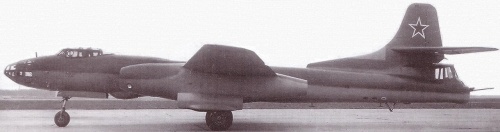
The Tu-14 'Bosun' was a Soviet jet-powered torpedo bomber, built in small numbers in the early 1950s. Initially designed as a competitor to the Ilyushin IL-28 'Beagle', the Tu-14 failed to generate sufficient interest and was thereafter redesigned as a torpedo bomber. Due to the low priority of naval aircraft in the Soviet military command, only small numbers of Tu-14s were built. The Tu-14 served as the primary Soviet land-based torpedo bomber until 1961, and served secondary duties until 1970.[1] Only 88 aircraft were built.[1]
Design and development
The Tu-14 was designed as a light bomber to compete against the IL-28. Initially designated the Tu-81, it was the culmination of several Tupolev bomber projects, including the Tu-72, -73, -74, -78 and -79. Originally designed as a trijet, it reverted to a twin-engine design after the improved Klimov RD-45/VK1 engine became available. The aircraft featured a conventional straight wing with the two engines slung on nacelles, with a large, spacious bomb bay located in the centre of the main fuselage. Armament consisted of a pair of forward-firing 23 mm cannons, with another pair located in the rear 'stinger' turret position, as well as 3,000 kg of bombs or torpedoes.[2] The aircraft was piloted by a crew of three; a pilot, bombardier and tail gunner. The aircraft could reach a top speed of 845 km/h, and had a range of 3,010 km.[1]
The first Tu-14 prototype was completed in 1948 and was test-flown in 1949. It had a slightly greater range than the IL-28, but failed to generate sufficient interest within the higher ranks of the Russian Military Command. As a result, the Ilyushin aircraft was chosen to become the principal Soviet jet-powered light bomber, and the Tu-14 was instead ordered as a torpedo-bomber and maritime patrol aircraft.[2]
Operational History
The Tu-14 started entering service in 1951, as a maritime reconnaissance aircraft and torpedo-bomber. However, due to the lower priority of naval aircraft, only small numbers of Tu-14s were built. The Tu-14 was redesignated the Tu-14T in production models to signify its role as a torpedo bomber.[1] A reconnaissance version of the aircraft was initially designed as well, with designation Tu-14R, but was never ordered.[1] In total, 88 Tu-14 aircraft were produced for the Soviet Naval air force, replacing the Tu-2T torpedo bomber. The Tu-14 stayed in frontline service until 1961, and was subsequently relegated to secondary duties. It continued to serve in secondary duties until 1970.[1][2]
Media
- Skins
See also
Links to the articles on the War Thunder Wiki that you think will be useful for the reader, for example:
- reference to the series of the aircraft;
- links to approximate analogues of other nations and research trees.
External links
References
- Citations
- Bibliography
- Aguilera, R. (1997). Tu-14 'Bosun'. Retrieved November 23, 2020, from http://www.theworldwars.net/weapons/entry.php?b=air
- Aviastar. (n.d.). Tupolev Tu-14 (Tu-81). Retrieved November 23, 2020, from http://www.aviastar.org/air/russia/tu-14.php
| Tupolev Design Bureau (Ту́полев Опытное конструкторское бюро) | |
|---|---|
| Bombers | TB-3M-17-32 · SB 2M-100 · SB 2M-103 MV-3 · SB 2M-103 · SB 2M-103U · SB 2M-103U MV-3 · SB 2M-105 |
| Tu-2 · Tu-2S · Tu-2S-44 · Tu-2S-59 · Tu-4 | |
| Arkhangelsky Bomber | Ar-2* |
| Strike Aircraft | Tu-1 |
| Jet Bomber | Tu-14T |
| Export | ␗SB 2M-103U · ␗Tu-2S-44 · ␗Tu-4 |
| ◔Tu-2S-59 | |
| * While Andrei Tupolev was imprisoned, Alexander Arkhangelsky, second in command at Tupolev OKB was able to append his name to the final production series of the SB bomber. | |
| USSR jet aircraft | |
|---|---|
| Bereznyak-Isayev | BI |
| Yakovlev | Yak-15 · Yak-15P · Yak-17 · Yak-23 · Yak-28B · Yak-30D · Yak-38 · Yak-38M · Yak-141 |
| Mikoyan-Gurevich | MiG-9 · MiG-9 (l) · MiG-15 · MiG-15bis · MiG-15bis ISh · MiG-17 · MiG-17AS · MiG-19PT |
| MiG-21F-13 · MiG-21PFM · MiG-21S (R-13-300) · MiG-21SMT · MiG-21bis | |
| MiG-23M · MiG-23ML · MiG-23MLD · MiG-27M · MiG-27K | |
| MiG-29 · MiG-29SMT | |
| Lavochkin | La-174 · La-15 · La-200 |
| Sukhoi | Su-9 · Su-11 |
| Su-7B · Su-7BKL · Su-7BMK · Su-17M2 · Su-17M4 · Su-22M3 | |
| Su-24M | |
| Su-25 · Su-25BM · Su-25K · Su-25T · Su-25SM3 · Su-39 | |
| Su-27 · Su-27SM | |
| Su-34 | |
| Ilyushin | IL-28 · IL-28Sh |
| Tupolev | Tu-14T |