Su-27
OLD‑WIKI.WARTHUNDER.COM (DEFUNCT)
| This page is about the Russian jet fighter Su-27. For other versions, see Su-27 (Family). |
Description
Shortly after the Vietnam War, both the United States and the Soviet Union got to work on a new generation of fighter aircraft that favoured manoeuvrability and dogfight performance over top speed. In 1969, the Soviet Union received details through spies on the USAF's F-X program and the aircraft it was leading to, the F-15 Eagle. As a result, the Soviets also decided to adopt a "Heavy support" doctrine with their new generation of fighters, with a smaller amount of a larger, more powerful aircraft supporting a larger amount of smaller, cheaper "frontline" aircraft just as the US was going to do with the F-15 and F-16 respectively. The design of the heavy fighter was handed to OKB Sukhoi, which quickly produced the T-10 prototype. The T-10 had many shortcomings, and after a lot of work with TsAGI to iron out the issues, the Su-27 would take to the skies for the first time in 1977. Development would continue further, and the first true "production models" would only enter service in 1985, beginning a fruitful life in Soviet service, and later in Chinese, Ethiopian, Vietnamese, Eritrean, Indonesian, Ukrainian, Kazakh, Uzbek, and Russian service with many aircraft of the type still seeing combat today.
The Su-27 (NATO reporting name: Flanker) was introduced in Update "Air Superiority" as the top-end heavy fighter for the USSR tree, capping off the Sukhoi line and beginning its transition from high speed fighter-bombers to the venerable Flanker family. The Su-27 is a jack of all trades yet a master of almost none, and that playstyle is its strongest suite. The Flanker carries a very generous amount of air to air missiles (ten), including up to six heat-seeking missiles with HMD targeting, and four of the infamous R-27ER coupled with the strong N001 Mech radar. The Flanker's lethal missile selection allows it to dispatch distracted many enemies at safe distances, and when push comes to shove, the Flanker's inherently unstable airframe and fly-by-wire control systems allows it to perform high angle-of-attack manoeuvres and partial post-stall manoeuvres at lower speeds, including the famed Cobra manoeuvres. All in all, the Su-27 should be played as a jack of all trades, and fits best into a very aggressive playable due to its lethal missiles, great avionics and sensors, and nimble flight performance. One must, however, be aware of various enemies you can encounter in the Flanker, such as all the aircraft that carry IRCCM missiles due to the Flanker's large heat signature as a result of the two massive AL-31 engines, but also be careful of dogfighting aircraft from the F-15 Eagle family, as the Eagle's superior TWR and high-speed handling as a result of the stable airframe will give F-15 players an advantage in some scenarios.
General info
Flight performance
As a heavy fighter, its performance is surprisingly great, giving enemies such as the similar F-15, or even the highly manoeuvrable F-16 a good challenge when fighting this aircraft. However, what sets it apart from the most is its extremely high AOA tolerance, remaining somewhat controllable even when the air is hitting the plane from the belly (90°+ AOA manoeuvres). This gives it a good initial dogfighting capability, proven deadly with the HMD and R-73 by firing missiles at angle of nearly 140° away from the direction of flight.
However, that amazing dogfighting capability and superb manoeuvring is gone as soon as you bring a full load of fuel. It will still be able to give a challenge to any opponent in the right conditions, but the manoeuvrability can only work for so long until the Su-27 starts stalling for real at low speeds.
| Characteristics | Max speed (km/h at 12,000 m) |
Max altitude (metres) |
Turn time (seconds) |
Rate of climb (metres/second) |
Take-off run (metres) | |||
|---|---|---|---|---|---|---|---|---|
| AB | RB | AB | RB | AB | RB | |||
| Stock | ___ | 2,357 | __._ | 24.6 | __._ | 173.4 | 750 | |
| Upgraded | ___ | 2,498 | __._ | 23.5 | __._ | 225.0 | ||
Details
| Features | |||||
|---|---|---|---|---|---|
| Combat flaps | Take-off flaps | Landing flaps | Air brakes | Arrestor gear | Drogue chute |
| X | ✓ | ✓ | ✓ | X | ✓ |
| Limits | ||||||
|---|---|---|---|---|---|---|
| Wings (km/h) | Gear (km/h) | Flaps (km/h) | Max Static G | |||
| Combat | Take-off | Landing | + | - | ||
| 1,540 | - | 652 | 600 | ~__ | ~__ | |
| Optimal velocities (km/h) | |||
|---|---|---|---|
| Ailerons | Rudder | Elevators | Radiator |
| < 680 | < 750 | < 700 | - |
Engine performance
| Engine | Aircraft mass | ||||||
|---|---|---|---|---|---|---|---|
| Engine name | Number | Basic mass | Wing loading (full fuel) | ||||
| Saturn AL-31F | 2 | 16,420 kg | 417 kg/m2 | ||||
| Engine characteristics | Mass with fuel (no weapons load) | Max Gross Weight | |||||
| Weight (each) | Type | 13m fuel | 20m fuel | 30m fuel | 44m fuel | ||
| 1,520 kg | Afterburning low-bypass turbofan | 19,240 kg | 20,614 kg | 22,711 kg | 25,820 kg | 33,798 kg | |
| Maximum engine thrust @ 0 m (RB/SB) | Thrust to weight ratio @ 0 m (WEP) | ||||||
| Condition | 100% | WEP | 13m fuel | 20m fuel | 30m fuel | 44m fuel | MGW |
| Stationary | 7,219 kgf | 11,656 kgf | 1.21 | 1.13 | 1.03 | 0.90 | 0.69 |
| Optimal | 7,219 kgf (0 km/h) |
15,640 kgf (1,540 km/h) |
1.63 | 1.52 | 1.38 | 1.21 | 0.92 |
Survivability and armour
What it has in good performance, it lacks in armour. After all, this is no ground attacker, and armour won't make any difference when a missile successfully hits your aircraft.
However, the Flanker actually has good survivability, and that's mostly because of the redundancy given by the two-engine setup, and the huge space between critical components (after all, the Flanker is nearly as long as the Lancaster), giving the pilot some good chances of getting back home.
Modifications and economy
Armaments
| Ballistic Computer | ||||
|---|---|---|---|---|
| CCIP (Guns) | CCIP (Rockets) | CCIP (Bombs) | CCRP (Bombs) | Lead indicator |
 |
|
|
|
|
Offensive armament
The Su-27 is armed with:
- 1 x 30 mm GSh-30-1 cannon, wing root-mounted (150 rpg)
- 96 x large calibre countermeasures
The Su-27 uses the same 30 mm autocannon as the MiG-29 with the same limited ammunition count of 150 rounds. Although it is not as forgiving as the American M61 Vulcan and demands precision, it has no spool up time and will deal heavy damage to any aircraft it hits. Something to note is that the Su-27's cannon is mounted on the right side of the fuselage, whereas the MiG-29's mount is on the left.
Suspended armament
The Su-27 can be outfitted with the following ordnance:
| 1 | 2 | 3 | 4 | 5 | 6 | 7 | 8 | 9 | 10 | 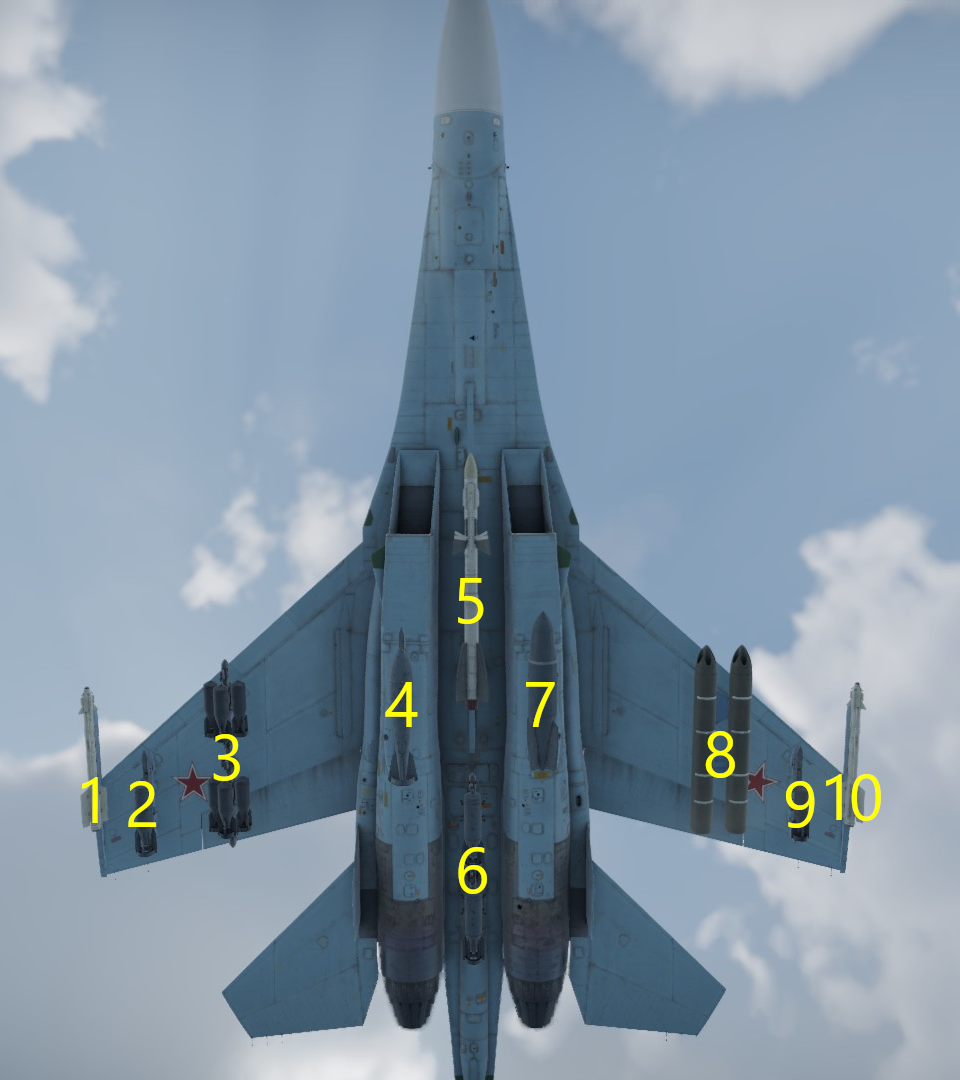 | |
|---|---|---|---|---|---|---|---|---|---|---|---|
| 100 kg OFAB-100 bombs | 1 | 6 | 6 | 6 | 6 | 6 | 6 | 1 | |||
| 250 kg FAB-250M-62 bombs | 1, 2 | 1 | 1 | 1 | 1 | 1, 2 | |||||
| 250 kg OFAB-250-270 bombs | 1 | 1, 2, 6 | 1, 5 | 1, 4 | 1, 2 | 1, 5 | 1, 2, 6 | 1 | |||
| 250 kg OFAB-250Sh bombs | 1, 2 | 1 | 1 | 1 | 1 | 1, 2 | |||||
| 500 kg FAB-500M-62 bombs | 1, 2 | 1 | 1 | 1 | 1 | 1, 2 | |||||
| 500 kg FAB-500Sh bombs | 1, 2 | 1 | 1 | 1 | 1 | 1, 2 | |||||
| ZB-500 incendiary bombs | 1, 2 | 1 | 1 | 1 | 1 | 1, 2 | |||||
| S-8KO rockets | 20, 40 | 20, 40 | |||||||||
| S-13OF rockets | 5, 10 | 5, 10 | |||||||||
| S-25O rockets | 1, 2 | 1, 2 | |||||||||
| S-25OF rockets | 1, 2 | 1, 2 | |||||||||
| S-25OFM rockets | 1, 2 | 1, 2 | |||||||||
| R-27ER missiles | 1 | 1 | 1 | 1 | 1 | 1 | |||||
| R-27ET missiles | 1 | 1 | |||||||||
| R-27R missiles | 1 | 1 | 1 | 1 | 1 | 1 | |||||
| R-27T missiles | 1 | 1 | |||||||||
| R-73 missiles | 1 | 1 | 1 | 1 | 1 | 1 | |||||
| Maximum permissible loadout weight: 8,040 kg Maximum permissible weight imbalance: 1,500 kg | |||||||||||
| Default weapon presets | |
|---|---|
| |
The Su-27 has a fairly wide arsenal. The air-to-air armaments are generally similar to the MiG-29SMT, with highly agile R-73 IR missiles for short-range combat and various marks of R-27 missiles for medium to long range engagements. The Su-27, however, lacks the active-radar homing R-77 missile the MiG-29SMT gets, which deprives pilots of this version of the Flanker of the tactical opportunities that active-radar "Fox-3" missiles provide; such as the ability to turn away after launch ("going cold") or engage multiple targets at once. However it has a large advantage in missile capacity over the MiG-29; a full air superiority loadout consists of four R-73s and up to six R-27s, which makes it an excellent missile truck for BVR jousting.
The extended-range R-27ER and R-27ET are the most capable members of the R-27 family and should be used over their standard variants once unlocked. The R-27ET (and its less advanced R-27T) can only be mounted on the inboard wing pylons for a maximum capacity of two, but this is sufficient for a couple of long-range sneak attacks to round out the Su-27's engagement capabilities. The inboard pylons can also mount R-73s instead for pilots who want to bring as many dogfight missiles as possible.
The Su-27 is limited to only unguided bombs and rockets for ground attack, so unlike the MiG-29SMT it cannot use TV-guided missile or bombs for standoff engagements. One notable feature is that it can carry up to four S-25O heavy bunker-buster rockets made famous by the Su-25, which can be a fun surprise for combined battles when enemy SAMs are suppressed or confused. All rockets are mounted in double racks on the inboard pylons, leaving the other pylons available for R-73s, R-27s, or bombs in a multirole loadout.
Usage in battles
The Su-27 is a fairly all-rounded aircraft, capable of of performing both air superiority and close air support duties, with the aircraft excelling at the former due to its ability to carry a massive arsenal of close to medium range air-to-air missiles like the potent and reliable R-73 and the manoeuverable and high speed R-27ER, whilst for more personal and intimate encounters the Su-27 sports a potent wing root mounted 30 mm GSh-30-1 with integrated EEGS for accurate lead prediction with a radar or IRST lock. The aircraft also has HMD (Helmet Mounted Display), allowing the pilot to lock-on a target within the HMD's arc which possesses a massive gimbal room. One thing to note is that the IR Missile seekers are slaved to the HMD, allowing the HMD to lock your R-73s and even R-27(E)Ts onto your enemies without the need to point your nose at the enemy. This gives the Su-27 a massive advantage in dogfights especially against opponents that lack the same technology.
For ground support duties, the aircraft offers a decently diverse payload options, ranging from conventional and retarded bombs to unguided missiles which featured CCIP support. One glaring issue however is the lack of computer guided munition due to the aircraft inherent nature of being an air-superiority fighter.
In Air Realistic Battles, the Su-27 is a smooth plane to fly, with excellent roll rate and turn speed. At the start of the battle, it's recommended for the player to load the aircraft with 4 x R-73s and 6 x R-27ERs, or exchange 2x R-73s for 2x R-27ETs. After taking off, push for afterburner until you reached ~1,200 km/h IAS and maintain it until contact is made. It's highly advised to stay on deck and follow the terrain to induce radar cluttering whilst en route to the combat zone, this will come in extremely handy when the opposition is fielding large amounts of aircraft which can engage with Active Radar Homing (ARH) missiles which can independently track target without the need for the enemy's radar to directly lock a target. (Datalink and TWS guidance as opposed to Single target track "lock" guidance as required by SARH missiles.) This way, it is easier for the Flanker pilot to go defensive with the incoming first wave of ARH missiles, making use of the low altitude and terrain to survive and subsequently re-engage.
After making contact with the enemy at any altitude beyond the range of 5 km+, you could attempt to acquire lock using your Radar or HMD mode and shoot a few of your R-27ERs at suitable targets to shed some weight, note that the R-27ERs possessed IOG and DL features, the former allowed the missile to continue tracking with the last given parameters whilst the latter enables the missile to reacquire its target after lock is regained, this allowed for some tricky plays like popping off the missile at the enemy, this will encourage them to deploy Countermeasures (CMs) expecting lock to be lost or disrupted, however with the addition of DL, lock could be reacquired and the missile will resume its tracking unlike its contemporary like the AIM-7M. This potentially allows the player to catch the prey off guard thinking that they've already gotten off the R-27ER's hook. At near tree top level, it's highly advised that the player use R-73s instead despite the Su-27's ability to reliably lock targets even at low altitude, it is in no way reliable enough to guide the R-27ERs lest you're flying at an even lower altitude than your enemy. If the fight devolves into an dogfights, the Su-27 have some tricks up its sleeves, that being the Su-27's ability to pull extremely high AOA for a very short amount of time when in the correct speed range (500-700 IAS), this ability should be used with the HMD and R-73 missiles, however you will find yourself out of energy and mostly defenseless if the R-73 failed to hit its target, at very low speeds (~400 km/h) the Su-27 will lose the rate fight against most of its enemies (This includes F-16s, F15s, Jas-39s, Mirage 4000 and more) Due to these reasons above it is best to keep the airspeed above 500 km/h IAS and only pull the maximum amount of AOA to launch a R-73 or to pull in for a gun kill. (another thing to note is that at speeds above 1,200 km/h IAS, the vertical control surfaces will stiffen up). However if you find yourself at speeds higher than 700 km/h IAS, then the Su-27 has yet another toy that is yet to be unveiled, which is the addition of a massive airbrake, specifically designed to enable the aircraft to perform a tight turn even at high speed, regardless the use of this airbrake should be done in moderation as it bleeds the aircraft speed at an astronomical rate which could be a double-edged sword or a lifesaver depending on the scenario it's used in, This allows the Su-27 to turn the table of the fight ever so slightly in its favour if used correctly, allowing the aircraft to enter its manoeuverable speed threshold which could help you get your HMD acquisition of the R-73 on the assailant or just pepper them with your potent 30 mm with the help of EEGS (Note: the R-73's IRCCM uses Gatewidth Tracking which is extremely flare resistant the closer the missile gets to its target, especially rear-aspect, due to the IR tracking scope narrowing post-launch, (like the iris of an eye when facing light). This means it's highly recommended for the pilot to launch the missile preferably from or below 1 km for best effect and from behind enemies.
Notable Opponents:
- F-16A/Cs - F-16s carry an advantage over the Flanker in manoeuverability, with greater energy retention and rate fighting abilities. What makes the Fighting Falcon dangerous, however, is the AIM-9M. The 9M carries an IRCCM (Infrared Counter-Countermeasure) system that is different to that of the R-73. The seeker of the Sidewinder will shut off when it detects flares, follow the aircraft's expected trajectory (IOG), and then reacquire lock once flares are passed. The only way to defeat these potent missiles is to constantly flare, cut throttle, and change direction. When the aircraft is not where the missile expects it to be after the pilot moves out of the expected path, the 9M will lock onto the recently deployed flares. Spamming large groups of flares sporadically does not work, as the missile will simply reacquire lock once flaring ceases. The best defense against powerful IRCCM missiles is to avoid them in the first place. By catching enemies off guard from their flanks and behinds, any pilot will find success, no matter the plane. The same counts for any other plane fielding the AIM-9M or any missile with this kind of IRCCM. In a dogfight, the F-16's advantage will grow the longer the fight takes, as the F-16 excels in sustained turn-rate fights, which are precisely the Su-27s weakness. When merging with an F-16, you have to shoot them down as fast as possible, ideally in the first turn either with R-73s, the gun, or even an R-27 using ACM mode depending on the range, or your odds of winning will diminish rapidly. The F-16C and AM can also carry the AIM-120 AMRAAM, which can negate your advantage in long-range combat, forcing you to go defensive until the dogfight happens.
- F-14A/Bs - F-14s are capable of launching AIM-54A/Cs as aforementioned, which could be extremely infuriating to deal with. The only real counter to this is by flying low and perpendicular to their radar lock ("notching"), however even the slightest mistake could resulted in you getting locked on by the AIM-54s if you don't fly close enough to the ground. Luckily, the Tomcat's combat prowess against the Su-27 starts to diminish at closer ranges where your R-27ERs and R-73s will outmatch their AIM-7F/M and AIM-9H/L.
- F-15A/J/Cs - F-15s are perhaps one of the Su-27s greatest adversaries. With more predictable and easier to use manoeuverability, the F-15s could pull off many tight turns just like the the Su-27 but without losing quite as much speed and energy. Combined with its use of AIM-9Ms and several times the Flanker's amount in gun ammunition, the Eagle can easily pick off the Flanker in close range engagements so caution is advised when engaging.
- JAS39A/Cs - Engagement against the Gripen is quite tricky for the Flanker, the aircraft possesses superior manoeuverability than the Flanker and Eagle in most cases; combine that with the Gripen's AIM-9Ms/RB-74(M)s, direct short range confrontation is ill-advised as after 3 turns or 2, most fights wouldn't end well for the Flanker, similar to when facing an F-16. The C variants of the Gripen furthermore carry ARH missiles such as AIM-120 or R-Darter which, just as when facing an F-16 or F-15C Eagle, provide them with tactical opportunities to defend against your incoming missiles early that the Su-27 simply does not have.
Pros and cons
Pros:
- Excellent acceleration and engine power
- Airframe can pull very tight turns at speeds between ~500-700 km/h IAS
- Massive assortment of air-to-air weaponry, capable of carrying a maximum of 10 missiles, including six potent R-27ER SARH missiles
- GSh-30-1 is hard-hitting and capable of incapacitating most foes with a single well landed burst
- HMD is integrated with IR tracking support allowing R-73s to be launched off-boresight from unexpected angles
- Flares drop singularly, giving more efficiency
Cons:
- Massive airframe compared to most contemporaries which makes for an easy target
- Control surfaces stiffens at speeds higher than 1,200 km/h
- Has a tendency to snap its wing at high speed whilst rolling excessively
- Poor energy retention below a speed of 1,000 km/h, will lose speed very quickly in prolonged dogfights.
- Low gun ammunition requires good trigger discipline and good aim to utilize effectively compared to its American counterparts
- Incompetent RWR for its rank: The SPO-15 "Beryoza" RWR as found on many late-Soviet era aircraft is an analog system that, as of its current implementation, does not provide nearly as much useful information as the digital Western RWR systems that can identify the exact threat type and precise bearing.
History
Development of the Su-27 began at the Sukhoi Design Bureau in early 1971. In 1977, the first prototype was built for testing. Due to a change in the concept of future aircraft, the team of aircraft manufacturers had to design an essentially new aircraft, only partially using the developments of the original project. The new prototype was ready by the end of 1980, and its flight tests began in the spring of 1981. The first Su-27s began to enter service with the armed forces in 1984, even though tests of a number of systems had not yet been completed. Today, Su-27 fighters of various modifications are in service with Russia, China, Ukraine, Kazakhstan, Uzbekistan and other countries.
- From Devblog
Media
- Skins
- Videos
See also
Links to the articles on the War Thunder Wiki that you think will be useful for the reader, for example:
- reference to the series of the aircraft;
- links to approximate analogues of other nations and research trees.
External links
| Sukhoi Design Bureau (Сухого Опытное конструкторское бюро) | |
|---|---|
| Jet fighters | Su-9 · Su-11 |
| Su-27 | Su-27 · Su-27SM |
| Strike aircraft | |
| Su-2 | BB-1 · Su-2 (M-82) · Su-2 MV-5 · Su-2 TSS-1 |
| Su-6 | Su-6 · Su-6 (AM-42) · Su-6 (M-71F) |
| Su-7 | Su-7B · Su-7BKL · Su-7BMK |
| Su-8 | Su-8 |
| Su-17 | Su-17M2 · Su-17M4 · Su-22M3 |
| Su-24 | Su-24M |
| Su-25 | Su-25 · Su-25BM · Su-25K · Su-25T · Su-25SM3 · Su-39 |
| Su-34 | Su-34 |
| Export | ◊Su-22UM3K · ◔Su-22M3 · ◊Su-22M4 · ◄Su-22M4 WTD61 |
| J-11* | |
| *CKD and SKD kits assembled by Shenyang Aircraft Corporation | |
| USSR jet aircraft | |
|---|---|
| Bereznyak-Isayev | BI |
| Yakovlev | Yak-15 · Yak-15P · Yak-17 · Yak-23 · Yak-28B · Yak-30D · Yak-38 · Yak-38M · Yak-141 |
| Mikoyan-Gurevich | MiG-9 · MiG-9 (l) · MiG-15 · MiG-15bis · MiG-15bis ISh · MiG-17 · MiG-17AS · MiG-19PT |
| MiG-21F-13 · MiG-21PFM · MiG-21S (R-13-300) · MiG-21SMT · MiG-21bis | |
| MiG-23M · MiG-23ML · MiG-23MLD · MiG-27M · MiG-27K | |
| MiG-29 · MiG-29SMT | |
| Lavochkin | La-174 · La-15 · La-200 |
| Sukhoi | Su-9 · Su-11 |
| Su-7B · Su-7BKL · Su-7BMK · Su-17M2 · Su-17M4 · Su-22M3 | |
| Su-24M | |
| Su-25 · Su-25BM · Su-25K · Su-25T · Su-25SM3 · Su-39 | |
| Su-27 · Su-27SM | |
| Su-34 | |
| Ilyushin | IL-28 · IL-28Sh |
| Tupolev | Tu-14T |