Ju 87 D-3
OLD‑WIKI.WARTHUNDER.COM (DEFUNCT)
| This page is about the German dive bomber Ju 87 D-3. For the Italian version, see Ju 87 D-3 (Italy). For other versions, see Ju 87 (Family). |
Description
The Ju 87 D-3 is a rank German dive bomber with a battle rating of (AB), (RB), and (SB). It has been in the game since the start of the Open Beta Test prior to Update 1.27.
The Ju 87 D-3 is a slow bomber when flying but decently fast in a dive. It is fairly durable for its battle rating, being able to take a decent amount of 7.7 mm and 12.7 mm fire before being fully disabled, but this doesn't mean you should fly in a straight line. The Stuka has a very low stall speed and is very manoeuvrable at lower speeds giving it an edge in a dive bomb run or a turn fight. The offensive and defensive armaments are a bit underwhelming, but can still heavily damage enemy aircraft in close proximity. In a dive attack, deploy the air brakes to control the acceleration so you don't gain too much speed and slam into the ground.
Its armament consists of two MG 17s mounted in the wings, very good for killing soft ground targets like armoured cars and AA, and has a good bomb load for destroying hard targets like tanks, pillboxes, ships and bases. Its defensive turret consists of two fast-firing MG 81s but they are not lethal enough to shoot down planes reliably.
General info
Flight performance
| Characteristics | Max Speed (km/h at 4,000 m) |
Max altitude (metres) |
Turn time (seconds) |
Rate of climb (metres/second) |
Take-off run (metres) | |||
|---|---|---|---|---|---|---|---|---|
| AB | RB | AB | RB | AB | RB | |||
| Stock | 369 | 359 | 32.4 | 33.9 | 8.7 | 8.7 | 513 | |
| Upgraded | 402 | 385 | 29.7 | 31.0 | 14.3 | 11.2 | ||
Details
| Features | ||||
|---|---|---|---|---|
| Combat flaps | Take-off flaps | Landing flaps | Air brakes | Arrestor gear |
| X | ✓ | ✓ | ✓ | X |
| Limits | ||||||
|---|---|---|---|---|---|---|
| Wings (km/h) | Gear (km/h) | Flaps (km/h) | Max Static G | |||
| Combat | Take-off | Landing | + | - | ||
| N/A | 454 | 320 | ~13 | ~5 | ||
| Optimal velocities (km/h) | |||
|---|---|---|---|
| Ailerons | Rudder | Elevators | Radiator |
| < 270 | < 350 | < 380 | > 325 |
Survivability and armour
- 4 mm steel underneath engine
- 4 mm steel tub surrounding pilot and gunner
- 4 mm steel around gunner turret
- 4 mm steel in front of gunner
- 8 mm steel pilot's seat
- 8 mm steel pilot's headrest
- 50 mm bulletproof glass in front of pilot
- 4 self-sealing fuel tanks, 2 in each wing (wing root and mid-wing)
Modifications and economy
It is recommended to research the radiator first, as it gives slight performance improvement and helps with engine overheating. Next, the offensive 7.92 mm belts, after that, you can unlock tier 2 modifications. Performance upgrades will also help greatly in the Ju 87 line.
Armaments
Offensive armament
The Ju 87 D-3 is armed with:
- 2 x 7.92 mm MG 17 machine guns, wing-mounted (1,000 rpg = 2,000 total)
With 2 MG 17 installed at the wing roots, the gunner can destroy soft ground targets (artillery position, AA vehicle or armoured car) or damage overshooting enemy aircraft. However, you can't inflict heavy damage to other aircraft as your calibre is too small but you can cripple them badly enough to abort mission and return to base. Engage below 500 m distance to make sure you reliably damage the targets you're going after. For information on the available belts, visit the MG page (link above).
Suspended armament
The Ju 87 D-3 can be outfitted with the following ordnance:
| 1 | 2 | 3 |  | |
|---|---|---|---|---|
| 50 kg SC50JA bombs | 2 | 2 | ||
| 250 kg SC250JA bombs | 1 | 1 | 1 | |
| 500 kg SC500K bombs | 1 | 1 | 1 | |
| 500 kg PC500 bombs | 1 | 1 | 1 | |
| 1,000 kg SC1000L2 bombs | 1 | |||
| 1,000 kg PC1000 bombs | 1 | |||
| Flam C 250 incendiary bombs | 1 | 1 | 1 | |
| Flam C 500 incendiary bombs | 1 | 1 | 1 | |
| Maximum permissible loadout weight: 1,510 kg | ||||
| Default weapon presets | |
|---|---|
| |
Defensive armament
The Ju 87 D-3 is defended by:
- 2 x 7.92 mm MG 81 machine guns, dorsal turret (1,000 rpg = 2,000 total)
With a traverse angle of ±60° and an elevation angle of -15°/+70°, the rear gunner can effectively cover the Ju 87 D-3 from opponents attacking from behind. The fast-firing MG 81 machine guns are quickly depleted and they overheat after a few seconds of continuous fire so use them sparsely (burst-firing). The tail of the Junkers is massive and will provide cover for enemy aircraft when they're directly behind you, change your heading by a few degrees to prevent that. Unlike the TBF-1C or the B6N series, your gunner can't reach pursuing aircraft flying well under your plane's level. Fly close to the ground to avoid this situation. For information on the available belts, visit the MG page (link above).
Usage in battles
Modes
Air Arcade Battles
In Arcade Battles, you should concentrate on destroying ground targets: use your bombs for tanks and pillboxes first and use your offensive machine guns for soft targets like armoured cars, artillery, howitzers and AA. In this mode, you won't need your air brakes since you can't break your wings and it's easy to pull up from a high-speed dive. It's also recommended that you maintain a high speed after dive-bombing so you can escape unscathed and keep a distance between your plane and pursuing enemy aircraft.
Because of its low speed, non-retractable landing gear and reasonable durability, the Ju 87 D-3 is quite good for capturing airfields in the Arcade "Domination" mode.
Air Realistic Battles
In Realistic Battles, you should keep your altitude, and look for tank columns to attack (ground targets as far from the battlefield or enemy airfield as possible are recommended, so that you are less likely to be intercepted). Once you are right over your intended target, set your throttle to 0% and point your nose at the tank you want to destroy (since you have no bombsight, there will not be a bomb-drop indicator like in Arcade, and you will have to guess where the bombs will land). Once you are nearing your target, you will have to deploy your air-brakes or you won't be able to pull up at high speeds. You can tell when you are reaching a high speed with the sounds that the air and wings make. Once you drop your bomb(s) point your nose up to pull up. At this point, you can use your offensive armament to destroy soft targets like AA, engage enemy fighters that are nearby (which is very likely), or head back to the airfield to rearm for another run.
Dogfighting in RB with the Ju 87 is a very difficult task if the enemy knows your advantages and disadvantages and uses them to his advantage. Head-on attacks are very much not recommended, as the Ju 87's relatively weak armament severely lowers its chances of succeeding or surviving. Instead, stay low and slow in a combat situation with enemy aircraft (because of the Ju 87's control stiffening at high speeds) and try to trick the enemy into a turn fight. If he falls for your turn fight, you should end up on his 6 o'clock in 3-5 turns on most enemies, depending on the turn rate of the enemy plane. If he doesn't fall for your turn fight, you are most likely going to go down... this plane is not a fighter plane.
When returning to base, landing and takeoff is simple, and use of the air brakes will help if you come in too fast to land.
Tank Realistic Battles
Take a modular payload of 3 bombs of 250 kg or more into battle, forget about 50 kg bombs whose effect is too weak to secure the destruction of an enemy tank. Two bombs are loaded on the wings and drop together, the third is under the fuselage, meaning that with accurate aiming, you can consistently destroy two enemy ground vehicles. It is recommended to set up a fuse of at least 1.5 seconds to have time to clear the blast zone.
Your goal is to evolve at an altitude between 1,500 and 2,000 m above the battlefield. Once you've identified a target, fly towards its position while keeping your altitude. Proceed then to dive and reach a speed of 450 km/h, extend the airbrake to control the acceleration (and set the throttle on zero if needed) so that you stay at that speed. Zoom in on the target and when it is twice as big as the mouse cursor, place the target between the cursor and the cockpit, and release the bomb. Trajectories vary depending on the weight of the bomb: place the target closer to the cursor for the 250 kg bomb and for the 1,000 kg one, closer to the cockpit. You can shoot a burst with your offensive machine guns to estimate your attack angle. Release your bombs around 1,000 m and pull on the stick to fly away and regain altitude. Once all bombs are out, return to your airfield to rearm for another run or target lightly armoured vehicles with your machine guns (SPAA, armoured car, light tank, open-topped SPG, etc.). If you are attacked by an enemy plane from behind, use your defensive MG and put a stray of 7.92 mm bullets into it, but use the Armoured targets belt to compensate for the small calibre.
Enemies Worth Noting
- With two 40 mm cannons, these fighters will cut the Ju 87 D-3 in half.
- He 112 B-0 · He 112 B-1/U2 · He 112 B-2/U2 · Bf 109 E-3 · MiG-3-34 · IL-2 (1941) · Yak-2 KABB · I-29 · IAR-81C
- With two 20 mm cannons, any of these aircraft can damage vital parts like the engine or cooling systems.
- With a single 20 mm cannon supported by machine guns, these planes are also dangerous for the Stuka to a lesser extent.
- P-40 (Family) · A-36 · F4U-1A · ▄Corsair F Mk II · A-20G-25 · Ki-61-I otsu · ␗Ki-61-I otsu · ␗Ki-44-II hei
- With four to six 0.50 cal machine guns, these aircraft can inflict heavy damage to your airframe.
- Hurricane Mk I/L · Hurricane Mk.I/L FAA M · Hurricane Mk IIB/Trop · Sea Hurricane Mk IB · Spitfire Mk Ia · Spitfire Mk IIa · Typhoon Mk Ia
- With eight to twelve 0.303 machine guns, these fighters can turnfight the Junkers and thus can damage you if you stay exposed for too long to their saturating fire. Avoid dogfighting these planes in general.
Manual Engine Control
| MEC elements | ||||||
|---|---|---|---|---|---|---|
| Mixer | Pitch | Radiator | Supercharger | Turbocharger | ||
| Oil | Water | Type | ||||
| Not controllable | Controllable Not auto controlled |
Controllable Auto control available |
Controllable Auto control available |
Separate | Not controllable 1 gear |
Not controllable |
Pros and cons
Pros:
- Best bomb load for the Ju 87 series
- More powerful engine than the previous Ju 87 models
- Extremely helpful in ground forces battles
- Easy landing and takeoff
- Low-speed manoeuvrability
- Precision bombing accuracy, has air brakes
- Good ammunition amount for the 7.92 mm machine guns
- Decent defensive armament
- Can perform both level and dive bombing equally
- Well armoured
- Dive siren removed, like the R-2 model
- Lower profile cockpit and no more large radiator below the engine
- Very high rate of fire for defensive armament
Cons:
- Very slow compared to what it will face
- Poor climb rate
- Truly helpless against higher BR fighters
- No bomb-sight, but with enough flight hours, precision bombing can be easily mastered
- Defensive armament is inadequate against well armoured and well-coordinated foes
- SPAA will rip you apart if not careful
- Poor stock performance
- No suspended guns, unlike the D-5 model
History
During the Battle of Britain, the Ju 87 was shown to be outclassed and outdated by modern allied aircraft, but with no replacement in sight, a new modification of Ju 87 was developed. The new Ju 87 designated D-1 was fitted with a more powerful Jumo 211 engine and a more aerodynamic airframe. In addition, more armour was added for protection and a better defensive armament of dual 7.92 mm machine guns. The payload was almost 4 times as much as the Ju 87 R-2 with 1,800 kg max bomb load. The fuel capacity was increased as well and had the ability to carry drop tanks, too. The D-3 version had improved armour from the D-1 for ground attack.
From May 1941 to March 1942 Ju 87 Ds were delivered to front-line units. In total 1559 Ju 87 D3s where built.
The Ju 87 D was used extensively on the Eastern Front and in North Africa. The Ju 87 was very effective at destroying Soviet counterattacks, disrupting supply-lines, and in one case on July 5, when StG 77 knocked out 15 trains and 500 vehicles. But everything has to come to an end, the Ju 87 had enjoyed superiority in the early war, but as the war progressed and the Soviet air force grew more effective and obtained better aircraft, the Ju 87 was made obsolete.
| Archive of the in-game description | |
|---|---|
|
The Junkers Ju 87 Stuka was a single-engine dive bomber and attack aircraft of the WWII era. The most famous Stuka pilot of the war was Hans-Ulrich Rudel, the most highly decorated Luftwaffe pilot in history. Despite its slow speed and mediocre aerodynamics (the landing gear was fixed), the Stuka was one of the most effective Luftwaffe aircraft early in the war due to its pin-point accuracy in a dive. The Ju 87 remains one of the most recognizable symbols of the Blitzkrieg. The Ju 87 D-3, a ground attack variant that still retained dive brakes, had improved armour. The pilot received some armour in the canopy, 8 mm armoured sheets were placed on the fuselage, and some examples even had armoured sliding panels in the canopy. Additional armour was also installed around the rear gunner's position. The new GSL-K 81Z turret had improved coverage. However, most aircrews thought that the gunner seat was less successful than that of the 'Bertha', the Ju 87 B. The D variant also received a 5 mm armour plating under the oil radiator and additional armour around the fuselage fuel tanks. For a ground attack aircraft, the Ju 87 D's armament was rather weak, the D-3 variant having nothing but twin 7.92 mm MG 17s in the wings, and the D-5 upgraded to twin 20 mm MG 151/20 cannon. Acting in a ground attack role, the Stuka most often used special containers containing 92 fragmentation SC 2 bombs, which were ineffective against armoured targets. In addition, much larger bombs were also used, weighing 250 or 500 kg. | |
Media
- Skins
- Images
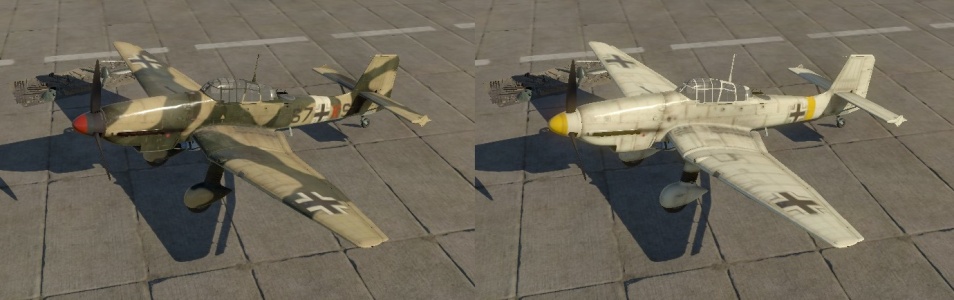
Camouflage obtainable in-game
- Videos
See also
- Related development
- Aircraft of comparable role, configuration and era
External links
- [Special] Junkers Ju 87, the Unexpected Legend
- [Wikipedia] Junkers Ju 87
- Official data sheet - more details about the performance
| Junkers Aircraft and Motor Works (Junkers Flugzeug- und Motorenwerke Aktiengesellschaft) | |
|---|---|
| Fighters | Ju 88 C-6 · Ju 388 J |
| Strike Aircraft | |
| Ju 87 | Ju 87 G-1 · Ju 87 G-2 |
| Bombers | Ju 88 A-1 · Ju 88 A-4 · Ju 188 A-2 · Ju 288 C |
| Ju 87 | Ju 87 B-2 · Ju 87 D-3 · Ju 87 D-5 · Ju 87 R-2 · Ju 87 R-2 Libya |
| Export | ▄Ju 87 D-3 · ▄Ju 87 R-2 · ▄Ju 88 A-4 |
| Germany bombers | |
|---|---|
| Arado | Ar 196 A-3 |
| Blohm & Voss | BV 138 C-1 · BV 238 |
| Dornier | Do 17 E-1 · Do 17 Z-2 · Do 217 E-2 · Do 217 E-4 · Do 217 K-1 · Do 217 M-1 |
| Focke-Wulf | Fw 189 A-1 · Fw 200 C-1 |
| Henschel | Hs 123 A-1 |
| Heinkel | He 111 H-3 · He 111 H-6 · He 111 H-16 · He 115 C-1 · He 177 A-3 · He 177 A-5 |
| Junkers | Ju 87 B-2 · Ju 87 R-2 · Ju 87 R-2 Libya · Ju 87 D-3 · Ju 87 D-5 · Ju 88 A-1 · Ju 88 A-4 · Ju 188 A-2 · Ju 288 C |
| Messerschmitt | Me 264 |
| Savoia-Marchetti | ▀S.M.79 serie 1 · ▀S.M.79 B · ▀S.M.79 serie 4 · ▀S.M.79 serie 8 |
| ▀S.M.79 AS · ▀S.M.79 bis/N · ▀S.M.79 bis/T.M | |
| Trophies | ▀Wellington Mk Ic |