Ju 88 A-1
OLD‑WIKI.WARTHUNDER.COM (DEFUNCT)
| This page is about the German bomber Ju 88 A-1. For other variants, see Ju 88 (Family). |
Description
The original "short wing" version of the famous Ju 88 family, the Ju 88 A-1 also had less powerful engines greatly limiting its war load. In the end only 133 of this model was ever built, with most being upgraded later. Amazingly, one of this incredibly rare version still exists in Norway today!
Introduced in Update 1.55 "Royal Armour", the Ju 88 A-1 is decent to use as an attacker in game with its speed and manoeuvrability, but its payload is a little lacking compared to some other bombers of class. Solid and dependable, a solid unit but not memorable.
General info
Flight performance
| Characteristics | Max Speed (km/h at 5,600 m) |
Max altitude (metres) |
Turn time (seconds) |
Rate of climb (metres/second) |
Take-off run (metres) | |||
|---|---|---|---|---|---|---|---|---|
| AB | RB | AB | RB | AB | RB | |||
| Stock | 430 | 416 | 31.5 | 32.9 | 3.8 | 3.8 | 530 | |
| Upgraded | 482 | 455 | 28.5 | 30.0 | 10.9 | 6.8 | ||
Details
| Features | ||||
|---|---|---|---|---|
| Combat flaps | Take-off flaps | Landing flaps | Air brakes | Arrestor gear |
| ✓ | ✓ | ✓ | ✓ | X |
| Limits | ||||||
|---|---|---|---|---|---|---|
| Wings (km/h) | Gear (km/h) | Flaps (km/h) | Max Static G | |||
| Combat | Take-off | Landing | + | - | ||
| 457 | 428 | 280 | ~10 | ~10 | ||
| Optimal velocities (km/h) | |||
|---|---|---|---|
| Ailerons | Rudder | Elevators | Radiator |
| < 350 | < 360 | < 370 | > 331 |
Survivability and armour
When introduced in 1939, the only protection the 88 A-1 had was self-sealing fuel tanks, which was somewhat unique at time. By the time armour and armoured glass was standard the A-1 series had all but vanished. Avoid being in the crosshairs of even rifle-calibre machine guns, as they will cause much damage quickly, and knock out the pilot with ease.
- No armour plating
- No armour glazing
- Engines and all fuel tanks in wings
Modifications and economy
Always unlock bombs racks first as you go down the tiers. Then unlock the ammo belt and select AP-T (Turret), Universal, or Stealth (Offensive). After those, get the Engine and Wing upgrades.
Armaments
Offensive armament
The Ju 88 A-1 is armed with:
- 1 x 7.92 mm MG 15 machine gun, nose-mounted (375 rpg)
Better than nothing and sometimes useful, success is more by luck than skill so bring your lucky charms!
Suspended armament
The Ju 88 A-1 can be outfitted with the following ordnance:
- 10 x 50 kg SC50JA bombs (500 kg total)
- 28 x 50 kg SC50JA bombs (1,400 kg total)
- 2 x 250 kg SC250JA bombs + 28 x 50 kg SC50JA bombs (1,900 kg total)
- 4 x 250 kg SC250JA bombs (1,000 kg total)
- 2 x 500 kg SC500K bombs (1,000 kg total)
- 4 x Flam C 250 incendiary bombs
- 2 x Flam C 500 incendiary bombs
- 2 x 500 kg PC500 bombs (1,000 kg total)
In most maps there is a convoy target, so always carry the 28 x 50 kg SC50JA bombs to make short work of ground vehicles. Adding the 250 kg bombs will cause a bigger speed loss but allow the chance to destroy medium tanks.
Defensive armament
The Ju 88 A-1 is defended by:
- 1 x 7.92 mm MG 15 machine gun, dorsal turret (600 rpg)
- 1 x 7.92 mm MG 15 machine gun, ventral turret (525 rpg)
One could get a lucky hit with the machine guns, but best to avoid any fighters.
Usage in battles
The Ju-88 A is a fast bomber with a rather light bomb load.
In any air AB/RB match, attack enemy AI units as your bombs barely have enough potency to destroy a base. Maintain your speed to evade pursuing fighters. The 28 x 50 kg bombs, on the other hand, are excellent for destroying convoys of trucks and armoured cars, and the 250 kg bomb could destroy a medium tank. In ground RB matches, it is recommended to carry the 2 x SC500K bombs as they can help you destroy reliably ground targets. With only a rifle-calibre MG as offensive armament, head-ons are ill-advised.
If you are under attack, force the enemy to tailgate you as that is your only chance of returning back to base. Dive down and have your gunners open fire on the enemy. There are 2 gunners that only cover the upper and lower rear of the plane, leaving most of the aircraft defenseless to attacking fighters.
Manual Engine Control
| MEC elements | ||||||
|---|---|---|---|---|---|---|
| Mixer | Pitch | Radiator | Supercharger | Turbocharger | ||
| Oil | Water | Type | ||||
| Not controllable | Controllable Auto control available |
Controllable Auto control available |
Controllable Auto control available |
Separate | Not controllable 1 gear |
Not controllable |
Pros and cons
Pros:
- Equipped with air brakes, able to dive bomb
- Airframe can withstand high speeds during a dive
- Can outrun lower-end fighters
- Has an offensive forward-firing machine gun
- Carries a decent max load of 1,900 kg compared to contemporaries
- Lots of suspended armament options
- Carrying the maximum payload doesn't have that much penalty in overall performance
- Very accurate in precision bombing
- The 50 kg bombs are very efficient in taking out soft ground targets (AA emplacements, MG nests, artillery positions)
Cons:
- Defensive armament is poor and has a massive dead zone
- Stock bomb load is inadequate
History
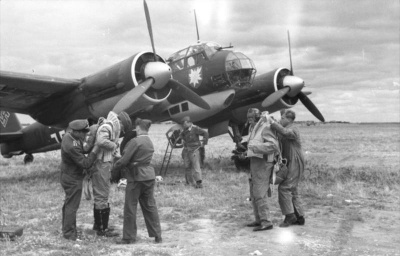
The Junkers Ju 88 A-1 was the first variant of the famous Junkers Ju 88 bomber. After the failure of the Junkers Ju 86, the Junkers team was tasked to make a new bomber able to go faster than the Dornier Do 17 and Heinkel He 111, and even fighters: a true "schnell bomber" (fast bomber)! The prototypes succeeded in their design requirement, being faster than any fighter then in service, but once all the military equipment was added, it was not much faster than what it was designed to replace. Regardless, it had great promise and with more changes proved to be a capable and adaptable warplane. Combat results with the short wing A-1 were below expectations, only 133 units being built before major upgrades were introduced with the A-4. All surviving A-1s were upgraded to the A-5 long wing standard. Amazingly, an Ju 88 A-1 exists today, being found in a freshwater lake in very good condition, and fully restored.
Design and development
The Ju 88 originated from a 1935 requirement for a new high-speed dive bomber with a crew of 3, capable of reaching 480 km/h.[1] The Henschel and Messerschmitt design firms also submitted designs, but later withdrew them; thus, Junkers won the competition and proceeded to produce prototypes. The first Ju 88 prototype flew in December of 1936, and managed to reach a speed of 520 km/h;[1] Later on, a pre-production Ju 88 set a record for a 1,000 km circuit, averaging 517 km/h. After the completion of ten prototypes of the Ju 88 A-0 series, the Ju 88 A-1 was ordered into production with deliveries starting in 1939.[1]
The Ju 88 is a conventional twin-engined light bomber, with the engines mounted in nacelles on each wing. The aircraft has a crew of three, being a pilot, bombardier and radio operator/rear gunner. The aircraft's armament was sparse, consisting of just three 7.92 mm machine guns; this was steadily improved in later Ju 88 variants. The A-1 could carry a maximum bomb load of 1,000 kilograms in standard load, though heavier loads could be carried with modifications.[1]
Operational history
The Ju 88 A-1 started entering service with the Luftwaffe in 1939; 69 aircraft were built that year.[2] The aircraft saw its first combat attacking British shipping in the fall of 1939.[2] The aircraft served extensively in the Battle of Britain as the main Luftwaffe bomber, and fulfilled the same role in Operation Barbarossa, the attempted German invasion of the USSR. By that point in time, it was complemented by more advanced variants of the Ju 88 such as the Ju 88 A-4.
During its time in service, it became highly apparent that the Ju 88 A-1 was not well suited to its task. Namely, the aircraft wasn't adequately armed, with just three defensive machine guns.[2] Thus, the later Ju 88 A-4 variant introduced a heavier defensive armament of five 7.92 mm machine guns; later derivatives such as the Ju 188 featured even more defensive armament.[2] As well, the aircraft experienced structural strength issues, which prevented it from entering fast dives without breaking up. This was also remedied by the later Ju 88 A-4.[2] Despite its flaws, the Ju 88 was a versatile, reliable aircraft and over 15,000 aircraft were built before the end of the war.[1][2]
Media
- Skins
See also
- Related development
External links
References
- Citations
- Bibliography
- V, R. (2019). Junkers Ju 88. Retrieved November 25, 2020, from http://www.century-of-flight.freeola.com/Aviation%20history/WW2/Junkers%20Ju%2088.htm
- Rickard, J. (2007, June 30). Ju 88A. Retrieved November 25, 2020, from http://www.historyofwar.org/articles/weapons_ju88A.html
| Junkers Aircraft and Motor Works (Junkers Flugzeug- und Motorenwerke Aktiengesellschaft) | |
|---|---|
| Fighters | Ju 88 C-6 · Ju 388 J |
| Strike Aircraft | |
| Ju 87 | Ju 87 G-1 · Ju 87 G-2 |
| Bombers | Ju 88 A-1 · Ju 88 A-4 · Ju 188 A-2 · Ju 288 C |
| Ju 87 | Ju 87 B-2 · Ju 87 D-3 · Ju 87 D-5 · Ju 87 R-2 · Ju 87 R-2 Libya |
| Export | ▄Ju 87 D-3 · ▄Ju 87 R-2 · ▄Ju 88 A-4 |
| Germany bombers | |
|---|---|
| Arado | Ar 196 A-3 |
| Blohm & Voss | BV 138 C-1 · BV 238 |
| Dornier | Do 17 E-1 · Do 17 Z-2 · Do 217 E-2 · Do 217 E-4 · Do 217 K-1 · Do 217 M-1 |
| Focke-Wulf | Fw 189 A-1 · Fw 200 C-1 |
| Henschel | Hs 123 A-1 |
| Heinkel | He 111 H-3 · He 111 H-6 · He 111 H-16 · He 115 C-1 · He 177 A-3 · He 177 A-5 |
| Junkers | Ju 87 B-2 · Ju 87 R-2 · Ju 87 R-2 Libya · Ju 87 D-3 · Ju 87 D-5 · Ju 88 A-1 · Ju 88 A-4 · Ju 188 A-2 · Ju 288 C |
| Messerschmitt | Me 264 |
| Savoia-Marchetti | ▀S.M.79 serie 1 · ▀S.M.79 B · ▀S.M.79 serie 4 · ▀S.M.79 serie 8 |
| ▀S.M.79 AS · ▀S.M.79 bis/N · ▀S.M.79 bis/T.M | |
| Trophies | ▀Wellington Mk Ic |