Spitfire Mk Ia
OLD‑WIKI.WARTHUNDER.COM (DEFUNCT)
| This page is about the British fighter Spitfire Mk Ia. For other versions, see Spitfire (Family). |
Description
The Supermarine Spitfire was one of the most world's most successful aircraft lines, with over 20,000 built across its 24 marks and numerous sub-variants. One of the most famous British WW2-era aircraft, its distinctive thin, elliptical wings allowed it a greater aerodynamic top speed than most of its contemporaries, while its adaptable airframe allowed the basic design to be continually upgraded into the 1950s. The prototype first flew on 5th March 1936 (four months after the maiden flight of the contemporary Hawker Hurricane), and the plane was quickly ordered into mass production upon demonstration of its capabilities. However, delays in initiating production lines for the aircraft meant that the first production models were only completed by mid-1938. Despite arguably being less important than its Hurricane counterpart, the Spitfire quickly became an icon of the war, particularly with its performance against the Luftwaffe during the Battle of Britain and beyond. While the majority of Spitfires participating in the Battle of Britain were of the Mk I variant, most would be replaced by the Mk II by the end of 1940.
In the game since the start of the Open Beta Test, the Spitfire Mk Ia is equipped with a Rolls-Royce Merlin III engine, producing 1,030 hp; coupled with its light and sleek design, the Spitfire has excellent climb rate and is relatively fast, but its main strength is the extremely tight turn radius. This allows the pilot to confidently draw any opponent into a turning engagement and emerge victorious (bar the occasional biplane and Japanese fighters, against which the superior speed and energy characteristics of the aircraft can be utilised). However, the key drawback of the Spitfire Mk Ia is the mediocre armament. While the 8 Browning machine guns present great volume of fire, they are rather weak and quite limited by convergence due to their spread-out nature across the wings, and thus may require a long time on target to successfully down an opponent.
General info
Flight performance
The Spitfire Mk Ia has an excellent climb rate and a high top speed of 460 km/h when flying in a straight line. The plane has a decently high wing-rip speed, which should not come into play in controlled dives.
It also possesses a very quick turning ability, although in some situations this can mean that manoeuvring energy retention is worse than one might expect. Roll rate is good at low speeds, but suffers about ~300 km/h.
In general, the Spitfire performs best at low and medium altitudes: below 4,500 m. Above this altitude, engine power and manoeuvrability suffer.
| Characteristics | Max Speed (km/h at 4,267 m) |
Max altitude (metres) |
Turn time (seconds) |
Rate of climb (metres/second) |
Take-off run (metres) | |||
|---|---|---|---|---|---|---|---|---|
| AB | RB | AB | RB | AB | RB | |||
| Stock | 528 | 506 | 16.7 | 17.7 | 10.7 | 10.7 | 300 | |
| Upgraded | 617 | 584 | 14.1 | 15.0 | 26.2 | 19.5 | ||
Details
| Features | ||||
|---|---|---|---|---|
| Combat flaps | Take-off flaps | Landing flaps | Air brakes | Arrestor gear |
| X | X | ✓ | X | X |
| Limits | ||||||
|---|---|---|---|---|---|---|
| Wings (km/h) | Gear (km/h) | Flaps (km/h) | Max Static G | |||
| Combat | Take-off | Landing | + | - | ||
| N/A | N/A | 230 | ~11 | ~6 | ||
| Optimal velocities (km/h) | |||
|---|---|---|---|
| Ailerons | Rudder | Elevators | Radiator |
| < 275 | < 400 | < 350 | > 500 |
| Compressor (RB/SB) | ||
|---|---|---|
| Setting 1 | ||
| Optimal altitude | 100% Engine power | WEP Engine power |
| 4,900 m | 1,020 hp | 1,357 hp |
Survivability and armour
- 38 mm Bulletproof glass - Armoured windscreen
- 4 mm Steel - Armour plate in pilot's seat
- 6-7 mm Steel -Armour plate behind the pilot
Modifications and economy
Armaments
Offensive armament
The Spitfire Mk Ia is armed with:
- 8 x 7.7 mm Browning machine guns, wing-mounted (350 rpg = 2,800 total)
Notes:
- 153 rounds per second total output (1150 rpm x 8 / 60).
- Muzzle velocity 810 m/s (2,660 feet/second). [1]
- The .303 was a rifle round, accurate but fairly ineffective in air combat unless in skilled hands. The calibre was chosen over the .50 as it was lighter, had a higher rate of fire and was less susceptible to jamming. However, it required an average 4,500 rounds to disable an enemy aircraft [2], of which 250 rounds needed to hit (i.e. a full 2-second burst). The accurate placing of the shot was essential, as it lacked sufficient energy to cause structural damage.
- The design used an open bolt mechanism to allow air to flow through the barrel and prevent overheating. This worked well at lower altitudes but caused icing at high altitude. The red canvas wing-port covering kept the gun clean and warm; later marks also ducted hot air from the engine to regulate the gun's breech temperature. [3]
- RAF recommended convergence in 1939 was 365 m (400 yards) in contrast to the Luftwaffe, with experience from the Spanish Civil War, using 200 m (which the RAF adopted by mid-1940). Although many high scoring pilots reduced this, close to 137 m (150 yards) or less for an accurate kill, others ignored convergence altogether or went to a box-shot where paired guns were set to different convergences.
- Choice of ammunition is essential as AP and ball rounds rely on kinetic energy to cause damage, which is lost quickly in small calibre rounds. The API round will also transfer chemical energy into the target and so will be more effective on lightly armoured targets, particularly if they hit something flammable. Pure tracer rounds help to target, especially in combat manoeuvres where lead varies, but have little penetration on contact.
Usage in battles
- Climbing
It is recommended to climb at the start of the match, using the Spitfire Mk Ia's excellent climb rate. This can be done efficiently in two ways depending on the preference of the pilot. If you want to get to high altitudes quickly without having covered much distance you can start off with a 26 degree climb until around 4 km (circa 13,000 ft), after which the nose of the aircraft can be lowered down to a 20 degree climb. If you want to get to a higher altitude at a more moderate tempo and cover more distance, the preference is then to climb steadily the entire way up at 20 degrees. The advantage of the first strategy is that you are going to be the highest altitude fighter in the game. The advantage of the second strategy is that you will be ahead of your bases and at the altitude of enemy bombers so that you can take easy head-on passes at them. In those situations, the bombers can be easy kills (if you fail a head-on against a bomber it is not recommended to turn around and attempt to finish off the bomber as the tail, ventral, dorsal and beam gunners would then have the advantage of you flying into their bullets).
- Speed
The Spitfire is fast, with a top speed of around 600 km/h, although in a straight line it normally only reaches around 460 km/h (which can be higher if you're using MEC). For its BR, the Spitfire Mk Ia's speed is above average overall, being able to reliably outrun aircraft that can outturn it and outturn aircraft that can outrun it. Utilizing its great climb rate, you can dive on faster, heavier aircraft to prevent then from extending away.
- Engaging Enemy Aircraft
The Spitfire is disadvantaged in head-ons due to the lack of armament in the center of the plane, which means you will have to rely on your convergence settings. In a Spitfire, it is highly recommended to initiate turnfight-only engagements. It is possible to fake a head-on (by pulling away once your enemy starts firing) if you're forced to do so by an enemy plane, but it is highly recommended to never commit to a head-on engagement with a dedicated monoplane fighter. A skilled opponent will try to energy fight you, which can catch a Spitfire pilot by suprise. You can lose your energy faster than you realize, and when you do, you've most likely been baited and can be an easy target for the enemy.
The Spitfire has a relatively good ammo count. The 4-digit ammo can will most likely not be deceiving, since there are 8 guns on the aircraft, making around 400 rpg. It is recommended to use the guns at around 400 m to have the most devastating effect. If aimed correctly, your enemy is going to have a bad day. The guns can also be used to attack light or unarmoured ground targets, usually with Stealth or Omnipurpose belts, but dedicated gun-platforms with additional suspended armaments like the Hurricane Mk I/L and Hellcat can perform the job more efficiently than the Spitfire.
When in a fight with an enemy plane which is not Japanese, it is recommended to entice them into a turnfight by waiting until they get close enough and then veering into them, forcing a turning fight.
The Spitfire Mk Ia is a plane known for its manoeuvrability. It is faster than Japanese planes, so if attacked by one, a Rolling Scissors technique or straight dash can be used to evade them. If in a good position, Boom & Zoom can be used: repeatedly strafing and then proceeding to either climb high and energy trap it, or extending away maintaining as much energy as possible.
Specific enemies worth noting
- The Bf 109 Friedrich (F) series are planes players should watch out for. They can do tremendous amounts of damage to a Spitfire if they get on your tail. They also can have very good turning performance, given the pilot flying the 109 knows what he's doing, which could catch you by surprise. The energy performance of the Bf 109 also greatly exceeds the Spitfire's.
- Japanese aircraft - Fighter planes like the Ki-43 and A6M will turn all over the Spitfire. As such, the Spitfire's famous turning ability is actually considered wide and sluggish against a Japanese opponent. Instead, the Merlin engine power on the Spitfire can be used to try and outrun the Japanese plane. When attacking a Japanese plane, Boom & Zoom tactics are recommended, rather than turning, to keep an energy advantage over the opponent.
- Biplanes - Biplanes like the Ki-10, I-15, and CR.32 may be slow, but they are among some of the most manoeuvrable aircraft in War Thunder. It is highly recommended not to turn-fight them and to use Boom & Zoom tactics instead. Luckily, most biplanes are fragile and your eight machine guns will tear them apart.
- Large bombers - Although you have eight machine guns, they are only 7.7 mm calibre. With larger aircraft, you may find yourself expending all of your ammunition and not even coming away with a kill. The Spitfire is also quite fragile, so you should be careful of defensive turrets. Even light machine guns can take out your engine, kill your pilot and destroy important combat surfaces.
- The I-180S premium Soviet fighter is extremely manoeuvrable and has great energy retention which can sometimes even out-turn Spitfires at higher speeds, thus it is recommended to be very careful when engaging these planes, making sure you have an energy advantage, or it will be a difficult battle.
Manual Engine Control
| MEC elements | ||||||
|---|---|---|---|---|---|---|
| Mixer | Pitch | Radiator | Supercharger | Turbocharger | ||
| Oil | Water | Type | ||||
| Controllable | Controllable Not auto controlled |
Not controllable Not auto controlled |
Controllable Not auto controlled |
Separate | Not controllable 1 gear |
Not controllable |
Pros and cons
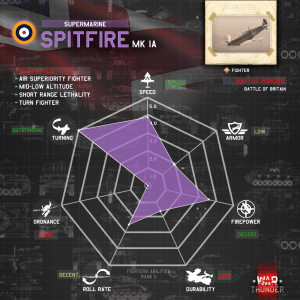
Pros:
- Outstanding turn radius, very good at turnfighting
- Adequate roll rate at low speed
- Good performance at altitudes below 4.5 km
- Excellent climb rate
- Decent armour: frontal 38 mm glass and rear 4-7 mm steel plates
- "100 octane fuel" modification provides roughly 15% increase in engine power
- Good anti-fighter armament of eight machine guns
Cons:
- Poor high-altitude performance
- Roll rate stiffens dramatically at ~300 km/h
- Below average energy retention: momentum is lost after pulling a few sharp turns
- Fragile construction: damage to the airframe, control surfaces, or engine can cripple the plane
- Negative Gs and inverted flight causes the Float Carburettor to fail, momentarily cutting the engine
- Engine prone to overheating
- Machine guns are effective only if the target is hit repeatedly at close ranges
- No suspended armaments or heavy guns for ground attack
- Pulling back hard on the joystick can cause dangerous flat-spins in Simulator mode
- Poor simulator cockpit visibility
History
| Archive of the in-game description | |
|---|---|
|
Despite the British Air Ministry's preference for biplane fighters in the early 1930s, Supermarine designer RJ Mitchell began work on an all-metal construction, single-engine, single-seat monoplane fighter with an enclosed cockpit and retractable landing gear. The Spitfire (Prototype K5054) made its first flight on March 5th 1936, and after demonstrating superb handling qualities, was ordered into mass production for the RAF. The first Spitfires entered service with No.19 Squadron at RAF Duxford in August 1938. Initially, the Mk I variant was equipped with type A wings and four wing-mounted Colt-Browning Mk II .303 (7.7 mm) machine guns, although this was soon increased to eight. Further upgrades included the use of a Rolls-Royce Merlin III engine instead of the original 1,030 HP Merlin II; the original two blade fixed pitch wooden propeller was also replaced with a metal, variable pitch three bladed propeller of either Rotol or De Havilland design. A bulged canopy, bullet proof windscreen, armour plating and hydraulics to operate the gear and flaps were also introduced, partly as a result of the combat experience gained by Hurricane squadrons during the Battle of France. The first Spitfires had a basic targeting system consisting of a ringed sight, but by July of 1939 a more sophisticated collimator sight, the GM2 Mk II, began to be used; machines already in service were retrofitted with the new sights. In 1940, 30 aircraft were delivered to front line service for Operational Trials with the new Type B wing; the Spitfire Mk IB was armed with two 20 mm Hispano cannon and four 0.303 Browning machine guns, and the older eight gun fighters were re-designated the Mk IA. However, the drum feed for the 20 mm cannon proved to be very unreliable and prone to jamming, so the Mk IB was withdrawn from service. At the time of its introduction, right through the Battle of Britain in the summer of 1940, the Spitfire Mk I was considered by many to be the greatest fighter aircraft in the world. By the time the Spitfire Mk II began to replace it, 1,566 Mk Is had been built. | |
Aces
The Spitfire Mk.1A was the iconic British aircraft of the Battle of Britain. Leading Spitfire aces of this battle were: [4]
| Name | Nationality | Squadron |
|---|---|---|
| Pilot Officer Eric Lock | British | 41 |
| Flying Officer Brian Carbury | New Zealand | 603 |
| Pilot Officer Colin Gray | New Zealand | 54 |
| Pilot Officer Bob Doe | British | 234 |
| Flight Lieutenant Paterson Hughes | Australia | 234 |
Notable pilots
-
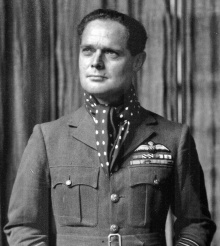 The Spitfire Mk Ia was the first Spitfire in which Douglas Bader flew. As it was he crashed the first one during take off, however immediately jumped into another and took to the air.
Media
- Skins
- Videos
See also
Links to the articles on the War Thunder Wiki that you think will be useful for the reader, for example:
- reference to the series of the aircraft;
- links to approximate analogues of other nations and research trees.
External links
References
- ↑ [The Aviation History Online Museum] Browning .303 Mark II Machine Gun
- ↑ Flying Guns: World War II by Anthony G Williams, Emmanuel Gustin (2003), p95
- ↑ [Wikipedia] Supermarine Spitfire - Armament
- ↑ [Wikipedia] The Few
| Supermarine | |
|---|---|
| Spitfires | |
| Merlin engine | Spitfire Mk Ia · Spitfire Mk IIa · Spitfire Mk.IIa Venture I · Spitfire Mk IIb |
| Spitfire Mk Vb · Spitfire Mk Vb/trop · Spitfire Mk Vc · Spitfire Mk Vc/trop | |
| Spitfire F Mk IX · Spitfire F Mk IXc · Spitfire F Mk XVI | |
| Spitfire LF Mk IX · Plagis' Spitfire LF Mk IXc | |
| Griffon engine | Spitfire F Mk XIVc · Spitfire F Mk XIVe · Prendergast's Spitfire FR Mk XIVe · Spitfire F Mk XVIIIe · Spitfire F Mk 22 · Spitfire F Mk 24 |
| Export | ▄Spitfire Mk Vb/trop · ▃Spitfire LF Mk IXc · ▂Spitfire Mk IXc · Spitfire Mk IXc · Spitfire Mk.IX (CW) · Weizman's Spitfire LF Mk.IXe · ▄Spitfire FR Mk XIVe |
| Seafires | Seafire LF Mk.III · Seafire F Mk XVII · Seafire FR 47 |
| Export | ▄Seafire LF Mk.III |
| Jet fighters | Attacker FB 1 · Attacker FB.2 · Scimitar F Mk.1 · Swift F.1 · Swift F.7 |
| Hydroplanes | Walrus Mk.I |