Spitfire F Mk IXc
OLD‑WIKI.WARTHUNDER.COM (DEFUNCT)
| This page is about the premium British fighter Spitfire F Mk IXc. For other versions, see Spitfire (Family). |
Description
The superiority of the Fw 190 over the Spitfire Mk V quickly became apparent after its introduction in late 1941. While a new engine, the Merlin 61, with a two-stage supercharger had been developed, a new airframe for high-altitude operations was still in the works; thus, as an interim measure, the new engine was fitted into the Spitfire Mk Vc, producing the Spitfire Mk IX. Even without the aerodynamic and structural improvements of the new design, the Mk IX was found to be an effective counter to the Fw 190, with much greater speed, climb rate, and high-altitude manoeuvrability than the Mk V, while matching its low-level performance. Many Mk Vc's would be converted to the new standard, and were armed in both all-cannon and B-type wing-style arrangements, but with the advantage of greater ammunition capacity due to the belt-feeding of the cannons facilitated by the wing redesign. In early 1943, the Merlin 61 engines were gradually replaced by the Merlin 63, and production of the Spitfire F Mk IX was finally halted in late 1943 in favour of the Merlin 66-powered LF Mk IX.
Introduced in Update 1.77 "Advancing Storm" as a reward for the 2018 "Royal Air Force Centenary" event, the Spitfire Mk IX series is the pinnacle of the Merlin-powered Spitfires. They feature an exceptional rate of climb and adequate speed, whilst still retaining the manoeuvrability of their early lineage. The Spitfire F Mk IXc is also equipped with the hard-hitting quad cannon armament of the Spitfire Mk Vc, allowing every opportunity for a critical shot to be easily taken advantage of. The Mk IX presents a good introduction to the more energy-fighting style of the later Griffon-powered aircraft, making use of the altitude advantage to make passes on an opponent while retaining the ability to return to a turn-fighting approach when desired. While the Spitfire Mk IX also finally comes with the ability to carry ground ordnance, the single option of a 250 lb bomb is very lacklustre, and its effect against medium and heavy targets is limited. It should be used only to engage lightly armoured vehicles and SPAAs, if at all.
General info
Flight performance
| Characteristics | Max Speed (km/h at 8,537 m) |
Max altitude (metres) |
Turn time (seconds) |
Rate of climb (metres/second) |
Take-off run (metres) | |||
|---|---|---|---|---|---|---|---|---|
| AB | RB | AB | RB | AB | RB | |||
| Stock | 618 | 602 | 18.1 | 18.8 | 15.3 | 15.3 | 380 | |
| Upgraded | 668 | 642 | 16.3 | 17.2 | 23.7 | 18.9 | ||
Details
| Features | ||||
|---|---|---|---|---|
| Combat flaps | Take-off flaps | Landing flaps | Air brakes | Arrestor gear |
| X | X | ✓ | X | X |
| Limits | ||||||
|---|---|---|---|---|---|---|
| Wings (km/h) | Gear (km/h) | Flaps (km/h) | Max Static G | |||
| Combat | Take-off | Landing | + | - | ||
| N/A | N/A | 230 | ~12 | ~7 | ||
| Optimal velocities (km/h) | |||
|---|---|---|---|
| Ailerons | Rudder | Elevators | Radiator |
| < 321 | < 400 | < 350 | > 450 |
Survivability and armour
- 38 mm Bulletproof glass in front of the pilot
- 3 mm Steel plate on top of fuel tanks
- 4 mm Steel plate on pilot's seat. Behind pilot is another 6-7 mm steel plate
- 3 mm Steel plates around ammunition
- Critical components located at the front of aircraft (fuel, pilot, engine, controls)
- Liquid cooling system at the wing root
Modifications and economy
Armaments
Offensive armament
The Spitfire F Mk IXc is armed with:
- 4 x 20 mm Hispano Mk.II cannons, wing-mounted (120 rpg = 480 total)
Suspended armament
The Spitfire F Mk IXc can be outfitted with the following ordnance:
- Without load
- 1 x 250 lb AN-M57 bomb (250 lb total)
Usage in battles
Describe the tactics of playing in the aircraft, the features of using aircraft in a team and advice on tactics. Refrain from creating a "guide" - do not impose a single point of view, but instead, give the reader food for thought. Examine the most dangerous enemies and give recommendations on fighting them. If necessary, note the specifics of the game in different modes (AB, RB, SB).
Manual Engine Control
| MEC elements | ||||||
|---|---|---|---|---|---|---|
| Mixer | Pitch | Radiator | Supercharger | Turbocharger | ||
| Oil | Water | Type | ||||
| Controllable | Controllable Not auto controlled |
Not controllable Not auto controlled |
Controllable Auto control available |
Combined | Controllable 2 gears |
Not controllable |
Pros and cons
Pros:
- Significantly increased firepower compared to the regular Spitfire F Mk IX at a minimal performance cost
- Ammunition pool boost to 120 rounds per gun compared to the 60 rounds of predecessors
- Good low altitude performance
- Highly manoeuvrable and excellent roll rate
- Good climb rate
- Very good at Boom and Zoom
- Engine (fuel injected) will not shut off performing a quick Negative G manoeuvre unlike the Spitfires before it (RB/SB)
Cons:
- Poor acceleration and rate of climb at high altitude
- Heavy recoil when firing, although can be negated by tap firing
- Mediocre energy retention in sharp turns
- Only one flap setting (landing), and the ripping speed is really low
- Ammunition pool is easy to burn out without trigger discipline
- Hispanos overheat and jam quickly
- Light airframe, which can't withstand a lot of punishment
- Suffers heavily from compression in steep dives
- A leak in the cooling system can cripple the engine in minutes
History
The Spitfire Mk IX was the result of combining the Spitfire Mk V airframe with a Rolls-Royce Merlin 61 (F - fighter variant) , 66 (LF - low altitude fighter variant), or 70 (HF - high altitude fighter variant) engine in order to improve performance. The Spitfire Mk IX was hastily developed as a temporary response to the Focke-Wulf 190 while production of the improved Spitfire Mk VIII airframe was ramping up. Early models of the Spitfire Mk IX were equipped with what was known as the "c" wing. The "c" wing was designed to decrease production cost and time when compared to the "a" and "b" wings while allowing for use of universal armament installation giving it the nomenclature of the universal wing. The "c" wing was capable of equipping 8 Browning .303 machine guns, 2 Hispano 20 mm autocannons and 4 Browning .303 machine guns, or 4 Hispano 20 mm autocannons. The most common configuration was that of 2 Hispano 20 mm autocannons and Browning .303 machine guns as equipping the wing with 4 Hispano 20 mm autocannons resulted in technical problems which could cause the guns to malfunction at high altitude.[1] Later models of Mk IX were equipped with the "e" type wing which was a slightly improved version of the "c" type that allowed for the installation of 2 Browning .50 calibre machine guns and 2 Hispano 20 mm autocannons.
Media
- Skins
- Images
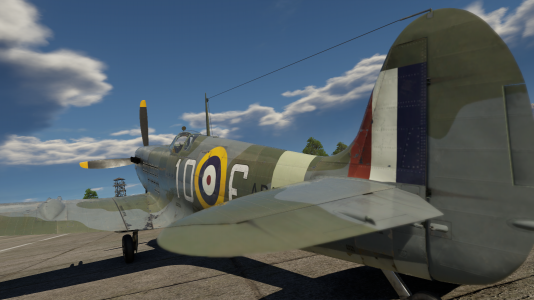
The Spitfire F Mk IXc holds a good mix of turning abilities and engine power.
See also
Links to the articles on the War Thunder Wiki that you think will be useful for the reader, for example:
- reference to the series of the aircraft;
- links to approximate analogues of other nations and research trees.
External links
References
- ↑ The Spitfire Site (2010, April 15). The Hispano Cannon. http://spitfiresite.com/2010/04/spitfire-the-hispano-cannon.html
| Supermarine | |
|---|---|
| Spitfires | |
| Merlin engine | Spitfire Mk Ia · Spitfire Mk IIa · Spitfire Mk.IIa Venture I · Spitfire Mk IIb |
| Spitfire Mk Vb · Spitfire Mk Vb/trop · Spitfire Mk Vc · Spitfire Mk Vc/trop | |
| Spitfire F Mk IX · Spitfire F Mk IXc · Spitfire F Mk XVI | |
| Spitfire LF Mk IX · Plagis' Spitfire LF Mk IXc | |
| Griffon engine | Spitfire F Mk XIVc · Spitfire F Mk XIVe · Prendergast's Spitfire FR Mk XIVe · Spitfire F Mk XVIIIe · Spitfire F Mk 22 · Spitfire F Mk 24 |
| Export | ▄Spitfire Mk Vb/trop · ▃Spitfire LF Mk IXc · ▂Spitfire Mk IXc · Spitfire Mk IXc · Spitfire Mk.IX (CW) · Weizman's Spitfire LF Mk.IXe · ▄Spitfire FR Mk XIVe |
| Seafires | Seafire LF Mk.III · Seafire F Mk XVII · Seafire FR 47 |
| Export | ▄Seafire LF Mk.III |
| Jet fighters | Attacker FB 1 · Attacker FB.2 · Scimitar F Mk.1 · Swift F.1 · Swift F.7 |
| Hydroplanes | Walrus Mk.I |
| Britain premium aircraft | |
|---|---|
| Fighters | Tuck's Gladiator Mk II · ▄Boomerang Mk I · ▄Boomerang Mk II · ▄D.520 |
| ▄Martlet Mk IV · ▄Corsair F Mk II · ▄Hellcat Mk II · ▄Thunderbolt Mk.1 · ▄Mustang Mk IA | |
| Hurricane Mk.I/L FAA M · Spitfire Mk.IIa Venture I · Spitfire F Mk IXc · Plagis' Spitfire LF Mk IXc · Spitfire F Mk XIVc · Prendergast's Spitfire FR Mk XIVe | |
| Typhoon Mk Ib · MB.5 | |
| Twin-engine fighters | Hornet Mk.I · Whirlwind P.9 |
| Jet fighters | Attacker FB.2 · Hunter FGA.9 · Lightning F.53 · Meteor F Mk.8 Reaper · Sea Vixen F.A.W. Mk.2 · F-4J(UK) Phantom II · ▄MiG-21 Bison |
| Strike aircraft | ▄Wirraway · Beaufighter Mk I (40-mm) · Wyvern S4 |
| Harrier GR.1 · Strikemaster Mk.88 | |
| Bombers | ▄Avenger Mk II · ▄Boston Mk I · ▄Catalina Mk IIIa · ▄DB-7 · ▄Havoc Mk I · ▄Hudson Mk V · Swordfish Mk II |