Spitfire F Mk 22
OLD‑WIKI.WARTHUNDER.COM (DEFUNCT)
| This page is about the British fighter Spitfire F Mk 22. For other versions, see Spitfire (Family). |
Description
The Spitfire F Mk 22 was one of the last models of the famous Supermarine Spitfire. The Mk 22 was derived from the previous Mk 21, differing in lowered rear part of the fuselage and bubble canopy. However, this change led to stability problems, which in turn led to not having a fuselage fuel tank installed. The problem was solved in December 1945 when the entire rear fuselage and tail section of the then-developed Supermarine Spiteful was installed. The RAF initially ordered 627, however the end of war decreased the number to 260. Twenty Spitfires were sold to Egypt, eleven to Rhodesia, and ten to Syria.
The Spitfire F Mk 22 was introduced in Update 1.39. The Spitfire F Mk 22 is the pinnacle of piston-powered aircraft, one of the first superprops. The playstyle of Mk 22 is very similar to the previous Griffon-powered Spitfires, with the exception of different armament as the Mk 22 is armed with four 20 mm Hispano cannons. Early jet aircraft that pilots may come across are at a severe disadvantage when encountering the Spitfire, as it can out-turn and also catch the majority of these in a dive.
General info
Flight performance
| Characteristics | Max Speed (km/h at 8,232 m) |
Max altitude (metres) |
Turn time (seconds) |
Rate of climb (metres/second) |
Take-off run (metres) | |||
|---|---|---|---|---|---|---|---|---|
| AB | RB | AB | RB | AB | RB | |||
| Stock | 706 | 685 | 19.4 | 20.2 | 18.5 | 18.5 | 420 | |
| Upgraded | 788 | 740 | 17.3 | 18.2 | 31.5 | 23.7 | ||
Details
| Features | ||||
|---|---|---|---|---|
| Combat flaps | Take-off flaps | Landing flaps | Air brakes | Arrestor gear |
| X | X | ✓ | X | X |
| Limits | ||||||
|---|---|---|---|---|---|---|
| Wings (km/h) | Gear (km/h) | Flaps (km/h) | Max Static G | |||
| Combat | Take-off | Landing | + | - | ||
| N/A | N/A | 260 | ~11 | ~6 | ||
| Optimal velocities (km/h) | |||
|---|---|---|---|
| Ailerons | Rudder | Elevators | Radiator |
| < 482 | < 400 | < 400 | > 500 |
Survivability and armour
- 42.8 mm Bulletproof glass - Armoured windscreen
- 4 mm Steel - Armoured pilot seat
- 4 mm Steel - Armour plate behind the pilot seat
- 7 mm Steel - Armour plate behind the pilot seat
- 3 mm Steel - Armoured boxes around the wing ammunition (each wing)
- 12.7 mm Steel - Armoured plate between fuel tanks.
- 6 mm Steel - Armoured plate in front of the liquid cooling system.
Modifications and economy
Suggested research order:
- Fuselage Repair
- Radiator
- Compressor
- Airframe
- Offensive 20 mm
- Engine
- Wings Repair
- Fuel Injection
- Cover (many of the upgrades are crucial to boosting the aircraft's speed and climb rate)
Armaments
Offensive armament
The Spitfire F Mk 22 is armed with:
- 4 x 20 mm Hispano Mk.II cannons, wing-mounted (150 rpg outer + 175 rpg inner = 650 total)
Suspended armament
| Default weapon presets | |
|---|---|
| |
Usage in battles
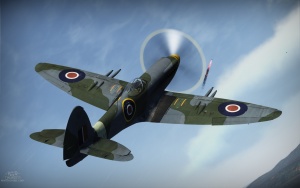
The Spitfire F Mk 22 an excellent plane in realistic battles with relatively few weaknesses, so the enemy will have a really hard time shaking the Spitfire off of its tail and only few will succeed.
The Spitfire F Mk 22 can keep up with most enemies in turnfights, excluding most Japanese fighters and some of the more nimble British fighters. The main task for a pilot is to utilize the great climb rate to gain an altitude advantage on enemy fighters (altitude allows you to control engagements). Target altitude should usually be around 5-6 km on smaller maps and 6-7 km on larger maps such as Norway and Spain. The main form of attack (especially when there are more fighters around the target) is Boom & Zoom. Energy fighting is an option too, if in a 1-vs-1 situation. The Griffon Spitfire is an excellent energy fighter, the Griffon engine provides a tremendous amount of horsepower which can be used to gain speed quickly and climb back at a safe altitude. Remember to maintain speed, altitude advantage, and judge the energy state before engaging an aircraft.
When fighting propeller aircraft, you should use your superior engine power and flight characteristics to your advantage. Fighters should be engaged based on their individual strengths and weaknesses. When facing Soviet fighters it is not recommended to duel them below 4,000 m. Maintain altitude and energy and get your guns on target. Do not commit to head-on attacks and do not burn all your energy in a turnfight with a Bf 109 or a Japanese fighter, this Spitfire handles differently to the previous ones in the series.
Specific enemies worth noting
- Heavy bombers: they are best left to heavy fighters like the F-82E twin-mustang or the de Havilland Hornet due to their more potent, nose-mounted armament. If you must engage a bomber, you should engage from directly below or above, or in a head-on. Closing in from behind or the sides, you are exposing yourself to a barrage of heavy machineguns and autocannons which will shred your flimsy airframe. Most bombers only have a single defensive armament in the nose and above and below are typically gunner dead-zones or entirely unarmed. A two-engine bomber requires both to remain aloft, take one out and it will surely die. 4-engine bombers only need 2 or 3, so aiming for the engines is ill-advised. For these, you should take out the pilot or destroy the wing-tips to cause the bomber to fall into a flat spin. Alternatively, you can take out the tail controls to disable a bomber (this however requires a rearward engagement which is most dangerous).
- Jet fighters: they are strong, though not infallible. German and Japanese jets tend to have horrific performance at altitudes exceeding 4,500 m. You can bait them up and energy trap them. Once they have lost their speed they are incredibly vulnerable due to their atrocious acceleration, which you can exploit and quickly gain on them. Soviet jets also suffer above about 5,000 m. They also have very little ammunition and low speeds. American jets are the biggest issue: your best bet is to bait them into turnfighting or losing their energy, where they are most vulnerable.
Manual Engine Control
| MEC elements | ||||||
|---|---|---|---|---|---|---|
| Mixer | Pitch | Radiator | Supercharger | Turbocharger | ||
| Oil | Water | Type | ||||
| Not controllable | Controllable Auto control available |
Not controllable Not auto controlled |
Controllable Auto control available |
Combined | Controllable 2 gears |
Not controllable |
Pros and cons
Pros:
- 4 cannons with a high rate of fire
- Good climb rate
- Quite agile at medium and higher speeds
- Very responsive elevator (starts to lock at speeds above 600 km/h IAS)
- Greatly improved high-speed handling relative to previous spitfires
- Wing rip speed is noticeably higher than previous spitfires
- Very good acceleration when using WEP
- Good performance at higher altitudes
Cons:
- From time to time, pitted against jets which can be tricky to avoid or outmanoeuvre
- Poor agility at lower speeds and significant drag/mass ratio at high speeds limits optimal combat speed range
- Easily set on fire due to the location of the fuel tanks
- Landing gear rips very easily during take-off and landing travelling in excess of 260 km/h
- Landing flaps also break off at roughly the same speed as the gear
- Can struggle to keep up with enemy airplanes without frequently utilizing WEP
History
| Archive of the in-game description | |
|---|---|
|
The Supermarine Spitfire Mk.22 was a single engine, single seat fighter which served with the Royal Air Force during the early post war period. When the first Rolls Royce Griffon equipped Spitfires were tested it was obvious that a stronger airframe would be needed to harness the full power of the new engine. Added to this was the requirement for a much stiffer wing; the result of these findings was the Spitfire Mk.21. The Mk.21 was also fitted with larger ailerons and the same 2050 hp Griffon 65 engine which was fitted to the Mk.XIV and Mk.XVIII. By this point in the aircraft's life, the Spitfire was so different from RJ Mitchell's original concept that the notion of renaming the new aircraft the 'Victor' was considered. The Air Fighting Development Unit at RAF Boscombe Down began to test the Mk.21 in late 1944, but were deeply unhappy with the new Spitfire and recommended that no further attempts were made to progress the basic Spitfire design. Chief amongst the AFDU's complaints was directional instability: Supermarine attempted to solve this problem by modifying the control surfaces. It was only with the introduction of a new, enlarged tailfin and tail plane which finally solved the instability problems. The Mk.22 differed from the Mk.21 only in having a teardrop bubble canopy – a change which had not required a new mark number in previous Spitfires – and a different electrical system. The Mk.22, as with the Mk.21, was armed with four 20mm Hispano cannons. The Mk.22 was more prolific and more successful than the Mk.21, with some 280 aircraft being manufactured. It was used to equip No.73 Squadron and twelve squadrons of the Royal Auxiliary Air Force. In 1955 the Spitfire Mk.22 was declared obsolete by the RAF and many were exported to South Rhodesia, Syria and Egypt. | |
Media
- Skins
- Videos
See also
Links to the articles on the War Thunder Wiki that you think will be useful for the reader, for example:
- reference to the series of the aircraft;
- links to approximate analogues of other nations and research trees.
External links
| Supermarine | |
|---|---|
| Spitfires | |
| Merlin engine | Spitfire Mk Ia · Spitfire Mk IIa · Spitfire Mk.IIa Venture I · Spitfire Mk IIb |
| Spitfire Mk Vb · Spitfire Mk Vb/trop · Spitfire Mk Vc · Spitfire Mk Vc/trop | |
| Spitfire F Mk IX · Spitfire F Mk IXc · Spitfire F Mk XVI | |
| Spitfire LF Mk IX · Plagis' Spitfire LF Mk IXc | |
| Griffon engine | Spitfire F Mk XIVc · Spitfire F Mk XIVe · Prendergast's Spitfire FR Mk XIVe · Spitfire F Mk XVIIIe · Spitfire F Mk 22 · Spitfire F Mk 24 |
| Export | ▄Spitfire Mk Vb/trop · ▃Spitfire LF Mk IXc · ▂Spitfire Mk IXc · Spitfire Mk IXc · Spitfire Mk.IX (CW) · Weizman's Spitfire LF Mk.IXe · ▄Spitfire FR Mk XIVe |
| Seafires | Seafire LF Mk.III · Seafire F Mk XVII · Seafire FR 47 |
| Export | ▄Seafire LF Mk.III |
| Jet fighters | Attacker FB 1 · Attacker FB.2 · Scimitar F Mk.1 · Swift F.1 · Swift F.7 |
| Hydroplanes | Walrus Mk.I |