Chieftain Mk 10
OLD‑WIKI.WARTHUNDER.COM (DEFUNCT)
| This page is about the British medium tank Chieftain Mk 10. For other versions, see Chieftain (Family). |
Description
The Chieftain Mk 10 is a rank British medium tank with a battle rating of (AB), (RB), and (SB). It was introduced in Update 1.71 "New E.R.A.".
General info
Survivability and armour
Armour type:
- Cast homogeneous armour (hull front, turret front half, cupola)
- Rolled homogeneous armour (hull sides, hull rear, hull roof, turret rear half, turret roof, cupola roof)
- Stillbrew composite armour (turret front half, turret ring - front part)
| Armour | Front | Sides | Rear | Roof |
|---|---|---|---|---|
| Hull | 70-127 mm (40-79°) Front glacis 76.2 mm (40-45°) Lower glacis 200* mm (0-45°) Turret ring |
88-220 (8-30°) + 13 mm Front Top 50 mm (1-31°) Center Top 37 mm (30°) + 13 mm Rear Top 37 (10°) + 13 mm Bottom |
37 mm (1-7°) | 13-28 mm |
| Turret | 125-250 + 80-150* mm (2-81°) Turret front 100-220 mm (1-53°) Gun mantlet | 45-196 mm (1-65°) | 45 mm (1°) | 50.8 mm Front 25 mm Rear |
| Cupola | 150 mm | 25 mm | ||
Notes:
- Suspension wheels and tracks are 20 mm thick while bogies are 19 mm thick.
- Belly armour is 16 mm of RHA.
| Stillbrew armour | Front |
|---|---|
| Turret ring - front part | 200 mm Kinetic 200 mm Chemical |
| Turret - front half | 450 mm Kinetic 500 mm Chemical |
Notes:
- Stillbrew armour at turret ring is pure 200 mm CHA.
- Stillbrew armour on turret front is composed of 80 to 150 mm CHA + 60 mm rubber + 150 to 250 mm CHA.
The Chieftain Mk 10 sports identical hull armour to the earlier variants, however the turret is augmented with Stillbrew composite armour, providing near-complete frontal protection when in hull-down positioning, with the exceptions of the small area around the gun breech and a small section of visible turret ring. The Chieftain's Stillbrew package offers extremely effective protection against most kinetic rounds, with only rounds available on vehicles such as the T-80B and Type 90 able to penetrate it.
The vehicle's hull armour should be considered essentially non-existent relative to the weaponry it faces; in most cases a hull shot will result in penetration.
Mobility
| Game Mode | Max Speed (km/h) | Weight (tons) | Engine power (horsepower) | Power-to-weight ratio (hp/ton) | |||
|---|---|---|---|---|---|---|---|
| Forward | Reverse | Stock | Upgraded | Stock | Upgraded | ||
| Arcade | Expression error: Unexpected * operator. | 1,178 | Expression error: Unexpected round operator. | __.__ | |||
| Realistic | 672 | Expression error: Unexpected round operator. | __.__ | ||||
The Chieftain Mk 10's mobility is extremely sub-par, particularly when considering the vehicles it will face regularly - such as the Leopard A1A1 or the AMX-30 Super. While the vehicle is technically capable of a maximum of 48 km/h in RB/SB, the lacklustre power and the Chieftain Mk 10's significant weight result in this speed being essentially unattainable except in on-road downhills.
As such, Chieftain Mk 10 players should not rely on their mobility for anything; rather they should make their way to positions with good visibility and attempt to maintain ranged engagements only, relying on their turret armour.
Modifications and economy
Armaments
Main armament
The L11 120 mm Rifled Cannon is reasonably competitive at the Chieftain's rank, although it does suffer from a somewhat mediocre reload time. The weapon is extremely accurate, particularly once utilising the L23 APFSDS round, and performs admirably in ranged engagements. The weapon's default APDS and HESH rounds can be used to good effect against most targets, given careful aim and target selection.
| 120 mm Ordnance BL Tk. L11 | Turret rotation speed (°/s) | Reloading rate (seconds) | |||||||||||
|---|---|---|---|---|---|---|---|---|---|---|---|---|---|
| Mode | Capacity | Vertical | Horizontal | Stabilizer | Stock | Upgraded | Full | Expert | Aced | Stock | Full | Expert | Aced |
| Arcade | 53 | -10°/+20° | ±180° | Two-plane | 21.4 | 29.6 | 36.0 | 39.8 | 42.4 | 9.75 | 8.63 | 7.95 | 7.50 |
| Realistic | 13.4 | 15.8 | 19.1 | 21.1 | 22.5 | ||||||||
Ammunition
The available ammunition allows for engaging all types of targets:
- L15A3: APDS; an armour-piercing round with a discarding sabot that has a good penetration power and no explosive filler. As it lacks post-penetration damage, the tactic with an APDS shot is to either knock out the majority of the tank's crew or to provoke ammo or fuel detonation by targeting their respective locations. This requires good knowledge of the layouts of potential opposing vehicles. Use the Protection analysis feature in the hangar menu to analyse potential foes for their weak spots! Also, keep in mind that with increased armour thickness the number of shrapnel shrinks.
- L31A7: HESH; a high-explosive squash head projectile works very differently from other shell types. It ignores any angle, except for ricochet, and deals damage by metal-flakes which are blown off inside the armour by the exterior explosion. To create this deadly shrapnel inside the tank, make sure to only hit armour plates which are a direct part of the interior crew compartment of the tank. Hitting exterior parts of a tank like spaced armour, the suspension, tracks etc. will not harm crew members/modules at all. Currently, only true armour thickness (as opposed to the line of sight thickness) will provide sufficient means of protection, benefiting the USSR turret designs and in general German tanks. Like all high-explosive shells, the fuse is very sensitive and can be set-off by most objects e.g. fences, trees, posts. The slow muzzle velocity of this shell can make it quite hard to hit targets at longer distances, but at the same time it can be handy because its arc trajectory allows it to land hits on enemies hiding behind shallow hills.
- L23: APFSDS; a kinetic dart with high penetration power capable of easily penetrating the majority of the foes it meets but without explosive filler. As it lacks post-penetration damage, the tactic with an APDS shot is to either knock out the majority of the tank's crew or to provoke ammo or fuel detonation by targeting their respective locations. This requires good knowledge of the layouts of potential opposing vehicles. Use the Protection analysis feature in the hangar menu to analyse potential foes for their weak spots! Also, keep in mind that with increased armour thickness the number of shrapnel shrinks.
- L34: Smoke; useful to blind enemy vehicles that are too remote for you to disable so that you can progress towards objectives.
| Penetration statistics | |||||||
|---|---|---|---|---|---|---|---|
| Ammunition | Type of warhead |
Penetration @ 0° Angle of Attack (mm) | |||||
| 10 m | 100 m | 500 m | 1,000 m | 1,500 m | 2,000 m | ||
| Shot L15A3 | APDS | 298 | 296 | 288 | 277 | 268 | 258 |
| Shell L31A7 | HESH | 152 | 152 | 152 | 152 | 152 | 152 |
| Shot L23 | APFSDS | 410 | 408 | 405 | 400 | 390 | 380 |
| Shell details | ||||||||||||
|---|---|---|---|---|---|---|---|---|---|---|---|---|
| Ammunition | Type of warhead |
Velocity (m/s) |
Projectile mass (kg) |
Fuse delay (m) |
Fuse sensitivity (mm) |
Explosive mass (TNT equivalent) (kg) |
Ricochet | |||||
| 0% | 50% | 100% | ||||||||||
| Shot L15A3 | APDS | 1,372 | 7.48 | - | - | - | 75° | 78° | 80° | |||
| Shell L31A7 | HESH | 670 | 17.34 | 0.1 | 4 | 6.53 | 73° | 77° | 80° | |||
| Shot L23 | APFSDS | 1,535 | 3.89 | - | - | - | 78° | 80° | 81° | |||
| Smoke shell characteristics | ||||||
|---|---|---|---|---|---|---|
| Ammunition | Velocity (m/s) |
Projectile mass (kg) |
Screen radius (m) |
Screen deploy time (s) |
Screen hold time (s) |
Explosive mass (TNT equivalent) (g) |
| L34 | 670 | 17.1 | 20 | 5 | 25 | 50 |
Ammo racks
| Full ammo |
Ammo part |
1st rack empty |
2nd rack empty |
3rd rack empty |
4th rack empty |
5th rack empty |
6th rack empty |
7th rack empty |
8th rack empty |
|---|---|---|---|---|---|---|---|---|---|
| 53 | Projectiles Propellants |
52 (+1) 48 (+5) |
48 (+5) 37 (+16) |
46 (+7) 20 (+33) |
43 (+10) 17 (+36) |
39 (+14) 11 (+42) |
37 (+16) 4 (+49) |
36 (+17) 1 (+52) |
35 (+18) N/A |
| 9th rack empty |
10th rack empty |
11th rack empty |
12th rack empty |
13th rack empty |
14th rack empty |
15th rack empty |
16th rack empty |
17th rack empty |
Visual discrepancy |
| 30 (+23) N/A |
20 (+33) N/A |
18 (+35) N/A |
17 (+36) N/A |
12 (+41) N/A |
8 (+45) N/A |
4 (+49) N/A |
3 (+50) N/A |
1 (+52) N/A |
Yes |
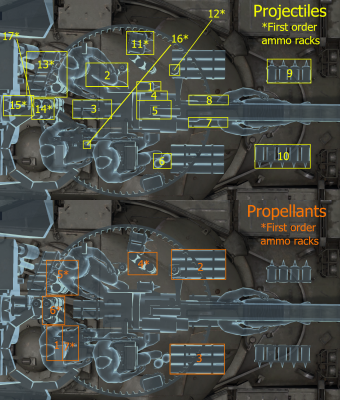
Notes:
- Like the other Chieftains, the Chieftain Mk 10 uses two-piece ammunition, composed of both projectiles (yellow) and propellants (orange). Both have separate racks. Projectiles' racks can be seen on the upper part of the image while the propellants' racks can be seen on the lower part.
- Like the previous Chieftains, every propellant rack is encased by 5 mm of RHA. In case of a successful penetration, the 5 mm of RHA provide protection against shrapnel. It however may not be enough to stop a direct hit to the propellant rack.
- Projectile racks 11 to 17 and propellant racks 4 to 7 are the first stage ammo racks. They total 20 shots and get filled first when loading up the tank.
- Unlike the previous Chieftains, the projectile racks have visual discrepancy: the ammo racks can "store" more ammo than what the model suggests. For instance projectile racks 9 and 10 have such phenomenon.
- So as to go into battle without any ammunition stored in the front hull, it is advised to bring 20 (+33) shells (projectile racks 1 to 10 emptied and propellant racks 1 to 3 emptied).
- Projectile racks 15 and 17 are located right next to each other: rack 15 being on top of rack 17.
Optics and night vision
The magnification of the gunner's optics on the Chieftain Mk 10 is ok, but not anything special compared to other tanks it faces. There is only a minimal difference between the default magnification and the zoomed in magnification.
The Chieftain is equipped with a fairly basic night vision system, consisting of image intensifiers and an IR searchlight, there is no thermal imager. The image intensifiers are fairly standard compared to those fitted to vehicles of the same time period, they have a lower resolution and higher noise than those fitted to later vehicles.
| Chieftain Mk 10 Optics | ||||||
|---|---|---|---|---|---|---|
| Type of optic | Magnification | Night Vision Devices | ||||
| Image Intensifier | Thermal Imager Resolution |
Notes | ||||
| Resolution | Light Mult | Noise Level | ||||
| Gunner's Sight | X7.25 - X8 | 800 x 600 | 8.0 | High | Not Fitted | Image intensifier unlocked by "NVD" mod (tier 3) |
| Commander's View | X6 | 800 x 600 | 8.0 | High | Not Fitted | Image intensifier unlocked by "NVD" mod (tier 3) |
| Driver's View | X1 | 800 x 600 | 5.0 | High | Not Fitted | Image intensifier unlocked by "NVD" mod (tier 3) |
The IR searchlight on the Chieftain Mk 10 is mounted in a distinctive box on the left hand side of the turret, it has a wide beam compared to other searchlights; however due to its placement some of the turret blocks some of the light which would otherwise go to the right. In practice this slightly narrows the beam, compared to the theoretical angle listed below (it is still much wider than other searchlights though).
| Chieftain Mk 10 IR Searchlight | ||
|---|---|---|
| Max Range | Beam Width | Location / Notes |
| 1,500 m | 15.3° | Searchlight mounted in box on left hand side of turret, does not pitch up or down. |
Machine guns
The small calibre of the 7.62 machine gun makes them largely ineffective against all armoured vehicles but the ones with an open compartment or to destroy incoming ATGMs, with a bit of luck.
| 7.62 mm L37A1 | ||||
|---|---|---|---|---|
| Mount | Capacity (Belt) | Fire rate | Vertical | Horizontal |
| Pintle | 2,000 (100) | 650 | -10°/+50° | ±180° |
| 7.62 mm L8A1 | ||||
|---|---|---|---|---|
| Mount | Capacity (Belt) | Fire rate | Vertical | Horizontal |
| Coaxial | 6,000 (200) | 600 | N/A | N/A |
Usage in battles
The Chieftain Mk 10 plays similarly to the Mk 3/Mk 5 - ideally taking long-ranged engagements from hull-down positions, or when forced into shorter-ranged engagements avoiding exposing the vehicle as much as possible. Fortunately, the Stillbrew addition on the Mk 10 significantly reduces the risks of exposing the turret, with the composite capable of deflecting most kinetic rounds it will face - although the armour package is not invulnerable to chemical rounds; some powerful HEAT rounds and most late ATGMs will easily punch through it. Augmenting the vehicle's ability further is the (researchable) access to L23 APFSDS, which significantly improves the L11's long range efficacy. Despite these improvements, the Chieftain still suffers from mediocre mobility and care must be taken to ensure one does not get engaged while the vehicle is moving, as the ability to quickly move into cover is often not an option.
Specific Adversaries
T-64B/T-80B: The Chieftain is susceptible to the T-64B and T-80B at close to medium ranges, where their highest-performance APFSDS rounds or their ATGMs are capable of punching through the Stillbrew armour. As such, when forced to engage either of these vehicles try to force mistakes by staying in cover, encouraging them to move within your firing line rather than attempting to brute-force your way through them.
Leopard 2K: The Leopard 2K is a dangerous adversary due to its speed and ability to move quickly and potentially flank the Chieftain Mk 10. The Leopard is however fairly easy to destroy due to its essentially non-existent armour - although don't underestimate the ability for the sharp angles to bounce rounds.
AMX-40: The AMX-40 is a threat to the Chieftain Mk 10 for similar reasons to the Leopard 2K; as with the Leopard, be wary of flanks and the power of the AMX-40's APFSDS.
Pros and cons
Pros:
- Stillbrew composite armour makes a hull-down Chieftain essentially impervious to all but the best kinetic rounds. It is also resistant to most rank VI chemical rounds and early generation ATGMs. Due to this, the tank is a nightmare to fight with outdated tanks for many nations, as not many tanks can even scratch its turret directly to begin with
- The L23 APFSDS round is very powerful and will have little trouble penetrating most vehicles at the Chieftain's rank
- 10° of gun depression
- Reasonably fast reload time for a 120 mm with a base time of 9.5s and a best time of 7.5s
- Reasonable reverse speed
- Receives a Laser Rangefinder as a Tier 4 modification
Cons:
- Stillbrew composite armour does not provide particularly good chemical protection against upgraded rank VI ATGM, which means, that while it can often allow Chieftain Mk 10 to ignore ATGM attacks from tanks like Begleitpanzer 57, KPz-70 or M551 and maybe even some attacks from unskilled IT-1 operator, in up-tier or against specialized rank VI ATGM tanks and tanks, which can carry advanced ATGM ( like BMP-1, BMP-1 (DDR), BMP-2, Type 89, Warrior, Etc.), the tank commander must be much more cautious
- While turret is near invulnerable to shells with poor flight characteristics, it still retains a glaring weak spot in form of cupola, which can be penetrated and obliterated by almost any APHE, sometimes even from light tanks such as Begleitpanzer 57, resulting in full crew knock-out. Because of this, the Chieftain Mk 10 is usually forced to keep their enemies away, even when going to the frontline
- Very poor mobility characteristics, much slower than most medium tanks it has to face
- Hull armour is negligible, comprised only of cast homogeneous armour, which means that it is even weaker, than what it looks like
- Hull penetration will often result in ammunition detonation as ammo is strewn throughout it
History
Concept
The idea of a "universal tank" began in Britain in 1944 when Montgomery and other influential people began advocating for a more standardized tank to replace the cruiser and infantry tank classes used on the field. Efforts did not start until after World War II under the General Staff designation A45, with development starting just as the new cruiser tank Centurion started to enter military service. The A45 was cancelled in 1948 after development troubles and its inability to be used as a "universal" platform. Ironically, the Centurion proved to be a better "universal tank" platform than the A45.[1]
Development
The Centurion tank series was very successful in British and its allies' service, but the development of new Soviet armour such as the IS-3 and T-54/55 caused the British tank arms race to take another leap forward. Development on the Centurion's successor began in 1951 under the name Medium Gun Tank No. 2. The project's priority was gun and armour, but with mobility to be equal to the Centurion's and weight of fewer than 45 tons. The weight limit caused a program known as the Concept Study Programme to commence in order to find ways to keep the tank under that weight limit yet meet all the armour and firepower specifications. One of the concepts that came out was the usage of bagged charges, which was already in use on naval ships but was a new concept for tank ammunition. Thus, a gun using the bagged charge propellant system began development in 1954, along with a new specification by General Staff that the Medium Gun Tank No.2, now known as FV4201, uses a conventional four crew tank with a turret and a better gun and armour than the Centurion. Though the Conqueror heavy tank was one such response to the firepower requirement, limited production cut that to only 200 units built.[1]
The biggest bump to the firepower of the FV4201 was the recommendation of a 120 mm calibre tank cannon. Though the Conqueror used a 120 mm, the new one would incorporate more innovative features such as the bagged charges. Other design features added was the usage of a Rolls-Royce V8 engine, an auxiliary engine, an automatic gearbox, and a reclining seat for the driver. The reclining seat was a very new feature in tank design as it reduced the vehicle's hull height and thus gave it a lower profile. Leyland Motors was assigned to be the main designer for the tank despite their commitment to the Centurion production lines. The manufacturing process of the tank was decided to be cast rather than welded. In 1957, several specifications added to the FV4201 impeded its attempt to fit in the specifications. A bigger turret was designed and it mounted IR equipment for night fighting. Troops requested more frontal and turret side armour, which along with the turret change caused an increase in the tank's overall weight. A controversial decision was also made in 1957 by NATO that tanks should have multi-fuel engines. The FV4201 installed a new engine conforming to these standards in 1958, a German engine derived from a Junkers Jumo aviation engine. This extended development time since the engine compartment had to be redesigned to fit the engine, raising the total tank weight to 50 tons. The engine, designated the L60, was received with a mixed reception by the Royal Armoured Corps (RAC) and other users due to its novel features. Britain stayed as the only user of a multi-fuel engine in the Cold War as many other nations found the concept impractical and abandoned it.[1]
As the FV4201 finalised its prototype stages, General Staff sent a revised specification for it. The tank was to have the firepower of the Conqueror with the mobility of the Centurion, an armour that maximises the protection-weight ratio, a weight limit at 45 ton with a top speed of 26 mph and an operating range of 300 miles. The first wooden prototype was made in March 1959, with full prototypes ordered in June 1959 for troop trials. Vickers-Armstrong and Royal Ordnance Factory shared the manufacturing process and the first prototypes were built in January 1960. The first two prototype FV4201 was trialled in Germany alongside their new Leopard 1. The greatest issue with the FV4201 was the engine, which caused many failures due to vibration, a result of the flawed multi-fuel concept. Trials were delayed due to lack of parts to fix broken pieces and redesigns were requested to fix problems. After a lengthy trial period in 1962, the FV4201, now named the Chieftain, was sent to the operational unit in Germany for service and combat trials. The Chieftain was finally accepted for service in 1st May 1963, despite the many faults in the design. The first deliveries of the improved and redesigned Chieftains began in mid-1965. These were the Chieftain Mk 1's, which further revealed problems with the horsepower that the Mk 2 was designed and sent in April 1966. The Chieftain Mk 3 rolled out of the production lines in September 1969, it now weighed 53 tons and the L60 engine was producing 650 hp, still under-powered for the weight. Engine failures were still frequent and left the Chieftain with a sour note until the Mk 5 variant fixed these pressing issues with a new engine and NBC protection. The Mk 5 would be the main variant of the Chieftain in British service. During its production life from 1965 to 1985, a total of 2,265 Chieftains would be built by Britain, with about 1,000 used by the British Army.[1]
Service
The first British units to receive the Chieftains was the 1st and 5th Royal Tank Regiments back during the trials. The Chieftain, despite its initial engine flaws, proved to be combat-proof and could be upgraded to fit new requirements. Some of these upgrades were the addition of composite add-on armour to fight off new anti-tank technology such as the HEAT rounds. The Chieftain earned the title "most formidable tank in the world" during the 1960's Cold War period and also redefined the specifications of a "main battle tank". Its success is due to its novel main gun and heavily sloped armour, as well as satisfactory mobility and speeds able to compete with the Leopard 1. The Chieftain stayed in use by the British Army On the Rhine on the German border with the Warsaw Pact, which caused the Soviets to in turn station their best tanks such as their T-64's against the Chieftains. The British retained the Chieftains all the way until 1997, when it was replaced by the Challenger II, initially being used in addition to Challenger I.
The Chieftain was also successful in the export market, primarily in the Middle East to the hands of Iran, Jordan, Kuwait, and Oman. Another user of the Chieftain was Israel, with Britain initially agreeing to help set up production for locally produced Chieftains. Two Chieftains were sent for trials among the Israeli Defense Force in 1967. After two years of trials and deliberation for the acquirement of the Chieftains, Britain ultimately refused to offer the Israelis the Chieftain for political reasons. The Israeli trials benefit Britain with data on desert combat with the Chieftain, however, and the refusal did jump start Israel's tank program that would become the Merkava.
Despite that, sales to the Middle East soared, with Iran being the major buyer of the Chieftains with at least 887 of mostly the MK3 and MK5 variants sent to them before their revolution in 1979. The Chieftain saw prolonged combat in the Middle East in the Iran-Iraq War, including Operation Nasr which was the largest tank vs. tank battle of the war where the Iranian Chieftains and M60A1 Pattons fought against the Iraqi T-62s. After that war, the Chieftain in Kuwait then saw combat fighting the Iraqis during their invasion in 1990. Kuwait eventually replaced their Chieftains with the Yugoslavian M-84 tanks, which are a variant of the Soviet T-72s.
The Chieftain is still in service Iran, Jordan, and Oman in varying numbers, about 100 in Iran, 350 in Jordan, and 27 in Oman. The Chieftains underwent local upgrades to keep them up to date against a modern threat, which resulted in the Iran Mobarez Chieftain upgrade.
Legacy
The Chieftain helped revolutionise tank design with its innovative features. The most important was the reclining driver seat, which allowed the tank to have a lower profile as the driver was now that highest part of the hull in tank design. It also had the most powerful NATO tank armament in service until the advent of the German Rheinmetall 120 mm, which came about two decades later. Chieftain can be considered the definitive main battle tank of the 1960s and help transition the path between second-generation main battle tanks and the third.
Media
- Skins
- Videos
See also
- Vehicles equipped with the same chassis
- Other vehicles of similar configuration and role
External links
- [Devblog] Chieftain Mk.10: Dressing Up for War
- [Wikipedia] Chieftain (tank)
- [Wikipedia] Stillbrew armour
- [Tanks Encyclopedia] FV4201 Chieftain
- [Military Factory] Chieftain MBT
References
| Leyland Motors Limited | |
|---|---|
| Cruiser Tanks | |
| Tank, Cruiser, Comet I (A34) | Comet I · Comet I "Iron Duke IV" |
| MBTs | |
| Centurion | FV4202 |
| Cheiftain | Chieftain Mk 3 · Chieftain Mk 5 · Chieftain Mk 10 |
| Britain medium tanks | |
|---|---|
| Valentine | Valentine I · Valentine IX · Valentine XI |
| Cromwell | Cromwell I · Cromwell V · Cromwell V (RP-3) |
| Cromwell derivatives | Challenger · Avenger · Comet I · Comet I "Iron Duke IV" · Charioteer Mk VII |
| Centurion | Centurion Mk 1 · Centurion Mk.2 · Centurion Mk 3 · Centurion Mk.5 AVRE · Centurion Mk 10 · Centurion Action X · FV4202 |
| Vickers MBT | Vickers Mk.1 · Vickers Mk.3 · Vickers Mk.7 |
| Chieftain | Chieftain Mk 3 · Chieftain Mk 5 · Chieftain Mk 10 |
| Challenger 1 | Challenger Mk.2 · Challenger Mk.3 · Challenger DS |
| Challenger 2 | Challenger 2 · Challenger 2 (2F) · Challenger 2 TES · Challenger 2 OES · Challenger 2E · Challenger 2 Black Night |
| Challenger 3 | Challenger 3 TD |
| Australia | A.C.I · A.C.IV · Centurion Mk.5/1 |
| South Africa | Olifant Mk.1A · Olifant Mk.2 · TTD |
| India | Vijayanta · Bhishma TWMP |
| Israel | ▄Sho't Kal Dalet |
| Jordan | Khalid |
| Sweden | ▄Strv 81 (RB 52) |
| USA | Grant I · Sherman II · Sherman Firefly · Sherman IC "Trzyniec" |