Ordnance BL Tk. L11A5 (120 mm)
Tank cannons
OLD‑WIKI.WARTHUNDER.COM (DEFUNCT)
Description
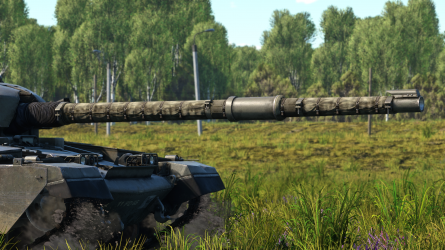
The Ordnance BL Tk. L11 is a British 120 mm rifled cannon derived from the Conqueror's L1A2 120 mm main gun. This powerful gun was meant to be used in the Chieftain series Main Battle Tank, in-game this cannon is present on the Mk 3, Mk 5 and Mk 10 variants of this vehicle. At time of production, the L11, firing armour-piercing discarding sabot rounds (APDS), was one of the most fearsome anti-tank solutions present in an Armoured Fighting Vehicle and thus, fulfilled its purpose to defeat the 60s Soviet armour.
Vehicles equipped with this weapon
General info
Tell us about the tactical and technical characteristics of the cannon or machine gun.
Available ammunition
| Penetration statistics | |||||||
|---|---|---|---|---|---|---|---|
| Ammunition | Type of warhead |
Penetration @ 0° Angle of Attack (mm) | |||||
| 10 m | 100 m | 500 m | 1,000 m | 1,500 m | 2,000 m | ||
| Shot L15A3 | APDS | 298 | 296 | 288 | 277 | 268 | 258 |
| Shell L31A7 | HESH | 152 | 152 | 152 | 152 | 152 | 152 |
| Shot L23 | APFSDS | 410 | 408 | 405 | 400 | 390 | 380 |
| Shell details | ||||||||||||
|---|---|---|---|---|---|---|---|---|---|---|---|---|
| Ammunition | Type of warhead |
Velocity (m/s) |
Projectile mass (kg) |
Fuse delay (m) |
Fuse sensitivity (mm) |
Explosive mass (TNT equivalent) (kg) |
Ricochet | |||||
| 0% | 50% | 100% | ||||||||||
| Shot L15A3 | APDS | 1,372 | 7.48 | - | - | - | 75° | 78° | 80° | |||
| Shell L31A7 | HESH | 670 | 17.34 | 0.1 | 4 | 6.53 | 73° | 77° | 80° | |||
| Shot L23 | APFSDS | 1,535 | 3.89 | - | - | - | 78° | 80° | 81° | |||
| Smoke shell characteristics | ||||||
|---|---|---|---|---|---|---|
| Ammunition | Velocity (m/s) |
Projectile mass (kg) |
Screen radius (m) |
Screen deploy time (s) |
Screen hold time (s) |
Explosive mass (TNT equivalent) (g) |
| L34 | 670 | 17.1 | 20 | 5 | 25 | 50 |
Comparison with analogues
- 105mm L7: The 120mm L11 is superior in every aspect to the early variants of the 105mm L7 gun found on early Leopard 1s and M60s who are firing their respective APDS rounds. However, several vehicles are present in the Chieftain Tank's matchmaking range that use 105mm APFSDS ammunition such as DM23 or M774 that surpass the L11's standard L15A3 APDS round in penetrating power and lethality. If using the L23 APFSDS rounds on the Chieftain Mk.10, the L11 gains the advantage once again. Early M60s and Leopard 1s, unlike the Chieftain, have unstabilised guns, giving the L11 a good first round hit probability.
- 100mm D-10T: The L11 surpasses the D-10 in every aspect, even in rate of fire when used by a skilled crew. The D-10 has the benefit of APCBC rounds with a high damage output, yet those lack in penetration compared to subcaliber rounds. Nonetheless, later variants of vehicles using the D-10 get access to advanced ammunition types such as HEAT-FS and even ATGMs, which pose a significant threat. As with the 105mm L7, vehicles using this gun in the lower matchmaking brackets of the Chieftain Tank are unstabilised, giving the L11 user the first shot hit advantage.
- 115mm U-5TS: This gun found on the T-62 is a formidable analogue to the L11 and a significant threat to both Chieftains in the 8.x matchmaker and Challengers in the 10.x matchmaker. Unlike the L11 and previous guns on this list, the U-5TS is a smoothbore gun firing high-velocity APFSDS ammunition that can negate your armour protection very easily if not positioned properly. Later variants such as on the T-62M-1 get access to even more powerful APFSDS rounds and even ATGMs.
- 120mm Rh120 L/44: These guns, which you will encounter when playing the Chieftain Mk 10 and Challenger 1 are superior to the L11 in penetration and lethality. One advantage L11 users enjoy is access to stock APFSDS ammunition in the higher tiers.
- 125mm 2A46: This gun, commonly found on T-64, T-72 and T-80 and also on Chinese MBTs is extremely lethal with a large variety of ammunition, yet L11 users can, with a skilled crew, outperform their reload rate. A Chieftain can match a T-72s rate of fire, while a Challenger can surpass both T-72 and T-80 with an aced crew.
Usage in battles
Describe the cannon/machine gun in the game - its distinctive features, tactics of usage against notable opponents. Please don't write a "guide" - do not impose a single point of view, but give the reader food for thought.
Pros and cons
Pros:
- The L15A3 APDS round has high penetrating power for its BR, able to defeat all but the most heavily armoured MBTs it encounters.
- L23 and L26 family APFSDS ammunition at higher ranks on Chieftain Mk 10 and Challenger 1 can comfortably defeat common MBT-type enemies at usual combat ranges.
- Has access to HESH ammunition, being capable of overpressuring and destroying lightly armoured vehicles in a single shot.
- The L21A1 12.7 mm Heavy Machine Gun can be used alongside with the main gun to accurately rangefind targets for the HESH due to the similar ballistic performance of both rounds.
Cons:
- HESH shells produce little spalling, making them impracticable to fight heavy vehicles and vehicles with spaced and/or composite armour.
- No access to conventional HE or HEAT shells.
History
During the development stage of the main armament of the future FV4201 Main Battle Tank, several novel propellant systems were considered. One of those was most notably a liquid propellant compound which would have allowed the crew to vary the propellant amount for each shot and thus the ballistics of the projectile. However, this system was quickly found to be unfeasible after trials in 1953, and thus a bag-charge system became the favoured method. A 105mm gun using bag-charges was specified in 1954. At this time, the turret design of FV4201 allowed a limited amount of space, leading engineers to limit the length of ammunition components to 27 inches (68,58cm) as the maximum. This ruled out conventional one-piece ammunition such as usually found on contemporary tank guns like the 20pdr OQF Mk.I (84 mm) or the Soviet D-10T (100 mm). Separate bag-charge ammunition was chosen, dividing the ammunition up into three pieces: Projectile, Bagged propellant charge, and ignition primer in the form of a small magazine containing essentially blank rifle caliber rounds to ignite the propellant. From Chieftain to Challenger 2, this system was retained. Curiously, an attempt was made to achieve a proper seal in the gun breech using brass stub cases (as later used on the Rh120 L/44 (120 mm) and its US American derivative, the M256 which are ejected after every shot automatically as the rest of the casing is combustible. However, this could not be made reliable or safe at the time. The British solution designed 100% of the propellant charge to be combustible, so that as soon as the breech opens, a new shell can be loaded. It was claimed that this system reduces loader fatigue, as each individual component the loader has to handle weighs much less than the equivalent one-piece 105mm round.
The 120mm calibre was not set in stone from the start either. Twelve guns in calibres between 105 and 130mm were considered before 120mm was recommended for further development in December of 1955. This experimental gun, designated as 120mm X23E2/3 was estimated to be able to defeat 120mm of RHA at 60° at 2000 yards (The same layout as the glacis plate of the T-54 Mod. 1947 and 20mm thicker than on subsequent variants of the T-54 and T-55, all of which was yet unknown to the British before a T-54 could be gathered after the Hungarian uprisings in 1956). Using the HESH round, about 150mm of RHA could be defeated at any combat range. By comparison, the NATO standard 105mm L7 derivative guns used on Leopard 1 and M60 could only defeat the NATO standard medium target ( a T-54) at 1.250 yards, and could not reliably defeat the NATO standard heavy target ( a T-10) at any range. Notably, whilst never entering British service, a range of export ammunition types destined for Iranian use was developed, including a sharp-nosed HESH shell and even a HEAT-FS round.
The design of the X23 which in service became the L11 offers a fascinating insight into tank design procedures: It was found that most loaders were right handed and preferred to load using their dominant arm. This meant they are best positioned on the left of the turret so gunner and commander would have to be on the right. This in turn meant that the sights would be offset to the right of the barrel's bore, and therefore the rifling of the barrel had to have a clockwise twist in order to compensate. A mechanised ramming system was also experimented with, however it was unreliable and added even more weight to an already dangerously overweight vehicle. British Army loaders therefore resorted to "charge-ramming", using the bagged propellant charge to push the projectile all the way into the breech. Gunnery trials in July of 1962 impressed: At targets out to 2000m, the crews managed an 81% first round hit probability using APDS, proving the L11's accuracy. [1]
Media
- Images
See also
Links to the articles on the War Thunder Wiki that you think will be useful for the reader, for example:
- reference to the article about the variant of the cannon/machine gun;
- references to approximate analogues by other nations and research trees.
External links
References:
- ↑ Taylor, Dick. Chieftain, Main Battle Tank, Owners' Workshop Manual 1966 to present. Haynes Publishing Inc., 2016
| Britain tank cannons | |
|---|---|
| 30 mm | L21A1 |
| 40 mm | QF 2-pounder |
| 47 mm | Ordnance QF 3-pounder |
| 57 mm | 6pdr OQF Mk.III · 6pdr OQF Mk.V |
| 75 mm | OQF Mk.V |
| 76 mm | OQF 3-inch Howitzer Mk I · OQF 3in 20cwt · QF 17-pounder |
| 77 mm | OQF Mk.II |
| 84 mm | 20pdr OQF Mk.I |
| 94 mm | 28pdr OQF · 32pdr OQF · OQF Mk.II |
| 95 mm | Howitzer, Tank No.1, Mk.I |
| 105 mm | LRF · Royal Ordnance L7A1 |
| 120 mm | Ordnance QF Tk. L1A2 · Ordnance BL Tk. L11 · L11A5 · L30A1 |
| 165 mm | ORD BL 6.5in L9A1 |
| 183 mm | QF L4A1 |
| Foreign: | |
| 25 mm | M242 (USA) |
| 37 mm | M5 (USA) · M6 (USA) |
| 75 mm | M2 (USA) · M3 (USA) |
| 84 mm | kan Strv 81 (Sweden) |
| 105 mm | Sharir (Israel) |
| 120 mm | Rh120 L/55 A1 (Germany) |
| 125 mm | 2A46M-5 (Russia) |
| 155 mm | M185 (USA) |
| South Africa | |
| 20 mm | GI-2 |
| 76 mm | GT-4 |
| 90 mm | GT-2 |
| 105 mm | GT-3 · GT-7 · GT-8 |
| 155 mm | G6 L/45 |