Yak-3 (VK-107)
OLD‑WIKI.WARTHUNDER.COM (DEFUNCT)
| This page is about the Soviet premium fighter Yak-3 (VK-107). For other versions, see Yak-3 (Family). |
Description
The Yak-3 (VK-107) is a premium rank Soviet fighter with a battle rating of (AB), (RB), and (SB). It was introduced in Update 1.51 "Cold Steel".
General info
Flight performance
| Characteristics | Max Speed (km/h at 5,900 m) |
Max altitude (metres) |
Turn time (seconds) |
Rate of climb (metres/second) |
Take-off run (metres) | |||
|---|---|---|---|---|---|---|---|---|
| AB | RB | AB | RB | AB | RB | |||
| Stock | 694 | 677 | 19.6 | 20.5 | 19.2 | 19.2 | 360 | |
| Upgraded | 740 | 719 | 18.8 | 18.9 | 28.2 | 23.6 | ||
Details
| Features | ||||
|---|---|---|---|---|
| Combat flaps | Take-off flaps | Landing flaps | Air brakes | Arrestor gear |
| X | X | ✓ | X | X |
| Limits | ||||||
|---|---|---|---|---|---|---|
| Wings (km/h) | Gear (km/h) | Flaps (km/h) | Max Static G | |||
| Combat | Take-off | Landing | + | - | ||
| 720 | N/A | N/A | 280 | ~11 | ~8 | |
| Optimal velocities (km/h) | |||
|---|---|---|---|
| Ailerons | Rudder | Elevators | Radiator |
| < 380 | < 420 | < 490 | > 400 |
Survivability and armour
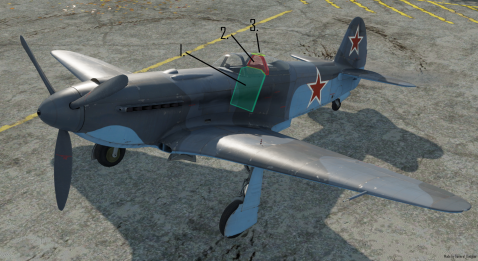
- 8.5 mm Steel - Pilot's seat armour
- 64 mm Bulletproof Glass - Shield behind the pilot's head
- 10 mm Steel - Armour above the pilot's head
- Critical components
- Self-sealing fuel tanks are located in the wings' root.
- All other critical components are located on the central airframe:
- The engine is at the front of the plane with the armament.
- Oil and liquid cooling systems are located in the belly, under the pilot.
The Yak-3 (VK-107) does not have either bulletproof windshield glass or engine protection plate. This makes head-on engagements ill-advised: even if the pilot manages to survive, the in-line engine cannot take much punishment. The overall durability of the plane is poor, as can be expected for a light aircraft. Large fuel tanks are located in the roots of the wings and easily set alight by any incoming bullets. The airframe itself is easily torn apart by heavy machine guns and cannons. Use the Yak-3's manoeuvrability and speed to avoid getting hit in the first place.
Modifications and economy
Armaments
Offensive armament
The Yak-3 (VK-107) is armed with:
- 1 x 20 mm B-20M cannon, nose-mounted (120 rpg)
- 1 x 20 mm B-20S cannon, nose-mounted (120 rpg)
The B-20M cannon is located in the engine shaft while the B-20S cannon is mounted above the engine offset to the left. The Yak-3 (VK-107) sports one less cannon than the Yak-3P. With only 2 x 20 mm cannons, the offensive armament is clearly lacking for a plane at this battle rating.
- Belt composition
- Default: FI-T · AP-I
- Universal: FI-T · HEF · AP-I · FI-T
- Ground targets: HEF · FI-T · AP-I
- Tracers: FI-T
- Armoured targets: AP-I · FI-T · AP-I · AP-I
- Stealth: AP-I · HEF · FI
Usage in battles
Describe the tactics of playing in the aircraft, the features of using aircraft in a team and advice on tactics. Refrain from creating a "guide" - do not impose a single point of view, but instead, give the reader food for thought. Examine the most dangerous enemies and give recommendations on fighting them. If necessary, note the specifics of the game in different modes (AB, RB, SB).
Manual Engine Control
| MEC elements | ||||||
|---|---|---|---|---|---|---|
| Mixer | Pitch | Radiator | Supercharger | Turbocharger | ||
| Oil | Water | Type | ||||
| Controllable | Controllable Not auto controlled |
Controllable Not auto controlled |
Controllable Auto control available |
Separate | Controllable 2 gears |
Not controllable |
Pros and cons
Pros:
- Fantastic rate of climb (comparable to J2M3/5, Bf 109 K-4, Spitfire LF Mk IX, Spitfire F Mk 24, and P-51H)
- Excellent turn rate and good roll rate
- Controls are very responsive at most speeds
- Amazing acceleration when below 5,000 m (16,400 ft), it's even better than some early jets
- Excellent energy retention in manoeuvres and in general
- Very good top speed below 6 km altitude
- Small, fast, and agile target; makes it good at defensive manoeuvres
- Flaps deploy and retract quickly
- Nose-mounted armament, allows for precision at longer ranges without need of convergence
- May survive being set on fire once
- Armour configuration makes pilot snipes less likely when being chased
Cons:
- Low top speed in a dive, the plane rips past 720 km/h IAS (450 mph)
- Control stiffening occurs at high speeds
- Fully deployed flaps break past 280 km/h IAS (175 mph)
- Engine performance is nothing special when above 6,000 m (19,600 ft)
- Engine overheats over 96% throttle, use 95% or less to cool down the engine
- Radiators eventually open at high throttle settings, adding significant drag
- Mediocre manoeuvrability at low speeds
- Low ammo count, only 120 rounds per gun with high rate of fire
- Guns are weak compared to most 20 mm cannons used by other nations
History
The idea to produce a new fighter for the Red Army Air Force went as far back as 1941. It was then that the Yakovlev Design Bureau presented the I-30 prototype, intended an alternative to the earlier Yak-1 design. However, the German invasion of the USSR, as well as aluminium shortages, meant that the project had to be put on hold. Yakovlev resumed the development in 1943 while working on an upgraded version of the Yak-1 fighter. This time, it was decided that a new aircraft should be produced to completely replace the Yak-1 and Yak-7 models.
By September 1943, yet another improved variant was ready, designated Yak-1M Dubler, on which the canvas skin on the tail section was replaced with 2mm plywood, and oil and water radiators were improved. The Dubler also had a new mastless antenna, a ring sight instead of a reflector sight, improved armour and a new propeller. Test pilots were impressed by the new prototype. Their report stated in part: "Yak-1M possessed excellent horizontal, and especially vertical, manoeuvrability. Top speed greatly improved compared to earlier serial-production Yaks. Despite the improved performance, the aircraft remains easy to fly and does not require extensive pilot training."
The new machine was dubbed as the Yak-3 and entered service with the Red Army Air Force in 1944. The Yak-3 was a further modification of the Yak-1, produced in 1944 and 1945, with a total of 4,848 built, and considered one of the best fighters of the war.
The new fighter quickly became very popular with Soviet pilots. They highly praised its solid armament of two Berezin UBS 12.7 mm machine guns and one ShVAK 20 mm cannon as well as ease of piloting and superb low-altitude performance. Marcel Albert, the top scoring French ace of World War II, cited the Yak-3 as one of the best fighters of the war, along with the P-51 Mustang and the Supermarine Spitfire. After the war, the Yak-3 was also used by the Air Forces of Socialist Yugoslavia and Poland.[1]
The Yak-3P was produced from April 1945 until mid-1946, armed with 3 × 20 mm Berezin B-20 cannon with 120 rounds for the middle cannon and 130 RPG for the side weapons. The three-cannon armament with full ammunition load was actually 11 kg (24 lb) lighter than that of a standard Yak-3, and the one-second burst mass of 3.52 kg (7.74 lb) was greater than that of most contemporary fighters. Starting in August 1945, all Yak-3 were produced in the Yak-3P configuration with a total of 596 built.
Media
- Skins
See also
Links to the articles on the War Thunder Wiki that you think will be useful for the reader, for example:
- reference to the series of the aircraft;
- links to approximate analogues of other nations and research trees.
External links
References
| A.S. Yakovlev Design Bureau (Яковлев Опытное конструкторское бюро) | |
|---|---|
| Fighters | |
| Yak-1 | Yak-1 · Yak-1B |
| Yak-3 | Yak-3 · Eremin's Yak-3(e) · Yak-3 (VK-107) · Yak-3P · Yak-3T · Yak-3U |
| Yak-7 | Yak-7B |
| Yak-9 | Yak-9 · Yak-9B · Yak-9K · Golovachev's Yak-9M · Yak-9P · Yak-9T · Yak-9U · Yak-9UT |
| Twin-engine fighters | I-29 |
| Jet fighters | |
| Yak-15 | Yak-15P · Yak-15 |
| Yak-17 | Yak-17 |
| Yak-23 | Yak-23 |
| Yak-30 | Yak-30D |
| Yak-141 | Yak-141 |
| Strike aircraft | |
| Yak-2 | Yak-2 KABB |
| Yak-38 | Yak-38 · Yak-38M |
| Bombers | Yak-4 |
| Jet bombers | Yak-28B |
| Foreign use | ▄Yak-3 · Challe's ▄Yak-9T · ◔Yak-9P |
| Captured | ▀Yak-1B |
| USSR fighters | |
|---|---|
| I-15 | I-15 WR · I-15 M-22 · I-15 M-25 · I-15bis · Krasnolutsky's I-15bis |
| I-153 M-62 · Zhukovsky's I-153-M62 · I-153P | |
| I-16 | I-16 type 5 · I-16 type 10 · I-16 type 18 · I-16 type 24 · I-16 type 27 · I-16 type 28 · I-180S |
| I-29 | I-29 |
| I-185 | I-185 (M-71) · I-185 (M-82) |
| I-225 | I-225 |
| ITP | ITP (M-1) |
| MiG-3 | MiG-3-15 · MiG-3-15 (BK) · MiG-3-34 |
| LaGG | I-301 · LaGG-3-4 · LaGG-3-8 · LaGG-3-11 · LaGG-3-23 · LaGG-3-34 · LaGG-3-35 · LaGG-3-66 |
| La | La-5 · La-5F · La-5FN · La-7 · Dolgushin's La-7 · La-7B-20 · La-9 · La-11 |
| Yak-1/7 | Yak-1 · Yak-1B · Yak-7B |
| Yak-3 | Yak-3 · Eremin's Yak-3(e) · Yak-3P · Yak-3T · Yak-3U · Yak-3 (VK-107) |
| Yak-9 | Yak-9 · Yak-9B · Golovachev's Yak-9M · Yak-9T · Yak-9K · Yak-9U · Yak-9UT · Yak-9P |
| Other countries | ▂P-40E-1 · ▂P-47D-27 · ▂Hurricane Mk IIB · ▂Fw 190 D-9 · ▂Spitfire Mk IXc |
| P-39 | ▂P-39K-1 · ▂Pokryshkin's P-39N-0 · ▂P-39Q-15 |
| P-63 | ▂P-63A-5 · ▂P-63A-10 · ▂P-63C-5 |
| USSR premium aircraft | |
|---|---|
| Fighters | Krasnolutsky's I-15bis · I-16 type 28 · Zhukovsky's I-153-M62 · I-153P · I-180S · I-301 · ITP (M-1) |
| LaGG-3-4 · LaGG-3-23 · LaGG-3-34 · Dolgushin's La-7 · La-11 | |
| Eremin's Yak-3(e) · Yak-3 (VK-107) · Yak-3T · Golovachev's Yak-9M | |
| ▂P-39K-1 · ▂Pokryshkin's P-39N-0 · ▂P-39Q-15 · ▂P-40E-1 · ▂P-47D-27 · ▂P-63A-5 · ▂P-63A-10 · ▂P-63C-5 | |
| ▂Hurricane Mk IIB · ▂Spitfire Mk IXc · ▂Fw 190 D-9 | |
| Twin-engine fighters | I-29 |
| Jet fighters | Su-11 · MiG-15bis ISh · MiG-17AS · MiG-21S (R-13-300) · MiG-23ML |
| Strike aircraft | IL-2M "Avenger" · IL-2 M-82 · IL-8 (1944) · Su-6 · Tandem MAI · TIS MA · Su-8 · Tu-1 |
| Yak-38 · Su-7BMK · Su-25K · Su-39 | |
| Bombers | Po-2M · Be-6 · MBR-2-M-34 · Pe-2-205 · TB-3M-17-32 |
| ▂PBY-5A Catalina · ▂Hampden TB Mk I · ▂A-20G-30 · ▂B-25J-30 | |