Panther "Dauphiné"
OLD‑WIKI.WARTHUNDER.COM (DEFUNCT)
| This page is about the French medium tank Panther "Dauphiné". For other versions, see Panzer V Panther (Family). For other uses, see Panther (Disambiguation). |
Description
Throughout the development of WWII after D-Day, French forces made an effort to capture and rearm as many German panzers as possible. Most of these tanks were Panzer IVs, however, a small number of Panthers and Tigers were also used by France. A number of Panthers were captured at the Battle of Dompaire after the French surrounded a Panzer Battalion, however not all the tanks captured during this encirclement were used due to logistical reasons. In the end, all tanks of this type were replaced shortly after the end of WWII.
The Panther "Dauphiné" was introduced in Update 1.91 "Night Vision". It is a French-captured example of the Panther G found in the German tree with a few cosmetic differences like missing side skirts and new French markings. The only significant difference between this Panther and the Panther G in the German tree is the early production variant of the gun mantlet, which does not prevent shots from ricocheting into the top of the hull. In all other aspects, the Panther "Dauphiné" behaves like any other Panther G. It features a very powerful cannon, which is easier to use thanks to the increased turret rotation when compared to the Panther D, however like all Panthers, it suffers from very poor reverse speed, and thus it is hard to escape from difficult situations, use your front armour at hull down positions and long-range combat for better chances of survival.
General info
Survivability and armour
Armour type:
- Rolled homogeneous armour
- Cast homogeneous armour (Gun mantlet, Cupola)
| Armour | Front (Slope angle) | Sides | Rear | Roof |
|---|---|---|---|---|
| Hull | 80 mm (55°) Front glacis 50 mm (56°) Lower glacis |
50 mm (30°) Top 41.5 mm Bottom |
40 mm (24°) | 17 mm |
| Turret | 110 mm Turret front 100 mm Gun mantlet |
45 mm | 45 mm | 15 mm |
| Cupola | 110 mm | 15 mm | ||
Notes:
- Belly armour front part is 18 mm thick while the back part is 15 mm thick.
- Turret right side is covered in tracks, providing 20 mm extra thickness.
Mobility
| Game Mode | Max Speed (km/h) | Weight (tons) | Engine power (horsepower) | Power-to-weight ratio (hp/ton) | |||
|---|---|---|---|---|---|---|---|
| Forward | Reverse | Stock | Upgraded | Stock | Upgraded | ||
| Arcade | Expression error: Unexpected * operator. | 930 | Expression error: Unexpected round operator. | __.__ | |||
| Realistic | 531 | Expression error: Unexpected round operator. | __.__ | ||||
Modifications and economy
Armaments
Main armament
| 75 mm KwK42 | Turret rotation speed (°/s) | Reloading rate (seconds) | |||||||||||
|---|---|---|---|---|---|---|---|---|---|---|---|---|---|
| Mode | Capacity | Vertical | Horizontal | Stabilizer | Stock | Upgraded | Full | Expert | Aced | Stock | Full | Expert | Aced |
| Arcade | 82 | -8°/+20° | ±180° | N/A | 19.0 | 26.3 | 32.0 | 35.4 | 37.6 | 9.6 | 8.5 | 7.9 | 7.4 |
| Realistic | 11.9 | 14.0 | 17.0 | 18.8 | 20.0 | ||||||||
Ammunition
| Penetration statistics | |||||||
|---|---|---|---|---|---|---|---|
| Ammunition | Type of warhead |
Penetration @ 0° Angle of Attack (mm) | |||||
| 10 m | 100 m | 500 m | 1,000 m | 1,500 m | 2,000 m | ||
| PzGr 39/42 | APCBC | 192 | 188 | 173 | 156 | 140 | 126 |
| Sprgr. 42 | HE | 13 | 12 | 11 | 11 | 11 | 11 |
| Shell details | ||||||||||||
|---|---|---|---|---|---|---|---|---|---|---|---|---|
| Ammunition | Type of warhead |
Velocity (m/s) |
Projectile mass (kg) |
Fuse delay (m) |
Fuse sensitivity (mm) |
Explosive mass (TNT equivalent) (g) |
Ricochet | |||||
| 0% | 50% | 100% | ||||||||||
| PzGr 39/42 | APCBC | 935 | 6.8 | 1.2 | 14 | 28.9 | 48° | 63° | 71° | |||
| Sprgr. 42 | HE | 700 | 5.74 | 0.2 | 0.1 | 725 | 79° | 80° | 81° | |||
Ammo racks
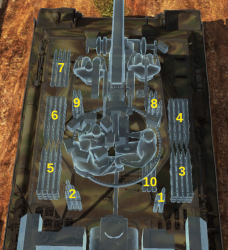
| Full ammo |
1st rack empty |
2nd rack empty |
3rd rack empty |
4th rack empty |
5th rack empty |
|---|---|---|---|---|---|
| 82 | 80 (+2) | 74 (+8) | 62 (+20) | 50 (+32) | 38 (+44) |
| 6th rack empty |
7th rack empty |
8th rack empty |
9th rack empty |
10th rack empty |
Visual discrepancy |
| 26 (+56) | 22 (+60) | 12 (+70) | 4 (+78) | 1 (+81) | No |
Notes:
- As they are modeled by sets of 2, shells disappear from the rack only after you fire both shells in the set.
- Right side empty: 50 (+32) or both sides empty: 22 (+60)
Machine guns
| 7.92 mm MG34 | ||||
|---|---|---|---|---|
| Mount | Capacity (Belt) | Fire rate | Vertical | Horizontal |
| Coaxial | 2,700 (150) | 900 | N/A | N/A |
The small calibre of the MG34 machine gun makes it largely ineffective against all armoured vehicles but the ones with an open compartment. It still can be used to ping targets as a rangefinding help or to mow down minor obstacles blocking your line of sight.
Usage in battles
As with all other Panther-series medium tanks, it is best played in a supporting role or as a front-line offensive tank due to its agility. The cannon is more than forgiving and powerful enough to destroy any potential target, so use it to an advantage; long-range shooting is effective as the muzzle velocity is extremely high, owing to the long-barreled 75 mm, the penetration values are more than capable of punching through any opposing armour, and the shell weight will, if the shell penetrates, consistently deal decent amounts of crew and module damage, if not immediately make the target on combat ineffective.
This tank, however, owing to its "mailbox" gun mantlet design, is not a good combatant frontally, especially at its BR; many enemy tanks will find the gun mantlet a juicy target. Never engage in extended frontal skirmishes with enemy tanks; instead, use the high mobility as much as possible. Don't stay in one place as much as possible, shoot and scoot before the enemy can react shoot through the mantlet.
Another thing to note: the only difference between this and the German Panther G is the absence of side skirts and the thicker lower part of the mantlet, as well as the French markings on the side of the gun mantlet and the tank's name at the hull rear. This is useful in Simulator battles because if you were to put German markings over the French ones you may just pass as a German tank. Take that as you will and warn the people on your team not to shoot you.
Pros and cons
Pros:
- Excellent cannon with great stock AP for common targets (e.g. Tiger H1, Pz.IV H and M4A3E2) and HE for light vehicles. Great accuracy and velocity allows easy long-range sniping. Plenty of ammo capacity means flexible ammo setups
- Heavily armoured frontal hull is immune to most guns like the 75 mm Kwk40, 88 mm L/56 and 76 mm M1
- Fast top speed and good hull traverse. Can get to positions in time
- Adequate gun depression of -8° adapts most terrains well
- Does not face threatening opponents (e.g. IS-2) as much as the German one would, increasing survivability
Cons:
- Gun mantlet is only 100 mm, a huge and well-known weak spot to shoot at. 76 mm Sherman, Pz.IV G/H/J, Tiger H1 can easily penetrate it
- Side ammo racks are prone to detonation when hit
- Terrible reverse speed of only -4 km/h, can get the player killed
- No access to APCR meaning it struggles to deal with tanks encountered in a uptier like Ho-Ri, Tiger II(H) and Ferdinand
- Very identical appearance to the German Panthers, and can get hit by friendly fire a lot in simulator mode
- Weak side armour gets penetrated easily by Russian APHEBC (mixed battle). Cannot angle too much
- Lower glacis often catches fire or brakes transmission when penetrated, leaving the tank immobile and vulnerable
- High profile for a medium tank makes it harder to hide
- Weak roof armour is vulnerable to strafers like IL-2 (Germany) or Hs-129 B3
- Although heavily armoured, it can still get frontally penetrated by common British tanks like the Sherman Firefly
History
The Panther "Dauphiné" played a significant role in a French initiative aimed at repurposing Panzers left behind by the Wehrmacht post-D-Day. Spearheaded by Captain Besnier, this initiative resulted in the formation of a small tank brigade comprising nearly 20 antiquated panzers, predominantly Panzer IVs, alongside 2 Panthers and even 2 Tigers. Operating under the moniker "Commando Besnier," these forces were instrumental during the encirclement of Saint-Nazaire, the final city under German control on May 11, 1945, before participating in the French Occupation of Germany toward war's end.
Following the conflict, some of these tanks were assigned to the 3rd Armored Division by late 1945 and remained operational for several months before eventual replacement. Several models found their way into museums, notably the Tiger housed in the Saumur museum in France.
Each tank under Besnier's command was affectionately dubbed after distinct French regions: Tiger "Colmar," Tiger "Bretagne," and Panther "Dauphiné."
Media
- Skins
- Videos
See also
- Vehicles equipped with the same chassis
External links
References
- Bibliography
- Braeuer, Luc. L'incroyable histoire de la poche Saint-Nazaire, 2000 (French)
| Maschinenfabrik Augsburg-Nürnberg Aktiengesellschaft (MAN AG) | |
|---|---|
| Medium tanks | |
| Panther | VK 3002 (M) · Panther A · Ersatz M10 · Panther D · Panther F · Panther G · Panther II |
| Export/captured | |
| USSR | ▂T-V |
| France | Panther "Dauphiné" |
| France medium tanks | |
|---|---|
| M4 Derivatives | M4A1 (FL10) · M4A4 (SA50) |
| AMX-50 | AMX M4 · AMX-50 (TOA100) · AMX-50 (TO90/930) |
| AMX-30 | AMX-30 · AMX-30 (1972) · AMX-30B2 · AMX-30B2 BRENUS · AMX-30 ACRA · AMX-30 Super |
| AMX-32/40 | AMX-32 · AMX-32 (105) · AMX-40 |
| Leclerc | Leclerc · Leclerc S2 · Leclerc SXXI · Leclerc AZUR |
| Other | D2 · S.35 · Lorraine 40t |
| Germany | Panther "Dauphiné" |
| USA | ▄M4A1 · ▄M4A3 (105) · ▄M4A4 · ▄M26 |
| France premium ground vehicles | |
|---|---|
| Light tanks | AMD.35 (SA35) · H.39 "Cambronne" · LVT-4/40 · AMX-13 (SS.11) · AMX-13-M24 · E.B.R. (1954) · E.B.R. (1963) · VBCI-2 (MCT30) |
| Medium tanks | M4A1 (FL10) · Panther "Dauphiné" · AMX-30 · AMX-30 Super · AMX-50 (TO90/930) |
| Heavy tanks | B1 ter · 2C bis · Somua SM |
| Tank destroyers | Lorraine 155 Mle.50 |