P-61A-11
OLD‑WIKI.WARTHUNDER.COM (DEFUNCT)
| This page is about the premium American fighter P-61A-11. For the regular version, see P-61C-1. |
Description
The P-61A was the first production variant of the P-61 "Black Widow". Production started in 1943 and differed from the YP-61 by being painted in an olive drab color. Some P-61As were built without the turret due to the B-29 bomber program and problems with the turret during high speed dives. A significant portion had the turret fixed pointing forward and would be controlled by the pilot instead of the gunner. Also, the gunner never flew on certain missions since his main job, controlling the turret, wasn't needed and missions were carried out with only the pilot and radio operator. With the A-5 block, the engines were replaced from the R-2800-10s to the more powerful R-2800-65 and increased the top speed and climb rate. The next block, the A-10, featured the all-important water injection system and returned to the black paint scheme. The A-11 was a modification of the A-10 and only added an extra pylon for either fuel or bombs. Only 20 P-61A-10s were modified to A-11 standards.
The P-61A-11 is a twin-engine fighter, also known as a strike fighter in-game. It is excellent in bomber hunting and excels when used with Boom & Zoom tactics. Unlike the more advanced P-61C-1 variant, this initial production aircraft has weaker engines and fewer external suspended weapons. However, it still has the remote-turret which is incredibly useful for bomber hunting or attacking enemy fighters, as well as four chin-mounted 20 mm cannons with 800 rounds. The P-61A-11 also has a decent amount of armour protecting the crew members and gun placements.
The P-61A-11 was introduced in Update 1.57 "Battle March" as an in-game premium vehicle purchasable with Golden Eagles  but was removed from in-game sale during the July 2021 Economy Update. It has been made available in the store periodically for "Black Friday" sales in 2017, 2019, 2020, 2021, and 2022.
General info
Flight performance
While being a large aircraft, it is unable to effectively turn to fight and when doing so, rapidly bleeds any energy and advantages it may have. The two engines are Pratt & Whitney R-2800-65s. It will only be able to take off with a speed of around 169 mph (271 km/h) and requires a very long airstrip since it is a very heavy plane.
| Characteristics | Max Speed (km/h at 7,315 m) |
Max altitude (metres) |
Turn time (seconds) |
Rate of climb (metres/second) |
Take-off run (metres) | |||
|---|---|---|---|---|---|---|---|---|
| AB | RB | AB | RB | AB | RB | |||
| Stock | 561 | 549 | 31.0 | 32.0 | 9.3 | 9.1 | 457 | |
| Upgraded | 602 | 582 | 29.1 | 30.0 | 13.3 | 11.2 | ||
Details
| Features | ||||
|---|---|---|---|---|
| Combat flaps | Take-off flaps | Landing flaps | Air brakes | Arrestor gear |
| ✓ | ✓ | ✓ | X | X |
| Limits | ||||||
|---|---|---|---|---|---|---|
| Wings (km/h) | Gear (km/h) | Flaps (km/h) | Max Static G | |||
| Combat | Take-off | Landing | + | - | ||
| 642 | 340 | 337 | 280 | ~7 | ~3 | |
| Optimal velocities (km/h) | |||
|---|---|---|---|
| Ailerons | Rudder | Elevators | Radiator |
| < 530 | < 420 | < 450 | > 340 |
Survivability and armour
It also offers very weak crew protection from head-on attacks.
- 12.7 mm Steel - Nose armour plating (behind radar unit)
- 60 mm Bulletproof glass - Pilot and gunner armoured windscreens
- 12.7 mm Steel - Gunner front armour (folds out of the way when not in use)
- 12.7 mm Steel - Lower gun plate
- 9.5 mm Steel - Gun turret ammo protection plates
- 12.7 mm Steel - Turret protection plate
Modifications and economy
Armaments
Offensive armament
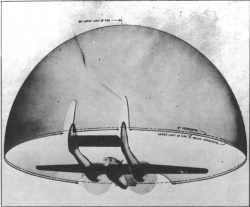
The P-61A-11 is armed with:
- 4 x 20 mm AN/M2 cannons, chin-mounted (200 rpg = 800 total)
The 20 mm AN/M2 cannons placed under the belly are able to make quick work of any plane which stands in your way.
Suspended armament
The P-61A-11 can be outfitted with the following ordnance:
- Without load
- 2 x 500 lb AN-M64A1 bombs (1,000 lb total)
- 2 x 1,000 lb AN-M65A1 bombs (2,000 lb total)
Defensive armament
The P-61A-11 is defended by:
- 4 x 12.7 mm M2 Browning machine guns, dorsal turret (560 rpg = 2,240 total)
The 4 x Browning machine guns are set in a remotely controlled dorsal turret controlled by a gyroscopic fire control computer which was operated by either the gunner or radar operator for both offensive and defensive situations. Turret defensive angles are limited to the upper plane of the aircraft as it can not aim any lower than the elevators. If an enemy plane is in the machine gun dead zone, you will need to change the position of the plane so the guns can acquire a firing solution, this can be accomplished by transitioning into a steep climb or dive. The P-61A-11 does not have defensive armament that provides essential protection from the low rear or belly attacks.
Usage in battles
The below tactics can be used in all games modes:
How to offensively Engage an enemy aircraft: Climb to high altitude and keep on a straight heading once you have seen the enemy. Overshoot the enemy plane, then perform a 180-degree turn. Make sure you stay on his tail and gradually descend. It is recommended to do something similar to a shallow descent, where you can keep speed and height to your advantage in case the enemy aircraft changes course and altitude. Do not perform a dive which requires you to dive straight down since you will rip the wings off and crash. Once you are within firing range, fire a short salvo from your cannons. A couple of bursts from the Black Widow are sufficient to easily rip an enemy plane to shreds.
How to perform defensive fighting: When you are being engaged by an enemy fighter, make sure you keep descending. Do not allow enemy aircraft to get lower than your elevator on the tail boom. You have no defensive armament to cover the belly or full-rear of the plane; these are your weakest defended parts.
- Tactic one: Descend slowly. Put the plane in a steep dive that does not exceed your structural limit of 399 mph (642 km/h). However, it must be steep enough to provide the turret gunner full visibility of the enemy plane. The four Browning machine guns will take care of the enemy plane.
- Tactic Two: Put the plane in a steep climb and make sure you set the throttle to at least 70%. Jump into the gunner turret and operate it. This will be the most accurate and fastest way of shooting down the hostile plane. When you operate the turret, make sure you try and perform defensive manoeuvres when operating it i.e. sharp turns, rapidly decreasing in height as well as gaining height and changing the speed of the plane in an irrational way. This will give you a higher chance of survival against the enemy.
Specific enemies worth noting
- Japanese Aircraft
The most dangerous opponents for the P-61A are going to be the Japanese aircraft, due to their incredible manoeuvrability, and their fast climb-rate, which will leave you at a disadvantage in altitude. However, the most notable threat from the Japanese arsenal is probably going to be the J2M Raiden, due to its fast speed and fairly durable armour for a Japanese plane. In addition, any of the later model A6M3 Reisen (Zero) models will give you problems, as they will out-turn you in seconds.
- German Aircraft
The Germans have the most planes with more dangerous cannons, thanks to their Minengeschoß rounds, which punch through and explode inside an airframe, thus causing maximum damage to control surfaces. At your battle rating, you have the possibility of facing the Bf 109 G-6, which has a fast speed and nose-mounted weaponry that are large enough in calibre to shred your airframe. Perhaps the biggest threat to your plane is the Focke-Wulf Fw 190 A-4, which boasts four 20 mm cannons, which will reduce your plane to a burning wreck. While it is unlikely to see many at high altitude, the Messerschmitt Me 410 A-1 is also a viable threat.
- Soviet Aircraft
Repeat after the following bold statement: do not head-on an IL-2 of any variant. As sluggish as they seem, the IL-2 will rip your aircraft to shreds due to the fast firing combination of machine gun and auto-cannon fire. The most common adversary that will be faced is any aircraft bearing the prefix "Yak"- most dangerous among them is the Yak-9K, which has a 45 mm cannon that can utterly obliterate your plane, and the Yak-9T, which has a 37 mm cannon that will do the same damage to your aircraft. The La-5FN is probably the biggest threat you will face due to its fast speed, ridiculously strong cockpit armour, climb rate, manoeuvrability and firepower. This is mainly given if a La-5FN pilot is using "Ground Target" ammunition, every third round fired is an Armor-Piercing Fragmentation Incendiary round, and every other round is either a Fragmentation-Incendiary Tracer or an Armor-Piercing Incendiary round. In short, the La-5FN has the biggest threat due to all the API rounds in the ammunition.
- British Aircraft
The British are among the most manoeuvrable adversary you will face, so with that in mind, do not try and turn-fight any British plane. Also, most British planes have an astonishing climb-rate, which will leave you at an altitude disadvantage. The most common adversary you will face is the Spitfire Mk. IIb, which can turn circles around you and it has two wing-mounted Hispano cannons, which can tear into the P-61's airframe. They may not be too common, but a Boomerang Mk. I or a Boomerang Mk. II will also give you a hard time, given their tighter grouping of shells, and the fact they have the Hispano Mk. II cannons, whose "Air Target" ammunition is practically "Stealth" ammunition. The Beaufighter Mk. VIc, will be the most dangerous threat, given the four Hispano cannons in the belly, which will tear apart the P-61. A Spitfire Mk. V will also give you a run for your money, due to the Hispano Mk. II cannons it wields.
- Italian Aircraft
The most plausible threat from the Italians will be the C.202EC (Experimental Cannon), which has the manoeuvrability, speed and especially firepower due to the plane boasting German 20 mm cannons which utilise the minengeschoß shells.
- American Aircraft
In addition, another major threat is the American P-47D Thunderbolt, which has the speed and firepower to out-class the P-61A in any fashion.
Radars
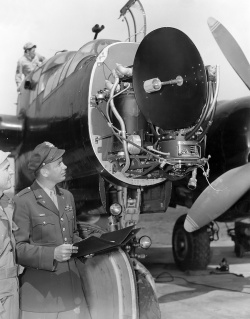
The P-61A-11 is equipped with an AI Mk. X search radar, located in the nose of the aircraft. The radar utilised a 29 in (74 cm) parabolic dish which it rotated at 360 rpm when set to ranges below 100 miles, however, it is slowed down to 100 rpm when set to the 100 miles setting. The scopes could be set to one of four ranges, 1, 10, 20 or 100 miles (1.6, 16, 32 or 160 km). The parabolic dish could be adjusted to different altitude settings which included 0° to 0°, -5° to +5°, +5° to +20°, and +20° to +50°. One of the benefits to the multiple choices in range and altitude settings of the radar was that it provided partial immunity to chaff and other radar interference or countermeasures conducted by the enemy.
| AI Mk. X - Target Detection Radar | |||
|---|---|---|---|
| Maximum Detection Range |
Guaranteed Detection Range |
Max Azimuth Scan Angle |
Max Elevation Scan Angle |
| 14,000 m | 8,500 m | ±75° | -20°/+40° |
Manual Engine Control
| MEC elements | ||||||
|---|---|---|---|---|---|---|
| Mixer | Pitch | Radiator | Supercharger | Turbocharger | ||
| Oil | Water | Type | ||||
| Controllable | Controllable Not auto controlled |
Controllable Auto control available |
Controllable Auto control available |
Separate | Controllable 3 gears |
Not controllable |
Pros and cons
Pros:
- The offensive armament is mounted under the belly of the plane, this provides excellent accuracy
- Powerful offensive armament of 4 x AN/M2 cannons with a total amount of 800 rounds
- Powerful defensive armament of 4 x Browning MGs in a turret with 2,240 rounds that can be used offensively
- Very stable climb rate
- Engines are able to cool down very fast
- Excellent bomber hunter
- Very strong and rugged airframe; is able to fly with wing tips missing
- Can keep a lot of momentum from a gradual dive
- Can do very sharp manoeuvres at high and low speeds due to the flaps
- Engine can stay very cool at high throttle settings (65-75%)
- Has access to a target detection radar, with much better range than German radars found around this battle rating
Cons:
- Slow acceleration and requires a long airstrip to take off due to weight
- Slow roll rates
- No airbrakes installed
- Not recommended to dive sharply, easy to get structural damage and rip apart at 642 kn/h (399 mph)
- Unable to put fires out in a dive, due to speed will reach in excess of structural limitations which will rip the wings off
- Unable to sustain a direct head-on attack against a well-armed, small-profile enemy plane
- Only one defensive dorsal turret installed, cannot cover the rear of the plane effectively
- No defence against low-rear and belly attacks
- Large body airframe, makes dogfighting almost impossible
- Can not carry additional armament
- Flaps snap off easily
- Compared to the main tech tree variant, worse in every way in terms of manoeuvrability, speed and climb rate
- Smaller payload than the P-61C-1
History
In 1940, the British Purchasing Commission wanted a high-altitude, high-speed interceptor to shoot down Luftwaffe bombers when they raided British cities. This called for a high-endurance heavy fighter with Aerial Interception (AI) radars and specified gun armament mounted in a 360 degrees gun turret. The requirements were sent to many aircraft manufacturers, one of them being Jack Northrop. The USAAC accepted his proposal, resulting in one of the most deadly and large fighters in World War Two. The prototype YP-61, had a long fuselage gondola in between two engine nacelles. The tail was a new radical twin-boom design. Full span flaps were fitted on the wings and it had two Pratt & Whitney R-2800-10 Double Wasp 18-cylinder radials, producing 2,000 horsepower each. The plane was mounted on a tricycle landing gear and had a three-man crew: a radar operator, gunner, and pilot. Armament includes four Browning 12.7 mm heavy machine guns mounted in a four-gun powered turret. The original design also had a ventral turret, but that was replaced by Hispano Mk.II cannons. Some versions also had air brakes so the pilot would not overshoot the target.
Media
- Skins
- Images
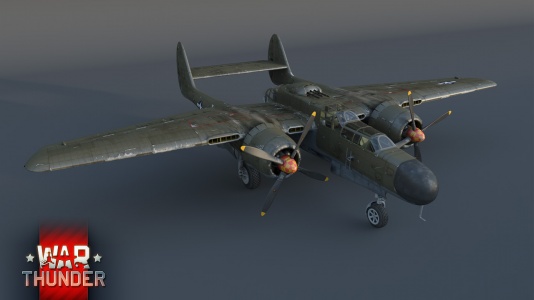
Front view of the deadly P-61 twin-engine fighter.
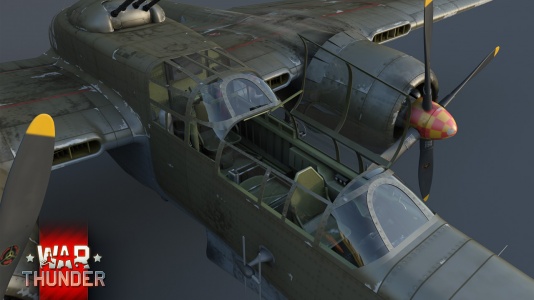
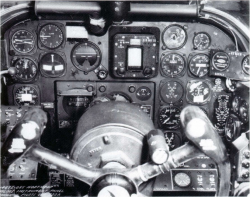
Detailed view of the two-seat cockpit of the P-61.
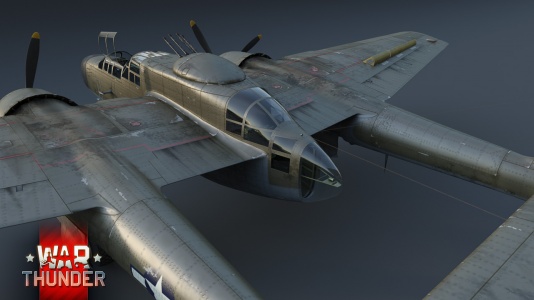
A close-up view of the radio operator position on the P-61.
- Videos
See also
External links
- Official data sheet - more details about the performance
- Pilot Training Manual for the P-61 Black Widow - By Headquarters AAF - Office of Flying Safety, 1944
- Northrop P-61 Black Widow Pilot's Flight Operations Instructions - USAAF, July 1945
| Northrop Corporation | |
|---|---|
| Fighters | P-61A-11 · P-61C-1 |
| Jet fighters | F-89B · F-89D |
| F-5A · F-5C · F-5E | |
| F-20A | |
| Export | ␗F-5A · ▄F-5E FCU |
| USA twin-engine fighters | |
|---|---|
| P-38 | XP-38G · P-38E · P-38G-1 · P-38J-15 · Bong's P-38J-15 · P-38L-5-LO · P-38K · YP-38 |
| P-61 | P-61A-11 · P-61C-1 |
| F7F | F7F-1 · F7F-3 |
| Other | XF5F · XP-50 · F-82E |
| USA premium aircraft | |
|---|---|
| Fighters | Thach's F2A-1 · Galer's F3F-2 · F2G-1 · F4U-4B VMF-214 · P-26A-34 · Rasmussen's P-36A · P-40C · P-43A-1 |
| P-47M-1-RE · ⋠P-47M-1-RE · P-51A · P-51D-10 · P-51D-20-NA · ␠Kingcobra · XP-55 | |
| ▃A6M2 · ▃Ki-43-II · ▃Ki-61-Ib · ▃Bf 109 F-4 · ▃Fw 190 A-8 · ▃Spitfire LF Mk IXc | |
| Twin-engine fighters | XP-38G · Bong's P-38J-15 · P-38K · YP-38 · P-61A-11 · XF5F · XP-50 · F7F-3 |
| Jet fighters | P-59A · F-86F-35 · F-89B · F-89D · F-4S Phantom II · F-5C · F-20A |
| Strike aircraft | A-1H · A2D-1 · AU-1 · XA-38 · AV-8A · AV-8B (NA) · A-6E TRAM · A-10A |
| Bombers | A-26C-45DT · B-10B · BTD-1 · PBM-3 "Mariner" · PBM-5A "Mariner" · PV-2D |