P-61C-1
OLD‑WIKI.WARTHUNDER.COM (DEFUNCT)
| This page is about the American twin-engine fighter P-61C-1. For the premium version, see P-61A-11. |
Description
The P-61C-1 is a rank American twin-engine fighter with a battle rating of (AB), (RB), and (SB). It was introduced in Update 1.57 "Battle March".
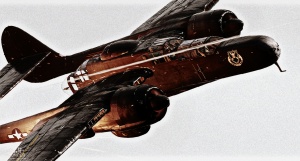
The Northrop P-61C-1 Black Widow is a heavy twin-engine strike fighter designed as the USAAF's first dedicated night-fighter and aircraft outfitted with radar. Though a large aircraft with a crew of three (pilot, turret gunner and radio/radar operator/gunner), the Black Widow utilised its speed, radar, and weapons advantages to dispatch enemy aircraft in the dead of night.
The P-61C-1 is powered by dual Pratt & Whitney R-2800-73 double wasp engines, the same engines which powered the Republic P-47N Thunderbolt. The one difference between the Thunderbolt's -57C and the -73s built explicitly for the P-61 was each had a General Electric CH-5-A3 turbocharger installed. The modified engines allowed the P-61C-1 to fly at all altitudes effectively. While outfitted with powerful engines, turning the aircraft causes loss of energy, and such manoeuvres should be limited as places the aircraft in vulnerable situations.
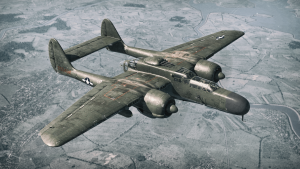
One of the roles of the P-61C-1 is to operate as a bomber interceptor. During these operations, if detected, the heavy fighter is likely to encounter defensive fire. To increase survivability and protection of the crew, the Black Widow utilizes various bulletproof glass and armour protective plates throughout the fighter. The gunner who operates the remote turret has the option to utilise armour plates, which fold out of the way when not in use. The crew member sitting in the aft of the aircraft has the least amount of armour protection but is the least likely to be shot at unless being attacked from the rear.
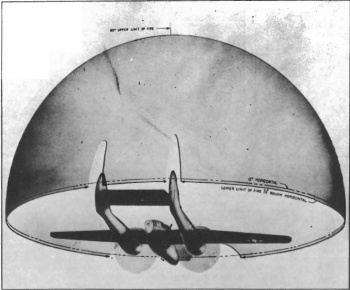
The armament configuration of the P-61C-1 is unique compared to most fighters which either utilise nose-mounted or wing-mounted guns. The Black Widow incorporates two weapon systems, the first consisting of four 20 mm AN/M2 autocannons mounted in the belly of the aircraft with 200 RPG, or 800 rounds total. Convergence is not a factor when utilising these guns. The aircraft also incorporates a dorsal turret outfitted with four 50 calibre machine guns (2,120 rounds or 530 RPG), which can be remotely operated by the gunner or the radio/radar operator. The turret has 360-degree mobility and can fire at elevations up to 90-degrees. The turret cannot depress lower than horizontal or else it would risk firing into the wings, cockpit, tail booms or tail section. The dorsal turret is utilised for both offensive and defensive uses.
General info
Flight performance
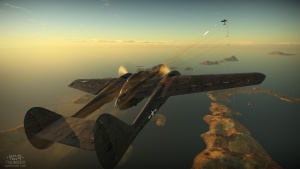
The P-61 climbs very well compared to twin-engine fighters from other countries. The engines overheat very slowly even when stock, while never really overheating at all when fully upgraded if using MEC or just being careful with the control of the engines. The turn rate is very slow, but to be expected from a twin-engined heavy fighter with a turret. The air brakes are very efficient, helping you slow down quickly in dives or when landing.
| Characteristics | Max Speed (km/h at 7,100 m) |
Max altitude (metres) |
Turn time (seconds) |
Rate of climb (metres/second) |
Take-off run (metres) | |||
|---|---|---|---|---|---|---|---|---|
| AB | RB | AB | RB | AB | RB | |||
| Stock | 656 | 643 | 26.3 | 27.5 | 12.2 | 12.2 | 457 | |
| Upgraded | 732 | 692 | 23.8 | 25.0 | 21.3 | 16.0 | ||
- Takeoff and landing speeds (critical for Simulator battles)- all speeds in km/h
- AB: 173 RB/SB: 163 - VR (aircraft rotate speed) - The speed at which the aircraft's control stick can safely be pulled back for takeoff, causing liftoff without risk of a tailstrike on the runway.
- AB: 126 RB/SB: 120 - VS0 - Landing speed with full flaps (depending on the aircraft, this could be landing flaps or take-off flaps).
- AB: 148 RB/SB: 145 - VS1 - Landing speed without flaps (clean). Knowing this speed is useful when the flaps are damaged or missing to prevent spins or tail strikes upon landing.
Details
| Features | ||||
|---|---|---|---|---|
| Combat flaps | Take-off flaps | Landing flaps | Air brakes | Arrestor gear |
| ✓ | ✓ | ✓ | ✓ | X |
| Limits | ||||||
|---|---|---|---|---|---|---|
| Wings (km/h) | Gear (km/h) | Flaps (km/h) | Max Static G | |||
| Combat | Take-off | Landing | + | - | ||
| 726 | 340 | 337 | 280 | ~7 | ~3 | |
| Optimal velocities (km/h) | |||
|---|---|---|---|
| Ailerons | Rudder | Elevators | Radiator |
| < 530 | < 420 | < 450 | > 337 |
Survivability and armour
- 12.7 mm Steel - Nose armour plating (behind radar unit)
- 60 mm Bulletproof glass - Pilot and gunner armoured windscreens
- 12.7 mm Steel - Gunner front armour (folds out of the way when not in use)
- 12.7 mm Steel - Lower gun plate
- 9.5 mm Steel - Gun turret ammo protection plates
- 12.7 mm Steel - Turret protection plate
With such beefy engines on the P-61C-1 it stood to reason that armour protection would be necessary to help protect the pilot and the gunner during a conflict against a potential bomber or attacker aircraft which may have defensive gunner positions. Since the main source of incoming bullets would most likely come towards the front of the P-61C-1 from defensive positions, it was reasonable to protect both the pilot and the gunner position, while the radio/radar operator received most of their protection from the gun turret and radio/radar equipment as there is no protection provided from the rear plane of the aircraft.
The pilot is afforded protection through the bulletproof canopy windscreen which is 60 mm thick and a 12.7 mm steel plate located directly behind the radar unit in the nose. These two items will aid to protect the pilot in the event a bomber or attacker's defensive gunners fire on an attacking P-61C-1, however, note that these protections will wane in their ability if the pilot of the Black Widow decides to take another aircraft head-on, especially if that aircraft is sporting 20 or 30 mm autocannons.
The P-61C-1's gunner sits directly behind the pilot, however, his station is slightly elevated giving him an unobstructed view of the front and side of the aircraft, allowing him great visibility to be able to aim and fire the machine gun turret. Since the gunner station is elevated, the gunner is exposed to incoming fire which the pilot's protective plate and armoured windscreen will not cover. To remediate this there are two 12.7 mm steel plates which the gunner can swing in front of him for protection or out of the way when not in use.
The rest of the armour protection for this aircraft are several steel plates which protect the critical components and the ammunition of the turret. Since the turret is mechanical in operation (remotely by the gunner or radio/radar operator), it is important that critical components are protected to ensure continued usage, as when the remote components fail, the turret is useless. Protecting the ammunition storage is also important not only to have it available for usage, setting the ammunition on fire or off in the storage container could cause catastrophic results to the aircraft and crew in the event they start firing.
Modifications and economy
The P-61C-1 is a thoroughbred Boom & Zoom aircraft. However, when the plane is first unlocked the flight performance will be very lackluster to support this tactic. As such, the initial priority should be to improve the aircraft, by researching the upgrades that improve flight performance the most, namely Compressor, Engine and Engine injection. When the flight performance has reached a satisfactory level to allow for effective Boom & Zoom tactics, the priority should be switched towards researching the New 20 mm cannons upgrade in order to improve the accuracy of the cannons. After this is done, either finish upgrading the flight performance or focus on the turret upgrade. The bomb racks should be left to research last, as they are not critical to the P-61's main role as a fighter.
Armaments
Offensive armament
The P-61C-1 is armed with:
- 4 x 20 mm AN/M2 cannons, belly-mounted (200 rpg = 800 total)
The P-61C-1 is armed with 4 x 20 mm AN/M2 autocannons which are mounted in the belly of the fuselage just below the cockpit. Each cannon is outfitted with 200 rounds which may not seem like very much, but for those who are conservative by maintaining trigger control (short bursts), the ammunition will go a long way. Having the guns clustered along the lower fuselage allows for both in-close and longer-ranged shots without the necessity of having to calculate for convergence, the only factor will be bullet-drop over a distance which comes with practice. The cannons are very effective when used against any aerial vehicle encountered as they have no problem disabling engines and destroying wings or puncturing fuel tanks.
Suspended armament
The P-61C-1 can be outfitted with the following ordnance:
- Without load
- 4 x 500 lb AN-M64A1 bombs (2,000 lb total)
- 4 x 1,000 lb AN-M65A1 bombs (4,000 lb total)
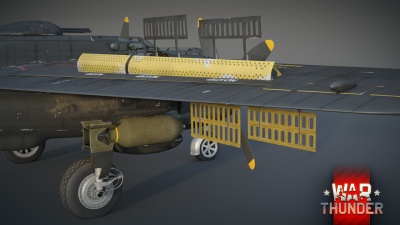
The P-61C-1 is typically used as a night or strike fighter which is used to sneak up on unwary targets and destroy them with the four forward-facing 20 mm autocannons, however, there is an opportunity to mix it up as a multi-role aircraft and outfit the plane with bombs. There are four external hardpoint pylons in which either 500 lb or 1,000 lb bombs can be loaded for a total of either 2,000 or 4,000 lb of bombs. With payloads like this, the P-61C-1 can rival the B-25 bombers in their payload deliveries. Unfortunately, for a strike fighter, the P-61C-1's flight performance and manoeuvrability suffer when adding the extra 2,000 or 4,000 lb of weight and can be a challenge to fly when attacked, however after the bombs have been released on their target, the P-61C-1 can get back to its heavy-fighter role.
Defensive armament
The P-61C-1 is defended by:
- 4 x 12.7 mm M2 Browning machine guns, dorsal turret (560 rpg = 2,240 total)
It is interesting to note that later fighters started to reduce or eliminate the ability to carry defensive weapons in order to help save on weight and crew needed to staff the aircraft, however, it was deemed necessary that the P-61C-1 should have a defensive turret. Utilising state-of-the-art technology, four .50 calibre machine guns were mounted on a dorsal turret which could be remotely controlled by either the gunner (sitting behind the pilot) or the radio/radar operator located in a separate compartment at the rear of the fuselage. The four machine guns in the dorsal turret had virtually a full 360° rotation field with an elevation straight up. Effectively the only dead zones for this turret were the upper propeller arcs and the vertical stabilizers to the rear. When enemy aircraft attempt to sit on the rear of the aircraft, the pilot will need to pitch the aircraft up and to one side or the other to allow the gunner the best possible chance of bearing the turret down on the enemy fighter.
Usage in battles
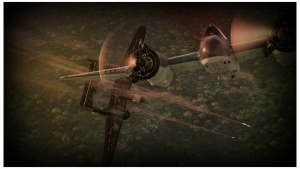
The below tactics are recommended for all game modes:
How to offensively engage an enemy aircraft: Climb to high altitude and keep on a straight heading once you have seen the enemy. Overshoot the enemy plane, then perform a 180-degree turn. Make sure you stay on his tail and gradually descend. It is recommended to do something similar to a shallow descent, where you can keep speed and height to your advantage in case the enemy aircraft changes course and altitude. Do not perform a dive which requires you to dive straight down since you will rip the wings off and crash. Once you are within firing range, fire a short salvo from your cannons. A couple of bursts from the Black Widow are sufficient to easily rip an enemy plane to shreds.
How to properly engage enemy bombers: Bombers at this battle rating tend to have quite strong defensive armaments, namely the Me264. To avoid defensive fire, approach the bomber from below, and maintain a distance of 1.5-2.5km away. Rather than engaging the bomber with the cannons, use the turret and fire bursts into the bomber from afar. The great ballistics of the .50 calibre machine guns on the turret make it quite easy to pepper bombers from afar, and deal quite reasonable damage(often cause fires). The idea behind this tactic is to basically dismantle the enemy bomber by firing from long distances as to avoid any retaliation. This tactic is especially effective against bombers at high altitudes.
How to perform defensive fighting: When you are being engaged by an enemy fighter, make sure you keep descending. Do not allow enemy aircraft to get lower than your elevator on the tail boom. You have no defensive armament to cover the belly or full-rear of the plane; these are your weakest defended parts.
- Tactic one: Descend slowly. Put the plane in a steep dive that does not exceed your structural limit. However, it must be steep enough to provide the turret gunner full visibility of the enemy plane. The four Browning machine guns will take care of the enemy plane.
- Tactic Two: Put the plane in a steep climb and make sure you set the throttle to at least 70%. Jump into the gunner turret and operate it. This will be the most accurate and fastest way of shooting down the hostile plane. When you operate the turret, make sure you try and perform defensive manoeuvres when operating it i.e. sharp turns, rapidly decreasing in height as well as gaining height and changing the speed of the plane in an irrational way. This will give you a higher chance of survival against the enemy.
- Tactic Three: Fly the plane almost touching the ground, this way the enemy can't get under your gunners. Use rudder yaw to fly side to side while shooting back at your pursuer. With a few hits you can heavily damage if not take out the enemy following you, or at least make them break off from your six and hopefully one of your allies can come and help you. If the enemy is not very fast in a straight line (e.g. Japanese fighters, etc.) you can fly straight and use your better top speed to kite the enemy.
Base destruction capability: With 4x 1,000 pound bombs, it has the capability to destroy a base in Air RB.
Radars
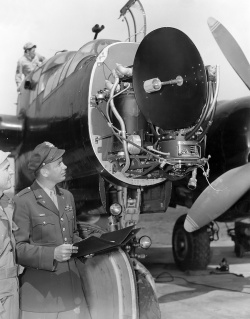
The P-61C-1 is equipped with an AI Mk. X search radar, located in the nose of the aircraft. The radar utilised a 29 in (74 cm) parabolic dish which it rotated at 360 rpm when set to ranges below 100 miles, however, it is slowed down to 100 rpm when set to the 100 miles setting. The scopes could be set to one of four ranges, 1, 10, 20 or 100 miles (1.6, 16, 32 or 160 km). The parabolic dish could be adjusted to different altitude settings which included 0° to 0°, -5° to +5°, +5° to +20°, and +20° to +50°. One of the benefits to the multiple choices in range and altitude settings of the radar was that it provided partial immunity to chaff and other radar interference or countermeasures deployed by the enemy.
| AI Mk. X - Target Detection Radar | |||
|---|---|---|---|
| Maximum Detection Range |
Guaranteed Detection Range |
Max Azimuth Scan Angle |
Max Elevation Scan Angle |
| 14,000 m | 8,500 m | ±75° | -20°/+40° |
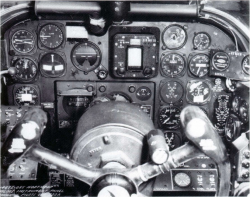
Manual Engine Control
| MEC elements | ||||||
|---|---|---|---|---|---|---|
| Mixer | Pitch | Radiator | Supercharger | Turbocharger | ||
| Oil | Water | Type | ||||
| Controllable | Controllable Not auto controlled |
Controllable Auto control available |
Controllable Auto control available |
Separate | Not controllable 1 gear |
Not controllable |
- Fully close the Oil and Water radiator.
- Set prop pitch to ~90-100% and hold down WEP.
- Climb to ~6 km altitude at a speed of 240-270 km/h (150-170 mph).
- Overall this guarantees a climb rate far higher than 16 m/s and with the plane having a automatic exhaust based turbo.
- High altitude performance will far exceed that of a Bf 109 where you can out climb them, forcing them to stall before booming and zooming them back to 6 km altitude.
- When cruising, 70% on pitch is ideal and you can set it to 100% with your airbrakes when you need to dive and search for planes with the radar.
- On desert maps, the engine can begin to heat but 20% oil radiator is usually sufficient to curb the overheating.
- When the engines take damage, ensure you open then water radiator more than 30%, when at altitudes above 6,000 m, as fully opening the radiators has no effect on speed.
Pros and cons
Pros:
- Four powerful 20 mm autocannons mounted under the fuselage, giving it great accuracy
- Great remote-controlled turret with four Browning MGs with full traverse, capable of being used either offensively or defensively
- Overall great flight performance; good climb rate, decent energy retention, and quite manoeuvrable at medium high speeds
- Very durable airframe, capable of taking a lot of punishment should the tail remains intact
- Can mount up to four 1,000 lb bombs, giving it great CAS capability
- Has access to a target detection radar, with much better range than German radars found around this battle rating
- Low stalling speed and has an access to airbrakes, enabling it to land on carriers or short runways
Cons:
- Large and heavy plane; slow acceleration when not upgraded and bleeds a lot of energy quickly in prolonged dogfight (especially with payloads)
- Due to its size, it can be hit very easily, especially at low speeds
- Carrying any payload will significantly reduces the plane's flight performance
- Noncompetitive roll rate at slow speeds
- Dorsal turret might hit friendlies when active under AI control during furballs or when you're behind friendlies chasing an enemy
- Huge elevator blocks the turret's direct firing range, often forcing the pilot to pull the nose up to get the guns at a chasing enemy
- Large tail surface can be easily destroyed with cannon shots, often with fatal results
History
P-61C is the final production version of the P-61 family with the production primarily in 1945. The most notable changes are the turbocharger fitted under each engine and the redesigned larger propeller system. With the turbocharger made by General Electric, the Pratt & Whitney R-2800 engine could output 2,800 hp each. Alongside the larger propeller, P-61C could perform much better at higher altitude. The 4 hardpoints under the wings for external fuel tanks and bombs from the P-61B variants were also kept, allowing the P-61C to not only perform as a night fighter, but also as a night intruder. Airbrakes were also added so P-61C would not overshoot its intended targets.
Media
- Skins
- Images
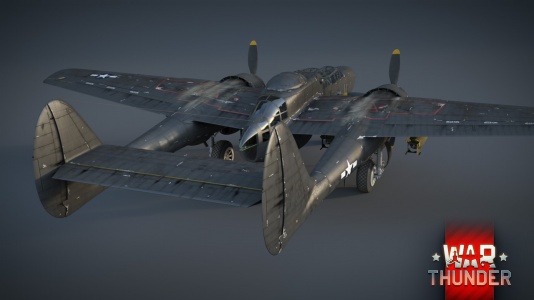
Rear view of the P-61's aerodynamic airframe
- Videos
See also
- Related development
External links
- [Devblog] P-61: The American "Flying Tank"
- Official data sheet - more details about the performance
- Pilot Training Manual for the P-61 Black Widow
 - By Headquarters Army Air Forces - Office of Flying Safety, 1944
 - Northrop P-61 Black Widow Pilot's Flight Operations Instructions - Pilot's Flight Operating Instructions for Army Model P-61C Airplane, July 1945, ISBN:978-1-4116-8900-8
| Northrop Corporation | |
|---|---|
| Fighters | P-61A-11 · P-61C-1 |
| Jet fighters | F-89B · F-89D |
| F-5A · F-5C · F-5E | |
| F-20A | |
| Export | ␗F-5A · ▄F-5E FCU |
| USA twin-engine fighters | |
|---|---|
| P-38 | XP-38G · P-38E · P-38G-1 · P-38J-15 · Bong's P-38J-15 · P-38L-5-LO · P-38K · YP-38 |
| P-61 | P-61A-11 · P-61C-1 |
| F7F | F7F-1 · F7F-3 |
| Other | XF5F · XP-50 · F-82E |