M18 GMC (China)
OLD‑WIKI.WARTHUNDER.COM (DEFUNCT)
| This page is about the Chinese light tank M18 GMC (China). For other versions, see M18 Hellcat (Family). |
Description
The ␗M18 Gun Motor Carriage is a rank Chinese light tank with a battle rating of (AB), (RB), and (SB). It was introduced in Update 1.91 "Night Vision".
General info
Survivability and armour
The M18 GMC (China) has extremely thin armour throughout its construction. Therefore, a player with the M18 should throw away any notion of trying to survive a shot and instead aim to avoid being hit at all. With an open-top construction and the placement of certain crew members, even enemy machine gun rounds can knock out the crew members inside and lower combat efficiency.
The thin armour is both a blessing and a curse for the vehicle. It is a curse as it means the vehicle can suffer through the overpressure damage mechanics. A single HE shell has the potential of knocking out the M18 instantly regardless of calibre. It can however benefit the M18 if the enemy's kinetic round does not hit any module or crew member: the shell may go through and the M18 may end up with little damage. As such, there can be second chances for this vehicle, but this should not be relied upon as a combat strategy.
With five crew members, the M18 has a standard amount of crew to survive off of. Three are essential for combat efficiency: the gunner, loader, and driver. The commander operates the cupola machine gun and if knocked out, will cause the machine gun to no longer function. This will be a constant occurrence due to the position of the commander with the torso exposed above the turret, this allows enemy machine gun rounds to easily hit and incapacitate the commander.
The M18's module configuration is rather standard with the transmission in front and engine in the back. The spread out nature means there is more "wiggle room" for kinetic shells to hit and pass through the vehicle.
Armour type:
- Rolled homogeneous armour
- Cast homogeneous armour (Gun mantlet)
| Armour | Front (Slope angle) | Sides | Rear | Roof |
|---|---|---|---|---|
| Hull | 12.7 mm (39-64°) Front glacis 12.7 mm (23-52°) Lower glacis |
12.7 mm (23-26°) Top 12.7 mm Bottom |
12.7 mm (12°) Top 12.7 mm (36°) Bottom |
8 mm |
| Turret | 25.4 mm (15-26°) Turret front 19 mm + 25.4 mm (0-55°) Gun mantlet |
12.7 mm (1-21°) | 12.7 mm (7°) | N/A Open-top 8 mm Bustle and Front |
Notes:
- Suspension wheels and tracks are 15 mm thick.
- Belly armour is 5 mm thick.
- The hull underside right above the tracks are only 8 mm thick.
- Tracks are attached the turret rear, granting some 15 mm in thickness.
Mobility
| Game Mode | Max Speed (km/h) | Weight (tons) | Engine power (horsepower) | Power-to-weight ratio (hp/ton) | |||
|---|---|---|---|---|---|---|---|
| Forward | Reverse | Stock | Upgraded | Stock | Upgraded | ||
| Arcade | Expression error: Unexpected * operator. | 620 | Expression error: Unexpected round operator. | __.__ | |||
| Realistic | 354 | Expression error: Unexpected round operator. | __.__ | ||||
Though the previous section on armour may imply poor survivability, the M18 GMC (China)'s shining trait is in its mobility. It produces enough engine horsepower to esaily speed around on the battlefield, quickly traversing through rough terrain to get to advantageous positions and ambush enemies that are just starting to get in the fight.
The vehicle displays great mobility when driving forwards and backwards, allowing it to perform quick exits from a dangerous position.
Modifications and economy
As with every ground vehicle Parts and FPE are an absolute top priority. Following that, depending on player preferences, one of 3 should be researched: Horizontal Drive (close-range, flanking), Suspension (medium-range) or Adjustment of Fire (long-range of a typical engagements). Following this the goal is to get rank IV mobility improvements in order Filters -> Engine -> Transmission. On rank III, along the way, the Crew Replenishment should be prioritized, as its an open-top vehicle, so it will suffer significant causalities from enemy airplanes. If your preferred engagement range is above 700 m then the Elevation Mechanism should be researched. Otherwise: Mobility upgrades are the most important, shells are the lowest priority, as even the situational advantage of the M93 shot is not worth researching over improved mobility, or even accuracy.
Armaments
Main armament
The 76 mm M1 is an extremely capable gun with a high damage potential and a very good gun handling. It is one of the most widely used Anerican guns throughout this rank with M18 being the first tanks to use it - it gives it a very high staying power throughout this rank. Once upgraded, the turret has very fair guidance in both: horizontal and vertical axis allowing to quickly catch pot-shots, though given exceptional mobility of the platform even it struggles to catch up with the near-instant hull rotation.
| 76 mm M1 | Turret rotation speed (°/s) | Reloading rate (seconds) | |||||||||||
|---|---|---|---|---|---|---|---|---|---|---|---|---|---|
| Mode | Capacity | Vertical | Horizontal | Stabilizer | Stock | Upgraded | Full | Expert | Aced | Stock | Full | Expert | Aced |
| Arcade | 45 | -10°/+20° | ±180° | N/A | 22.8 | 31.6 | 38.4 | 42.5 | 45.2 | 7.93 | 7.02 | 6.47 | 6.10 |
| Realistic | 14.3 | 16.8 | 20.4 | 22.6 | 24.0 | ||||||||
Ammunition
- M79 shot - AP - Stock round, has decent penetrative power but no explosive filler. Replace it by the M62 shell as soon as possible.
- M42A1 shell - HE - The best round for dealing with unarmoured targets or unarmoured sections of vehicles. It should be used carefully, as everything over 10 mm armour can negate its effects.
- M62 shell - APCBC - The best anti-tank shell. It has very good penetration and an excellent post-penetration effect.
| Penetration statistics | |||||||
|---|---|---|---|---|---|---|---|
| Ammunition | Type of warhead |
Penetration @ 0° Angle of Attack (mm) | |||||
| 10 m | 100 m | 500 m | 1,000 m | 1,500 m | 2,000 m | ||
| M79 shot | AP | 134 | 132 | 121 | 109 | 99 | 89 |
| M42A1 shell | HE | 16 | 16 | 14 | 13 | 11 | 10 |
| M62 shell | APCBC | 149 | 146 | 133 | 119 | 106 | 94 |
| Shell details | ||||||||||||
|---|---|---|---|---|---|---|---|---|---|---|---|---|
| Ammunition | Type of warhead |
Velocity (m/s) |
Projectile mass (kg) |
Fuse delay (m) |
Fuse sensitivity (mm) |
Explosive mass (TNT equivalent) (g) |
Ricochet | |||||
| 0% | 50% | 100% | ||||||||||
| M79 shot | AP | 792 | 6.8 | - | - | - | 47° | 60° | 65° | |||
| M42A1 shell | HE | 823 | 5.84 | 0.2 | 0.1 | 390 | 79° | 80° | 81° | |||
| M62 shell | APCBC | 792 | 7 | 1.2 | 14 | 63.7 | 48° | 63° | 71° | |||
| Smoke shell characteristics | ||||||
|---|---|---|---|---|---|---|
| Ammunition | Velocity (m/s) |
Projectile mass (kg) |
Screen radius (m) |
Screen deploy time (s) |
Screen hold time (s) |
Explosive mass (TNT equivalent) (g) |
| M88 | 274 | 3.44 | 13 | 5 | 20 | 50 |
Ammo racks

| Full ammo |
1st rack empty |
2nd rack empty |
3rd rack empty |
4th rack empty |
5th rack empty |
Visual discrepancy |
|---|---|---|---|---|---|---|
| 45 | 37 (+8) | 27 (+18) | 17 (+28) | 9 (+36) | 1 (+44) | No |
Turret empty: 37 (+8)
When fighting in downtiers it's best to take only 17 shells, which allows the turret and sides of the tank to be empty of shells, notably increasing survivability. Otherwise, it doesn't matter how many rounds are loaded, as most hits against the tank will prove deadly regardless.
Machine guns
| 12.7 mm M2HB | ||||
|---|---|---|---|---|
| Mount | Capacity (Belt) | Fire rate | Vertical | Horizontal |
| Pintle | 800 (200) | 576 | -10°/+70° | ±60° |
Usage in battles
Before all, avoid colourful or bright decals. Camouflage is the main part of the M18's defence. Chances for good performance in battle are: be "invisible", fast and effective. The M18's speed is its best ally. This speed has to be used for flanking manoeuvres and relocate. Not for trying to cross an open field, that will leave it open to enemy fire, speed is not a substitute for armour.
Relocate:
- This movement will have to be done again and again. Choose a good spot wisely, remove the foliage if necessary to get a clear field of fire. When in the fire spot, use the gun depression and stay in a hull-down position until a target is located. Once a target is locked on, aim at critical components. Try to immobilize the enemy by firing at the engine or transmission, or remove their firepower by shooting the gun or breech, or for instant destruction with a shot to the ammo storage. The last option can work very well or not, as skilled players only carry a few rounds of ammo.
- If positive that the enemy hasn't discovered the firing spot, go for another shot. Stay attentive that none of the enemy's teammates has also located the firing spot. If detected, hide immediately and relocate.
Flanking:
- Flanking is the most dangerous manoeuvre of all because the vehicle will have to be exposed as it moves to the enemy's rear, but it is very effective when it's coordinated with other vehicles. A distraction is needed to gain the enemy's attention while the M18 makes its move. Isolated enemy units are very vulnerable to this tactic. Using the M18 speed to get to the rear and as the enemy heads toward the objective, the firing perspective should give a very clear view of the enemy's side armour. A good shot with the M62 APCBC shell could knock out the enemy rather quickly, but if using solid AP shots like the M79, aim at critical components on mobility and firepower before knocking out the crew or ammo stowage.
Avoid flat terrain
- Flat terrain means that the Hellcat will become an easy target for virtually any vehicle by exposure, especially when not moving or when moving in a straight line. Open plains are the bane of the Hellcat. Whenever possible, one should try to stay amongst hills.
Pros and cons
Pros:
- Overall mobility is superb, with very responsive manoeuvring that allows the Hellcat to excel in flanking manoeuvres
- Fast reload speed and turret traverse
- M62 APCBC round has great penetration and lots of explosive fillers, rarely requiring more than one penetrating shot to kill common tanks like M4s, Tiger H1 or Panthers
- Low profile, reducing target size and allows it to hide behind small bushes or rocks easily
- The nature of its thin armour means AP rounds have a tendency to pass straight through without damaging modules, and an APHE fuze may not even be triggered. For example the Soviet 122 mm (mixed battle) will over-penetrate, dealing little damage
Cons:
- Thin armour means rapid-fire autocannons, heavy machine guns, and aerial weapons could easily shred it. Beware of the R3 T20 FA-HS and Wirbelwind
- Commander is exposed at the 0.50 calibre machine gun mount, and knocking him out would render the weapon useless
- Open-top construction means aerial strikes and artillery could rain havoc onto the crew
- Gun has poor penetration in an uptier, often can't penetrate anything frontally unless hitting a weak spot. The Ho-Ri, Tiger II (H) and M26 are frontally immune to this 76 mm M1
- Doesn't have access to APCR unlike its American counterpart
- Rarely reaches 50 km/h in Realistic Battles, even in a straight line, therefore can be outran by the Sd.Kfz.234 series or the R3 T20 FA-HS
- A moment of immobility due to a damaged engine or transmission could be a sign of impending doom for the M18
- Overpressure mechanics mean any explosions or well-aimed HEAT or HE rounds could instantly knock out the vehicle
History
US Tank Destroyer Doctrine
The self-propelled anti-tank doctrine established by the US military called for fast, powerful vehicles able to stop the German blitzkrieg tactics by ambushing the attacking tank forces. This doctrine, known as the "Tank Destroyer Doctrine", called for anti-tank forces to be held in reserve to blunt the massed Panzer attacks that many in the War Department believed was the key to German victory in France in 1940. The concentration of antitank weaponry away from the frontline was eventually determined to be an unnecessary weakness, and the solution was to keep a few anti-tank guns in the front-line as the first defence, while a large reserve of mobile tank destroyers would move in at the location where a German tank breakthrough is happening to ambush and destroy the enemy forces. This role led to the desire for a fast vehicle with a powerful gun and mobility. Minimal emphasis was placed on armour, as the doctrinal role of tank destroyers was to respond rapidly to an enemy armoured breakthrough; heavy armour would only hinder a timely response. The development of a purpose-built tank destroyer languished in bureaucratic limbo for the early years of the war (a delay caused by poor designs such as the M5 Cletrac and bureaucratic infighting between the various departmental cliques), and consequently, the majority of self-propelled tank destroyers were expedients derived from the M4 Sherman chassis. The most common tank destroyer was the M10 GMC, made from the M4 Sherman hull and armed with a 3-inch M1918 gun. Although perfectly capable and welcome addition for frontline forces, it was no faster than an ordinary Sherman tank. The tank destroyers would in 1944 finally receive their purpose-built self-propelled tank destroyer in 1944: the M18 Hellcat.[1]
Development
The origin of the M18 design came as early as December 1941 with the requirement of a Christie suspension and a 37 mm gun. This requirement called for a radical new tank design rather than a derivative of the M4 Sherman. These requirements changed as the war progressed, the first change was to the new and innovative Torsion bar suspension from Buick Motor Division from General Motors and another change was to mount the British QF 6-pounder gun then in use on their Churchill Mark III tanks, the developed prototype vehicle was called the T49 GMC. Then the US Army wanted the heavier 75 mm gun used on the Shermans on it, this prototype was designated the T67 GMC. Finally, the army decided to mount the 76 mm gun also in development for the Sherman onto the prototype, now known as T70 GMC. Changes to hull shape and turret took place to accommodate all these new requirements and armament, but it eventually was approved for service and finally renamed as the M18 GMC and started production in mid-1943, which went on until ending in October 1944 with 2,507 units produced. A variant called the M39 Armored Utility Vehicle was also produced, its turret was removed for space for cargo, 8 personnel, or to tow guns.
Service in ROC Armed Forces
The Korea War broke out in 1950 and soon China sent a volunteer army into Korea. The situation provided the background for United States strengthening its military alliance with Republic of China (ROC). As a result, the Military Assistance Advisory Group (MAAG) was sent to Taiwan and US began to supply ROC armed forces with surplus materials from WWII. The M18 "Hellcat" tank destroyers arrived in Taiwan in 1952 as the first batch of military assistance supplies. In fact, these Hellcats were listed as the first combat vehicles that US provided to ROC since 1949. A total number of 243 M18 tank destroyers were sent throughout the military aid operation. Those Hellcats were supplied to the Army and Marine Corps and soon became the backbone of the ROC combat forces. These tank destroyers took the places of outdated M3/M5 Stuarts and captured Japanese tanks, improving the fighting capacity of armoured forces significantly.
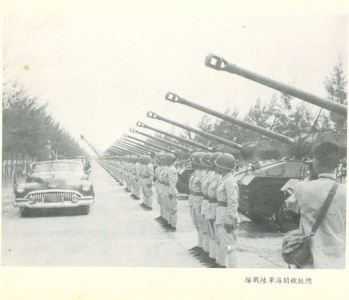
The M18 tank destroyers saw multiple combats during its service in Taiwan. It served quite differently from the US military in the later stages of the European battlefield: For the fact that ROC Army and Marine Corps lacked tanks and other armoured vehicles at that time, the Hellcat tank destroyer often had to play the role of tanks and even self-propelled artillery. During the First Taiwan Strait Crisis (the Artillery battle of September 3rd), the tank destroyers stationed in Kinmen had a record of bombarding the PLA's broadcasting station on the mainland. By the time of Second Taiwan Strait Crisis (Artillery battle on August 23th), armoured vehicles and even the M1 90 mm anti-aircraft guns were mobilized to launch an artillery counterattack in the direction of Xiamen. Since the PLA did not initiate any amphibious assaults, the M18 Hellcat tank destroyer never had the chance of engaging armoured targets during service.
The M18 "Hellcat" tank destroyer stayed in the ROC Army and Marine Corps until the 1970s when its poor armour, outdated firepower and backwards fire control system no longer met the requirements of active service. Some Hellcats were transferred to the outer islands and served as stationary shore defense artilleries in fortifications. Since the original Wright R-975 engine became exhausted after the long service, the Army Ordnance Department planned a reutilization of M18 Hellcat turrets by assembling them onto the chassis of M42 SPAAG. The reutilization design was designated as a new light tank called Type 64. A total number of 42 Type 64 light tanks were modified and equipped to the 751th Battalion of the 202th Armored Cavalry. The battalion was merged by 208th Armored Cavalry in August 1979 and stationed in Penghu. At the end of 1981, all Type 64 light tanks were decommissioned from service in Penghu depot. One of these modified vehicle is currently displayed at the Armored Forces School in Hukou, Taiwan in public.
Media
- Skins
- Images
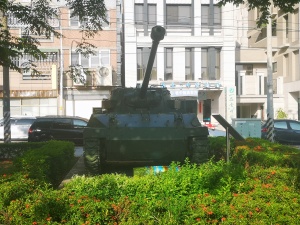
One of the very last M18 GMC in Taiwan, Dali Environmental Park, Taichung
See also
- M64- Domestic assembled light tank from spare parts of M18 and M42 Duster.
External links
References
- Citations
- ↑ Zaloga, S. (2004)
- Bibliography
- Zaloga, Stephen. (2004). M18 Hellcat Tank Destroyer 1943–97. Oxford: Osprey Publishing.
| Buick Division of General Motors | |
|---|---|
| Tank Destroyers | M18 GMC · M18 "Black Cat" · Super Hellcat |
| Export | ␗M18 GMC · ▄M18 |
| Note | Buick is a division of General Motors (GM). |
| China light tanks | |
|---|---|
| Type 63 | Object 211 · Type 63 · ZTS63 |
| Type 62 | Type 62 |
| WZ551 | ZSL92 · PTL02 · WMA301 |
| ZBL08 | ZLT11 |
| Type 86 | ZBD86 |
| WZ502 | ZBD04A |
| ROC | M41D · M64 |
| Type 59 | QN506 |
| USA | ␗M8 LAC · ␗M3A3 Stuart · ␗M3A3 (1st PTG) · ␗M5A1 · ␗M24 · ␗M18 GMC · ␗M41A3 |
| USSR | ␗T-26 · T-26 No.531 · ␗PT-76 |