Jagdpanzer IV
OLD‑WIKI.WARTHUNDER.COM (DEFUNCT)
Description
The Jagdpanzer IV (Sd.Kfz. Index: Sd.Kfz. 162) is the first variant of the Panzer IV medium tank-based tank destroyer family. It was created as a successor to the Sturmgeschütz III assault gun family against the wishes of Heinz Guderian, the inspector general of the Panzertruppen, and was the first casemate-style turretless tank destroyer built on a Panzer IV medium tank chassis. It is armed with a 75 mm Panzerjägerkanone 39 L/43 tank gun. The armour plates on the front are sloped. Internally, the ammunition racks and fuel tanks were moved to make room for the new superstructure. The auxiliary engine that drove the turret traverse mechanism was removed from the vehicle since it did not have a turret. The 80 mm thick sloping armour on the new superstructure provided effective protection equivalent to more than 100 mm of vertical armour. The superstructure was constructed from huge, interconnecting plates that were welded together to simplify the production process.
Introduced in the Closed Beta Test for Ground Forces before Update 1.41, the Jagdpanzer IV is a heavily armoured tank destroyer that can be played in both offensive and defensive roles. Its strong frontal armour plates make it difficult for most adversaries to penetrate. However, since it lacks a turret, players should not use it on city maps with narrow streets. Nevertheless, it is a formidable vehicle with excellent defence and main armament. It should be easy for players to take the initiative and lead the attack or hold down choke points.
General info
Survivability and armour
Armour type:
- Rolled homogeneous armour (Hull, Superstructure)
- Cast homogeneous armour (Gun mantlet)
| Armour | Front (Slope angle) | Sides | Rear | Roof |
|---|---|---|---|---|
| Hull | 60 mm (47°) Upper glacis 50 mm (55°) Lower glacis |
30 mm (12-48°) + 5 mm (29°) Top 30 mm Bottom |
22 mm (15°) | 20 mm (6°) Front 20 mm (2°) Rear |
| Superstructure | 60 mm (50°) Front glacis 75 mm (conical) Gun mantlet 80 mm (spherical) Gun mount 120 mm (50°) Gun mount frame |
30 mm (29°) | 30 mm (31°) | 20 mm 60 mm Gun mount |
Notes:
- Suspension wheels and bogies are 15 mm thick while tracks are 20 mm thick.
- The add-on armour module adds tracks on the front and sides of the superstructure and the front hull.
- Mudguards are 4 mm thick.
The Jagdpanzer IV has a very vulnerable front hull, which can be penetrated easily by most guns at the battle rating. The fact that the transmission is mounted directly behind the front glacis means that any shot will disable it. It can be a double-edged sword: the transmission will soak up most shots which can be good at long range, but at close range it is a death sentence, as it allows your enemy to casually flank to your vulnerable sides and take out your whole crew.
Mobility
| Game Mode | Max Speed (km/h) | Weight (tons) | Engine power (horsepower) | Power-to-weight ratio (hp/ton) | ||||
|---|---|---|---|---|---|---|---|---|
| Forward | Reverse | Stock | AoA | Stock | Upgraded | Stock | Upgraded | |
| Arcade | -0.5 | 0.46 | 426 | -926.09 | __.__ | |||
| Realistic | 265 | -576.09 | __.__ | |||||
Based on the chassis of the Pz.IV, the Jagdpanzer IV is slightly heavier but still benefits from the same all-round mobility: it accelerates steadily and is able to reach a maximum speed of 43 km/h in a dozen of seconds. The brakes are powerful and make the Jagdpanzer IV stop within metres (the violent braking however causes the hull to wobble, making your targeting less accurate). The reverse speed is good: it will get you out of a dangerous situation quickly but not enough to play overextending tactics. The lack of neutral steering makes turning on the spot slow (2 km/h): make sure to build a little speed before turning and you'll turn faster (6 km/h). If you need to quickly turn your hull on the spot towards flanking enemies, privilege the reverse gear (-3 km/h). Turning at high speed makes you significantly lose speed but your acceleration compensates for that aspect. The stock tracks are narrow and grant you a decent mobility on hard terrain (solid ground, roads) but poor mobility on soft terrain (mud, snow, sand). Once researched, the "Winterketten" wide tracks for snowy terrain will grant you a very good mobility on soft terrain. The Jagdpanzer IV reaches 17 km/h when fording, 17 km/h when driving uphill with some speed built-up but a mere 7 km/h uphill from a stop start. Light and medium obstacles (fences, posts, bushes and small trees) are not a problem but large obstacles (trees, concrete blocks and parked vehicles) will hinder your mobility: avoid them.
Modifications and economy
Armaments
Main armament
| 75 mm PaK39 L48 | Turret rotation speed (°/s) | Reloading rate (seconds) | |||||||||||
|---|---|---|---|---|---|---|---|---|---|---|---|---|---|
| Mode | Capacity | Vertical | Horizontal | Stabilizer | Stock | Upgraded | Full | Expert | Aced | Stock | Full | Expert | Aced |
| Arcade | 79 | -8°/+15° | ±12° | N/A | 7.04 | 9.75 | 11.84 | 13.09 | 13.93 | 7.67 | 6.79 | 6.25 | 5.90 |
| Realistic | 4.76 | 5.60 | 6.80 | 7.52 | 8.00 | ||||||||
The 75 mm PaK39 L48 cannon stays reliably accurate until 1,200 m distance. Beyond 1,500 m the loss of accuracy becomes a real handicap, together with the poor magnification of your optics. Using the "sight distance control" feature can help mitigate that aspect.
The average muzzle velocity of your APCBC and APCR shells still grants you flat predictible trajectories and thus helps firing at moving targets from a distance. HEAT and HE shells on the other hand are slow and will fly with a curved trajectory. Lacking a stabilizer, the tank can't accurately fire on the move.
The gun has a limited traverse on the horizontal axis. This can make the tracking of a target difficult as the gun quickly reaches a stop. Take that constraint into account when positioning your hull at a firing spot. The traverse speed of the gun however is slow in comparison to other tank destroyers at the battle rating, which makes your targeting process slow. The elevation angle is average and the depression angle is good. Make good use of it to shoot from behind ridges.
Your reload time is similar to vehicles at the same BR, if not a little longer than average. The gun recoil is average for a German vehicle and not important enough to throw your gun off target after firing.
Although exemplary at lower battle ratings, the PaK39 will find itself coming up short at the Jagdpanzer IV's BR. Compared to analogue 75 & 76 mm cannons, the PaK39 comes last in both ballistic performance and muzzle velocity.
To compensate for these shortcomings, tanks mounting the PaK39 are able to use the PzGr 40 APCR shell which offers an increased penetration power at point blank range. Although lacking in significant post-penetration damage, using the APCR could mean the difference between disabling a vehicle and bouncing a shell.
Ammunition
The ammunition available to the Jagdpanzer IV allows for engaging all types of targets:
- PzGr 39: APCBC; a shell with explosive filler but an average penetration power. It will destroy any tank it penetrates and should be the main ammunition used in battle. Few vehicles will be able to withstand this shell but follow-up shots may be needed occasionally.
- PzGr 40: APCR; a composite round with the best penetration but no explosive filler and that will only penetrate flat vertical surfaces. Pack a few of these shells to use against heavily armoured foes that the PzGr 39 can't penetrate, or when sniping as the higher muzzle velocity makes aiming at moving targets easier.
- Hl.Gr 38B: HEAT; a shaped charge with mediocre penetration but without penetration loss over distance. It penetrates only flat vertical surfaces but the post-penetration damage is very effective on open and lightly armoured vehicles. It has however a very slow muzzle velocity (around twice slower than your fast projectiles).
- Sprgr. 34: HE; a high-explosive round perfect to obliterate open and lightly armoured vehicles but it has a slow muzzle velocity.
- K.Gr.Rot Nb.: Smoke shell; useful to blind enemy vehicles that are too remote for you to disable so that you can progress towards objectives.
| Penetration statistics | |||||||
|---|---|---|---|---|---|---|---|
| Ammunition | Type of warhead |
Penetration @ 0° Angle of Attack (mm) | |||||
| 10 m | 100 m | 500 m | 1,000 m | 1,500 m | 2,000 m | ||
| PzGr 39 | APCBC | 145 | 143 | 130 | 116 | 104 | 93 |
| Hl.Gr 38B | HEAT | 80 | 80 | 80 | 80 | 80 | 80 |
| PzGr 40 | APCR | 182 | 177 | 159 | 140 | 122 | 107 |
| Sprgr. 34 | HE | 10 | 10 | 10 | 10 | 10 | 10 |
| Shell details | ||||||||||||
|---|---|---|---|---|---|---|---|---|---|---|---|---|
| Ammunition | Type of warhead |
Velocity (m/s) |
Projectile mass (kg) |
Fuse delay (m) |
Fuse sensitivity (mm) |
Explosive mass (TNT equivalent) (g) |
Ricochet | |||||
| 0% | 50% | 100% | ||||||||||
| PzGr 39 | APCBC | 770 | 6.8 | 1.2 | 14 | 28.9 | 48° | 63° | 71° | |||
| Hl.Gr 38B | HEAT | 450 | 4.4 | 0.05 | 0.1 | 872.1 | 62° | 69° | 73° | |||
| PzGr 40 | APCR | 990 | 4.1 | - | - | - | 66° | 70° | 72° | |||
| Sprgr. 34 | HE | 550 | 5.74 | 0 | 0.1 | 686 | 79° | 80° | 81° | |||
| Smoke shell characteristics | ||||||
|---|---|---|---|---|---|---|
| Ammunition | Velocity (m/s) |
Projectile mass (kg) |
Screen radius (m) |
Screen deploy time (s) |
Screen hold time (s) |
Explosive mass (TNT equivalent) (g) |
| K.Gr.Rot Nb. | 540 | 6.2 | 13 | 5 | 20 | 50 |
Ammo racks
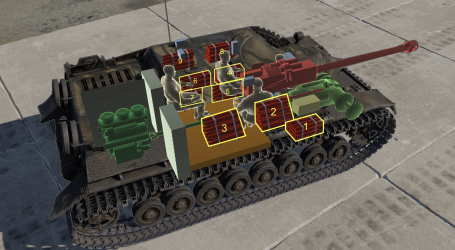
| Full ammo |
1st rack empty |
2nd rack empty |
3rd rack empty |
4th rack empty |
5th rack empty |
6th rack empty |
7th rack empty |
8th rack empty |
9th rack empty |
Visual discrepancy |
|---|---|---|---|---|---|---|---|---|---|---|
| 79 | 69 (+10) | 59 (+20) | 49 (+30) | 43 (+36) | 35 (+44) | 29 (+50) | 21 (+58) | 11 (+68) | 1 (+78) | No |
Notes:
- Pack 29 (+50) shells to go into battle with the right flank and hull empty.
- Shells in racks are depleted by increments of two.
- Sponson racks contain 10 shells each.
Machine guns
| 7.92 mm MG42 | ||||
|---|---|---|---|---|
| Mount | Capacity (Belt) | Fire rate | Vertical | Horizontal |
| Hull | 1,200 (150) | 1,200 | -3°/+4° | ±5° |
The Jagdpanzer IV has a MG42 machine gun. Since it is mounted on the hull, it cannot effectively shoot at planes. However, it does have a higher fire rate, making it useful for gunning down lightly armoured vehicles.
Usage in battles
- Combat tactics
- In an offensive role, the Jagdpanzer IV should be played as a long range sniper, taking advantage of the APCBC shell's good penetration values, high gun accuracy and frontal sloped armour. Use your good mobility to get to a shooting spot. Engage targets from at least 1,000 m away to prevent enemy progress towards the objectives. You will also suppress enemy fire to prevent your team from being pinned down by enemy tank destroyers. Because of your weak side armour, always stay away from the frontline to avoid being flanked or swarmed and thus maximise your chances of survival. When engaging enemy tanks, privilege firing hull-down from behind cover. With your firepower, any enemy wandering in your sight alone is practically dead.
- In a defensive role, your role is to contain the enemy advance in case of a breakthrough. The enemy will be pushing forward and thus moving the front line, making engagements take place at a closer range than you're comfortable with. You should identify and target in priority choke points, narrow passages and corridors of the map that the enemy will be forced to take. Your limited gun traverse still allows you to monitor an area spanning 212 m at 500 m distance without having to reposition your hull. A flanking enemy, artillery strikes or CAS will be the greatest threats to the Jagdpanzer IV in that combat role.
- If you try to play the Jagdpanzer IV as a front-line tank or a support tank, you will be confronting with the following issues. As a turretless tank destroyer, your turning speed is too poor to manoeuvre quickly enough in close combat to face flanking enemies. You will be quickly disabled by any fire targeting your sides. As soon as you are immobilized (driver or transmission disabled), you are most likely dead. From up close, most tanks will have no problem penetrating your hull or your superstructure. And if are even slightly angled, most enemies will be able to penetrate your superstructure's side armour with little effort.
- Notable enemies
Any tank sporting a long gun of calibre 75 mm or bigger will disable you with little effort in a close range encounter at this battle rating because of your weak armour. For long range engagements, M4A3E2 Jumbos are the enemies most likely to bounce your shell from a distance. Luckily, it won't be able to return lethal fire from afar.
- Defeating a Jagdpanzer IV
- Flanking the tank destroyer undetected and immobilizing it with your first shot remains your best chance to destroy it. But it is difficult because it will position very far from the frontline.
- The most suitable shells to deal with a Jagdpanzer IV are APCBC or APHE shells with a high penetration power.
- Force the Jagdpanzer IV out of position with indirect fire (artillery strikes) if you're at relative close range and it is locking down a passage.
- As a turretless tank destroyer with weak side armour, initiate a pincer movement on the Jagdpanzer IV together with a teammate. This will force it to retreat and relocate or face the risk of being destroyed.
- In case of a frontal attack (choke point/corridor), try blinding the Jagdpanzer IV with smoke and then swarm it with several tanks to saturate its defensive capacities.
Pros and cons
Pros:
- Very comfortable to drive thanks to the fair acceleration and top speed
- Excellent gun traverse arc to each side gives the ability to shot while having the tank angled
- Low profile, not an easy target at long ranges
- Can load APCR to help with heavier tanks
- Frontal armour is well sloped and can mount tracks to improve protection
Cons:
- Vulnerable sides
- Will often face vehicles that can punch through its armour frontally
- PaK39 is lacking compared to enemy armaments
- Prone to ammo rack detonation
- As with most casemates, a dead transmission or driver means a dead vehicle
- Small vehicle, if it gets penetrated all the crew can be knocked out in one hit
History
Development
In September 1942, the Wehrmacht arms bureau called for a new type of assault vehicles. The specifications listed was 100 mm front armour, 40-50 mm on the sides, wide tracks, a top speed of 26 km/h, ground clearance of 50 cm, and a very low firing position. The design was to be armed with the 75 mm Pak 42 mounted on the Panther tanks. Though this project was originally conceived over a completely new chassis, the Panzer IV was chosen to be used instead. The design was to have a low silhouette and an enclosed casemate fighting compartment after experiences with the Marder IIIs showed that such features were necessary for a successful fighting vehicle.
The Panzer IV chassis was converted into the Jagdpanzer IV, which featured new designs to the original. The utilization of the Panzer IV chassis was met with much criticism by General Heinz Guderian, who saw the diverting of Panzer IV tank resources as unnecessary since the current assault gun StuG III was more than adequate in the role and Germany still needed reliable tanks that it could use. The vertical front hull armour was replaced with large sloped armour plates, ammunition and fuel were moved to accommodate the new superstructure design, and the auxiliary engine that once powered the Panzer IV turret was removed. The superstructure had 80 mm thick sloping armour that gives it an effective 100 mm thick. To simplify the production of this vehicle, the superstructure was essentially made of large interlocking plates that are welded together. The vehicle had a crew of four, the commander, gunner, loader, and driver. The vehicle was armed with a 75 mm gun, though originally suppose to be the one from the Panther, shortages forced the mounting of older guns such as the 75 mm Pak 39 L/48 cannon, which were less powerful than the Panther's PaK 42, but were still lethal. Due to the different gun mounts, three main variants were produced from the Jagdpanzer IV, the original Jagdpanzer IV (with the 75 mm Pak 39 L/48 cannon), the Panzer IV/70 (V), and the Panzer IV/70 (A) (Both of which have the 75 mm Pak 42 L/70 cannon).
The Jagdpanzer IV, mounting the 75 mm Pak 39, was designed and produced by Vomag. It was produced from January to November 1944 with about 769 units produced. The early version had a muzzle brake and zimmerit anti-magnetic paste added to the vehicle. However, the muzzle brake was removed as it kicks up a large amount of dust from the ground that obscures the gunner's sights so that was removed, and the zimmerit was also removed after September 1944 due to rumours that they were causing vehicle fires. Other modifications were made to the design over time, but the biggest change in its production was the addition of Schürzen side armour plates.
Combat usage
The Jagdpanzer IV (the name was interchangeable between all of its variants) was first issued on March 1944 and was employed in an anti-tank role in the Western and Eastern Front. The Jagdpanzer IV participated in the Normandy Campaign, Battle of the Bulge, and the Soviet Offensives on the Eastern Front. Their overall performance was very successful as tank destroyers and only sub-par in other roles that are usually taken by tanks or assault guns, as the high-velocity 75 mm cannon it mounts were unsuitable for anti-infantry and fortification purposes. However, they were soon put in positions of tanks due to shortages of capable fighting vehicles in German inventory. One of the popular Jagdpanzer IV aces was SS-Oberscharführer Rudolf Roy who was attached to the 12th SS Tank Destroyer Battalion. He was killed while looking out of his Jagdpanzer IV hatch during the Battle of the Bulge.
After World War II ended, the Jagdpanzer IV's design still saw service with the German Bundeswehr as the Hanomag-Henschel JPz 4-5|Kanonenjagdpanzer, which has the nearly same design as the Jagdpanzer IV, but most notably with a 90 mm gun. Some captured Jagdpanzer IVs were given out by the Soviet Union to Romania and Syria, but Romania scrapped all the German armour by 1954 and Syria used them in conflicts against Israel until 1967.
| Archive of the in-game description | |
|---|---|
|
This self-propelled gun was developed in 1943 to strengthen German anti-tank defensive capabilities. A very low, welded hull was placed on the Pz.Kpfw. IV's chassis, with reasonably-sloped front and side armour plates. This way, the front armour was almost 50% thicker than the tank's base model. The combat and control crew compartments were located in the front, and the engine was in the rear. The tank destroyer was armed with a 75 mm 7,5cm Pak39 L/48 anti-tank gun with a long 48 calibre barrel, mounted in the combat crew compartment. On the exterior, the gun was covered by a massive, cast mantlet. To enhance the armour protection on the sides of the self-propelled vehicle, additional Schurzen side skirts were added. Self-propelled anti-tank guns released before September 1944 had anti-magnetic Zimmerit paste applied to their vertical surfaces. Vomag AG factories released 769 of these vehicles from January to October 1944. In August 1944, vehicles began to be produced with the 75 mm 7.5 cm KwK42 L/70 gun, similar to the gun installed on the Panther tank. This transition passed smoothly, and production of Jagdpanzer IV tanks with the shorter guns gradually tapered off. This tank destroyer enjoyed great popularity with tank troops, since its gun could knock out virtually any Allied tank of its day. This anti-tank gun fought with anti-tank divisions on all fronts. The generally successful vehicle had a number of shortcomings. Its front armour was 60 mm thick, resulting in the loss of a number of vehicles. However, increasing the thickness to 80 mm shifted the vehicle's center of gravity, overloading the front pair of road wheels, which were prone to fail. | |
Media
- Skins
- Videos
See also
- Vehicles equipped with the same chassis
- Other vehicles of similar configuration and role
External links
- [Wikipedia] Jagdpanzer IV
- [Tanks Encyclopedia] Jagdpanzer IV
- [Military Factory] SdKfz 162 Jagdpanzer IV (Panzerjager 39)
| Germany tank destroyers | |
|---|---|
| Pz. I Derivatives | Panzerjäger I |
| Pz. II Derivatives | 15cm sIG 33 B Sfl |
| Pz. 38(t) Derivatives | Marder III · Marder III H · Jagdpanzer 38(t) |
| Pz. III Derivatives | StuG III A · StuG III F · StuG III G · StuH 42 G |
| Pz. IV Derivatives | Jagdpanzer IV · Panzer IV/70(A) · Panzer IV/70(V) · Dicker Max · Nashorn · Brummbär · VFW |
| Pz. V Derivatives | Jagdpanther G1 · Bfw. Jagdpanther G1 |
| Pz. VI Derivatives | Sturer Emil · Elefant · Ferdinand · 38 cm Sturmmörser · Jagdtiger |
| Wheeled/Half-track | 8,8 cm Flak 37 Sfl. · Sd.Kfz.251/9 · Sd.Kfz.251/10 · Sd.Kfz.251/22 · Sd.Kfz.234/3 · Sd.Kfz.234/4 · 15 cm Pz.W.42 |
| ATGM Carrier | RakJPz 2 · RakJPz 2 (HOT) · Wiesel 1A2 |
| Other | Waffenträger · M109G · JPz 4-5 · Raketenautomat · VT1-2 |