Add-on Armor
Modules and modifications
OLD‑WIKI.WARTHUNDER.COM (DEFUNCT)
Description
Add-on Armor is a modification in-game that allows the player to enable the addition of armour onto their tanks. This additional armour is either improvised (for WW2 vehicles) or designed (for post-WW2 vehicles). Improvised add-on armour was most often a field modification performed by the crew by adding track links or mesh screens to the standard issue vehicle. Designed add-on armour is an upgrade tested and validated by the tank manufacturer. It comes in the form of an armour kit (addition of composite armour) or a protection package (addition of explosive reactive armour blocks). The add-on armour increases the overall weight of the vehicle, giving a lower power-to-weight ratio and thus worse mobility.
Tanks able to use modification
 |
 |
 |
 |
 |
 |
 |
 |
 |
 | |
I Rank
|
 Ka-Chi |
|||||||||
II Rank
|
M4A2 M10 GMC |
Pz.IV F2 Pz.IV G Pz.IV H Pz.IV J StuG III G StuH 42 G |
T-34 (1941) T-34 (1942) |
Achilles |
▄M10 GMC |
|||||
III Rank
|
M4A1 (76) W M4A3 (76) W |
Jagdpanzer IV ▀M4 748 (a) Panther D Panzer IV/70(A) Panzer IV/70(V) Pz.Bef.Wg.IV J |
Achilles (65 Rg.) Churchill VII Sherman Firefly Sherman IC "Trzyniec" TOG II |
␗T-34 (1943) |
||||||
IV Rank
|
M46 |
Panther A Panther G |
IS-2 (1944) T-34-85 |
␗Т-34-85 (S-53) T-34-85 No.215 |
||||||
V Rank
|
▃Magach 3 (ERA) |
Conqueror |
Magach 3 (ERA) | |||||||
VI Rank
|
XM8 |
BMP-2 T-62M-1 T-64B T-72A |
Warrior |
Merkava Mk.2D | ||||||
VII Rank
|
M1 KVT M1128 ▃Merkava Mk.3D |
Leopard 2A4M |
T-72B3 T-80B |
Challenger 2 Challenger 2 (2F) ␙Challenger 2 |
Ariete Ariete PSO |
Ra'am Sagol | ||||
VIII Rank
|
M1A2 SEP M1A2 SEP V2 |
Leopard 2A7V |
T-80BVM T-90M |
Leopard 2A7HU |
Strv 122B PLSS Strv 122B+ |
Merkava Mk.4 LIC |

|
The BMP-1, the SPz BMP-1 and the ZBD86 do not appear in the table because the modification increasing the weight of the vehicle is not armour-related (installation of an ATGM launcher). |
History
Tank warfare is a type of battle that can make the equipment involved become obsolete very quickly in terms of protection and firepower. In World War II, this is seen especially in the later half of the war when the Shermans and T-34s began being outgunned by better German tanks, and the German Panzer IV also being outgunned by those tanks. In an effort to get more protection onto their tanks, crew often improvise a variety of methods to increased the armour on their tanks. Methods included welding tracks or sheet metals as appliqué armour onto the tanks, placing sand bags on the hull, hanging logs from the sides, placing mesh sheets, or simply just pour concrete on the hull for the thickness. While these protection vary in their ability to stop a penetrating round or warhead, they all increase the overall weight of the tank, often taxing the suspension and steering beyond their normal capabilities. General George S. Patton, commander of the U.S. Third Army during the invasion of France, heard of this effect of improvised armour on the tank's suspension and forbid his units from using the common sandbags as improvised armour to mitigate vehicle breakdowns (he was however a fan of welded metal sheets similar to the M4A3E2 Jumbo and had many normal Shermans made into make-shift Jumbos).
Results vary from the variety of improvised armour used in the war. Some armour, like the concrete, was deemed useless or impractical and were not widely used. Sandbags and logs were mostly seen as ineffective against the tank rounds and HEAT warheads used by infantry anti-tank launchers. Out of the bunch, welded metal was perhaps the most effective improvised armour one can put onto a tank. A study done by the U.S. Army on the improvised armour used by the tankers on their Shermans reveal that while the majority of improvised armour had little effect on armour protection, the best impact of improvised armour was morale, as they at least gave the worried tankers an additional bit of psychological, if not physical, protection for their tanks.
Media
- Images
- In-game screenshots
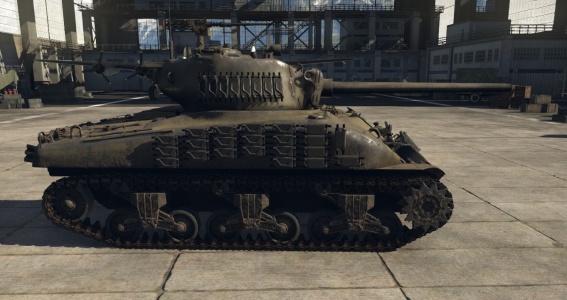
The M4A1 (76) W Sherman with add-on armour on side of the hull and turret.
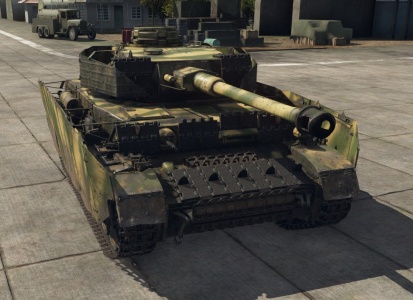
The Panzer IV Ausf. H with add-on armour on the front of the hull and turret.
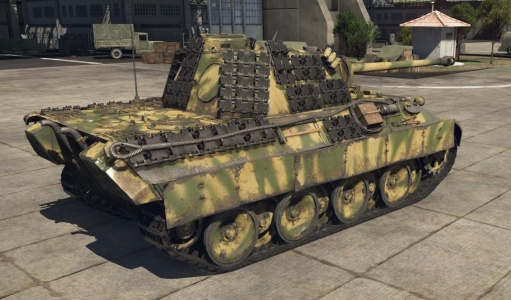
The Panther D with add-on armour on the sides of the turret.
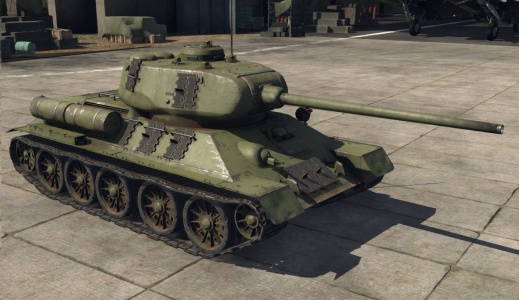
The T-34-85 with add-on armour on the sides of the turret and hull.
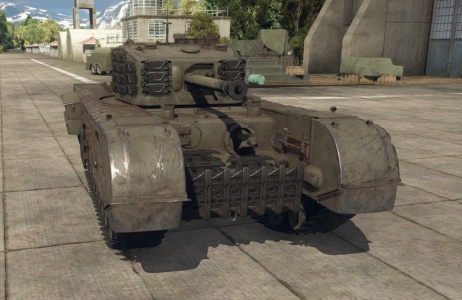
A Churchill Mk VII with add-on armour on front hull, front turret, and turret sides.


- Historical photos
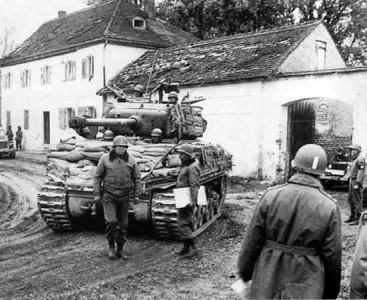
A M4A3E8 Sherman sporting sand bag add-on armour. The man in front is George Patton, who just finished chewing out the crew for using sand bags, which he banned on tanks.
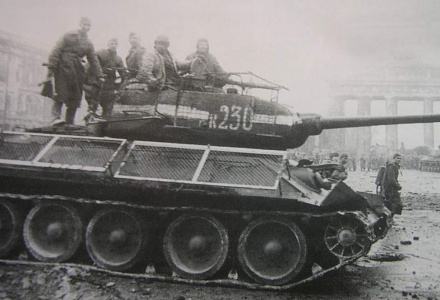
A T-34-85 with added mesh screens as protection against HEAT rounds.
