36 cm/45 Type 41 (356 mm)
Naval cannons
OLD‑WIKI.WARTHUNDER.COM (DEFUNCT)
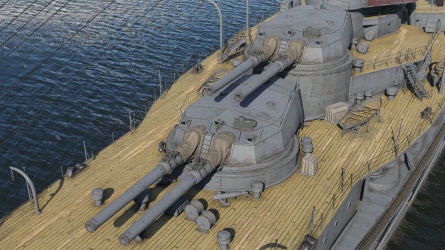
Description
The 36 cm/45 Type 41 is a Japanese 356 mm naval cannon. It is a very capable naval weapon in War Thunder, often able to take down enemy destroyers or light cruisers with a single salvo (even if only by flooding). Even the default SAP shells will penetrate everything but the heaviest armour on battleships and battlecruisers.
Like all high-calibre guns, the Type 41 is best used against large, predictable targets, as the base 39-second reload time (decreased down to 30 seconds with crew skills and qualifications) makes it tricky to correct for maneuvering targets, such as destroyers or coastal vessels. These are better left for the secondary, or even anti-air guns.
Vehicles equipped with this weapon
General info
The 36 cm/45 Type 41 is the main armament found on a battleship and battlecruisers, coming in two distinct turret designs. The IJN Hyuga has armour tailored for broadsides, with higher protection on the turret face and the sides of the ammo elevator. IJN Fuso's armour is similar, the most notable difference being a better and more uniform protection of the ammo elevators. The Kongo-class features protection that's more all-rounded, lacking any particular weak spots like the base of the ammo elevator on Hyuga.
| Ship | Front | Sides | Top | Elevator | ||||
|---|---|---|---|---|---|---|---|---|
| Tickness (mm) | type | (mm) | type | (mm) | type | (mm) | type | |
| IJN Hyuga | 305 | RCA | 203 | RCA | 115 | RHA | 299—100 | RCA |
| IJN Kongo | 254 | RCA | 254 | RCA | 152 | RCA | 229 | RCA |
| IJN Fuso | 279 | RCA | 229 | RCA | 114 | RHA | 305 | RCA |
| IJN Ise | 305 | RCA | 203 | RCA | 115 | RHA | 300—125 | RCA |
Available ammunition

There are 4 types of shells available, SAP shared by all ships, distinct APC shells for IJN Hyuga, a distinct APC shells for Kongo-class and the HE shells available only for the Kongo-class.
- 356 mm ordinary SAP - the default shell, is most useful of the three, having the largest bursting charge while also maintaining good penetration capabilities and one of the best muzzle velocities in its class. It's able to deal with most of the targets delivering an abundance of damage. It struggles against battleships or otherwise heavily-armoured parts of the warships (turret faces, armoured magazines, etc.).
- APC shells (Type 91 / 3rd Year Type) - a perfect choice for dealing with battleships or more heavily-armoured and/or angled battlecruisers. What they lack in explosive filler, they make up for in penetration. Generally it shouldn't be used against lightly-armoured targets, as the damage output is rather inadequate. Older 3rd Year Type APC shells have about 30 mm less penetration, but in most engagements it makes no difference.
- Common Type 0 HE - an oddity among warships, where the HE shell has significantly less explosive filler than the SAP shell. Given that SAP has a fuse of just 12 mm it leaves HE only for the least armoured targets, such as destroyers (which likely would be better dealt with using the secondary guns) or taking out exposed emplacements like unarmoured secondary and anti-aircraft guns.
| Penetration statistics | |||||||
|---|---|---|---|---|---|---|---|
| Ammunition | Type of warhead |
Penetration @ 0° Angle of Attack (mm) | |||||
| 1,000 m | 2,500 m | 5,000 m | 7,500 m | 10,000 m | 15,000 m | ||
| Ordinary SAP | SAPCBC | 301 | 280 | 248 | 222 | 199 | 168 |
| 3rd Year Type APC | APCBC | 607 | 564 | 500 | 447 | 402 | 338 |
| Type 91 APC | APCBC | 635 | 593 | 529 | 476 | 431 | 366 |
| Common Type 0 | HE | 67 | 67 | 67 | 67 | 67 | 67 |
| Shell details | ||||||||||||
|---|---|---|---|---|---|---|---|---|---|---|---|---|
| Ammunition | Type of warhead |
Velocity (m/s) |
Projectile mass (kg) |
Fuse delay (s) |
Fuse sensitivity (mm) |
Explosive mass (TNT equivalent) (kg) |
Ricochet | |||||
| 0% | 50% | 100% | ||||||||||
| Ordinary SAP | SAPCBC | 780 | 635.58 | 0.01 | 26 | 68.64 | 48° | 63° | 71° | |||
| 3rd Year Type APC | APCBC | 780 | 635.58 | 0.05 | 26 | 13.31 | 48° | 63° | 71° | |||
| Type 91 APC | APCBC | 771 | 671.3 | 0.05 | 26 | 11.66 | 48° | 63° | 71° | |||
| Common Type 0 | HE | 805 | 621 | 0 | 0.1 | 31 | 79° | 80° | 81° | |||
Comparison with analogues
There's no direct 1-to-1 analogue to the Type 41, the nearest competitor is the American 14 inch/45 Mk.8 (historically Mk. 8 was 1930s upgrade to the 1910s design, around the same age as the Type 41 designed in 1908). Against the US equivalent the Type 41 has a far better rate of fire, targeting speed, vertical guidance, somewhat lower muzzle velocity, smaller explosive filler, and about the same penetration, overall being able to deliver Expression error: Unexpected * operator.% higher explosive mass on target with the HE shells on per-gun basis, or even Expression error: Unexpected * operator.% more when the SAP shells are used.
However, comparisons to the other high-calibre guns are not so rosy. While muzzle velocity and guidance speed are about average and perfectly adequate for a gun this size, the explosive filler is one of the worst for each of the shell types. The AP shell has average to above-average penetration, but the SAP round has some of the worst penetration values across the ranges. To give a specific example, the Type 41 falls significantly behind the Soviet 305 mm/54 B-50 in pretty much every respect for every shell type, despite the Soviet gun's much lower calibre.
In spite of this, the 36 cm/45 Type 41 is a very solid gun - it's lacking any particular highlights, but it also has no huge downsides.
HE
| Cannon | Sample Ship | Ammo | Calibre (mm) |
Muzzle Velocity (m/s) |
Sustained rate of fire (rounds/min) |
Targeting speed (°/s) |
TNT Equivalent (kg) |
Penetration @ 0° Angle of Attack (mm) | ||||
|---|---|---|---|---|---|---|---|---|---|---|---|---|
| Horizontal | Vertical | 1,000 m | 5,000 m | 10,000 m | ||||||||

|
356 mm Common Type 0 | IJN Kongo | HE | 356 | 805 | 2 | 2.6 | 4.2 | 32.45 | 67 | 67 | 67 |
|
|
12-inch/45 Vickers (305 mm) | IJN Ikoma | HE | 305 | 825 | 2 | 2.6 | 3.4 | 37.82 | 69 | 69 | 69 |

|
14 inch/45 Mk.8 (356 mm) | USS Arizona | HE | 356 | 823 | 1.2 | 1.7 | 3.6 | 39.3 | 70 | 70 | 70 |

|
13.5 inch/45 Mark 5(H) (343 mm) | HMS Marlborough | HE | 343 | 759 | 2 | 1.7 | 4.2 | 88.11 | 77 | 77 | 77 |
|
|
305 mm/45 Mark X (305 mm) | HMS Invincible | HE | 305 | 831 | 2 | 2.6 | 3.4 | 53.13 | 72 | 72 | 72 |

|
305 mm/50 SK L/50 (305 mm) | SMS Kaiser | HE with base fuse | 305 | 855 | 3 | 2.6 | 3.4 | 27 | 167 | 124 | 87 |

|
12-inch/52 pattern 1907 (305 mm) | Parizhskaya kommuna | HE patt.1928 | 305 | 950 | 2.2 | 2.7 | 5.1 | 55.41 | 72 | 72 | 72 |
|
|
305 mm/54 B-50 (305 mm) | Kronshtadt | HE patt.1928 | 305 | 950 | 3 | 4.3 | 8.5 | 55.41 | 72 | 72 | 72 |
SAP
| Cannon | Sample Ship | Ammo | Calibre (mm) |
Muzzle Velocity (m/s) |
Sustained rate of fire (rounds/min) |
Targeting speed (°/s) |
TNT Equivalent (kg) |
Penetration @ 0° Angle of Attack (mm) | ||||
|---|---|---|---|---|---|---|---|---|---|---|---|---|
| Horizontal | Vertical | 1,000 m | 5,000 m | 10,000 m | ||||||||
|
|
356 mm Common Type 0 | IJN Kongo | SAPCBC | 356 | 780 | 2 | 2.6 | 4.2 | 38.64 | 301 | 248 | 199 |
|
|
13.5 inch/45 Mark 5(H) (343 mm) | HMS Marlborough | SAPCBC | 343 | 759 | 2 | 1.7 | 4.2 | 53.3 | 305 | 267 | 223 |
|
|
15 inch/42 BL Mark I (381 mm) | HMS Hood | SAPCBC | 381 | 752 | 2 | 1.7 | 4.2 | 58.6 | 487 | 418 | 352 |
|
|
305 mm/50 SK L/50 (305 mm) | SMS Kaiser | SAP | 305 | 850 | 3 | 2.6 | 3.4 | 10.8 | 481 | 357 | 252 |
|
|
12-inch/52 pattern 1907 (305 mm) | Parizhskaya kommuna | SAPCBC | 305 | 762 | 2.2 | 2.7 | 5.1 | 55.2 | 395 | 301 | 223 |
APC
| Cannon | Sample Ship | Ammo | Calibre (mm) |
Muzzle Velocity (m/s) |
Sustained rate of fire (rounds/min) |
Targeting speed (°/s) |
TNT Equivalent (kg) |
Penetration @ 0° Angle of Attack (mm) | ||||
|---|---|---|---|---|---|---|---|---|---|---|---|---|
| Horizontal | Vertical | 1,000 m | 5,000 m | 10,000 m | ||||||||
|
|
356 mm Common Type 0 | IJN Kongo | APCBC | 356 | 805 | 2 | 2.6 | 4.2 | 12.21 | 635 | 529 | 431 |
|
|
12-inch/45 Vickers (305 mm) | IJN Ikoma | APC | 305 | 825 | 2 | 2.6 | 3.4 | 13.64 | 496 | 345 | 229 |
|
|
14 inch/45 Mk.8 (356 mm) | USS Arizona | APCBC | 356 | 823 | 1.2 | 1.7 | 3.6 | 14 | 645 | 542 | 444 |
|
|
13.5 inch/45 Mark 5(H) (343 mm) | HMS Marlborough | APCBC Mk.IIIa | 343 | 759 | 2 | 1.7 | 4.2 | 14.1 | 601 | 519 | 441 |
|
|
15 inch/42 BL Mark I (381 mm) | HMS Hood | APCBC | 381 | 752 | 2 | 1.7 | 4.2 | 20.68 | 644 | 528 | 422 |
|
|
305 mm/50 SK L/50 (305 mm) | SMS Kaiser | APC | 305 | 855 | 3 | 2.6 | 3.4 | 13.6 | 519 | 383 | 270 |
|
|
12-inch/52 pattern 1907 (305 mm) | Parizhskaya kommuna | APCBC | 305 | 762 | 2.2 | 2.7 | 5.1 | 12.96 | 522 | 398 | 295 |
|
|
305 mm/54 B-50 (305 mm) | Kronshtadt | APCBC | 305 | 900 | 3 | 4.3 | 8.5 | 18.79 | 677 | 541 | 415 |
Usage in battles
Usage of the 36 cm/45 Type 41 is no different than most of the other high-calibre main guns on the battlecruisers and battleships. The only feature of note are the lacklustre HE shells that should be avoided outside of some very specific circumstances. Overall though the gun is perfectly adequate, there's no point in which it stands out above all its peers, but there's also nothing where it's extraordinarily lacklustre.
Pros and cons
Pros:
- Good, high-velocity SAP shell
- Good penetration of the AP shell with a more flat penetration curve at range than the contemporaries
- Large shells make for a huge holes in the enemy ships, speeding up flooding and making unwatering longer making it common to sink ships via flooding, especially destroyers and light cruisers
Cons:
- Extremely lacklustre HE shell, having some of the smallest explosive fillers and muzzle velocity, thus being extremely situational
- Dedicated armour-piercing shell has one of the smallest explosive fillers, trading off above-average penetration for a very poor after-penetration damage
History
The 45 calibre 41 Type 36 cm Gun (45口径四一式36cm砲) was the main gun famously used on the Kongō-class battlecruisers along with the Ise and Fusō-class battleships. It shared a piece of history with the 50 calibre 41 Type 15 cm gun, being originally introduced with the Kongō battlecruiser, at the time the highest calibre naval guns in service of any country in the world. First units were manufactured in the UK by Vickers, while the remaining was constructed at the Kure Naval Arsenal, for a total of over 100 guns of the type being built until the end of World War 2.
Being widely used type of gun, they have seen a number of modifications and modernisations over their lifetime.
During the inter-war period gun turrets were modified to increase the elevation from 33° to 43°. It was achieved by reconstructing the gunwell and lowering the revolving part of the turret's structure. This upgrade was completed for all ships with the Type 41 guns except for the aft-most guns on Ise and Hyūga, until both were eventually rebuilt to hybrid carriers, thus removing the problematic gun turrets.
Other upgrades included a new, double, longitudinal flashtight bulkheads separating the two guns in the turret or a new loading cages allowing a full set of charges to be loaded in a single stroke of the power rammer. Additionally in December 1937 an experimental sprinkler system was added to the battleship Ise, decreasing the risk of fire and catastrophic explosion.
The 36 cm gun weighted 86 tonnes (for a total weight of 699 t (Ise-type) or 664 t (Haruna-type) turrets) and could fire shells with a muzzle velocity of 770 to 805 m/s (depending on the mass of the shell) up to 35,500 m away or 9,750 m altitude (for anti-air duty).
Shells
The 36 cm Type 41 used several different shell types over its lifespan. Most of the development was focused on the armour-piercing shells, which were supplemented by two types of high explosive rounds, and, during the WW2, the Sanshikidan shells.
Armour-piercing
- Type 3 APC - Armour-piercing shell, officially adopted into service in 1917. It's marked after the year Taishō 3 (or 1914 Georgian calendar).
- Type 5 APC - An upgrade of the Type 3 shell using the lessons learnt for the German and British shells purchased by the Japanese after the Great War. Type 5 was officially adopted into service in 1925, designated after Taishō 5 (1916 Georgian calendar). It used an 0.2-sec delay Type 13 Mark 3 Short Delay Fuse.
- No. 6 APC - Adopted in 1928 was a further upgrade to the Type 5, it improved the shell behaviour below the water surface, improving the penetration below the water line, and decreased the probability of premature detonation.
- Type 88 APC - Had no changes in relation to No. 6, it's just a redesignation made in 1931.
- Type 91 APC - A new type of the shells introduced in 1931. Over time it completely replaced older types of the armour-piercing rounds. It used the 0.4-sec delay, Type 13 Mark 4 base fuse and Type 13 Mark 4 Mod 1 base fuse (modification decrease the probability of a fuse failure), in 1941 a new 0.4-sec delay Type 13 Mark 5 fuse was added. Number 91 stands for the 2591 Japanese Imperial year, which translates to 1931 in Georgian calendar.
- Type 1 APC - The last type of the armour-piercing shell used by the Type 41 guns. It was based on the Type 91, with added option to include a special dye that colored the splashes of the naval artillery. This allowed different warships to fire at the same target and still visually distinguish hit locations from different ships, even if the splashes were from the same caliber of the guns at the same time. Kongô used red dye, Haruna used black, while Hyuga never used one.
High-explosive and incendiary
- Common Projectile Type 3 HE (also known simply as "Common Capped") - was the shell type used by Japanese during the World War 1, being derived from the imported British shells. It was officially adopted into service in 1915 and has seen decades of use in the Japanese fleet being only replaced by WW2.
- Common Projectile Type 0 HE - filled with 65.1 lb (29.5 kg) of trinitroanisole (Type 91 explosive). Shell could be equipped in one of the fuses: Type 4 Mod.1 (Mechanical Time Fuse), Type 0 (Mechanical Time Fuse), or nose contact fuse.
- Common Projectile Model 3 (sometimes confusingly referred to as a "Type 3") - Sanshikidan incendiary/anti-aircraft shell. Each shell carried 735 incendiary tubes and 375 strays that when exploded dispersed them in 15° cone over 213 m. While being truly spectacular their real combat effectiveness was marginal at best.
Practice
An additional set of practice shells was built for the training exercises:
- Practice - from a converted WW-1 era high explosive shell
- Type 91 Practice - converted Type 91 APC
- Type 0 Practice - converted Type 0 HE
Media
Excellent additions to the article would be video guides, screenshots from the game, and photos.
See also
Links to the articles on the War Thunder Wiki that you think will be useful for the reader, for example:
- reference to the article about the variant of the cannon/machine gun;
- references to approximate analogues by other nations and research trees.
External links
- [Wikipedia] Vickers 14 inch/45 naval gun
- [NavWeaps] Japan 36 cm/45 (14") 41st Year Type
- [Combined Fleet] Japanese Naval Ordnance - 14"/45 caliber
US historical sources
- U.S. Naval Technical Mission to Japan Report O-47(N)-1 - Japanese Naval Guns and Mounts Under 18"
- U.S. Naval Technical Mission to Japan Report O-19 - Japanese Projectiles, General Types
- U.S. Naval Technical Mission to Japan Report O-17 - Japanese Naval Projectile Fuzes
- [Google Play] Handbook of Japanese Explosive Ordnance: Opnav 30-3M. 15 August 1945
| Japan naval cannons | |
|---|---|
| 20 mm | JM61 · Type 98 |
| 25 mm | 25 mm/60 Type 96 |
| 37 mm | Type 4 · Type 11 pattern 1922 |
| 40 mm | 40 mm/62 Vickers |
| 57 mm | Type 97 |
| 75 mm | Type 88 AA |
| 76 mm | 3-inch/40 Type 41 · 8 cm/40 3rd Year Type · 8 cm/60 Type 98 |
| 100 mm | 100/65 mm Type 98 mod A |
| 120 mm | 120 mm/45 3rd Year Type · 120 mm/45 10th year type |
| 127 mm | 5 inch/40 Type 89 · 127 mm/50 3rd Year Type |
| 140 mm | 140 mm/50 3rd Year Type |
| 152 mm | 6-inch/45 Type 41 · 15 cm/50 Type 41 |
| 155 mm | 155 mm/60 3rd Year Type |
| 200 mm | 20 cm 3rd year type No.1 |
| 203 mm | 20 cm/45 Type 41 · 20 cm/50 3rd year type No.2 |
| 356 mm | 36 cm/45 Type 41 |
| 410 mm | 410 mm/45 Type 3 |
| Foreign: | |
| 20 mm | 20 mm/70 Oerlikon Mk.II (USA/Britain) |
| 40 mm | Bofors L/60 Mark 1 (USA) · Bofors L/60 Mark 2 (USA) · Bofors L/60 Mark 3 (USA) |
| 47 mm | 3 pdr QF Hotchkiss (Britain) |
| 76 mm | 3-inch Mark 10 (USA) · 3 inch Mk.33 (USA) · 3-inch Mk.34 (USA) |
| 120 mm | 4,7-inch/40 Armstrong (Britain) |
| 127 mm | 5 inch/38 Mk.12 (USA) |
| 305 mm | 12-inch/45 Vickers (Britain) · 12-inch/50 Vickers (Britain) |