5 inch/40 Type 89 (127 mm)
Naval cannons
OLD‑WIKI.WARTHUNDER.COM (DEFUNCT)
| This page is about the Japanese naval cannon 5 inch/40 Type 89 (127 mm). For other uses, see Type 89 (Disambiguation). |
Description
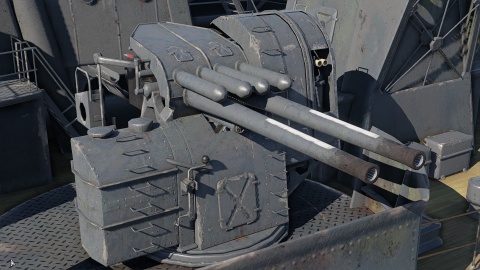
The 127 mm 5 inch/40 Type 89 gun is a Japanese fast-firing gun primarily found as a secondary or anti-air weapon in IJN cruisers, though it's also a primary armament of the IJN Isuzu. Historically it was widely adopted by the navy since 1932, finding use on everything from transport ships, through destroyers to battleships and aircraft carriers.
Vehicles equipped with this weapon
- IJN Isuzu
- IJN Mikuma
- IJN Suzuya
- IJN Mogami
- IJN Tone
- IJN Myoko
- IJN Haguro
- IJN Kongo
- IJN Haruna
- IJN Ise
- IJN Fuso
General info
Tell us about the tactical and technical characteristics of the cannon or machine gun.
Available ammunition
| Penetration statistics | |||||||
|---|---|---|---|---|---|---|---|
| Ammunition | Type of warhead |
Penetration @ 0° Angle of Attack (mm) | |||||
| 1,000 m | 2,500 m | 5,000 m | 7,500 m | 10,000 m | 15,000 m | ||
| 127 mm HE | HE | 25 | 25 | 25 | 25 | 25 | 25 |
| 127 mm HE-TF | HE-TF | 25 | 25 | 25 | 25 | 25 | 25 |
| Shell details | ||||||||||||
|---|---|---|---|---|---|---|---|---|---|---|---|---|
| Ammunition | Type of warhead |
Velocity (m/s) |
Projectile mass (kg) |
Fuse delay (m) |
Fuse sensitivity (mm) |
Explosive mass (TNT equivalent) (kg) |
Ricochet | |||||
| 0% | 50% | 100% | ||||||||||
| 127 mm HE | HE | 720 | 23 | 0 | 0.1 | 1.96 | 79° | 80° | 81° | |||
| 127 mm HE-TF | HE-TF | 720 | 23 | 0 | 0.1 | 1.96 | 79° | 80° | 81° | |||
Comparison with analogues
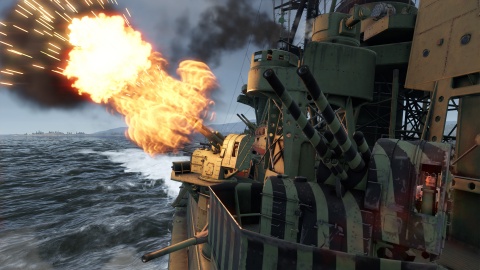
In both anti-air and anti-shipping duties, the Type 89 is a subpar, dated weapon that suffers in all key metrics comparing to its contemporary WW2 rivals, especially when used by the IJN Isuzu or Mogami-class cruisers, where the rate of fire is just 8 rounds per minute. On larger Kongo-class the rate of fire increases to 14 rounds per minute, making it able to put 75% more rounds on target, and a vertical firing angle increases from the +85° typical for the heavy AA to +90°, getting rid of the deadzone above the ship.
| Cannon | Sample Ship | Ammo | Calibre (mm) |
Muzzle Velocity (m/s) |
Sustained rate of fire (rounds/min) |
Targeting speed (°/s) |
TNT Equivalent (kg) |
Penetration @ 0° Angle of Attack (mm) | ||||
|---|---|---|---|---|---|---|---|---|---|---|---|---|
| Horizontal | Vertical | 100 m | 1,000 m | 2,000 m | ||||||||

|
5 inch/40 Type 89 (127 mm) | IJN Isuzu | HE | 127 | 720 | 8 | 5.1 | 10 | 1.96 | 25 | 25 | 25 |
|
|
5 inch/40 Type 89 (127 mm) | IJN Isuzu | HE-TF | 127 | 720 | 8 | 5.1 | 10 | 1.96 | 25 | 25 | 25 |
|
|
5 inch/40 Type 89 (127 mm) | IJN Kongo | HE | 127 | 720 | 14 | 5.1 | 10 | 1.96 | 25 | 25 | 25 |
|
|
5 inch/40 Type 89 (127 mm) | IJN Kongo | HE-TF | 127 | 720 | 14 | 5.1 | 10 | 1.96 | 25 | 25 | 25 |
|
|
127 mm/50 3rd Year Type (127 mm) | IJN Ayanami | HE | 127 | 910 | 9.1 | 6 | 27 | 2.31 | 28 | 28 | 28 |
|
|
127 mm/50 3rd Year Type (127 mm) | IJN Ayanami | HE-TF | 127 | 910 | 9.1 | 6 | 27 | 2.31 | 26 | 26 | 26 |

|
5 inch/25 Mk.13 AA (127 mm) | USS Pensacola | HE-TF | 127 | 657 | 20 | 17 | 26 | 3.16 | 35 | 35 | 35 |

|
5.25 inch/50 QF Mark I (133 mm) | HMS Dido | HE-TF | 133 | 814 | 10 | 8.5 | 8.5 | 2.95 | 35 | 35 | 35 |

|
120 mm/45 Canet-Schneider-Armstrong mod.1918-19 (120 mm) | RN Leone | HE-TF | 120 | 850 | 7 | 13 | 13 | 2.39 | 29 | 29 | 29 |
|
|
120 mm/45 3rd Year Type (120 mm) | IJN Mutsuki | HE-TF | 120 | 850 | 8.3 | 5 | 4 | 1.95 | 24 | 24 | 24 |

|
100 mm/56 B-34 (100 mm) | Kirov | HE-TF | 100 | 900 | 15 | 21 | 17 | 1.93 | 24 | 24 | 24 |
Usage in battles
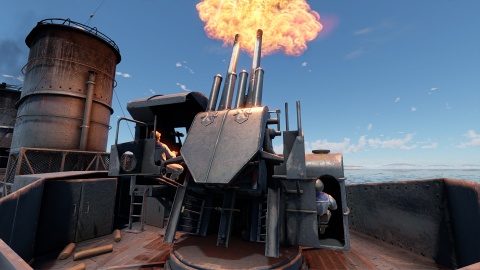
Despite of being subpar relative to the foreign equivalents, the 5 inch/40 Type 89 is still a perfectly capable anti-air gun, with a single hit usually being sufficient to take down even the largest strategic bombers. In the anti-ship role, thanks to being a dual-mount weapon, it's able to quickly take down subsystems of a destroyers, having a good chance of detonating ammunition with a near-direct hit. Any cruiser with armor thicker than 25 mm will be a struggle to take down with your ammunition (relatively common on US, British and German light cruisers, but at the rank IV and higher every cruiser has armor thick enough to stop all available shells.
Pros and cons
Pros:
- The gun comes in a dual-mount, with both shells flying parallel, thus making for a truly destructive damage at the hit location, be it a destroyer's ammo-rack or an enemy plane
- Being an anti-aircraft gun, it has a very good vertical guidance angles (going as far down as -8° on some mounts), making it possible to engage torpedo boats in a near-point-blank range or retain aim if the ship suffers from excessive heeling
Cons:
- Low explosive filler, muzzle velocity and (typically) low rate of fire comparing to the closest analogues
- Being a tight dual-mount weapon, a salvo of two HE-TF shells creates just a single, highly-localized shrapnel cloud, decreasing the chances of a random hit
- Low targeting speed makes it tricky to hit any airplanes with a high angular velocity
- A lack of AP, SAP or HE-VT (the anti-air shells with proximity fuse) makes for a suboptimal choice of shells against both: airborne and naval targets.
History
The 12.7 cm/40 Type 89 naval gun (12.7センチ高角砲) is a redesigned variant of the 12 cm/45 3rd Year Type, officially adopted by the IJN on 6 February 1932.
Modifications to the 120 mm/45 had several goals in mind, most notably increasing the blast radius of an individual shells (what was achieved by increasing the caliber), increasing the rate of fire (to as high as 14 shells per minute), automated setting of the time fuse and in increasing the speed in which vertical elevation could be adjusted (which was done in response to the perceived risk of the dive-bomber attacks).
Over time, however, two key limitations of the gun came to the daylight. Even a highly trained crew missed the fire rate goal, achieving sustained 12 rounds per minute, while a green crew fired only 8 rounds per minute. Also the low horizontal targeting speed turned out to be an issue, though it was eventually resolved with the Matsu-class destroyers by swapping the electric motors from older 10 kW-rated to a newer, 15 kW. Matsu-class was also the first ship to incorporate a single-mount Type 89, as previously all guns were deployed in the twin-mounts.
The gun was used in a wide array of ships, including the Yamato herself, a number of carriers like Kaga, Soryu, Shoukaku, seaplane and submarine tenders, even on the No.1-class landing ships.
Media
Excellent additions to the article would be video guides, screenshots from the game, and photos.
See also
External links
- [Wikipedia] 12.7 cm/40 Type 89 naval gun
- [NavWeaps] 12.7 cm/40 (5") Type 88 and 12.7 cm/40 (5") Type 89
- [Pacific Wrecks] Japanese 127mm Anti-Aircraft Gun Type 89 (1929)
- [Combined Fleet] Japanese Naval Ordnance - 5"/40 caliber
| Japan naval cannons | |
|---|---|
| 20 mm | JM61 · Type 98 |
| 25 mm | 25 mm/60 Type 96 |
| 37 mm | Type 4 · Type 11 pattern 1922 |
| 40 mm | 40 mm/62 Vickers |
| 57 mm | Type 97 |
| 75 mm | Type 88 AA |
| 76 mm | 3-inch/40 Type 41 · 8 cm/40 3rd Year Type · 8 cm/60 Type 98 |
| 100 mm | 100/65 mm Type 98 mod A |
| 120 mm | 120 mm/45 3rd Year Type · 120 mm/45 10th year type |
| 127 mm | 5 inch/40 Type 89 · 127 mm/50 3rd Year Type |
| 140 mm | 140 mm/50 3rd Year Type |
| 152 mm | 6-inch/45 Type 41 · 15 cm/50 Type 41 |
| 155 mm | 155 mm/60 3rd Year Type |
| 200 mm | 20 cm 3rd year type No.1 |
| 203 mm | 20 cm/45 Type 41 · 20 cm/50 3rd year type No.2 |
| 356 mm | 36 cm/45 Type 41 |
| 410 mm | 410 mm/45 Type 3 |
| Foreign: | |
| 20 mm | 20 mm/70 Oerlikon Mk.II (USA/Britain) |
| 40 mm | Bofors L/60 Mark 1 (USA) · Bofors L/60 Mark 2 (USA) · Bofors L/60 Mark 3 (USA) |
| 47 mm | 3 pdr QF Hotchkiss (Britain) |
| 76 mm | 3-inch Mark 10 (USA) · 3 inch Mk.33 (USA) · 3-inch Mk.34 (USA) |
| 120 mm | 4,7-inch/40 Armstrong (Britain) |
| 127 mm | 5 inch/38 Mk.12 (USA) |
| 305 mm | 12-inch/45 Vickers (Britain) · 12-inch/50 Vickers (Britain) |