Type 11 pattern 1922 (37 mm)
Naval cannons
OLD‑WIKI.WARTHUNDER.COM (DEFUNCT)
Description
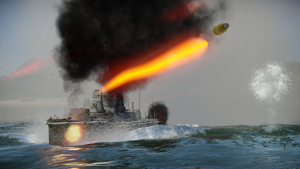
The 37 mm Type 11 pattern 1922 is a Japanese medium-calibre infantry gun adopted for naval use, one of the first slow-firing Japanese weapons that the player will use while going through the research tree. Its effectiveness is average at best, however its explosive power is capable of piercing through nearly anything it might encounter.
Vehicles equipped with this weapon
General info
Tell us about the tactical and technical characteristics of the cannon or machine gun.
Available ammunition
| Penetration statistics | |||||||
|---|---|---|---|---|---|---|---|
| Ammunition | Type of warhead |
Penetration @ 0° Angle of Attack (mm) | |||||
| 10 m | 100 m | 500 m | 1,000 m | 1,500 m | 2,000 m | ||
| 37 mm HE | HE | 3 | 3 | 3 | 3 | 3 | 3 |
| Shell details | ||||||||||||
|---|---|---|---|---|---|---|---|---|---|---|---|---|
| Ammunition | Type of warhead |
Velocity (m/s) |
Projectile mass (kg) |
Fuse delay (m) |
Fuse sensitivity (mm) |
Explosive mass (TNT equivalent) (g) |
Ricochet | |||||
| 0% | 50% | 100% | ||||||||||
| 37 mm HE | HE | 451 | 0.65 | 0 | 0.1 | 55 | 79° | 80° | 81° | |||
Comparison with analogues
The Type 11 comes with the best explosive filler of a comparable cannons, however at the same time it's above average targetting speed and one of the lowest rates of fire. Note that the table below is meant only as an overview, not a detailed analysis.
| Cannon | Ammo | Rate of fire (shots/min) | Targetting speed (°/s) | Muzzle Velocity (m/s) | Explosive Mass (TNT equivalent) (g) | Fuse delay (m) |
Penetration @ 0° Angle of Attack (mm) | |||
|---|---|---|---|---|---|---|---|---|---|---|
| 100 m | 1,000 m | 2,000 m | ||||||||
 |
Type 11 | HE | 30 | 38 | 451 | 451 | 0 | 3 | 3 | 3 |
| |
Type 4 | HE | 30 | 43 | 677 | 363 | 0 | 3 | 3 | 3 |
| |
Type 4 | APHE | 30 | 43 | 677 | 11 | 1 | 47 | 33 | 26 |
 |
AN-M4 | HEFI-T | 150 | 38 | 610 | 65.25 | 0 | 3 | 3 | 3 |
 |
3,7 cm SK C/30 | HE | 30 | 17 | 1,000 | 27.7 | 0 | 2 | 2 | 2 |
Usage in battles
Due to the weapon's low targetting speed, combined with an extremely low muzzle velocity it's very difficult to use at range of above 1,000 m, forcing to close in in order to accurately inflict damage. The weapon's strength lies in its explosive filler, able to handle most small boats within few shots.
Pros and cons
Pros:
- Effective against small, cramped vessels
- Very high maximum range for its battle rating
- High firing angle makes it possible to shoot while from behind a complete cover
Cons:
- Low muzzle velocity makes it difficult to lead targets
History
The 37 mm Type 11 (37 mm狙撃砲, 37 mm sniper) was designed as an infantry gun with the objective of destroying enemy machine gun emplacements. Serial production began in 1918 and the gun saw a number of improvements and evolutions over the years, including pattern 22 (十一年式平射歩兵砲, 11th year model low trajectory infantry gun) until it was finally replaced in 1934 by the Type 94 of the same calibre. The weapon was originally derived from the French Canon d'Infanterie de 37 modèle 1916 TRP.
The gun saw wide use in Japanese forces, from being an infantry support gun, through use in tanks (e.g. Chi-Ro), to the first Japanese armoured boat (with subsequent designs using the 57 mm Type 97 cannon instead). While the gun was up to the task during the Second Sino-Japanese War, it was severely lacking by the time of the Pacific War and unable to penetrate >30 mm armour on allied armoured vehicles even from as close a distance as 50 m.
The weapon featured a wide range of ammunition, including various types of high-explosive rounds with different fillers, armour-piercing, anti-concrete rounds, and of course training rounds.
Media
Excellent additions to the article would be video guides, screenshots from the game, and photos.
See also
Weapons of comparable role, configuration and era
- Type 4 (37 mm) - (Another Japanese 37 mm naval gun)
- Ho-203 (37 mm) - (Japanese airborne cannon of the same calibre)
- AN-M4 (37 mm) - (American naval cannon)
- 3,7 cm SK C/30 (37 mm) - (German naval cannon)
Automatic naval cannons of the same calibre (higher rate of fire, primarily anti-aircraft role)
- 3,7 cm FlaK-Lafette LM/42 (37 mm) - (German automatic naval cannon)
- 2pdr Rolls Royce - (British automatic naval cannon)
- 2pdr QF Mk.IIc (40 mm) - (British automatic naval cannon)
- 70-K (37 mm) - (USSR automatic naval cannon)
- V-11 (37 mm) - (USSR automatic naval cannon)
External links
| Japan naval cannons | |
|---|---|
| 20 mm | JM61 · Type 98 |
| 25 mm | 25 mm/60 Type 96 |
| 37 mm | Type 4 · Type 11 pattern 1922 |
| 40 mm | 40 mm/62 Vickers |
| 57 mm | Type 97 |
| 75 mm | Type 88 AA |
| 76 mm | 3-inch/40 Type 41 · 8 cm/40 3rd Year Type · 8 cm/60 Type 98 |
| 100 mm | 100/65 mm Type 98 mod A |
| 120 mm | 120 mm/45 3rd Year Type · 120 mm/45 10th year type |
| 127 mm | 5 inch/40 Type 89 · 127 mm/50 3rd Year Type |
| 140 mm | 140 mm/50 3rd Year Type |
| 152 mm | 6-inch/45 Type 41 · 15 cm/50 Type 41 |
| 155 mm | 155 mm/60 3rd Year Type |
| 200 mm | 20 cm 3rd year type No.1 |
| 203 mm | 20 cm/45 Type 41 · 20 cm/50 3rd year type No.2 |
| 356 mm | 36 cm/45 Type 41 |
| 410 mm | 410 mm/45 Type 3 |
| Foreign: | |
| 20 mm | 20 mm/70 Oerlikon Mk.II (USA/Britain) |
| 40 mm | Bofors L/60 Mark 1 (USA) · Bofors L/60 Mark 2 (USA) · Bofors L/60 Mark 3 (USA) |
| 47 mm | 3 pdr QF Hotchkiss (Britain) |
| 76 mm | 3-inch Mark 10 (USA) · 3 inch Mk.33 (USA) · 3-inch Mk.34 (USA) |
| 120 mm | 4,7-inch/40 Armstrong (Britain) |
| 127 mm | 5 inch/38 Mk.12 (USA) |
| 305 mm | 12-inch/45 Vickers (Britain) · 12-inch/50 Vickers (Britain) |