SMS Kaiser
OLD‑WIKI.WARTHUNDER.COM (DEFUNCT)
Description
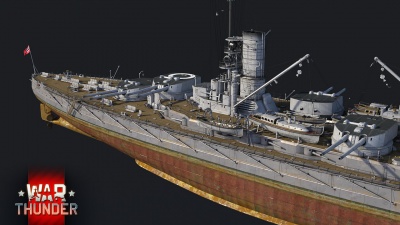
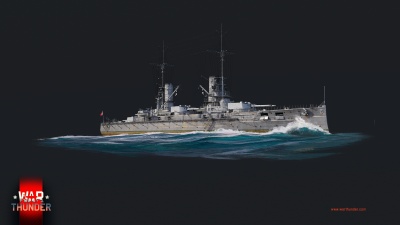
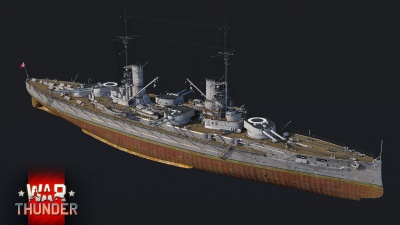
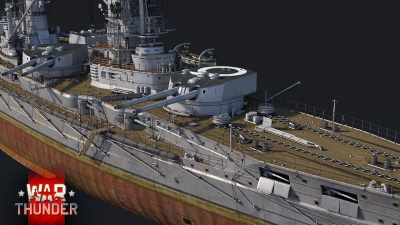
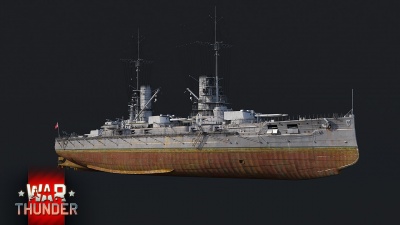
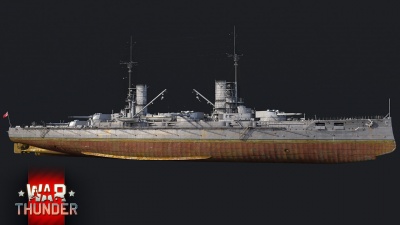
The Kaiser-class, SMS Kaiser, 1911 was a German WWI dreadnought, lead ship of the Kaiser class. She had four other sister ships, namely Friedrich der Grosse, Kaiserin, Prinzregent Luitpold and König Albert. Kaiser was ordered as a replacement for obsolete coastal defense ship Hildebrand. She was laid down in September 1909 and launched on 22nd March 1911, this date was chosen on purpose as it was birthday of Kaiser Wilhelm I. His grandson, Kaiser Wilhelm II. attended the ceremony. The primary armament of Kaiser consisted of ten 30.5 cm SK L/50 guns in five twin turrets. Unlike the previous battleships, these weren't in hexagonal arrangement. Instead three were mounted centerline and the other two placed en echelon amidship. Her secondary armament consisted of fourteen 15 cm SK L/45 guns in casemates amidship and twelve 8.8 cm SK L/45 guns out of which four were for anti-aircraft protection. She was also armed with five 50 cm torpedo tubes with one in the bow and four broadside.
In December 1913, Kaiser together with her sister König Albert and light cruiser Strassburg were selected to participate in long distance cruise in order to test reliability of new turbine propulsion system. They departed Germany bound for German colonies in West Africa, then sailed to St. Helena and Rio de Janeiro where they arrived on 15th February 1914. After visiting various other South American ports, the ships left Rio de Janeiro on 16th May, bound for Germany, where they arrived to Kiel on 17th June 1914. The ships sailed about 20,000 nautical miles (37,000 km) during their journey. After the outbreak of WWI, Kaiser conducted several sweeps into the North Sea without seeing much action. On 31st May 1916, Kaiser participated in Battle of Jutland where Kaiser and her sisters were leading the German battle line. During the battle, Kaiser sunk British destroyer HMS Nomad and together with other ships sunk armoured cruiser HMS Defence. Kaiser also engaged and damaged the steering gear of HMS Warspite. Kaiser herself suffered minor damage as she got hit twice by 12 inch guns from HMS Agincourt over the course of battle. In September 1917, Kaiser participated in Operation Albion, German attack on port of Riga where she damaged Russiand destroyer Grom. All five ships of the class survived the war and were scuttled while interned in Scapa Flow in 1919 and subsequently broken up for scrap.
Kaiser was introduced in Update "Ixwa Strike". Unlike the previous Helgoland-class battleship, Kaiser offers improved armour protection as well as better firing angles due to the different turret layout, allowing for firing a full broadside of ten guns unlike Helgoland's eight. When compared to Nassau-class battleships such as Westfalen, Kaiser offers better firepower with its 305 mm calibre guns as opposed to 283 mm found on Westfalen as well as increased armour protection. The ship's machinery and magazines are protected alongside the entire length by coal bunkers. Although after the coal bunkers get destroyed, the ship's magazine become vulnerable to explosion as it's placed relatively close to the waterline and underwater hit by a large calibre shell can pierce the 180 mm thick armour around the magazines with ease.
General info
Survivability and armour
The Kaiser is undoubtedly a formidable ship. She has plenty of armour, up to 350 mm on the main belt. However, the frontal armour, just below the forward barbette is a major weak spot, having only 170 mm behind an additional sloped 60 mm. She is also relatively fast compared with other battleships, being able to cruise at a whopping 23 knots or 43 km/h (in RB). Her armament scheme, with two wing turrets amidships, also allows for a full 10-gun broadside, making it more effective than the Helgoland and Westfalen with only 8. However, her lower crew complement, at 1,084, leaves her slightly more vulnerable to fires and sustained gunfire.
Mobility
The speed of Kaiser is definitely handy. While other battleships putter along at ~35 km/h, Kaiser can manage 43 km/h, making her faster than most other battleships. At 27,400 tons, she's certainly a large ship, and her turning radius definitely reflects that. While not impossible to dodge incoming torpedoes, captains will need ample time to manoeuvre out of their way.
| Mobility Characteristics | |||
|---|---|---|---|
| Game Mode | Upgrade Status | Maximum Speed (km/h) | |
| Forward | Reverse | ||
| AB | |||
| Upgraded | |||
| RB/SB | |||
| Upgraded | |||
Modifications and economy
Armament
Primary armament
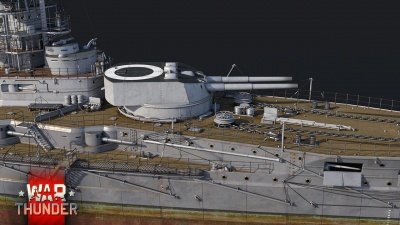
The primary armament of SMS Kaiser are 10 x 305 mm SK L/50 cannons. They are placed in 5 twin gunned turrets, with two super firing aft, two wing amidships and one front turret. This layout, while slightly better than its other German counterparts, still forces captains to show much of their hull when attempting to use all 10. However, 8 can still be used fairly well, as Kaiser can be sufficiently angled while still bringing front, one wing and both aft turrets to bear. This will be the go-to for many instances, as showing full broadside to enemy battleships is always asking for trouble.
These are mediocre guns when looking at other 305 mm cannons from other nations. While the rounds are fired with a decent muzzle velocity, their damage potential is certainly underwhelming. The Kaiser can choose from three different ammo types, though only two of which have much use and dividing between the 850 total shells in the magazines, players will have to choose between a few combinations of loadouts.
- HE with base fuse - This is the stock ammo type for all German 305 mm cannons. It is akin to a SAP round however, it lacks penetration having only 167 mm at 1 km. This shell type has 27 kg of explosive filler, sadly the most filler of any German shell in the game. This will be fairly effective against cruisers, as the low penetration potential means it is less likely these rounds will pass through the target ship. However, they have a low amount of filler and with no potent penetration, they become ineffective against other battleships. While not impossible to ammo rack enemy battleships, it is extremely rare. Overall, this shell type is good to bring along for lighter targets and in a few cases, can be used to whittle down crew numbers and start fires on battleships.
- APC - This armour-piercing capped shell is a solid alternative to the HE shell. With a maximum penetration of 519 mm at 1 km, it is an effective round against other battleships. It also has a relatively high muzzle velocity at 855 m/s, making it easier to aim. Its explosive filler is quite high compared to other AP shells. In fact, it has 13.6 kg of TNT, which by 305 mm AP standards is very good. This shell can be used effectively against battleships, though can still punch holes in lighter targets.
- SAP: The semi armour-piercing round of the Kaiser is really where things feel lacklustre. Like with many German shells, it lacks ample amounts of filler, with only 10.8 kg of TNT. This is five times less than Russian 305 mm SAP shells. While this shell type has a tiny bit more angle penetration, its high base penetration and its lack of filler makes it less useful against both battleships and cruisers. These shells are totally opposite to the SAP of nations like Japan and Russia, where captains can almost exclusively use SAP as their main rounds.
| Penetration statistics | |||||||
|---|---|---|---|---|---|---|---|
| Ammunition | Type of warhead |
Penetration @ 0° Angle of Attack (mm) | |||||
| 1,000 m | 2,500 m | 5,000 m | 7,500 m | 10,000 m | 15,000 m | ||
| Spgr. L/3.8 Bdz | HE | 167 | 149 | 124 | 103 | 87 | 66 |
| Spgr. L/3.3 SAP | SAP | 481 | 430 | 357 | 299 | 252 | 193 |
| Psgr. L/3.4 | APC | 519 | 463 | 383 | 320 | 270 | 205 |
| Shell details | ||||||||||||
|---|---|---|---|---|---|---|---|---|---|---|---|---|
| Ammunition | Type of warhead |
Velocity (m/s) |
Projectile mass (kg) |
Fuse delay (s) |
Fuse sensitivity (mm) |
Explosive mass (TNT equivalent) (kg) |
Ricochet | |||||
| 0% | 50% | 100% | ||||||||||
| Spgr. L/3.8 Bdz | HE | 855 | 405.9 | 0.025 | 17 | 27 | 79° | 80° | 81° | |||
| Spgr. L/3.3 SAP | SAP | 850 | 410 | 0.025 | 17 | 10.8 | 47° | 60° | 65° | |||
| Psgr. L/3.4 | APC | 855 | 405.5 | 0.025 | 17 | 13.6 | 48° | 63° | 71° | |||
Secondary armament
The secondary armament is where Kaiser shines. It has 7 x 150 mm and 6 x 88 mm guns per side. This makes it exceptionally effective against lighter targets like destroyers, patrol boats and even some light cruisers. These guns are able to deal a devastating blow to all but the heaviest of ships in the game. However, note that the 88 mm guns are labeled as AA guns when selecting between armament types, though their limited elevation and lack of a timed explosive makes them far more effective against lighter ships. Kaiser can carry a total of 2,100 secondary shells. The 150 mm guns however have 3 shell types once again.
- HE: These high-explosive shells are the stock round for secondary armaments and are exceptionally deadly to light targets like patrol boats and destroyers. They have 1.6 kg of explosive, making them a good option for setting fires on larger ships as well.
- AP: The AP rounds from the 150 mm guns will be very useful when fighting light and heavy cruisers. With 225 mm of base penetration and 990 g of filler, they are very good at punching through even the thickest armour belts of cruisers, even damaging turrets and barbettes.
- SAP: Again, the semi armour-piercing shells from German guns tends to be underwhelming. These round have 15 g more explosive filler than the AP while sacrificing 131 mm of base penetration. They still may be used effectively against lighter targets, but a combination of AP and HE shells will do better at fighting all types of targets.
| Penetration statistics | |||||||
|---|---|---|---|---|---|---|---|
| Ammunition | Type of warhead |
Penetration @ 0° Angle of Attack (mm) | |||||
| 1,000 m | 2,500 m | 5,000 m | 7,500 m | 10,000 m | 15,000 m | ||
| Sprgr. L/4.1 Kz | HE | 21 | 21 | 21 | 21 | 21 | 21 |
| Sprgr. L/4.1 Bdz | SAPBC | 95 | 80 | 61 | 47 | 37 | 28 |
| Psgr. L/3.7 | APCBC | 238 | 201 | 153 | 117 | 93 | 71 |
| Shell details | ||||||||||||
|---|---|---|---|---|---|---|---|---|---|---|---|---|
| Ammunition | Type of warhead |
Velocity (m/s) |
Projectile mass (kg) |
Fuse delay (s) |
Fuse sensitivity (mm) |
Explosive mass (TNT equivalent) (g) |
Ricochet | |||||
| 0% | 50% | 100% | ||||||||||
| Sprgr. L/4.1 Kz | HE | 835 | 45.3 | 0 | 0.1 | 1,600 | 79° | 80° | 81° | |||
| Sprgr. L/4.1 Bdz | SAPBC | 835 | 45.3 | 0.01 | 7 | 1,050 | 48° | 63° | 71° | |||
| Psgr. L/3.7 | APCBC | 835 | 45.3 | 0.015 | 7 | 990 | 48° | 63° | 71° | |||
Anti-aircraft armament
The anti-air capability of the Kaiser is lacking. However, this is typical for most battleships of this era. It has 12 x 88 mm guns, half of which are in hull mounted casemates. Therefore, the elevation of said guns (only +18°), is not very useful. There are of course 6 guns mounted in superstructures, however they too lack meaningful elevation and traverse speed. This results in a large zone above the ship where captains will be completely vulnerable to attack. While the 88 mm guns can be used to shoot at low-flying targets, their lack of elevation and traverse speed makes them hard to use in the AA role. As before, they are much easier to use as light ship deterrents.
Additional armament
The Kaiser is armed with multiple 500 mm torpedoes. They have a relatively small warhead of only 160 kg and have a mild range of 5 km. They also move at a whole 50 km/h, meaning cruisers and destroyers can simply outrun them, let alone dodge them. However, in rare circumstances, they can still be effective as a surprise attack on an enemy vessel. Loading them will make the Kaiser easier to ammo rack as well.
Usage in battles
The Kaiser is definitely a fun ship to play given the right circumstance. While she doesn't stack up to ships like Marlborough or Mariya, she does still have the armour to take quite a few hits. The main armament of Kaiser is best used at longer range, as plunging fire only helps its lower penetration rounds find weak spots. Surprisingly though, she can be extremely effective in close quarters as well, using her strong belt and bow plating to tank rounds from cruisers and even battleships. However, the armour below the forward barbette is weaker than other battleships and can be exploited by other large calibre rounds from opposing dreadnoughts. The speed of Kaiser is very useful up close and its slightly better turning radius compared to other ships allows better responsiveness to incoming torpedoes, though captains will still need to stay vigilant.
Additionally, the overwhelming firepower of the secondary battery makes Kaiser a very formidable opponent up close, especially against light targets. However, its lack of air defense makes it an easy target for high flying and dive bombing planes, so be careful.
Overall, Kaiser is a well rounded ship, being able to sit comfortable at range and duel with its main guns, or take it up close and brawl with unsuspecting cruisers. While its main guns lack filler, it can still be effective against all types of enemies and will surely be fun to take out once in a while.
Pros and cons
Pros:
- Fast with decent agility
- Fantastic secondary battery
- Great belt armour for up close battles
Cons:
- Lacklustre main battery shells
- Little air defence
- Weak internal armour
History
Devblog
During the 1900's, the German Imperial navy placed orders for five new dreadnought battleships to be constructed in order to replace older warships of the Siegfried and Odin classes. These five new ships would become the Kaiser-class battleships, which among other technological advancements, featured turbine propulsion systems - a novelty on German warships at the time.
Kaiser, the lead ship of the class, was laid down in Kiel in December 1909, launched in March 1911 and subsequently commissioned in August 1912. After crew training and taking part in several fleet exercises, Kaiser along with its sistership König Albert and cruiser Strassburg, was sent on a long-distance cruise to German South-West Africa and South America to test the novel steam propulsion system for endurance and reliability. The flotilla returned from their cruise to Kiel in June of 1914.
Following the outbreak of the Great War, Kaiser took part in nearly every major naval operation of the conflict. This included the famous Battle of Jutland in mid 1916, where Kaiser sustained two direct hits, but suffered no substantial damage. Furthermore, Kaiser also took part in Operation Albion in 1917, bombarding Russian coastal positions in the Baltic, and crippling the destroyer Grom, followed by her sinking.
With the German surrender in November 1918, part of the High Seas Fleet, including the SMS Kaiser, was interned at the British naval base at Scapa Flow. The commanding German officer, Rear Admiral Ludwig von Reuter, believing that the fleet would be seized by the British, ordered the scuttling of the entire fleet on 21st of June, 1919. Kaiser was later raised in 1929 and broken up for scrap in the early 1930's.
Media
- Skins
- Images
- Videos
See also
Links to articles on the War Thunder Wiki that you think will be useful for the reader, for example:
- reference to the series of the ship;
- links to approximate analogues of other nations and research trees.
External links
| Deutsche Werke AG | |
|---|---|
| Light Cruisers | |
| K-class | Karlsruhe |
| Leipzig-class | Nürnberg |
| Battleships | |
| Kaiser-class | SMS Kaiser* |
| *Previously Kaiserliche Werft Kiel | |
| Germany battleships | |
|---|---|
| Nassau-class | SMS Nassau · SMS Westfalen |
| Helgoland-class | SMS Helgoland · SMS Ostfriesland |
| Kaiser-class | SMS Kaiser |
| Bayern-class | SMS Bayern · SMS Baden · SMS Sachsen |