3-inch Mark 10 (76 mm)
Naval cannons
OLD‑WIKI.WARTHUNDER.COM (DEFUNCT)
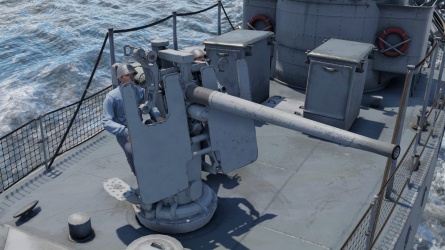
Description
3-inch Mark 10 is an American anti-air gun with a good muzzle velocity, an excellent selection of rounds, and a very good killing potential against motor torpedo boats and aircraft alike.
It was originally introduced in 1914 to the US Navy and its modernised derivatives remain in use to this day in the Spanish Navy. The gun seen an extremely wide use, including coastal patrol vessels, submarines, cruisers, battleships, carriers and even merchant ships.
Vehicles equipped with this weapon
- Asagao (YTE-01)
- Carmi (PC-466)
- LCS(L)(3)
- PC-451
- USS Candid
- USS Detroit
- USS Hoquiam
- USS Raleigh
- USS Trenton
General info
Tell us about the tactical and technical characteristics of the cannon or machine gun.
Available ammunition
3-inch Mark 10 features an excellent choice of ammunition, which includes HE, proximity-fuse HE-VT and a dedicated armour-piercing round.
- HC Mk.27 - best used against torpedo boats, but it will also destroy any aircraft with a single hit, and it's the round of choice when trying to disable anti-air guns on bluewater vessels (however ill-advised it might be).
- AP Mk.29 - dedicated armour-piercing round with a very good penetration for the calibre, it's best used to ammo-rack enemy vessels. The round will travel 8 meters after fusing, making it extremely prone to overpenetration when used against Motor Torpedo Boats, so for such a small targets HE ammunition is generally a better choice, unless you face them head-on.
- AA Mk.31 - One of the best anti-air rounds in this calibre range, primarily thanks to its proximity fuse. Below 548 meters, it will work like a regular HE round, making it possible to load these rounds instead of the HC Mk.27 and still effectively engage coastal vessels, even if the explosive filler is 29% smaller than in the dedicated HE shell.
| Penetration statistics | |||||||
|---|---|---|---|---|---|---|---|
| Ammunition | Type of warhead |
Penetration @ 0° Angle of Attack (mm) | |||||
| 100 m | 1,000 m | 2,000 m | 3,000 m | 4,000 m | 5,000 m | ||
| HC Mk.27 | HE | 8 | 8 | 8 | 8 | 8 | 8 |
| AP Mk.29 | APCBC | 111 | 90 | 71 | 56 | 44 | 36 |
| AA Mk.31 | HE-VT | 7 | 7 | 7 | 7 | 7 | 7 |
| Shell details | ||||||||||||
|---|---|---|---|---|---|---|---|---|---|---|---|---|
| Ammunition | Type of warhead |
Velocity (m/s) |
Projectile mass (kg) |
Fuse delay (s) |
Fuse sensitivity (mm) |
Explosive mass (TNT equivalent) (g) |
Ricochet | |||||
| 0% | 50% | 100% | ||||||||||
| HC Mk.27 | HE | 823 | 5.9 | 0 | 0.1 | 500 | 79° | 80° | 81° | |||
| AP Mk.29 | APCBC | 823 | 5.9 | 0.01 | 4 | 133.28 | 48° | 63° | 71° | |||
| Proximity-fused shell details | ||||||||||||
|---|---|---|---|---|---|---|---|---|---|---|---|---|
| Ammunition | Type of warhead |
Velocity (m/s) |
Projectile mass (kg) |
Fuse delay (m) |
Fuse sensitivity (mm) |
Arming distance (m) |
Trigger radius (m) |
Explosive mass (TNT equivalent) (g) |
Ricochet | |||
| 0% | 50% | 100% | ||||||||||
| AA Mk.31 | HE-VT | 823 | 5.85 | 0 | 0.1 | 548 | 15 | 352.8 | 79° | 80° | 81° | |
Comparison with analogues
Compared to its peers, 3-inch Mark 10 is overall an average gun. The biggest downside is its horizontal targeting speed, while the biggest upside is the selection of the shells for the gun.
HE
| Cannon | Sample Ship | Ammo | Calibre (mm) |
Muzzle velocity (m/s) |
Sustained rate of fire (rounds/min) |
Targeting speed (°/s) |
Vertical guidance (°) |
TNT equivalent (kg) |
TNT equivalent per minute (kg) |
Penetration @ 0° Angle of Attack (mm) | ||
|---|---|---|---|---|---|---|---|---|---|---|---|---|
| Horizontal | Vertical | |||||||||||

|
3-inch Mark 10 | USS Raleigh | HE | 76 | 825 | 17 | 8.5 | 15 | 85 | 0.5 | 8.5 | 8 |
  
|
3 inch Mk.33 | Geniere | HE | 76.2 | 823 | 6 | 20 | 26 | 85 | 0.5 | 3 | 8 |
|
|
3-inch Mk.34 | USS Asheville | HE | 76.2 | 823 | 49.8 | 20 | 26 | 85 | 0.5 | 24.9 | 8 |

|
34-K (76 mm) | Soobrazitelny | HE | 76.2 | 845 | 27 | 12 | 8 | 85 | 0.483 | 13.04 | 8 |
|
|
39-K (76 mm) | Tashkent | HE | 76.2 | 845 | 20 | 18 | 11 | 87 | 0.483 | 9.66 | 8 |
|
|
76 mm/60 AK-176M | MPK Pr.12412 | HE | 76.2 | 845 | 20 | 30 | 26 | 85 | 0.616 | 12.32 | 10 |
|
|
AK-726 (76 mm) | SKR-7 | HE | 76.2 | 980 | 16.2 | 26 | 30 | 85 | 0.616 | 9.98 | 10 |
|
|
3 inch 12pdr 12 cwt QF Mk.V (76 mm) | HMS Churchill | HE | 76.2 | 823 | 17 | 25 | 25 | 70 | 0.5 | 8.5 | 8 |
|
|
76 mm/45 QF 3in 20cwt (76 mm) | HMS Valhalla | HE | 76.2 | 762 | 12 | 13 | 10 | 40 | 0.32 | 3.84 | 6 |
|
|
Type 88 AA (75 mm) | Type 5 | HE | 75 | 720 | 20 | 21 | 20 | 50 | 0.42 | 8.4 | 5 |
|
|
8 cm/40 3rd Year Type (76 mm) | Type K-8 No.13 late | HE | 76.2 | 685 | 20 | 11 | 10 | 75 | 0.48 | 9.6 | 8 |
|
|
8 cm/60 Type 98 (76 mm) | IJN Agano | HE | 76.2 | 902 | 25 | 18 | 16 | 85 | 0.399 | 9.98 | 7 |

|
76 mm/40 Ansaldo mod.1917 (76 mm) | RN Aquila | HE | 76.2 | 690 | 15 | 11 | 10 | 75 | 0.65 | 9.75 | 10 |

|
76 mm/62 OTO-Melara Compact (76 mm) | Sparviero | HE | 76 | 925 | 85.7 | 51 | 30 | 85 | 1.08 | 92.57 | 15 |
|
|
76 mm/62 SMP 3 (76 mm) | Albatros | HE | 76.2 | 930 | 8.57 | 34 | 60 | 85 | 0.864 | 7.40 | 15 |

|
75 mm/50 model 1922 | Duguay-Trouin | HE | 75 | 850 | 15 | 19 | 18 | 85 | 0.45 | 6.75 | 8 |
AP / SAP
| Cannon | Sample Ship | Ammo | Calibre (mm) |
Muzzle velocity (m/s) |
Sustained rate of fire (rounds/min) |
Targeting speed (°/s) |
Vertical guidance (°) |
TNT equivalent (kg) |
TNT equivalent per minute (kg) |
Penetration @ 0° Angle of Attack @ 5000 m (mm) | ||
|---|---|---|---|---|---|---|---|---|---|---|---|---|
| Horizontal | Vertical | |||||||||||
|
|
3-inch Mark 10 | USS Raleigh | APCBC | 76 | 823 | 17 | 8.5 | 15 | 85 | 0.13328 | 2.27 | 57 |
|
|
3-inch Mk.34 | USS Asheville | APHE | 76.2 | 823 | 49.8 | 20 | 26 | 85 | 0.0637 | 3.17 | 62 |
|
|
34-K (76 mm) | Soobrazitelny | APHEBC | 76.2 | 816 | 27 | 12 | 8 | 85 | 0.119 | 3.21 | 65 |
|
|
39-K (76 mm) | Tashkent | APHEBC | 76.2 | 816 | 20 | 18 | 11 | 87 | 0.119 | 2.38 | 65 |
|
|
Type 88 AA (75 mm) | Type 5 | APHEBC | 75 | 720 | 20 | 21 | 20 | 50 | 0.150 | 3 | 55 |
|
|
76 mm/40 Ansaldo mod.1917 (76 mm) | RN Aquila | APHE | 76.2 | 690 | 15 | 11 | 10 | 75 | 0.319 | 4.79 | 20 |
|
|
76 mm/62 OTO-Melara Compact (76 mm) | Sparviero | SAP | 76 | 925 | 85.7 | 51 | 30 | 85 | 0.6552 | 57.46 | 32 |
Usage in battles
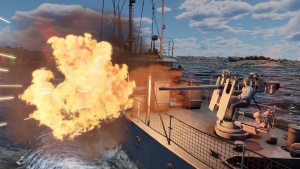
The designated role for the 3-inch Mark 10 is anti-air, and thanks to the excellent vertical guidance along with access to the HE-VT shells and a good rate of fire it can fulfil that role very competently. When controlled by AI the guns will engage enemy planes at a very considerable distance, making it possible to score kills long before your vessel gets in any danger.
But the gun is also widely used as a primary weapon on coastal vessels, where it's role is to engage enemy boats. And here it remains relatively competent, owning it to an acceptable rate of fire while having a good explosive filler. Rounds are not large enough to sking enemy vessels with a single hit, but they will do very considerable damage.
Pros and cons
Pros:
- Access to HE-VT shells
- Good penetration of the AP shells
Cons:
- Very slow targeting speed compared to its peers
History
The 3"/50 Mark 10 was a successor to the Mark 6, introduced in 1915 as an anti-aircraft gun, but also considered dual-purpose. Before the adoption of the variable-time fuse, the gun was considered ineffective, as the gun lacked stopping power against surface combatant, and with the manual guidance and loading it lacked rate of fire and precision in the anti-aircraft role. The advent of HE-VT shells and a new Mark 51 director system made it relevant again.
The gun seen a whole series of upgrades during the interwar period, WW2 and into the Cold War.
Media
Excellent additions to the article would be video guides, screenshots from the game, and photos.
See also
External links
| USA naval cannons | |
|---|---|
| 20 mm | 20 mm/70 Oerlikon Mk.II · 20 mm/70 Oerlikon Mark V · 20 mm/70 Oerlikon Mark 24 |
| 25 mm | 25 mm/87 Mk.38 |
| 28 mm | 1.1 inch/75 Mk.1 |
| 37 mm | AN-M4 |
| 40 mm | Bofors L/60 Mark 1 · Bofors L/60 Mark 2 · Bofors L/60 Mark 3 |
| 76 mm | 3 inch/23 Mk.4 · 3-inch/50 Mk.10 · 3-inch/70 Mk.37 · 3-inch Mark 10 · 3 inch Mk.33 · 3-inch Mk.34 |
| 102 mm | 4 inch/50 Mk.9 |
| 127 mm | 5 inch/25 Mk.11 · 5 inch/25 Mk.13 AA · 5 inch/38 Mk.12 · 5-inch/50 Mk.5 · 5 inch/51 Mk.7 · 127 mm/54 Mark 18 |
| 152 mm | 6 inch/47 Mk.16 · 6 inch/47 DP Mk.16 · 6 inch/53 Mk.12 · M81 |
| 203 mm | 8 inch/55 Mark 9 · 8 inch/55 Mark 12 · 8 inch/55 Mark 14 · 8 inch/55 Mark 16 |
| 305 mm | 12-inch/45 Mk.5 · 12 inch/50 Mk.7 · 12 inch/50 Mk.8 |
| 356 mm | 14 inch/45 Mk.8 · 14 inch/45 Mk.12 · 14 inch/50 Mk.11 |
| Japan naval cannons | |
|---|---|
| 20 mm | JM61 · Type 98 |
| 25 mm | 25 mm/60 Type 96 |
| 37 mm | Type 4 · Type 11 pattern 1922 |
| 40 mm | 40 mm/62 Vickers |
| 57 mm | Type 97 |
| 75 mm | Type 88 AA |
| 76 mm | 3-inch/40 Type 41 · 8 cm/40 3rd Year Type · 8 cm/60 Type 98 |
| 100 mm | 100/65 mm Type 98 mod A |
| 120 mm | 120 mm/45 3rd Year Type · 120 mm/45 10th year type |
| 127 mm | 5 inch/40 Type 89 · 127 mm/50 3rd Year Type |
| 140 mm | 140 mm/50 3rd Year Type |
| 152 mm | 6-inch/45 Type 41 · 15 cm/50 Type 41 |
| 155 mm | 155 mm/60 3rd Year Type |
| 200 mm | 20 cm 3rd year type No.1 |
| 203 mm | 20 cm/45 Type 41 · 20 cm/50 3rd year type No.2 |
| 356 mm | 36 cm/45 Type 41 |
| 410 mm | 410 mm/45 Type 3 |
| Foreign: | |
| 20 mm | 20 mm/70 Oerlikon Mk.II (USA/Britain) |
| 40 mm | Bofors L/60 Mark 1 (USA) · Bofors L/60 Mark 2 (USA) · Bofors L/60 Mark 3 (USA) |
| 47 mm | 3 pdr QF Hotchkiss (Britain) |
| 76 mm | 3-inch Mark 10 (USA) · 3 inch Mk.33 (USA) · 3-inch Mk.34 (USA) |
| 120 mm | 4,7-inch/40 Armstrong (Britain) |
| 127 mm | 5 inch/38 Mk.12 (USA) |
| 305 mm | 12-inch/45 Vickers (Britain) · 12-inch/50 Vickers (Britain) |